




Abstract
The National Assessment Program for Literacy and Numeracy (NAPLAN) is intended to assess all Australian students in Years 3, 5, 7 and 9 to ensure equity and inclusion. This paper explores the extent to which equity and inclusion are achieved for students with disability through NAPLAN reporting. Document analysis of publicly accessible NAPLAN reports, technical reports, handbooks and protocols was conducted to evaluate how this cohort is represented in NAPLAN reports. This paper demonstrates the paucity of NAPLAN reporting about students with disability. It highlights opportunities for NAPLAN data from this cohort to be reported and used to inform educational decisions at all levels (teachers, schools, systems and parents) for students with disability.
Keywords
Introduction
The National Assessment Program – Literacy and Numeracy (NAPLAN) was established in 2008, becoming a primary mechanism by which the learning progress of all Australian students could be monitored and tracked by governments, school sectors and individual schools. One aim was to identify student groups at educational risk, which includes students with disability.
The purpose of this study was to investigate how achievements of students with disability are represented in NAPLAN reports and to identify opportunities for NAPLAN to support greater equity and inclusion for students with disability. Researchers have argued that NAPLAN does not fulfil these goals for students with disability (e.g. Cumming & Dickson, 2013; Haisken-DeNew et al., 2017). Given that a lack of inclusivity in NAPLAN has been evident through the research for many years, this paper aims to identify the extent to which progress has been made to rectify inequities in NAPLAN reporting for students with disability.
Australian students in Years 3, 5, 7 and 9 undertake NAPLAN annually. NAPLAN is a series of standardised, census tests that provide an indication of student learning and progress within the domains of literacy and numeracy. The original intention of NAPLAN was to ‘identify students at an early stage who were not meeting minimum standards in literacy and numeracy’ (Parliament of Australia, 2014b, Section 2.6). It was developed to report on progress towards achievement of two primary educational goals (Australian Curriculum, Assessment and Reporting Authority [ACARA], 2016) drawn from the Melbourne Declaration on Educational Goals for Young Australians (The Ministerial Council on Education, Employment, Training and Youth Affairs [MCEETYA], 2008), namely, to ensure that: • Australian schooling promotes equity and excellence; • All young Australians become successful learners, confident and creative individuals and active and informed citizens (Parliament of Australia, 2014b, Section 2.4; MCEETYA, 2008).
More recently, the Alice Springs (Mparntwe) Education Declaration (Education Council, 2019) echoes the earlier goals of equity, excellence and successful learning, extending them from ‘Australian schooling’ to ‘the Australian education system’ (p. 4). The new Education Declaration also recognises the need for students to develop lifelong learning. It calls for ‘targeted support’ that helps learners from a range of disadvantaged groups, including ‘…children with disability to reach their potential’ (Education Council, 2019, p. 17).
In keeping with these goals, NAPLAN is intended to fulfil a range of purposes. Firstly, NAPLAN data supports monitoring the efficacy of programs and policies in improving student learning outcomes at the National as well as State and Territory levels (McGaw et al., 2020). At a local level, it can be used to inform school improvement (Joseph, 2018; McGaw et al., 2020). The reports provided to parents allow them to monitor how their child is progressing (Joseph, 2018; McGaw et al., 2020). Finally, it also holds schools and school systems to account for literacy and numeracy outcomes (Joseph, 2018; McGaw et al., 2020; Swain & Pendergast, 2018).
Accountability testing occurs in many countries (Torres, 2021), enabling governments to monitor the performance of schools and education systems. While NAPLAN is an accountability test (Cumming & Dickson, 2013; Joseph, 2018; McGaw et al., 2020), the Australian Curriculum Assessment and Reporting Authority (ACARA) once maintained that it was ‘low stakes’ (ACARA, 2014; Howell, 2012). However, in 2010, when NAPLAN data became publicly available through the introduction of the MySchool website, NAPLAN school level data could be compared by the public, used for school selection by parents and scrutinised by other stakeholders. This means it is now perceived by some to be ‘high stakes’ (Gorur, 2016; McGaw et al., 2020). Furthermore, NAPLAN data is linked with resourcing and funding for schools (Parliament of Australia, 2014a, Section 3.48; Davies, 2012). It is also high stakes for teachers, whose performance could be scrutinised based on how their students achieved on the test (Gorur, 2016). As Howell (2017) points out, ‘confusion is intensified by inconsistencies between claims that NAPLAN is a low-stakes test, and high stakes uses of the data’ (p. 569). These high-stakes uses of the data may influence schools’ application of NAPLAN protocols around participation.
NAPLAN is a brief point-in-time test that should not be the only source of evidence about students’ literacy and numeracy skills. However, Thompson (2013) has described NAPLAN’s negative influences on curriculum choices, pedagogy and learning opportunities. NAPLAN data needs to be considered in the broader context of delivering a rich and effective curriculum for all students.
Research into NAPLAN and students with disability
According to NAPLAN protocols, students can be exempted, withdrawn or reported absent from NAPLAN (ACARA, 2022a). Although student absences require no formal approval, student exemptions can only be granted on the grounds of having language backgrounds other than English (where the student has attended an Australian school for less than a year) or having a significant disability (ACARA, 2023a), which includes ‘students with significant intellectual disability and/or those with significant co-existing conditions which severely limit their capacity to participate in the tests’ (ACARA, 2023a, Exemptions section, para. 3).
Despite ACARA’s (2023d) assertion that ‘every effort is made to ensure it is an equitable experience, regardless of the student’s background, school location or disability’ (Who is expected to do NAPLAN? section, para. 1), there has been criticism of the way in which NAPLAN caters for students with disability and allows for their exclusion (Haisken-DeNew et al., 2017; McGaw et al., 2020; Teather & Hillman, 2017). This potential for exclusion contradicts an early focus of NAPLAN which was to identify student groups at risk (Cumming & Dickson, 2013) or students who need additional support (Adams et al., 2020), including those with disability. There is considerable research that discusses the exclusion of students with disability from NAPLAN (e.g. Anderson & Boyle, 2015; Canavan, 2017; Elliott et al., 2012; Haisken-DeNew et al., 2017; McGaw et al., 2020; Teather & Hillman, 2017).
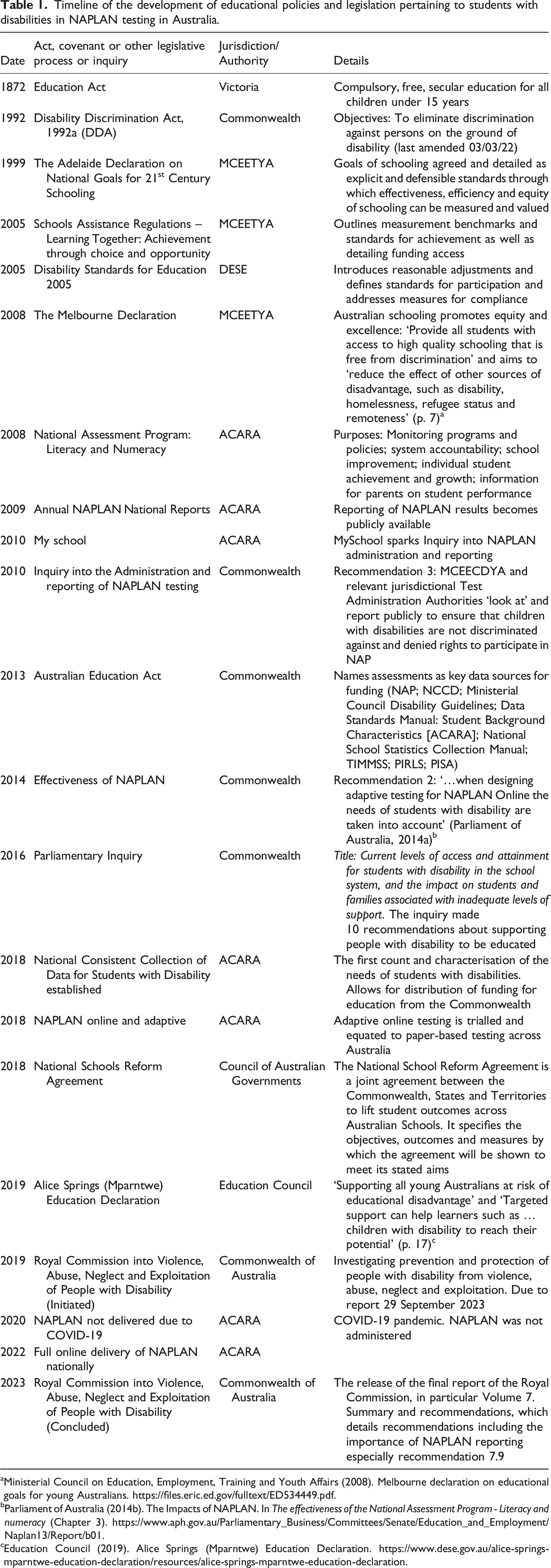
Legislation and making disability count
Timeline of the development of educational policies and legislation pertaining to students with disabilities in NAPLAN testing in Australia.
aMinisterial Council on Education, Employment, Training and Youth Affairs (2008). Melbourne declaration on educational goals for young Australians. https://files.eric.ed.gov/fulltext/ED534449.pdf.
bParliament of Australia (2014b). The Impacts of NAPLAN. In The effectiveness of the National Assessment Program - Literacy and numeracy (Chapter 3). https://www.aph.gov.au/Parliamentary_Business/Committees/Senate/Education_and_Employment/Naplan13/Report/b01.
cEducation Council (2019). Alice Springs (Mparntwe) Education Declaration. https://www.dese.gov.au/alice-springs-mparntwe-education-declaration/resources/alice-springs-mparntwe-education-declaration.
A confounding factor in this lack of understanding is that the number of students with disability in Australia is unclear. Based on data collected by the Nationally Consistent Collection of Data on School Students with Disability (NCCD), ACARA (2023e) reports that 24.2% of students enrolled in Australian schools had a disability in 2023. In contrast, the Australian Institute of Health and Welfare (AIHW) (2022) states that students with disability constitute around 10% of the school-aged population, while the Australian Bureau of Statistics (ABS, 2019) reported 7.7% of children (approximately 357,500) under 15 as having a disability in 2018. These population discrepancies may be attributed to the way in which disability is interpreted, recognised or defined across data sources, whether it be from parents, schools or medical professionals. This lack of clarity reduces the possibility of representing the population of students with disability accurately.
Disparity in defining the population of students with disability may also be attributed to a lack of clarity in the Disability Discrimination Act (1992a) (Cth), from which the NCCD draws its definition of disability. The Act defines the breadth of the term 1 and context of the disability, stating it ‘…includes a disability that: (h) presently exists; or (i) previously existed but no longer exists; or (j) may exist in the future (including because of a genetic predisposition to that disability); or (k) is imputed to a person’ (S.4.1) [emphasis added]. According to the NCCD, imputation of a disability means that a school may establish reasonable grounds to make a judgement that a student has disability in the absence of a formal medical diagnosis (NCCD, 2021a). This has implications for determining participation rates of students with disability in NAPLAN.
While the true size of the population of students with disability is uncertain, it is evident that they are a population at risk. In 2018, approximately 34% of people with a disability aged 20 and over had completed Year 12 or equivalent compared with around 66% of people without disability (AIHW, 2022). It is also worth noting that people living with disability have lower employment rates (53.4% compared with 84.1% of people without disability [ABS, 2020]). Given that educational attainment is still an area of inequity for people living with disability, large-scale standardised tests, like NAPLAN, could provide a means of monitoring the effectiveness of schooling for this group, if the tests were fit for purpose and if the population parameters were known. Furthermore, data from standardised tests may provide impetus for greater focus on government-funded support to improve educational outcomes for students with disability, as per NAPLAN’s original intention.
The Disability Discrimination Act (1992a) (Cth) and the Disability Standards for Education (2005) (the Standards) were established to provide clarification and elaboration of legal obligations in relation to the education of students with disability. The Standards are legally binding (Cumming & Dickson, 2013; Department of Education, Skills and Employment [DESE], 2020) and refer to students with disability having the right to access education ‘on the same basis’ as students without disability (s.2.2). To achieve this, the Standards refer to the schools’ and other education providers’ 2 obligation to implement ‘reasonable adjustments’ (s.3.4).
In educational assessment, adjustments are ‘measures or actions … taken by an education provider’ (The Standards, s3.3) that should minimise the impact of traits associated with the disability. In assessment, adjustments should not be relevant to the construct that is being assessed (Camara, 2009), enabling the student to demonstrate their knowledge and skill without changing the construct. By addressing a functional impairment, an appropriate adjustment enables more valid inferences to be made about the student’s proficiency in the area that is being assessed (Kettler, 2012). Kettler (2012) asserts that adjustments should be made based on both the individual characteristics of the student with disability and the assessment task and constructs that are being assessed.
A wide range of adjustments is described in the literature (Cormier et al., 2010; Davis et al., 2016; Gibson et al., 2005; Strnadová et al., 2020), and some authors have commented on the ‘…substantial research attention…’ (Elliott et al., 2012) to testing adjustments. Research into the effectiveness of assessment-based adjustments is evolving internationally (Albus et al., 2020; Anderson & Boyle, 2015; Elliott et al., 2010; Gibson et al., 2005). However, research findings in this area are inconsistent (Cormier et al., 2010) and may demonstrate limited efficacy of these adjustments (Douglas et al., 2016; Tai et al., 2022). Analysis of adjustment data from NAPLAN could provide an opportunity for greater understanding of how well the adjustments for students with disability support them. However, there has been criticism of the adjustments available to enable students with disability to access NAPLAN testing (Cumming & Dickson, 2013; Jenkin et al., 2018).
There is a paucity of research into how NAPLAN data are gathered, analysed and reported for those students with disabilities who are accommodated to participate. To address this, the present study investigates the following questions: • To what extent are the data pertaining to students with disability analysed and reported? • To what extent do the sanctioned adjustments support students with disability to demonstrate what they know and can do as assessed by NAPLAN? • What gaps exist in the collection and reporting of NAPLAN data for students with disability?
Method
The current study seeks to explore the presence of students with disability in NAPLAN data and critically analyse what this means for educational provision for this group of students.
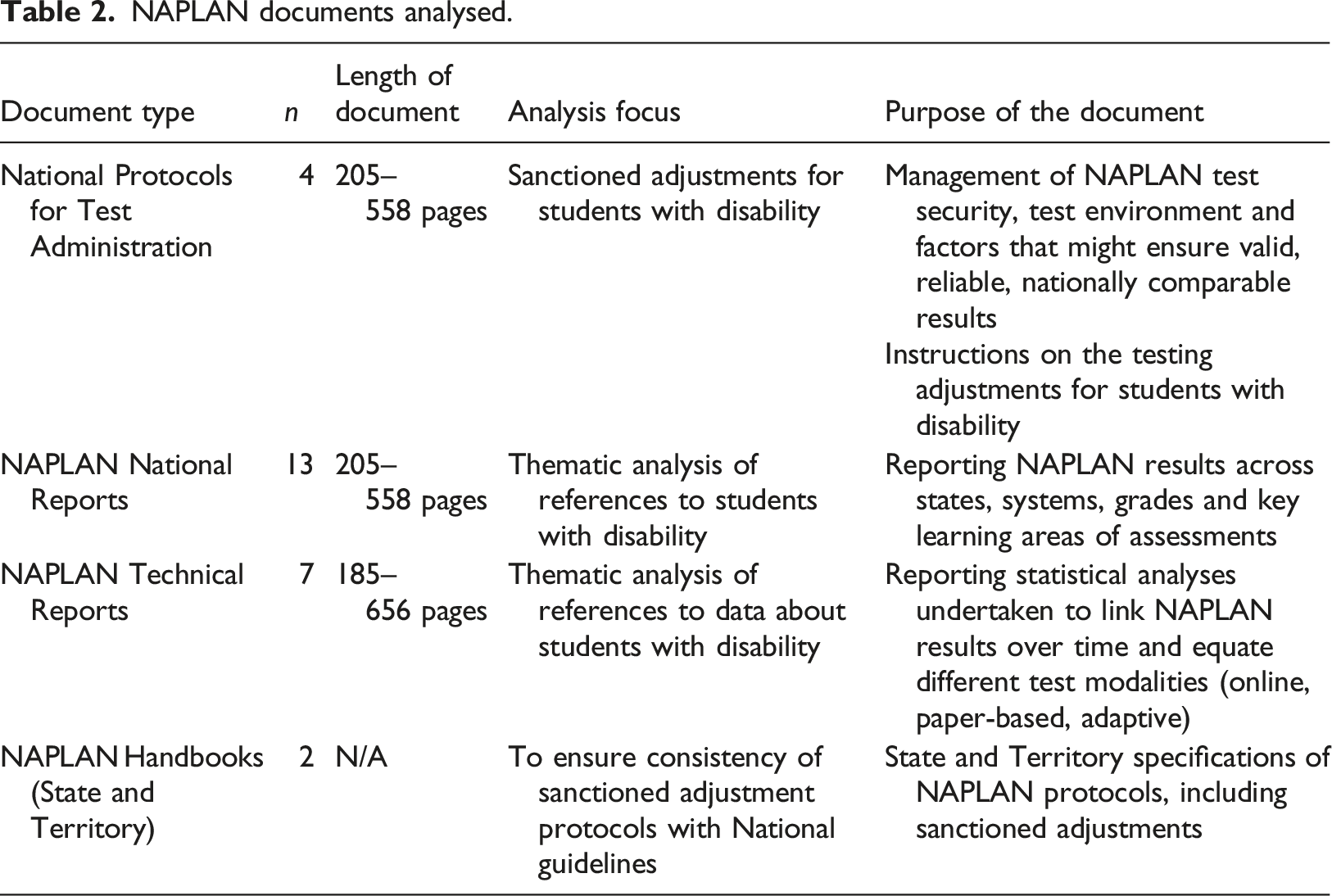
Data collection
NAPLAN documents analysed.
Data analysis
Originally, the authors intended to conduct a thematic analysis of NAPLAN documents (Bowen, 2009; Braun & Clarke, 2006) using reflexive thematic analysis (Morgan, 2022) to explore latent meaning. This approach ‘relies on the researchers being alert to the social political and cultural factors that influence their perspectives’ (Morgan, 2022, p. 73) and the perspectives of the people they study. However, NAPLAN documents were found to contain too few references to students with disabilities to conduct a thematic analysis. Documentary analysis was therefore used (Cohen et al., 2007). Documentary study supports longitudinal analyses, allowing researchers to demonstrate how NAPLAN’s reporting of students with disability has evolved over time (Cohen et al., 2007).
NAPLAN documents published between 2008 and 2022 were searched. Preliminary analysis of each document type (see Table 2) determined the structure of each document. Documents were then compared for potential redundancies, iterations and information that could be used to corroborate evidence across sources (Cohen et al., 2007). This enabled researchers to identify what data are collected about students with disabilities in NAPLAN and revealed that none of these data are reported.
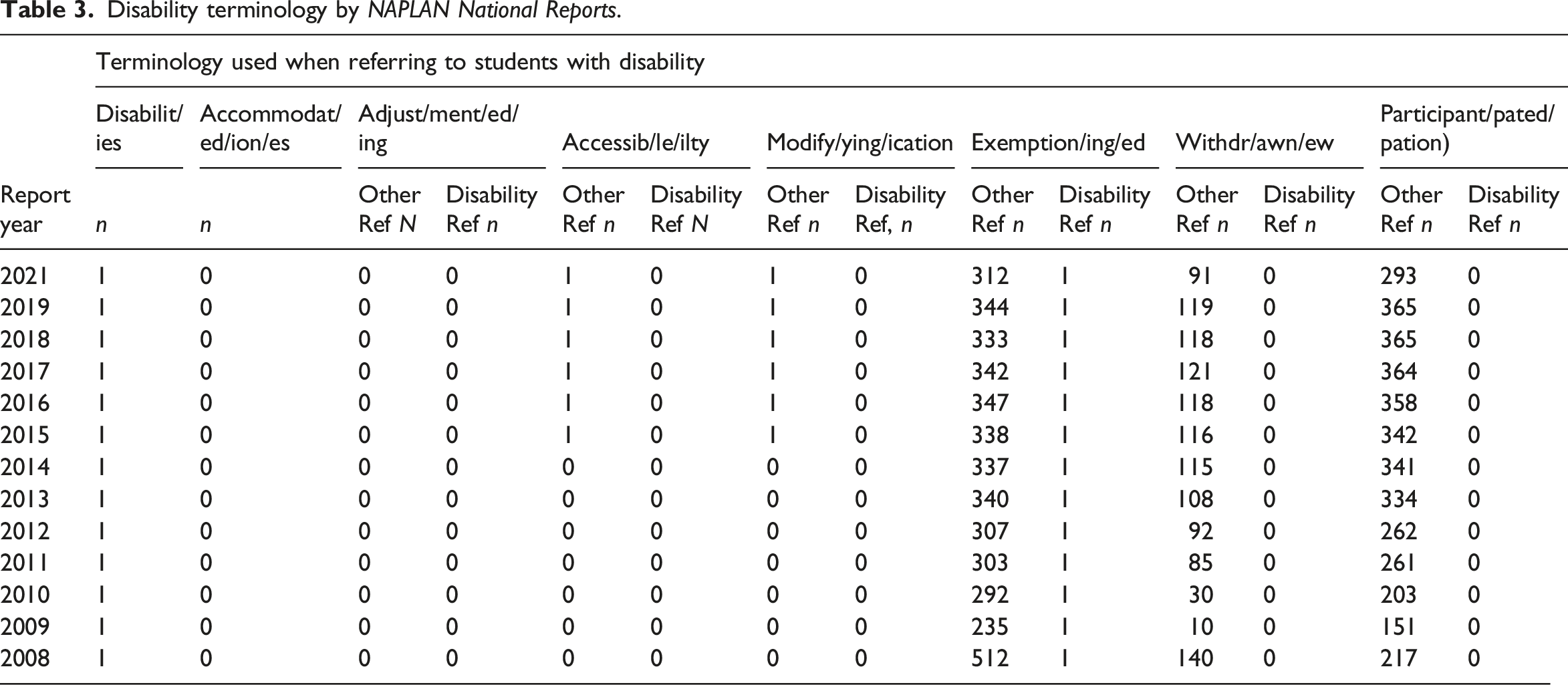
Disability terminology by NAPLAN National Reports.
Results
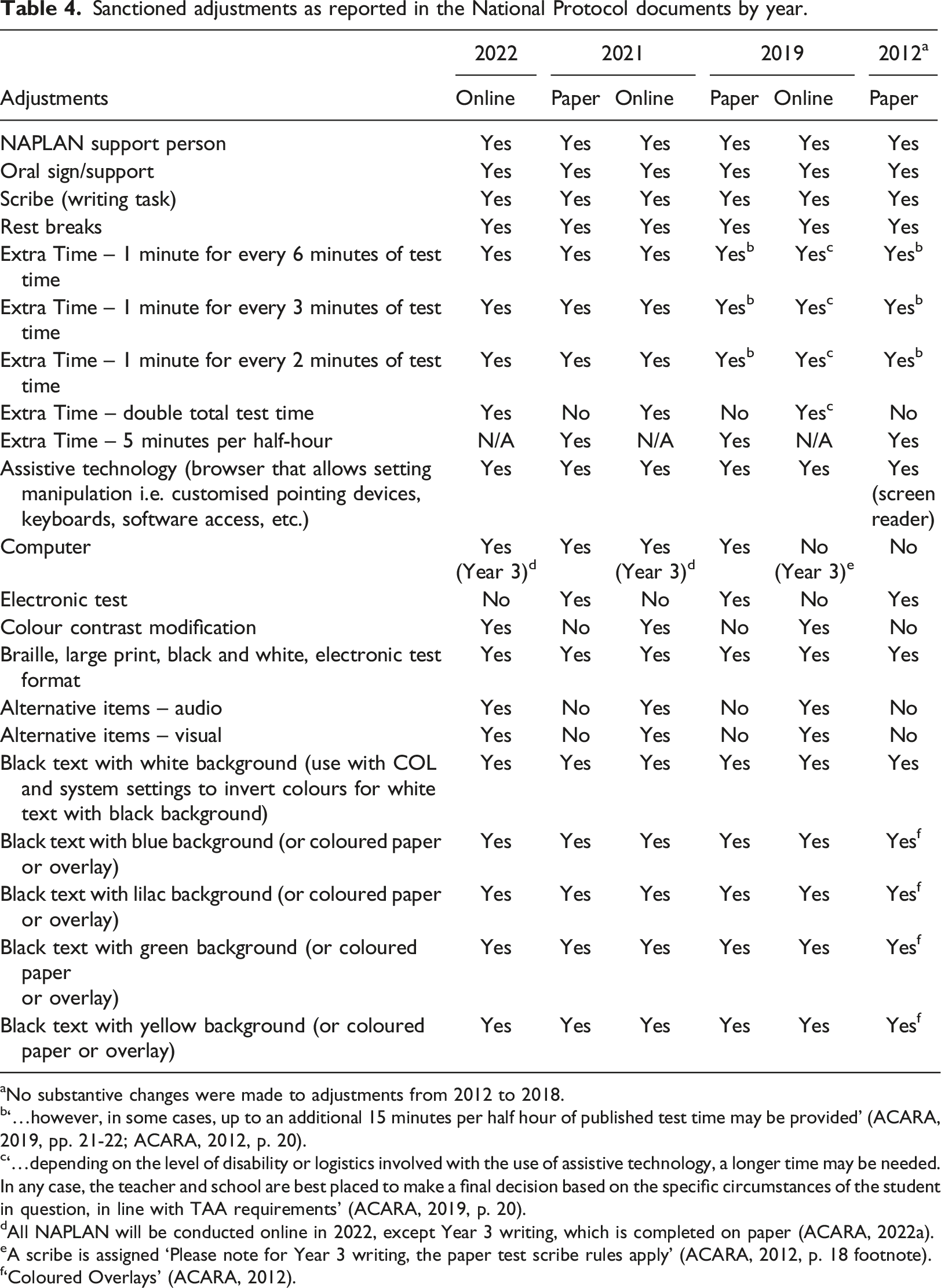
A unifying theme that emerged was the absence of students with disability from reporting. Students with disability were referenced in relation to sanctioned educational adjustments (in the Protocols), and withdrawal and exemption (in the reports).
NAPLAN National Protocols
Sanctioned adjustments as reported in the National Protocol documents by year.
aNo substantive changes were made to adjustments from 2012 to 2018.
b‘…however, in some cases, up to an additional 15 minutes per half hour of published test time may be provided’ (ACARA, 2019, pp. 21-22; ACARA, 2012, p. 20).
c‘…depending on the level of disability or logistics involved with the use of assistive technology, a longer time may be needed. In any case, the teacher and school are best placed to make a final decision based on the specific circumstances of the student in question, in line with TAA requirements’ (ACARA, 2019, p. 20).
dAll NAPLAN will be conducted online in 2022, except Year 3 writing, which is completed on paper (ACARA, 2022a).
eA scribe is assigned ‘Please note for Year 3 writing, the paper test scribe rules apply’ (ACARA, 2012, p. 18 footnote).
f‘Coloured Overlays’ (ACARA, 2012).
The National Protocols also require data for withdrawals and exemptions to be submitted to TAAs (ACARA, 2022a, Section 3.1.2, p. 8). Participation of students with disability is largely defined in terms of withdrawals and exemptions. For instance, section 5.2 of the Protocol (2022) states that: ‘Students with significant intellectual disability and/or students with significant comorbidity 3 that severely limit their capacity to participate in the tests may be exempt from taking NAPLAN’ (p. 13). Exemptions are decided by agreement between the principal and parent/carer, who concur that a student is not able to access the tests, even with adjustments. Reasons for exemptions must be documented (ACARA, 2022a, Section 5.2, p. 13), and exempted students are recorded as participants who are below national minimum standards. The National Reports do not include reasons for students being withdrawn nor do they report them under categories of exemption.
NAPLAN National Reports
Analysis of the NAPLAN National Reports revealed no information about the achievement of students with disability nor adjustments they received as shown in Table 3. Reasons for this are unclear. However, data sharing restrictions, data privacy concerns and other legislative concerns related to the sharing of health information (such as disability diagnoses) between legal jurisdictions could be contributing factors.
Analysis also revealed that the performance of different student groups is reported including State or Territory, sex, Indigenous status, geolocation, LBOTE status, parental education, and parental occupation. However, performance of students with disability is not reported. Participation rates are also reported along with overall exemptions, withdrawals and absences for States and Territories as well as for Indigenous students. However, the participation of LBOTE students and students with disability is not reported.
NAPLAN Technical Reports
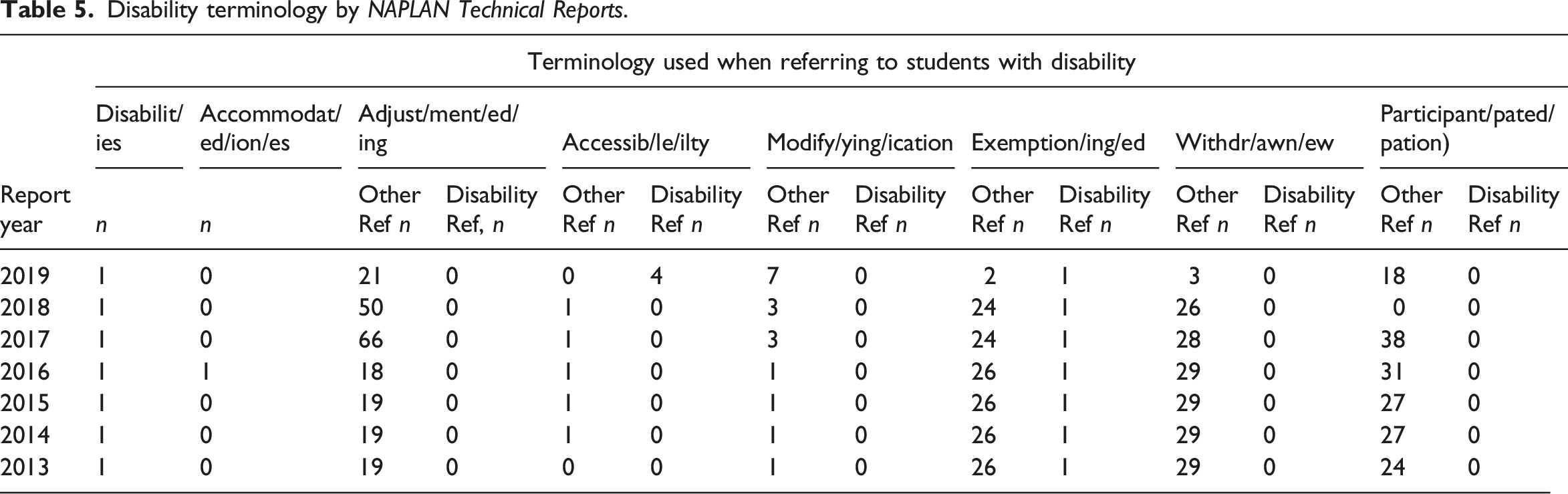
NAPLAN Technical Reports provide information about how NAPLAN data are analysed. It was found that achievement data for students with disability are not discussed in the Technical Reports. However, data about exemptions, withdrawals and absence have been analysed here because students with disability may be included in each of these categories. Both the Technical Reports and the National Reports indicate that exempted student data are treated as assessed and pooled into ‘below National minimum standards’. However, deficit assumptions and subsequent treatment of exemption data may not provide an accurate representation of this cohort of students. As Cumming and Dickson (2013) state, ‘It should not be assumed that students with disability are also low academic achievers’ (p. 232).
Disability terminology by NAPLAN Technical Reports.
Discussion
To what extent are the data pertaining to students with disability analysed and reported?
This study finds that NAPLAN documents demonstrate a conspicuous absence of reporting about students with disability that has persisted over the life of the assessment, despite assertions that students with disability are encouraged to participate in NAPLAN (ACARA, 2023c). It is also despite the legislative requirement that was introduced after NAPLAN began that the performance of students with disability be reported (Schools Assistance Regulations, 2009, s. 3). Since 2008, every NAPLAN National Report has referenced the term ‘students with disability’ only in the context of exemption from assessment. There is no mention of their achievement nor information to track the educational progress of this at-risk group despite data from other at-risk groups being reported and analysed (e.g. Adams et al., 2020; Cumming et al., 2020; Dixon & Angelo, 2014). This appears to be contrary to the stated purpose of NAPLAN to identify students at risk and could present an underexplored opportunity to support the provision of universal education for students with disability. There is further opportunity to ensure that NAPLAN reporting practices are consistent with the recent National School Reform Agreement (2018) and the current Schools Assistance Act 2008: Administrative Guidelines (Australian Government, Department of Education, Employment and Workplace Relations [DEEWR], 2013). There is also scope for aligning NAPLAN with Australia’s inclusive education agenda and with recommendations from the Royal Commission into Violence, Abuse, Neglect and Exploitation of People with Disability (Commonwealth of Australia, 2023).
The invisibility of the cohort of students with disability in NAPLAN reports also raises questions regarding collection of data that may never be used for the benefit of students with disability. It appears to contrast ACARA’s assertion that NAPLAN is inclusive of students with disability (ACARA, 2021b; 2021a, November 12). The extent to which students with disability are withdrawn for ‘philosophical objections to testing’ as per National Protocol 5.3.1 (ACARA, 2022a, p. 14) is not reported. Absentee data regarding this cohort are also unreported. This has implications for interpreting ‘statistically imputed’ performance descriptions for students who are withdrawn or absent. Although this expression has a clear statistical meaning, imputation may be based on data that misrepresents students in these categories, which may perpetuate systemic, discriminatory stereotypes of students with disability.
To what extent do the sanctioned adjustments support students with disability to demonstrate what they know and can do as assessed by NAPLAN?
No information is reported regarding the scope and nature of adjustments that are provided during NAPLAN making their efficacy unknowable. While the National Protocols require schools to record sanctioned adjustments for students with disability to enable their participation in NAPLAN, no data about sanctioned adjustments are reported at the National level. In line with Davies (2012) and Dempsey and Davies (2013), this paper finds that scrutiny of sanctioned adjustments continues to be warranted but that it is not possible when the students to which they might be applied are not visible through the reporting. Evaluation of sanctioned, reasonable adjustments could lead to broader consideration of possible adjustments and may enable greater participation of students with disability. It might also allow policy makers to determine whether the sanctioned adjustments are suitable. Analysis and review of NAPLAN adjustments may also enable greater validity in interpreting the achievements of students with disability. Not reporting these findings limits the extent to which educational decisions informed by NAPLAN data can be applied to all students universally in Australia.
NAPLAN documentation defines participation of students with disability in terms of absenteeism, exemption and withdrawal, indicating a deficit-based approach to disability. The formulas cited across reports defining participation include expressions such as: • ‘Assessed = present + exempt’ • ‘Total number of students in year level = assessed + absent + withdrawn’ (sic: NAPLAN report, Terms used in this report).
However, definitions of participation were altered slightly in 2022 to ‘Participants = assessed + non-attempts + refusals + exempt’ and ‘Total number = participants + absent + withdrawn’ (sic: ACARA, 2022b, p. ix). These algorithms may create confusion when interpreting the reports, because students who did not undertake NAPLAN are included in the participant population and therefore in the total number of students.
Despite the recent alterations, these algorithms continue to render students with disability invisible by aggregating them into exempt data and, likely, hiding them within withdrawn and absentee data. Therefore, it is impossible to ascertain the extent to which these students are represented in the measured cohort which necessitates caution when making inferences about them (e.g. Thompson et al., 2018).
An explanation and justification may be warranted for the reasoning behind the statistical treatment of exemptions, withdrawals and absences in the Technical Reports. Exempt students’ data are included in the analysis as ‘assessed’ and deemed ‘below National Minimum Standard (NMS)’ (e.g. ACARA, 2021b; 2021a, p. viii). This process of exemptions assumes that those with ‘significant disabilities’ (who may be included in exempt data) are unable to demonstrate performance above the minimum standard within the constructs assessed. As such, NAPLAN scales may not represent all students included in this category. Because these students do not have a chance to demonstrate their level of proficiency, their proficiency cannot be known. Under current reporting methods, NAPLAN data cannot be used to monitor the effectiveness of funding for students with disability (Haisken-DeNew et al., 2017) nor the effectiveness of support programs, nor educational adjustments.
With NAPLAN’s full transition to online adaptive testing in 2022, ACARA (2021b, 2021a, November 12) suggests it will be more accessible to students with disabilities. However, studies have found that computer adaptive testing may pose issues of disadvantage for students who experience test anxiety (Ortner & Caspers, 2011; Ortner et al., 2014). This may impact further on the participation and achievement of some students with disabilities in NAPLAN, unless appropriate and effective adjustments are sanctioned, implemented and reported.
Data regarding students’ disability ‘levels of adjustment’ are generated by schools for the NCCD and, for students who are exempted from NAPLAN due to disability, the NCCD level is reported to TAAs. Therefore, there appears to be opportunity for performance data to be linked to students with an NCCD profile (see National Protocol, 2022, 5.2.3). ACARA and the TAAs could work together to link and report findings so that more can be gleaned about the educational experiences of students with disability through NAPLAN. Furthermore, ACARA and the TAAs may have an opportunity to report the nature of adjustments and their impact, consistent with the principles of the National School Reform Agreement (2018) and the current Schools Assistance Act 2008: Administrative Guidelines (DEEWR, 2013).
What gaps exist in the collection and reporting of NAPLAN data for students with disability?
The current study identifies the imperative not just to collect data for students with disability but to report it to ensure education is universal and inclusive in Australia. This study identifies opportunities to improve reporting clarity and to extend reporting to include links to other data sets (e.g. NCCD) so that the impact of adjustments can be made clearer and, if warranted, changed and potentially even improved. It also indicates the potential utility of reporting and analysing findings in NAPLAN relating to students with disability regarding • the number of students concerned, • the achievement of these students, • suitability of adjustments for individuals and • adequacy of scope of sanctioned adjustments.
In doing so, Australia’s education system can demonstrate intent to effect improvements in education for students with disability.
Conclusion
The original purpose of NAPLAN was to identify student groups at educational risk which makes it consistent with the aims of the National Schools Reform Agreement (Department of Education and Training, 2021). However, despite many innovations in the assessment itself and repeated recommendations for greater inclusion since its inception, improvements in identifying the needs and adjustments provided for students with disability through the NCCD have not yet been achieved through NAPLAN. This study found a lack of consistency between the reported number of students with disability registered through the NCCD and the representation of this cohort in NAPLAN reports. Improved reporting about this at-risk group and their achievement would enable educational progress to be tracked, the efficacy of educational initiatives that target them to be monitored and potentially improve access to education that is universal for all Australian students.
The findings of this study align well with the recommendations of the recent Royal Commission into Violence, Abuse, Neglect and Exploitation of People with Disability (Commonwealth of Australia, 2023) regarding the importance of fully utilising and reporting all collected data to monitor and improve the evidence base to inform inclusive education practices and policies. Data collected through NAPLAN has great potential to contribute to monitoring and reporting of education outcomes of students with disability. In doing this, NAPLAN ought to contribute to improved outcomes for this vulnerable population.
Footnotes
Declaration of conflicting interests
The author(s) declared no potential conflicts of interest with respect to the research, authorship, and/or publication of this article.
Funding
The author(s) received no financial support for the research, authorship, and/or publication of this article.
