



Abstract
Young people’s confidence in their creative abilities, as well as their beliefs about whether these abilities are fixed or malleable, play potentially important roles in educators’ efforts to foster creativity. This study explores a multidimensional model of young people’s creative self-beliefs that comprises creative self-efficacy, growth-creative mindsets, and fixed-creative mindsets. It operationalizes and tests this model via a new three-factor instrument appropriate for young samples. Drawing on data from 2980 children and adolescents (mean age 12–13 years), confirmatory factor analysis established the construct validity of the scales, and hence, the multidimensional concepts underpinning creative self-beliefs. All measures evinced suitable levels of reliability, and invariance analysis supported configural, metric, and scalar invariance across gender, language background, and school type. Findings supported the convergent and divergent validity of scales against Big Five (openness and conscientiousness) personality measures. Implications of this three-factor creative self-beliefs model for researchers, educational practitioners, and youth are discussed.
Keywords
Introduction
Creativity, defined by Hennessey and Amabile (2015) as “the development of a novel product, idea, or problem solution that is of value to the individual and/or the larger social group” (p.572), is consistently identified as a critical capacity for children and adolescents’ effective responses to future change and challenge, yet through their education many young people are not adequately prepared to develop creativity (Jefferson & Anderson, 2017). Understanding how young people think about their own creative capabilities is a vital part of efforts to support their creativity. This requires rigorous conceptual development of what constitutes creative self-beliefs (CSBs) and operationally parsimonious models that are appropriate to young people. It also requires valid instrumentation that can be administered to young people to reliably assess their self-conceptions regarding creativity. The present study attends to both these concerns: (1) it adapts prior research among adults to propose a CSBs framework that is appropriately parsimonious for application to children and adolescents; (2) it develops and validates self-report measures of self-beliefs regarding creativity suitable for these young people, including in-school settings.
Creativity in School Contexts
Each generation faces a fresh set of challenges—driven by changes in society, demographics, climate, economies, and health (Cropley, 2022; Naughtin et al., 2022)—requiring creative responses. There is increasing recognition that schools can and should develop students' creative capabilities (Beghetto et al., 2017; OECD, 2019), with a review of national curricula by Taylor et al. (2020) finding that creativity is now mandated in 21 countries. The growth in creative thinking in national syllabuses is also reflected by the focus in PISA 2022 on assessment of creativity across a range of domains (OECD, n.d.). Given the rise of interest in creativity in school-based curriculum design, we need to understand the school-based environments that best enable learning and creativity (for reviews, see Davies et al., 2013; Kupers et al., 2019), but also how students themselves think about their capabilities for creativity.
In Australia, “Critical and Creative Thinking” has been a core capability since the release of the Australian Curriculum (Lucas, 2022). Much of the research regarding creativity and schooling has been driven by discussion of creativity emerging from the creative arts (Ewing, 2020). Large-scale longitudinal research with Australian school students by Martin et al. (2013) investigated relations between school-, home- and community-based arts participation and students’ academic and nonacademic outcomes. Controlling for socio-demographics, prior achievement, and prior variance in outcome measures, arts engagement and in-school arts participation predicted students’ motivation, academic buoyancy, academic intentions, and class participation (academic outcomes), while also predicting self-esteem, life meaning and purpose, and life satisfaction (nonacademic outcomes). These findings establish a range of potential benefits of school curricula incorporating the creative arts.
More recently, with the emergence of STEM (Science, Technology, Engineering, and Mathematics) and STEAM (Science, Technology, Engineering, Arts, and Mathematics) areas of the curriculum (Harris & de Bruin, 2017; 2018), the capability for critical and creative thinking is now considered an Australian cross-curriculum priority (Australian Curriculum, Assessment and Reporting Authority [ACARA], n.d.). ACARA’s current formulation of this capability emphasizes critical and creative thinking working in tandem, with critical thinking providing the capacity to “think where others do not” (Willingham, 2019, p.3) as a basis for creative problem-finding. ACARA (n.d.) defines creative thinking as involving “students learning to generate and apply new ideas in specific contexts, seeing existing situations in a new way, identifying alternative explanations, and seeing or making new links that generate a positive outcome.” Creative thinking is thus defined with reference to the cognitive processes underpinning student creativity. Beyond these cognitive activities, ACARA also emphasizes dispositions enhanced by critical and creative thinking, including “inquisitiveness, reasonableness, intellectual flexibility, open- and fair-mindedness, a readiness to try new ways of doing things and consider alternatives, and persistence.” We argue CSBs should be considered part of this constellation of dispositions and to the extent this is the case, these require closer substantive and empirical attention.
Creative Self-Beliefs
Creativity researchers have identified several related CSBs that are deemed to be pivotal to subsequent creative responses and behaviors (for a review see Karwowski & Lebuda, 2016). To capture these beliefs, Karwowski (2014) identified a model involving creative self-concept (comprising creative self-efficacy and creative personal identity), fixed-creative mindsets, and growth-creative mindsets. Creative self-efficacy refers to “individuals’ beliefs in their own potential and ability to manage creative challenges” (Karwowski & Lebuda, 2016, p. 214). Creative personal identity refers to individuals’ personal valuing of creativity and the role of creativity in their identity (Karwowski, 2014). Creative mindsets, defined by Karwowski (2014) as “beliefs about the stable-versus-malleable character and the nature of creativity” (p.62), builds on Dweck’s (1999) research on implicit theories of intelligence (mindsets) and distinguishes between fixed-creative and growth-creative mindsets. People holding fixed-creative mindsets tend to believe creative skills are unchangeable and that creativity is the province of “geniuses,” while people holding growth-creative mindsets are more likely to believe that creativity is trainable (Karwowski & Brzeski, 2017). This multidimensional framing of CSBs has received empirical support in numerous studies. For example, in exploring these constructs from a validation perspective, researchers have hypothesized that creative self-efficacy and creative mindsets can be expected to covary with the Big Five personality construct of openness to experience, widely acknowledged as the “core of the creative personality” (Oleynick et al., 2017, p.9). Reviewing the potential foundations of these relations, Karwowski and Lebuda (2016) distinguish between “hard core” personality traits with a substantial genetic component that are relatively insensitive to cultural influences and life experiences, and “surface self-concept characteristics”—including CSBs—that are more responsive to contextual influences. Under this framing, personality factors are viewed as causal antecedents of self-concepts, although Karwowski and Lebuda (2016) acknowledge the empirical challenge of establishing this chain of causation. In a meta-analysis of relations between CSBs and Big Five personality factors, Karwowski and Lebuda (2016) did indeed find openness was the strongest predictor of CSBs. Other personality factors, in particular conscientiousness, were only weakly related to CSBs.
To our knowledge, this multidimensional CSBs framing has not been applied to children and adolescents, nor has instrumentation appropriate to this group been developed and tested. This is important because in the current climate of educational, workplace, and social change due to rapid automation and computerization (e.g., Frey & Osborne, 2017), educators are increasingly charged with responsibility to help young people develop attributes to navigate change (OECD, 2019). Creativity is one such attribute and CSBs are a vital foundation of this attribute (Karwowski, 2014; Karwowski & Brzeski, 2017). Reviewing theory and research on the development of creative self-beliefs, Karwowski and Barbot (2016) noted the increasing evidence that creative self-beliefs—such as creative self-efficacy, creative personal identity, and creative mindsets—shape creativity and creative achievement across the lifespan, including during childhood and adolescence. Indeed, other researchers have recognized the potential for educational yields and practices with regards to self-efficacy (Luzzo et al., 1999; McCabe, 2006; Schunk, 1985; Schunk & Miller, 2002; Schunk & Rice, 1989; Usher & Pajares, 2008) and implicit theories of intelligence (Burnette et al., 2013; Martin, 2015; Yeager & Dweck, 2020); the present study is an ideal opportunity to extend this practice-related scholarship to creative self-efficacy and creative mindsets.
Conceptual and Measurement Dimensions Appropriate to Children and Young People
The present investigation focuses on the CSBs of children and adolescents. In doing so, we harness Karwowski’s (2014) multidimensional approach, but posit one operational adaptation—namely, a parsimonious framing that we consider more appropriate to children and adolescents. In Karwowski’s (2014) model, creative self-concept is a higher order construct comprising creative self-efficacy and creative personal identity. When Karwowski empirically tested that model, the higher order factor loadings of creative self-efficacy and creative personal identity were .98 and .94 respectively, indicating substantial empirical overlap. We also suggest that the “creative personal identity” construct is somewhat abstruse for children to reflect and report on, being defined as a general, holistic, and underlying construct (Karwowski et al., 2019). In contrast, “creative self-efficacy” is defined as a specific, modifiable, and situation-relevant construct (Karwowski et al., 2019) that we believe children will find easier to reflect and report on (and indeed, was the higher loading of the two constructs; Karwowski, 2014). We thus propose a CSBs framework that is appropriate to children, comprising creative self-efficacy (but not creative personal identity), growth-creative mindsets, and fixed-creative mindsets.
Alongside some conceptual adaptation appropriate to children and adolescents, there are numerous measurement challenges facing researchers wishing to understand CSBs among this cohort. For example, Tierney and Farmer’s (2002) widely used three-item scale is oriented more towards creative self-efficacy in the workplace rather than in educational settings. Hass et al. (2016) expanded on the above scale to test a six-item creative self-efficacy scale, but again with adult participants. An alternative measure developed by Abbott (2010) drew on Torrance’s (2008) model of creative thinking (involving elaboration, flexibility, fluency, and originality), but this measure also appears to have only been validated with adult participants. Likewise, Karwowski’s (2014) creative mindset instrument was developed with adult participants, with phrasing on some items likely to pose difficulties for many children and young people. Karwowski (2015) investigated the clarity of creative self-concept self-reports by adapting the Short Scale of Creative Self (SSCS: Karwowski et al., 2013) for children, then testing competing measurement models for 10 to 12-year-old Polish children’s (N = 139) responses to the SSCS’s creative self-efficacy and creative personal identity items. While findings suggested this cohort were generally able to define creativity and describe themselves as more or less creative, substantial cross-loadings across the latent factors suggested some aspects of this cohort’s creative self-concept were still underdeveloped. Taken together, the above findings indicate revisions in expression and focus for both the creative self-efficacy and creative mindset scales would be required to ensure suitable measurement with children and adolescents. Lastly, in selecting personality variables for analyses of convergent and discriminant validity, we consider it important to acknowledge the general pattern of lower differentiation in personality across childhood and adolescence compared to adulthood (Shiner et al., 2021).
Aims of the Present Study
The present study explored a multidimensional CSBs framework appropriate to children and adolescents and tested the measurement properties of a parallel instrument developed for them to rate their CSBs comprising the three factors of creative self-efficacy, fixed-creative mindsets, and growth-creative mindsets. Adopting a construct validation approach, our first aim was to test the construct validity of the proposed CSBs scales using confirmatory factor analysis. A related second aim was to test the internal consistency of the proposed scales using reliability analysis. As demonstrating measurement invariance is necessary for testing an instrument’s applicability (and, thus its underlying conceptual applicability) across subgroups (e.g., across males and females) and for making meaningful comparisons of these groups unconfounded by measurement differences, a third aim was to test for measurement invariance across a number of key demographics. Lastly, our fourth aim was to test for convergent and divergent validity drawing on Karwowski and Lebuda’s (2016) meta-analysis of relations between personality and CSBs. We hypothesized a substantial positive correlation between creative self-efficacy and a growth-creative mindsets and a substantial negative correlation between creative self-efficacy and fixed-creative mindsets, as well as more salient correlations between CSBs (creative self-efficacy and mindsets) and openness to experience than between CSBs and conscientiousness (in line with Karwowski & Lebuda, 2016).
Method
Participants
Data were collected as part of a study on school experiences of creativity. Participants were a convenience sample of 2980 Australian students attending 11 primary school (n = 655) and 11 high schools (n = 2325). Data for high school students’ creative self-efficacy and Big Five personality factors are shared with the substantive Ginns et al. (2021) study, that tested a structural model of students’ perceptions of creative school environments, school motivation, and academic/creative self-efficacy, controlling for demographic and personological factors. Schools were mixed-ability comprehensive schools, although higher in socioeconomic status than the Australian national average (M = 1000; SD = 100, compared to M = 1133.67, SD = 56.72) based on schools’ Index of Community Socio-Educational Advantage (ICSEA) (ACARA, 2020). The mean age of participants was 12.86 years (SD = 1.61); 69.20% identified as male, and 22.4% as coming from a non-English speaking background. Students completed the survey individually during normally scheduled classes through the Qualtrics system using personal computers or tablets. The study was approved by the first author’s university research ethics committee (University of Sydney Human Research Ethics Committee, Protocol no. 2017/493) and the principals of the schools.
Instruments
The Creative Self-Efficacy Scale was adapted from Abbott’s (2010) creative thinking self-efficacy (CTSE) scale, measuring self-efficacy for each of the creative capabilities of fluency (2 items, e.g., “I can come up with many possible solutions to problems”), flexibility (2 items, e.g., “I can answer problems in different ways”), elaboration (2 items, e.g., “I can talk to my friends about wild ideas, and make them sound believable”), and originality (2 items, e.g., “I can imagine brand new ideas”). Items were shifted from the third-person question format used by Abbott to a first-person statement format to increase their readability for a younger audience. Analysis using the Coh-Metrix Common Core Text Ease and Readability Assessor (T.E.R.A.; Jackson et al., 2016) confirmed the revised items had substantially higher narrativity than the original format (91% vs. 37%), with more “story-like” texts being easier to comprehend. Participants were asked to rate their degree of confidence regarding each of the statements using a 5-point Likert scale with the following response anchors: 1 = cannot do at all, 3 = moderately can do, 5 = highly certain can do. The Creative Mindsets Scale consists of eight items adapted from De Castella and Byrne’s (2015) revised implicit theories of intelligence scale. Following the design of that scale, all items consisted of statements that reflected a first-person claim about the extent to which creativity was fixed (fixed-creative mindsets: four items, e.g., “I don’t think I can do much to increase my creativity”) or malleable (growth-creative mindsets: four items, e.g., “With enough time and effort I think I could improve my creativity level”). For validation purposes, students also completed two scales drawn from the Big Five Inventory—Children (John & Srivastava, 1999): Openness/intellect (8 items, e.g., “I see myself as someone who…is original, comes up with new ideas”) and Conscientiousness (8 items, e.g., “I see myself as someone who…does things carefully and completely”). Participants responded to the Creative Mindsets Scale and personality items using a 5-point Likert scale with the following response options: 1 = strongly disagree, 2 = disagree, 3 = neither agree nor disagree, 4 = agree, 5 = strongly agree. All items are presented in Appendix A.
Statistical Analysis
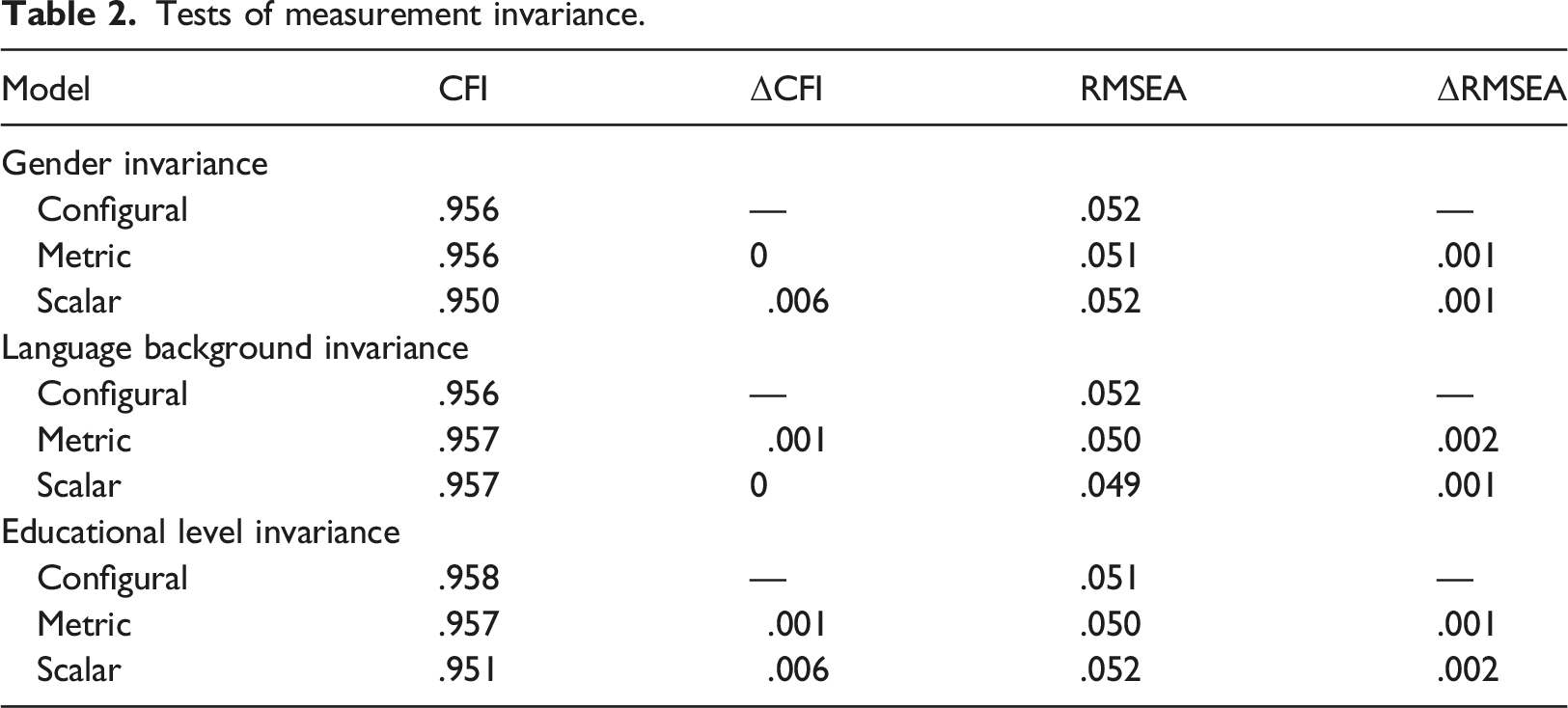
We tested the psychometric functioning of the CSB scales with an initial confirmatory factor analysis (CFA) of the hypothesized three-factor model. Subsequent analyses focused on scale reliability and measurement invariance testing, followed by an expanded CFA to test convergent and divergent validity hypotheses using personality scales. All analyses were conducted with JASP 0.14.1 (JASP Team, 2021). Given the use of an ordinal response format coupled with violation of the assumption of multivariate normality using Small’s (1980) omnibus test (χ2 = 3953.62, df = 60, p < .001), all analyses were based on the robust maximum likelihood estimator. We evaluated model fit using the comparative fit index (CFI) and the root mean square error of approximation (RMSEA). CFI values range from 0 to 1.00; values equal to or more than .90 and .95 are taken to indicate acceptable and close fit to the data respectively (McDonald & Marsh, 1990). RMSEA values equal to or below .05 and .08, respectively, are taken to constitute close and acceptable levels of fit (Jöreskog & Sörbom, 1993). We assessed internal consistency of scales using McDonald’s (1999) omega. Measurement invariance testing used CFA to examine whether the hypothesized factor structure of the Creative Mindsets Scale varied according to gender (male vs. female), language background (English-speaking background vs. non-English-speaking background), and school level (primary school—Year five students, vs. high school—Year seven and Year nine students). We examined the CFIs and RMSEAs for a series of models (configural, metric, and scalar invariance), holding successive elements of the factor structure invariant across the above demographics. Following Putnick and Bornstein’s (2016) guidelines, we initially tested for configural invariance, that is, that the three latent constructs had the same pattern of free and fixed loadings across groups. We then tested for metric invariance, that is, equivalence of item loadings on the three hypothesized factors. Lastly, we tested for scalar invariance, that is, equivalence of item intercepts. Invariance was established based on Cheung and Rensvold’s (2002) recommendation of a reduction in CFI of no more than .010, and Chen’s (2007) recommendation of an increase in RMSEA of no more than .015, between an initial constraint-free model and subsequent models including constraints. Covariances between residuals of negatively worded items in the Conscientiousness scale were fitted given the established recognition of this source of model misfit in personality research (Ginns et al., 2014).
Results
Descriptive and Confirmatory Factor Analyses
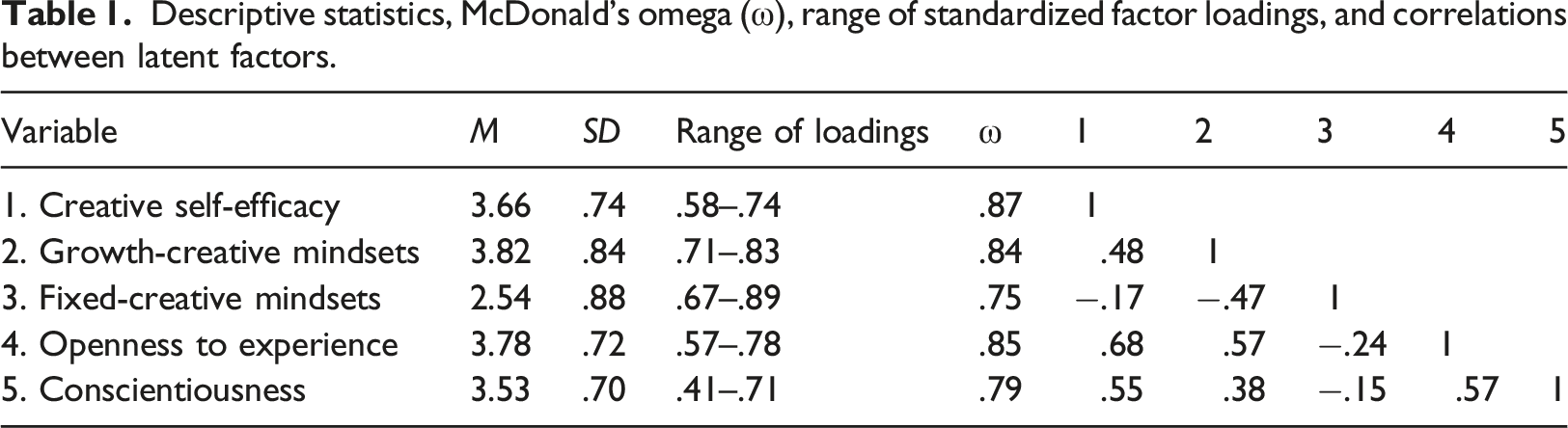
Descriptive statistics, McDonald’s omega (ω), range of standardized factor loadings, and correlations between latent factors.
Measurement Invariance Analyses
Tests of measurement invariance.
Inter-Factor Correlations
Having established the viability of the three-factor measurement model, we tested an additional 5-factor model incorporating students’ self-reports regarding openness to experience and conscientiousness, which had acceptable fit to the data: CFI = .931, RMSEA = .044 (90% confidence interval 0.043–0.046). Factor loading ranges and correlations between all latent variables are presented in Table 1. The patterns of these correlations provide evidence of both convergent and divergent validity. Both creative self-efficacy and growth-creative mindsets were positively and substantially correlated with openness to experience. As expected, fixed-creative mindsets was negatively correlated with growth-creative mindsets, creative self-efficacy, and openness to experience. Evidence of divergent validity comes from the generally lower correlations of the CSBs with conscientiousness compared to openness to experience, although the correlations of the CSB constructs with conscientiousness were larger than would be expected based on Karwowski and Lebuda’s (2016) meta-analysis. Further inspection of the correlation matrix reveals a substantial correlation (r = .57) between students’ latent scores on openness to experience and conscientiousness. This result is consistent with results from van der Linden et al.’s (2010) meta-analysis of Big Five factor intercorrelations, which reported a meta-analytic correlation between these factors of ρ = .62 for school samples, compared to ρ = .19 for adult samples. Both sets of results speak to the broad trajectory of increasing differentiation in personality across the lifespan (Shiner et al., 2021). 1
Discussion
The present study drew on prior research among adults to develop a parsimonious CSBs framework suitable for research and evaluation with children and adolescents, comprised of creative self-efficacy, fixed-creative mindsets, and growth-creative mindsets. To operationalize this model, we adapted a creative self-efficacy scale for adults (Abbott, 2010) and two scales focusing on adolescents’ implicit theories of intelligence (De Castella & Byrne, 2015). The findings confirm the expected factor structure of the three scales, with each scale evincing robust levels of reliability. Invariance analyses established the psychometric properties of the three scales did not differ across key demographics of gender, language background, and school level. Inspection of the latent correlations among the CSBs, and partial correlations between the CSBs and the Big Five personality constructs of openness to experience and conscientiousness, provides evidence for the convergent and divergent validity of the scales.
Theoretical Contributions
The present study aimed to understand how young people think about their own creative capabilities, as a critical aspect of efforts to support their creativity. We hypothesized a tripartite framework of creative self-beliefs, comprising creative self-efficacy alongside growth-creative mindsets and fixed-creative mindsets. This model draws on Karwowski’s (2014) model specifying creative self-concept (comprising creative self-efficacy and creative personal identity), fixed-creative mindsets, and growth-creative mindsets. Given the substantial empirical overlap between creative self-efficacy and creative personal identity found by Karwowski, and the relatively abstruse nature of creative personal identity for young people, we considered the above tripartite model to be more parsimonious and applicable to young people. Findings of the present study were successful in differentiating between creative self-efficacy and creative mindsets. Our investigation thus supported the conceptual framework hypothesized in the Introduction that sought to capture the key sources of variation in young people’s CSBs, as the basis for measurement, practice, and policy.
Measurement Contributions
The present study contributes to our understanding of the measurement of CSBs in several ways. First, findings demonstrated the successful adaptation of adults’ creative self-efficacy (Abbott, 2010) and adolescents’ implicit theories of intelligence (De Castella & Byrne, 2015) instruments to develop a comprehensive suite of CSB measures appropriate for both children and adolescents. While such scales may be useful in and of themselves, their functioning together under the proposed multidimensional model provides a broader understanding of the nomological network of children’s and adolescents’ creative self-beliefs. Correlations between students’ responses to the three scales provide evidence for the scales’ convergent and divergent validity, and thus researchers can confidently target and assess the specific dimensions of the model. Lastly, invariance tests suggest the scales are widely applicable as CSB measures across key demographic groups.
Policy Implications
In the face of unprecedented and intersecting global challenges (Naughtin et al., 2022), school systems around the world, including Australia’s, are recognizing the need to foster students’ creativity (OECD, n.d.; Taylor et al., 2020). In the Australian context, ACARA’s (n.d.) positioning of “critical and creative thinking” within the Australian National Curriculum signals the development of creative dispositions as both a process and outcome of schooling; we argue the CSBs investigated here align well with this policy framing. Developing this complex capability at scale will in part be driven by curriculum and school environment redesign (Davies et al., 2013; Ginns et al., 2021; Jefferson & Anderson, 2017), but alongside such efforts, students’ CSBs must also be developed (see below); otherwise, students may lack the disposition to think or act creatively. The present study has identified a framework (supported by valid instrumentation) that policy makers may draw on as they consider approaches to nurture young people’s CSBs at scale in education systems.
Practice Implications
Educational research on academic self-efficacy and implicit theories of intelligence provides starting points for educators seeking to enhance students’ CSBs. Research focusing on academic self-efficacy (Usher & Pajares, 2008) has identified several foci for interventions to build creative self-efficacy, including providing mastery experiences (Luzzo et al., 1999), personalizing tasks (Schunk & Miller, 2002), and developing goal-setting skills (Schunk, 1985; Schunk & Rice, 1989). Given teacher feedback is an important source of self-efficacy development (Schunk & Swartz, 1993), McCabe’s (2006) framework for building students’ writing self-efficacy through feedback prompts (e.g., “You were able to” and “You now have the idea” to signal enactive mastery) might be straightforwardly adapted for feedback on creative task assessments. The substantial body of intervention research on implicit theories of intelligence also provides directions for building growth-creative mindsets. Yeager and Dweck (2020) argue successful interventions are autonomy-supportive and not didactic; they do not simply exhort students to “try harder” (an effort attribution) but emphasize the potential for within-person change relative to prior ability, alongside developing new learning strategies and asking for advice when needed. Investigating reciprocal relations between personal best (PB) goals and high school students’ implicit theories of intelligence, Martin (2015) found PB goals were directionally salient over incremental and entity theories, suggesting intervention efforts—including on creative learning and assessment tasks—should focus on setting both process PB goals (e.g., on effort, engagement, skill development, participation) and outcome PB goals (e.g., improved productivity and performance). Such goal-setting-based interventions could be expected to also impact students’ creative self-efficacy (cf. Schunk, 1985; Schunk & Rice, 1989). In these practice-oriented efforts, it will also be important to identify students who may particularly benefit from creativity-based interventions; for example, we showed that students who were low in openness and conscientiousness were also lower in adaptive (and higher in maladaptive) CSB dimensions, and this might signal what attributes to consider when deciding who receives intervention.
Implications for Future Research and Limitations
The present study provides psychometric support for brief CSB self-reports. Such measures could be used for a range of research and evaluation purposes, such as tracking the development of CSBs over time; understanding how CSBs relate to students’ perceptions of the school environment (cf. Ginns et al., 2021); determining whether CSBs mediate or moderate the impact of such programs (treating CSBs as process variables); or whether different curricula result in higher (or lower) CSBs (treating CSBs as outcome variables). Several limitations of the present study suggest directions for future research. Our sample was focused on Australian schools serving children of relatively higher socioeconomic status than the national average. Hence, the CSB scales would benefit from validation with a broader sample of students. Translation of the CSB scales from English and validation in a range of other cultural settings would likewise provide further tests of these measures’ generalizability. While the present study provided some evidence of the nomological network for CSBs with children and adolescents in juxtaposing CSBs with personality factors, future research might also expand the scope of this network by examining relations with objective measures of creativity, as well as relations with social factors supporting or inhibiting creativity (for a review see van der Zanden et al., 2020). As part of understanding this nomological network, researchers might also test whether the subscale measure of creative personal identity (see Karwowski, 2014; 2015) becomes more differentiated from creative self-efficacy as children mature. Longitudinal research would support understanding of changes in specific CSBs over time; fixed-creative mindsets may be especially useful in understanding processes underpinning children’s and adolescents’ creative mortification, “the loss of one’s willingness to pursue a particular creative aspiration following a negative performance outcome” (Beghetto & Dilley, 2016, p.85); and academic buoyancy may play an important protective role when students encounter this form of adversity (Martin & Marsh, 2020). Lastly, such scales should be useful in testing effects of interventions focusing on CSBs (e.g., Karwowski et al., 2020). The choice of CSB scales will depend on researchers’ specific research questions, such that survey administration time might be saved by focusing on a subset of the scales. Nonetheless, based on Berry’s (2009) estimate that populations with lower literacy might be expected to complete four items per minute, the CSB scales should not present a major imposition on school schedules.
Conclusions
Our goals in the present study were to develop and test a multidimensional model of young people’s CSBs that comprises creative self-efficacy, growth-creative mindsets, and fixed-creative mindsets. Confirmatory factor analysis established the construct validity of the scales, demonstrating the multidimensional concepts underpinning creative self-beliefs. Invariance analysis supported configural, metric, and scalar invariance across gender, language background, and school type, meaning the scales can be used with confidence across a range of settings. Given the increasing focus on developing creative capabilities in Australian schools and beyond, the framework and measures developed in the present study have potential to inform educators, researchers, and policy makers in their efforts to enhance students’ creativity through school—and beyond.
Footnotes
Declaration of Conflicting Interests
The author(s) declared no potential conflicts of interest with respect to the research, authorship, and/or publication of this article.
Funding
The author(s) disclosed receipt of the following financial support for the research, authorship, and/or publication of this article: This work was supported by the Chartwell Trust.
