



Abstract
Rurality is an identified point of disadvantage in measures such as the Index of Community Socio-Educational Advantage (ICSEA) and school resourcing models. However, socioeconomic disadvantage is commonly used as an explanation for lower average student achievement in rural locations. Thus, policies are often directed towards reducing disadvantage associated with socioeconomic status, and rurality is overlooked. This research tests the validity of these assumptions using a matched study approach. We examine data on New South Wales (NSW) students, schools and courses to investigate how the English and Mathematics achievement levels of students in their final year of secondary school are associated with family and school characteristics across locations. The findings show that socioeconomic variation does not fully account for differences in achievement in rural locations. Instead, rurality appears to mediate other effects on student achievement in a complex interplay of factors contributing to lower average results. This highlights the need to consider the specificities of rurality in schooling, particularly the role of rural knowledges and perspectives in schooling and student achievement.
Keywords
Introduction
In Australia and internationally, there is evidence that students in rural locations have lower academic achievement, on average, than metropolitan students (Australian Curriculum, Assessment and Reporting Authority [ACARA], 2021; Halsey, 2017; James et al., 2008; Thomson et al., 2019). This includes lower achievement in the National Assessment Program – Literacy and Numeracy (NAPLAN) (ACARA, 2021; Lamb & Glover, 2014) and the Programme for International Student Assessment (PISA) (Thomson et al., 2019). In the 2019 NAPLAN, almost 97% of students in major cities achieved at or above average Year 3 reading results, while 96%, 94%, 88% and 65% of students achieved at or above average results in inner regional, outer regional, remote and very remote locations, respectively (ACARA, 2021). Patterns of achievement similarly decline across all areas of NAPLAN testing in Years 3, 5 and 7, the further away students live from major cities (ACARA, 2021). In the results from PISA 2018, Australian students outside metropolitan locations performed at lower levels in reading literacy, mathematical literacy and scientific literacy, with average performance between two-thirds of a year and almost 2 years behind metropolitan students in all these assessment areas (Thomson et al., 2019). Most of the Australian research has examined achievement in literacy and numeracy and international testing (Halsey, 2017), and relatively few studies have examined senior secondary achievement (e.g., Roberts et al., 2019; Teese, 2000). Further, policy responses have sought to address rural achievement concerns through approaches that appear to conflate rurality and socioeconomic status (SES). In this paper, we examine achievement data in senior secondary education in NSW, the most populous state of Australia, to address the relative gap of research in senior secondary achievement and extrapolate the specific influence of rurality on student achievement.
Attending school in a rural location is regarded as a mediator of disadvantage in Australia, along with SES, Indigeneity, disability and certain language backgrounds (ACARA, 2020). National policy responses have sought to address these influences on education disadvantage by providing additional funding to schools so they can resource the improvement of educational outcomes of students (ACARA, 2020; Department of Education, Skills and Employment, 2022; Gonski et al., 2011, 2018). Major reviews into school funding, colloquially known as the Gonski reforms, have aimed ‘…to develop a funding system for Australian schooling which is transparent, fair, financially sustainable and effective in promoting excellent outcomes for all Australian students’ (Gonski et al., 2011, p. xiii) by providing funding to the most educationally disadvantaged students and schools. States and territories have similar policies that aim to reduce disadvantage through increased targeted funding. In NSW for example, funding is provided to schools for students with disabilities, students from low socioeconomic backgrounds, students with low levels of English, for refugees or new arrivals and Indigenous students. Additional funding is provided for location in recognition that schools situated further away from major cities have less access to services and supports (NSW Department of Education [DoE], 2022). Notably, while the base allocation for the funding model is assigned according to where a school is situated, needs-based equity loadings calculated on the basis of student SES and other characteristics are designed to ‘reduce the impact of disadvantage on student outcomes’ (NSW DoE, 2022, p. 4). Thus, the presumed effects of location are conflated with those of SES (NSW DoE, 2014) in a way that may underestimate the unique, and mediating, influences of each.
The mediating influences of and intersections between rurality and SES are not well understood in education policy. Indeed, the first Gonski review (Gonski et al., 2011) acknowledges that the extent of the relationship between rurality and SES as mediators of disadvantage is not fully understood and requires more work, that both location and low SES impact student performance and together may have a compounding effect on disadvantage (see Gonski et al., 2011, p. 121–127). The NSW DoE submission to the Gonski review (NSW Government, 2011) provides an analysis of NAPLAN results from 2010 and highlights that after controlling for SES, there is still a low correlation between NAPLAN performance and rurality. The submission goes on to acknowledge that education disadvantage in rural locations is ‘different’ and is complicated by socioeconomic disadvantage (NSW Government, 2011, p. 32). Both reports thus indicate that our understanding of rurality as a mediator of student performance in itself needs to be developed.
Outside funding structures based solely upon location, there are currently no national programs that focus on addressing rural school disadvantage as uniquely produced through rural contexts. Historically, the Country Areas Program focussed on recognising the specific needs of rural communities through targeted funding to supplement student learning, enhanced teacher professional learning and school-based curriculum initiatives to better link curriculum to school, community and student life worlds (Randell, 1980). The nature of the curriculum was similarly a concern for the Commonwealth Schools Commission (1988) and Human Rights and Equal Opportunity Commission (2000) which each queried the relevance and equity implications of a standardised curriculum. However, concerns about issues of knowledge and the curriculum have moved away from questions of relevance towards standardisation and achievement in a standard curriculum. Consequently, the Country Areas Program was discontinued in 2009 under new funding agreements with programs to address disadvantage in rural schools now predominantly addressing socioeconomic disadvantage in accessing the curriculum, rather than school-based curriculum reforms (Department of Education, Science and Training, 2003; Halsey, 2009). This is unsurprising given there are higher concentrations of socioeconomic disadvantage in rural communities (Australian Bureau of Statistics [ABS], 2018b; Gonski et al., 2011). However, this approach conflates the influence of rurality and SES. Moreover, it understands ‘rural’ as merely a statistical category using the remoteness structure within the Australian Statistical Geography Standard (ABS, 2018a) which references proximity to large towns and services. Through this focus, policy interventions to date are based on comparing average outcomes for students across geographic categories and directing interventions towards minimising the differences across these geographic categories. This approach ignores the social and cultural dimensions of rurality (Roberts & Guenther, 2021) and lacks any recognition of rurality as generative, relational, knowledge-producing and culturally meaningful (Balfour et al., 2008; Green & Reid, 2021; Halfacree, 2006; Soja, 2010). Consequently, interventions largely reflect meanings of rurality that recognise the needs of the rural from the perspective of the non-rural (Roberts & Green, 2013) where a ‘politics of distribution’ (Chesters & Cuervo, 2022, p. 48) has advocated the view that social structures can be transformed through ‘the class distribution of benefits and burdens’ (Fraser, 2003; as cited in Chesters & Cuervo, 2022, p. 49). In this study we contribute to better understandings of the unique influence of rurality and SES in senior secondary schooling to seek to undo the conflation of each influence. This article will develop understandings of rurality 1 as a mediator of education disadvantage and identify whether a more targeted focus on programs to specifically address rurality is needed. First, we turn to background literature to situate our broader critique.
Socioeconomic status and links to academic achievement
The link between SES and educational outcomes has received much attention from scholars both in Australia and overseas (Roksa & Potter, 2011; Sirin, 2005) and there is a well-established correlation between generational wealth, SES, and school achievement (Chesters & Daly, 2015, 2017; Redmond et al., 2014). Cultural, social and human capital theories underpin research showing that children with higher levels of SES generally do better in school compared with their lower SES counterparts (see e.g. Lareau, 2011; Nordlander, 2015; Potter & Roksa, 2013). Such explanations postulate that parents transfer advantages to their children that directly or indirectly affect educational chances and success, with students whose parents are less educated or are in jobs that carry less social capital achieving lower average results in school (Evans et al., 2010; Lareau, 2011; Roksa & Potter, 2011). Other research has highlighted issues of disadvantage, poverty and home resources and their effects on educational outcomes and schooling transitions (e.g. Hilferty et al., 2010), although the strength of the relationship and the causes of disadvantage are both complex and contested (Downey & Condron, 2016; Marks, 2017; Marks & O'Connell, 2021; Sciffer et al., 2020). Complicating direct associations between SES and academic achievement is the well-developed history of research establishing the sociological basis of knowledge as relating to SES and social reproduction (Teese, 2000; Young, 2013).
Schooling and academic achievement
Student achievement may also be influenced by the characteristics of the schools that students attend. Research has shown that students from low SES families achieve stronger academic results when they attend high SES schools, and this may be especially relevant in the Australian context (Chesters, 2018; Perry & McConney, 2010). For example, in a study comparing Australia and Canada, Perry and McConney (2013) concluded that peer effects measured through the average SES of the school provided greater advantage to students in Australia than those in Canada and was attributable to differences in ‘school socioeconomic segregation’ across the two countries (p. 14). Studies have also focussed on the interaction between schooling and family contexts through the generated social capital or other factors that may assist or add to students’ achievement levels (Chesters & Daly, 2017; Downey & Condron, 2016; Dufur et al., 2013) as well as the effects of school resourcing and management on levels of student achievement (Helal, 2012; Jackson, 2018).
Opportunity to learn
A concept also relevant to the current discussion is that of opportunity to learn, which explores the idea that achievement levels in school are related to the extent to which students have been exposed to subject content and coverage (Reeves, 2012; Schmidt et al., 2015). Focussing on the relationship between SES and opportunity to learn using PISA data from multiple countries, Schmidt and colleagues found that 37% of the strength of the relationship between numeracy and SES can be explained by differences in students’ opportunities to learn. Similarly, Reeves (2012) found that the growing gap in rural mathematics achievement levels between junior and senior years is associated with the lesser opportunity to learn advanced mathematics in the senior years. Opportunities to learn typically relate to the practices used by schools to stream students by level or by access to more advanced subject content, but also include the segregation of students across schools that may lead to the opportunities that they may have to access more advanced course content (Dean et al., 2021; Dupriez & Dumay, 2006). These issues have been identified as having high incidence in Australia (Chmielewski, 2014; Schmidt et al., 2015) and emphasise that structural inequalities both between and within schools mediate SES and other factors in regard to academic achievement.
The spatial implications of student achievement
Given the emphasis on the influence of socioeconomic factors on student achievement as outlined above, it is perhaps not surprising that levels of rural student achievement are often subsumed into the disadvantage themes arising out of the socioeconomic circumstances of students and schools. This is reflected in much of the research conducted in both the United States (see e.g. Koricich et al., 2018; Roscigno et al., 2006) and Australia (see e.g. Lamb & Glover, 2014; Muir et al., 2009). Significant research movements in the United States examining spatial aspects essentially overlay their findings with elements of social or material disadvantage. One example of this is what has come to be known as research on ‘neighbourhood effects’ (Durlauf, 2004, p. 1). The original proponent of this research was William Julius Wilson (1987), who argued that the spatial disadvantage of poor neighbourhoods has persisted because of the levels of disadvantage resulting from people of low SES living together. Since his work, literature has proliferated on neighbourhood effects including those relating to education outcomes (Durlauf, 2004; Levy, 2019) and the ecology of poor neighbourhoods (Quillian, 2017; Sharkey, 2008). Similar analyses are more infrequent in Australia but most that do exist again argue that socioeconomic (dis)advantage largely colours spatial issues (e.g. Pawson et al., 2015; Vinson et al., 2007, 2015).
This study seeks instead to ask the question, following Shucksmith (2012): ‘How far is “place” central to the construction, maintenance and representation of social differences and divisions?’ (p. 384). In response to questions such as this, Reid et al. (2010) have developed a trialectic of ‘rural social space’ (p. 271), in which the interrelation of social, economic and environmental dimensions structure and sustain the diversity of rural communities in ways that are ‘richly complex and contradictory’ (p. 269). Drawing on the work of Halfacree (2006), Lefebvre (1991) and Soja (2010), Reid and colleagues articulate the ways that space is created out of social relationships, practices and knowledge, and are connected through the places and spaces that make up everyday life (Green & Reid, 2021; Reid et al., 2010). This article is informed by these perspectives, recognising that both achievement and the knowledges students gain through their schooling experiences are spatially related, and that advantage and disadvantage are mediated in a complex interplay of factors that play out in the spatial contexts in which they arise.
Also implicated here are questions of knowledge in curriculum and its relationship to student SES (Young, 2013). Emerging research is extending these perspectives specifically to notions of rural knowledges (Roberts, 2021), forms of knowledge that are ‘…grounded in an understanding of rural life worlds as opposed to meanings rooted in a more metropolitan-cosmopolitan worldview’ (Downes & Roberts, 2015, p. 81). In this context, we argue that knowledge itself is continually produced and reproduced in and through places and spaces, where the rural is seen as a social and cultural phenomenon rather than a generalized and static category (Roberts et al., 2022). These ideas are proposed as a beginning-point in exploring implications for spatial-epistemic justice for rural spaces in which we seek to establish if a distinct pattern exists. Thus, we provide a warrant and justification for further investigation through the current research.
In doing this research, we acknowledge that it is impossible to operationalise concepts like rurality and SES without defining them, and that these concepts are never value neutral, especially if they are applied to people and communities. In this sense, the current research encapsulates a paradox in that it operationalises rurality in ways that may hold unintended and unexplored assumptions about people’s educational experiences and outcomes (Greenough & Nelson, 2015; Koziol et al., 2015; Roberts et al., 2021). Similarly, we are necessarily bound by the definitions, conceptualisation and measurement of SES and its attendant assumptions and biases (Hobbs, 2016; Marks & O'Connell, 2021). While we acknowledge these issues, the arguments in this article are the next best to ensure improved understanding of issues affecting rural people and communities.
Aims and research questions for the study
This study adds to the existing research by analysing final year school achievement through a matched study approach. Matching research methods have traditionally been used in fields such as health (Stuart, 2010) and economics (Zhao, 2004) but are relatively unusual in education research. The benefit of such an approach is that it is possible to examine effects between observational groups with similar covariates, and thus reduce confounding factors in estimation for the variable(s) of interest (in this case, location). We examine the association between location and the Mathematics and English results of Year 12 students using hierarchical linear regression modelling to answer the following research questions: 1. Is there an association between location and student achievement in Mathematics after controlling for parental SES, school SES and other variables? 2. Is there an association between location and student achievement in English after controlling for parental SES, school SES and other variables?
Method
Data
The data used for this analysis are drawn from a research dataset developed by the research team from the NSW Education Standards Authority data on schools, courses and students. The dataset comprises 73,371 students and 772 secondary schools located throughout NSW in 2017. Data are examined under University of Canberra Human Ethics approval number 20170077 and are used with permission from the NSW Education Standards Authority. Unlike most other data, the research dataset identifies all subjects undertaken by students in the final year of school and is supported by information about students and the school they attended. In the dataset, students are recorded at the physical location of the school where they are enrolled, together with all subjects they are undertaking at this school.
Selected characteristics of NSW Year 12 students by location, 2017.
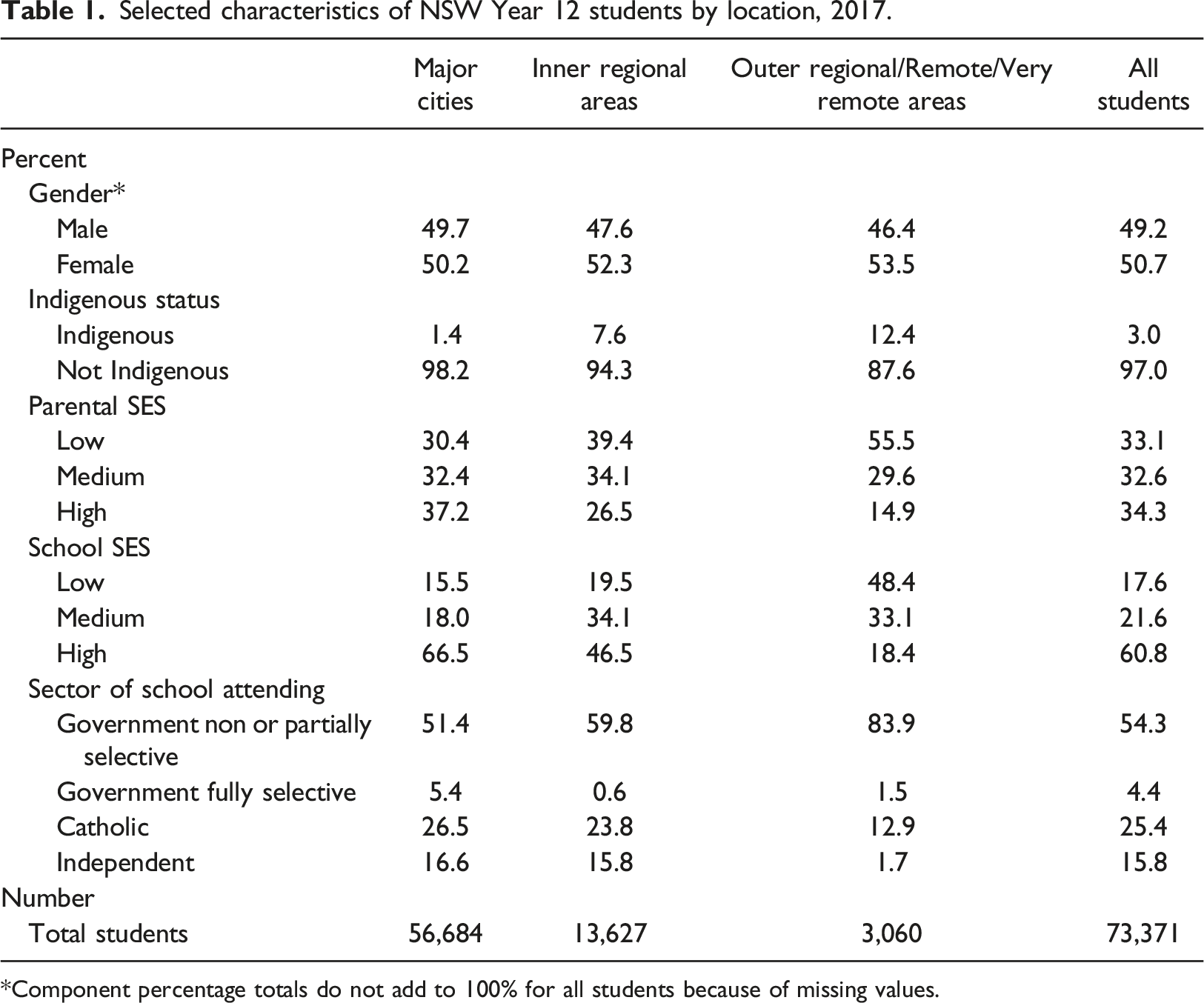
*Component percentage totals do not add to 100% for all students because of missing values.
Matched study
This research includes a series of matched studies in which Year 12 students were selected and matched according to school and student characteristics across major city areas, inner regional areas, and outer regional, remote and very remote areas in NSW. Matched studies approximate an experimental design allowing any potential confounding variable(s) to be controlled (Rubin, 2006). All Year 12 students living in outer regional, remote and very remote areas who completed the relevant Mathematics and English subjects (see below for details) were matched to students with the same characteristics who completed the same subject(s) in major city or inner regional areas: that is, they had the same gender, the same level of parental SES and they attended a school with the same level of school SES and school sector (fully or partially/non-selective Government, Catholic or Independent school). The matching process resulted in four separate but related studies totalling 5928 students. Characteristics of students included in the matched studies are given in Tables A1 and A2 of the appendix.
Variables
In NSW, final year student achievement is awarded through the Higher School Certificate (HSC) Record of Achievement (Universities Admissions Centre, 2018). The outcome variables for student achievement are represented in this research through the individual HSC marks for the subject streams of Mathematics, Mathematics General 2, Advanced English and Standard English. Two subjects (Mathematics General 2 and Standard English) can be regarded as more foundational while the other two subjects (Mathematics and Advanced English) are more advanced. Students’ HSC marks are aligned to course achievement standards for each subject and include a moderation of marks to allow student performance to be compared across different years (NSW Education Standards Authority, 2020, n.p.). Records with zero marks are excluded from the research (usually indicating a student did not sit the exam for the relevant subject or had dropped the subject at some time during the year).
The main predictors used in this research are location, parental SES and school SES. Location is measured through the geographic remoteness structure based on the Accessibility Remoteness Index of Australia (see ABS, 2018a). This classification divides Australia into five locations in which each shares common characteristics in relation to road distance to services. In the study, location is coded to a three-way distinction based on contracted categories of this classification: major city areas, inner regional areas and outer regional, remote and very remote areas (combined). Parental SES is measured through an index based on information provided by parents on school enrolment forms relating to their occupation and education. To create a continuous variable for each student, joint parental values are standardized, and the mean calculated, allowing each student to be placed on a normal distribution relative to other students. For analysis, this variable is then divided into the three equal categories of low, medium and high SES. School SES is measured by taking the mean of the parental socioeconomic scores of all students per school divided into the three groups of low, medium and high. Due to the uneven number of schools across different SES categories by remoteness, these categories are based on adequate sample across different school SES categories in the smallest locational category of outer regional, remote and very remote areas.
Additional variables included are Year 3 and Year 9 reading achievement, derived from the relevant NAPLAN test scores for each student (ACARA, 2016), presented as means and also divided into the equal categories of low, medium and high across Year 3 and 9 students, Year 3 and Year 9 numeracy achievement (similarly derived from mean NAPLAN test scores, and presented as means as well as the equal categories of low, medium and high achievement across Year 3 and 9 students), gender (male or female), Indigenous status (Indigenous or not Indigenous 2 ) and sector of school attended (government or non-government).
Descriptive analysis
We first examine descriptive statistics on the intersection between location and the SES and other characteristics of students and schools, and how patterns of achievement in Mathematics and English vary by these characteristics.
Table 1 presents summary statistics that compare student and school level variables for all Year 12 students and the location of the school they attended in Year 12 (i.e. in major cities, inner regional areas and outer regional, remote and very remote areas). There are major differences across these locational groupings in the proportions of students classified as Indigenous (1.4, 7.6 and 12.4%), those who had high parental SES (37.2%, 26.5% and 14.9%), those who attended high SES schools (66.5%, 46.5% and 18.4%) and those who attended schools in the government sector (56.8%, 60.4% and 85.4%).
Figure 1 highlights differences in student and school SES by location, showing that the mean standardised SES of students in major city areas of NSW is 0.17, compared with −0.05 for students in inner regional areas, and −0.35 in outer regional, remote and very remote areas. In turn, the proportions of those in high SES schools in these areas decrease dramatically by location. Parental SES and school SES of NSW Year 12 students by location, 2017.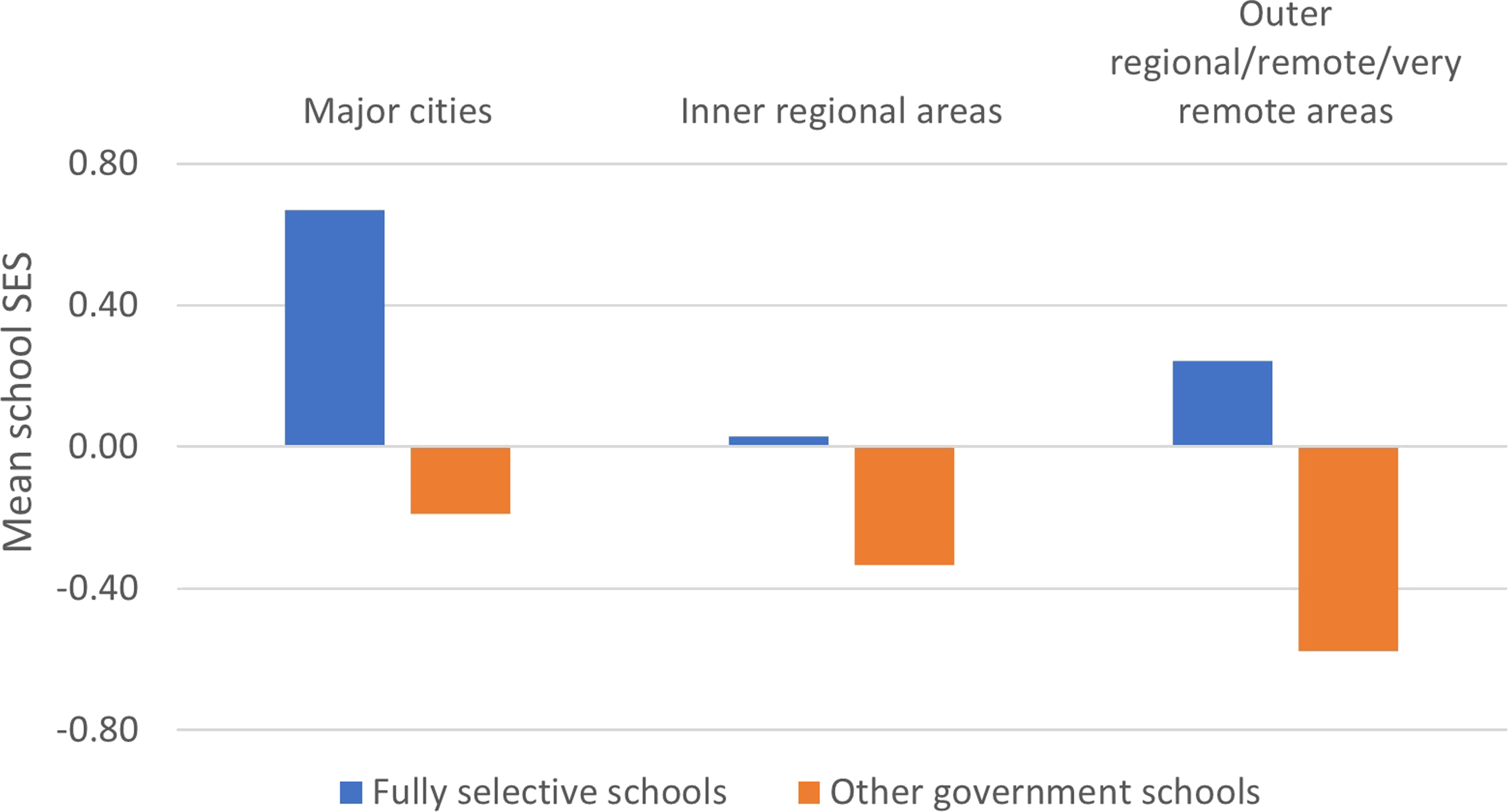
Participation, prior and final year achievement levels of NSW Year 12 students by location, 2017 (selected subject streams).
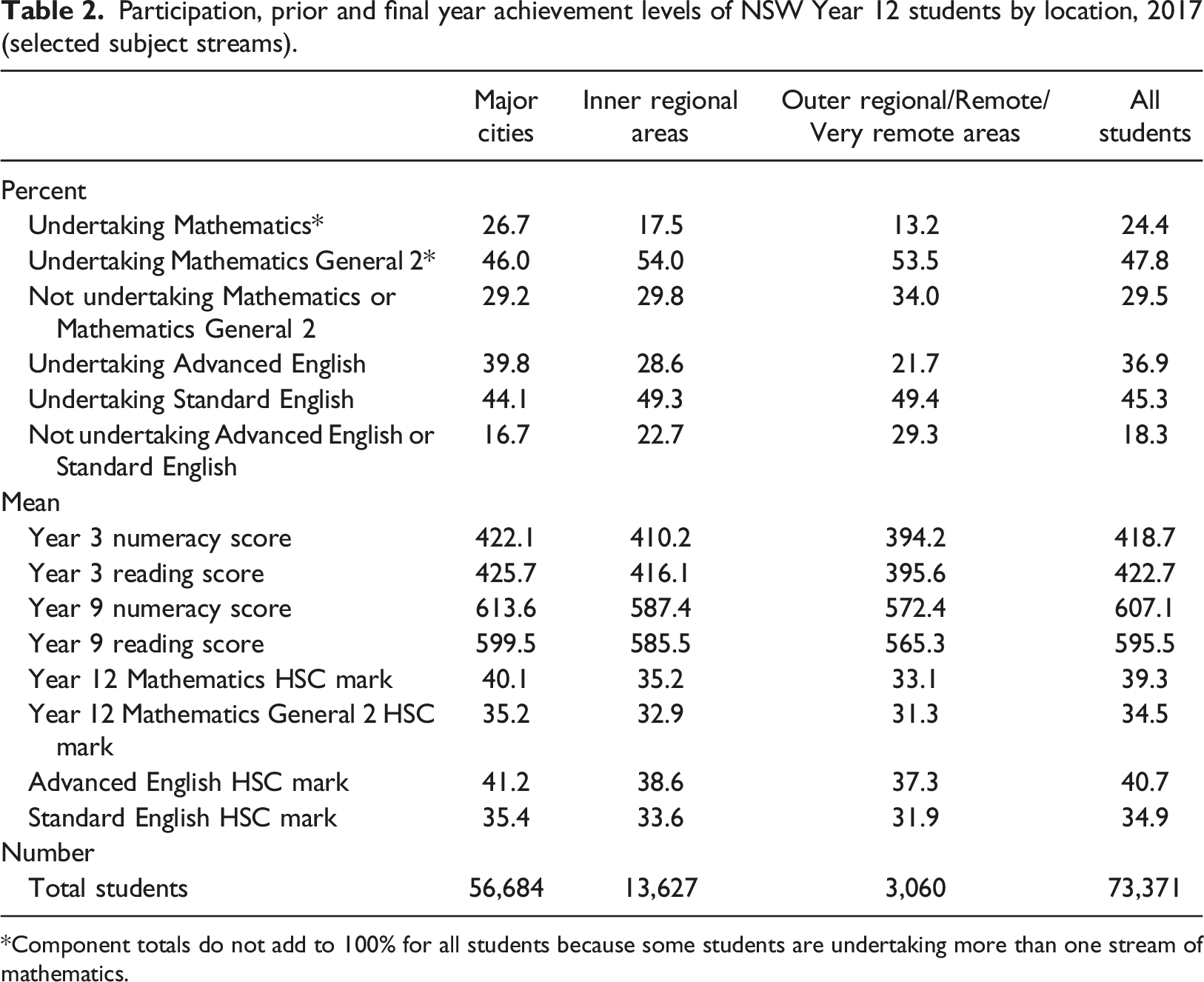
*Component totals do not add to 100% for all students because some students are undertaking more than one stream of mathematics.
The findings presented to this point may seem to support explanations that rural (under)achievement is simply a function of lower average levels of parental SES or are because schools in rural areas have lower levels of socioeconomic advantage compared to the metropolitan norm. Many studies explore the primacy of SES as a predictor of student achievement (as explored in prior sections of this paper) and we are not suggesting that it plays no role in terms of student achievement. However, our research seeks to analyse whether the achievement levels of students undertaking core Year 12 subjects manifest further complexities in an interplay of factors contributing to lower average student achievement in rural locations. As Corbett (2015) states: ‘The overall sociological conclusion that socioeconomic status is the best predictor of school success is mediated by the way that rurality and urbanity inflect the nature of poverty and what it looks like’ (p. 10).
Our research assesses these more complex notions by adopting a matched study modelling approach where students across three locations have the same characteristics for levels of parental SES, school SES, school sector and gender. This allows the effects of location on student achievement to be isolated and analysed as distinct from these other variables, including the SES of students and schools.
Analytical strategy
In answering the research questions, four models are constructed to examine separate effects on the mean HSC marks for the subjects of Mathematics, Mathematics General 2, Advanced English and Standard English. In all four models, location is the key predictor variable, while the student level variables of parental SES, gender, Indigenous status and Year 3/9 reading or numeracy achievement, and the school level variables of school SES and sector of school attended are included as control variables. The associations between student and school variables are examined simultaneously and the regression coefficients are interpreted as net effects on the respective outcome variables.
The analysis takes account of the clustered effects of student and school characteristics on achievement through hierarchical modelling which is necessary because characteristics at the student level are clustered by characteristics at the school level. In the hierarchy, units within a cluster are assumed to be statistically more similar than units in different clusters, and the estimation of standard errors both within and across clusters must therefore take this into account. Standard error estimation is robust to account for the assumed correlations between observations across schools, and the intra-class correlation (ICC) is calculated to estimate the size of the variation between schools.
Regression results
Hierarchical linear models predicting fixed effects on student HSC Mathematics results, 2017.
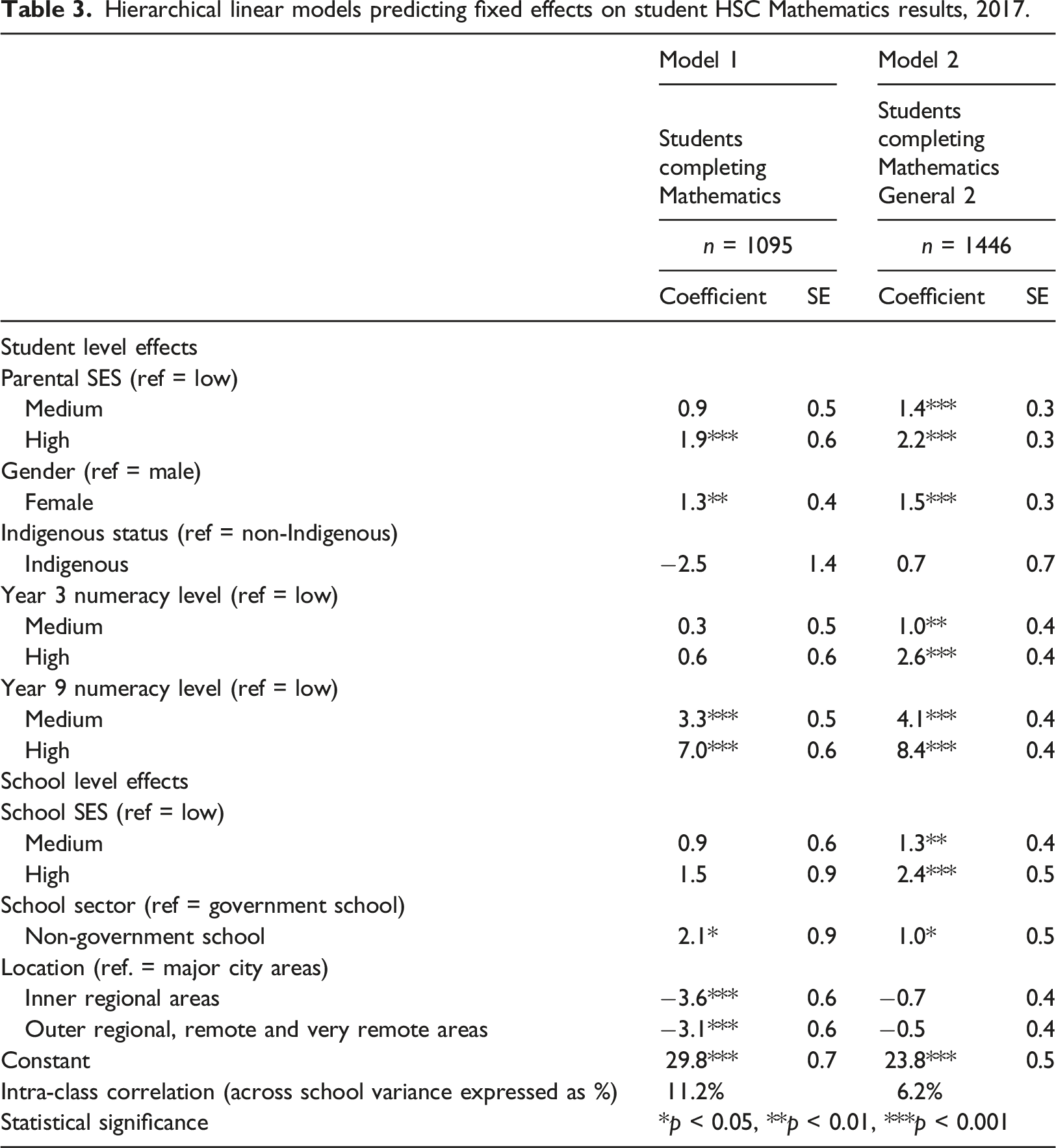
The second model in Table 3 shows HSC marks for the subject of Mathematics General 2. The model shows that the variables of parental SES, gender, Year 3 and 9 numeracy achievement, school SES and school sector are significant and positive in terms of their effects on average HSC marks, net of the effects of all other factors. However, in contrast to the results for Model 1, while the coefficients for students in both inner regional areas and outer regional, remote and very remote areas are lower compared to those in major city areas (by −0.7 and −0.5 points, respectively), these results are not significant. The ICC for this model is 6.2%, again indicating that while there is some variation in reading achievement between schools, within-school differences are a more important factor in variance than between-school differences.
Hierarchical linear models predicting fixed effects on student HSC English results.
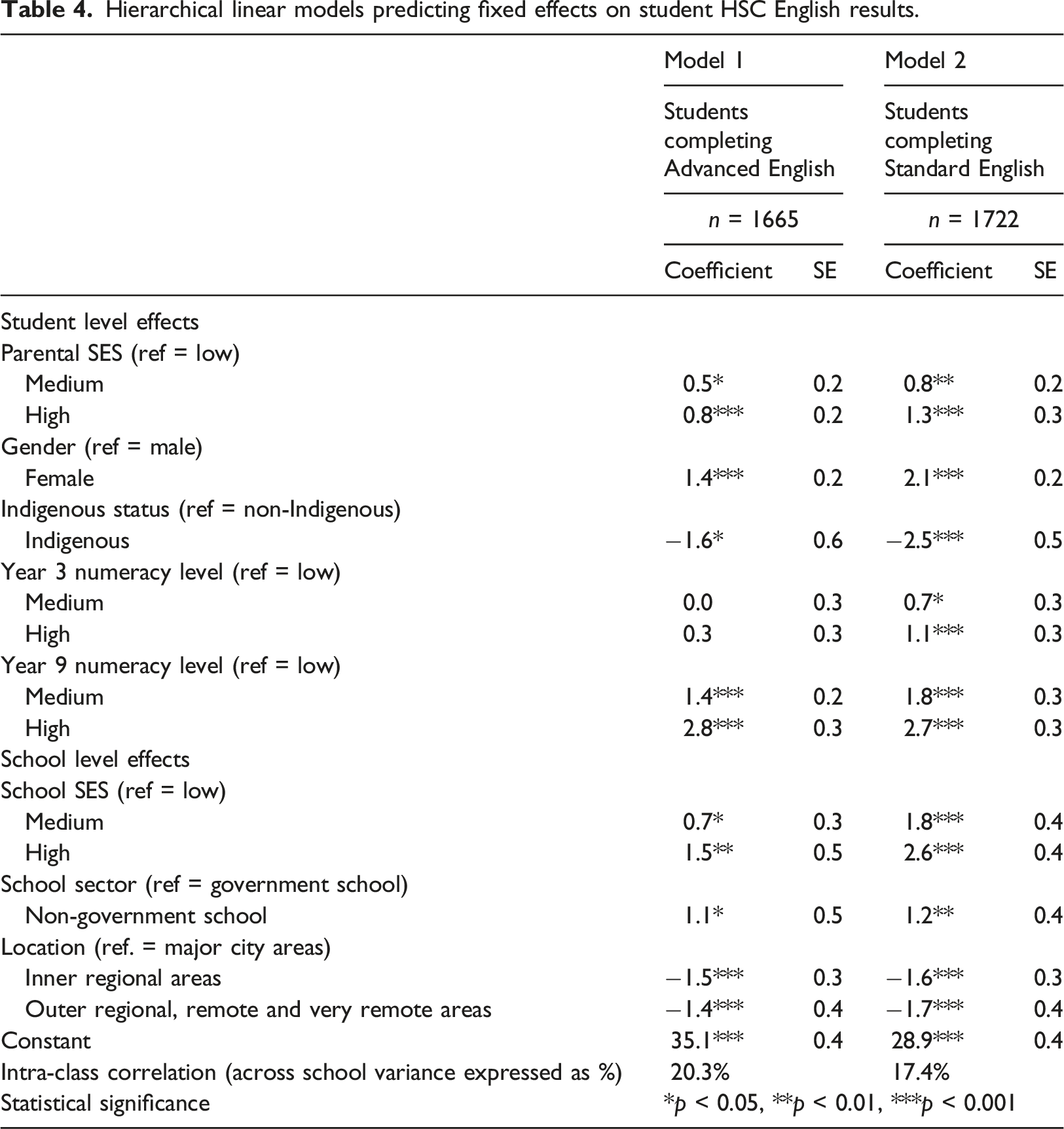
Finally, when controlling for all other factors, the HSC marks for the subjects of both Advanced English and Standard English for students in inner regional areas are significantly lower than for those in major city areas (by −1.5 and −1.6 points, p < 0.001) and likewise, the HSC marks for both Advanced English and Standard English are significantly lower for students in outer regional, remote and very remote areas on average than for those in major city areas (by −1.4 and −1.7 points, p < 0.001). The ICCs for these models are 20.3% and 17.4%, respectively, indicating that there is significant variation in reading achievement between schools as well as within schools.
Discussion and conclusion
In summary, for three out of the four subjects of interest – Mathematics, Advanced English and Standard English – there is a significant negative association between school achievement and location, when holding all other factors constant. Put another way, students attending schools in rural locations, regardless of their parents’ SES levels as well as the average SES of their peers at school and a number of other factors, achieve at lower levels than their non-rural counterparts. These effects are not uniform, nor does it appear that achievement levels, in the final year of school at least, are wholly dependent on school or family disadvantage, or on school effects more generally.
Although it is commonly assumed that SES is one of the main influences on the achievement levels of students, this research shows that SES does not explain all of the variability in achievement in core subjects, and that other factors independent of SES are impacting achievement across inner and outer regional areas as well as remote areas (Roberts et al., 2021). Although not directly tested in this study, it is likely that students’ differential opportunities to learn (Chmielewski, 2014; Reeves, 2012; Schmidt et al., 2015) form part of the range of structural inequalities that exist both between and within schools in rural settings that mediate factors leading to differences in students’ results. Limitations on curriculum access, access to curriculum enrichment activities, staff professional learning, teachers teaching out-of-field and the overall provision of subject experts have also been well canvassed as challenges rural students face (Halsey, 2017, 2018) and these factors undoubtably play a role in these findings. The results also confirm that prior achievement, as represented in Year 9 NAPLAN test scores and earlier Year 3 scores to a more limited extent, is associated with later achievement levels (Marks, 2010, 2017). However, as with other variables, prior achievement does not fully explain the effects of location on students’ HSC marks for three out of four of the subjects examined.
Our analysis of HSC marks of Year 12 secondary school students matched across a range of characteristics for different locations shows that both within and across schools, and even measuring achievement within the same subject streams, secondary students in rural locations achieve at lower levels than those in non-rural locations. Given that each jurisdiction has its own particular characteristics, and our research only covers NSW, further research in this area is needed to determine whether these findings are more generally applicable and what factors are key drivers of student performance in rural environments in addition to those examined. Two areas worthy of further attention are the differentiation of students’ achievement via curriculum access (e.g. Dean et al., 2021; Green et al., 2022; Roberts et al., 2019) and subject streaming practices (e.g. Berliner, 2011; Hornby & Witte, 2014; Macqueen, 2012). More positively, recent research has indicated that less advantaged schools do not necessarily have poorer quality teachers (Gore et al., 2021). What is evident, then, is that current redistributive measures to address inequitable outcomes have only had marginal success and further approaches are necessary.
The results presented here suggest that the nature of rural inequality is very different to that which dominates the discourses about student and school disadvantage. As Roberts and Green (2013) state: ‘Relatively low educational outcomes in rural areas … interact with other causes of social and educational disadvantage in a manner not fully understood’ (p. 768).
As our research controls for a range of variables and is a multi-level analysis, the findings reinforce the meaning of the triad of ‘rural social space’ proposed by Reid et al. (2010, p. 769). That rurality is exerting a unique and distinct influence on rural students’ outcomes that is largely unexplained raises important questions for future research. From the perspective of the authors, we want to be very clear that our inference is that there is important work to be done in relation to the nature of knowledge in the senior secondary curriculum and how this intersects with rurality. Such questions were once recognised in the Country Areas Program (Department of Education, Science and Training, 2003) that facilitated curriculum modifications to address the perspective of the Commonwealth Schools Commission (1988) and Human Rights and Equal Opportunity Commission (2000) report findings pertaining to the lack of relevance of the curriculum for rural students. Given the relationship between class, culture and knowledge has been long discussed (Teese, 2000) it would seem that looking at the ‘knowledge question’ (Roberts, 2021; Young, 2013) from a rural perspective is long overdue.
Footnotes
Acknowledgements
We would like to acknowledge the support of the NSW Education Standards Authority in facilitating access to the data used in this project.
Declaration of conflicting interests
The author(s) declared no potential conflicts of interest with respect to the research, authorship, and/or publication of this article.
Funding
The author(s) disclosed receipt of the following financial support for the research, authorship, and/or publication of this article: This work was supported by the Australian Research Council (DECRA Research Fellowship 2020-2022, DE200100953).

Notes
Appendix
Number and characteristics of students in Mathematics matched studies, 2017.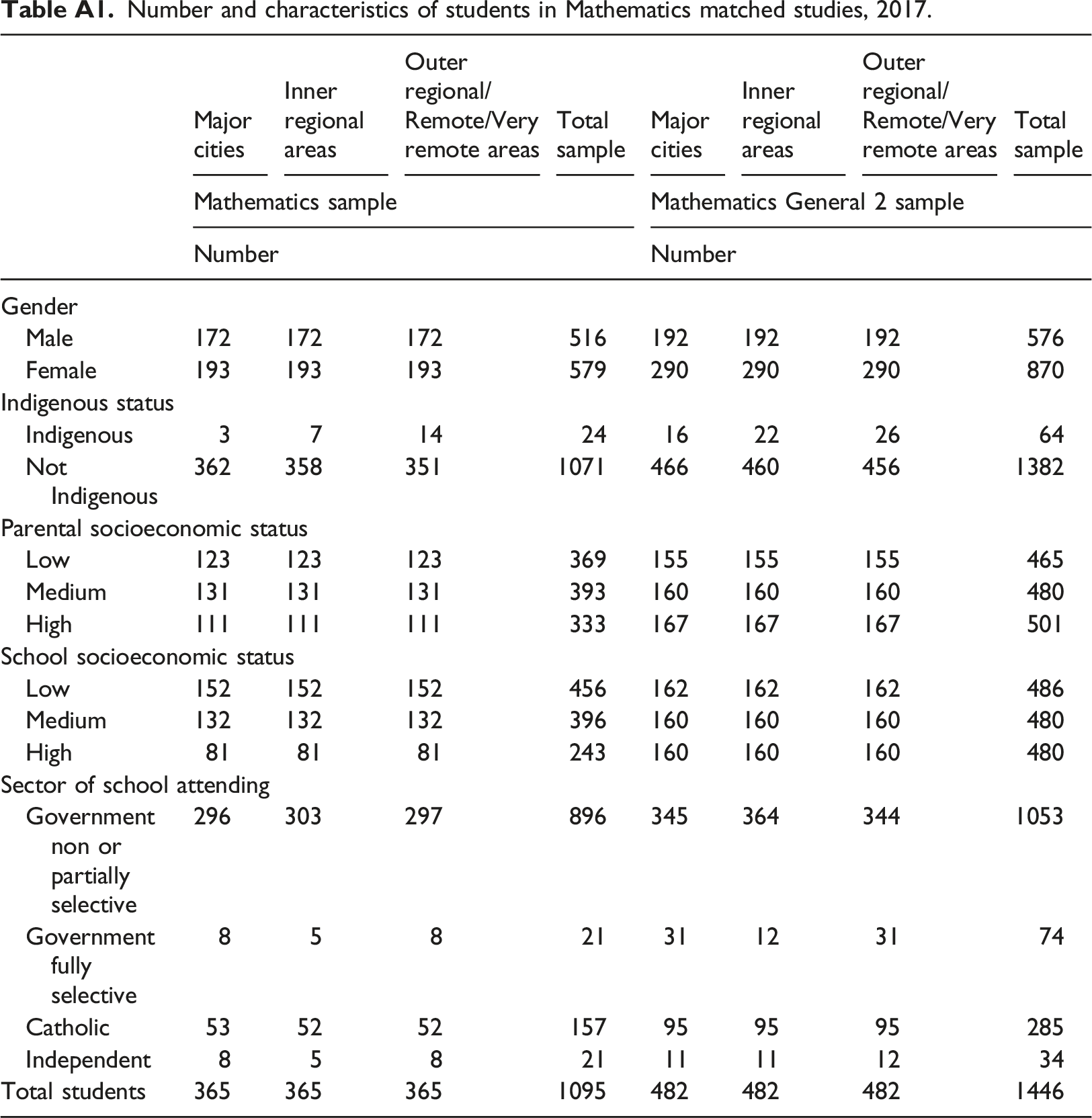
Major cities
Inner regional areas
Outer regional/Remote/Very remote areas
Total sample
Major cities
Inner regional areas
Outer regional/Remote/Very remote areas
Total sample
Mathematics sample
Mathematics General 2 sample
Number
Number
Gender
Male
172
172
172
516
192
192
192
576
Female
193
193
193
579
290
290
290
870
Indigenous status
Indigenous
3
7
14
24
16
22
26
64
Not Indigenous
362
358
351
1071
466
460
456
1382
Parental socioeconomic status
Low
123
123
123
369
155
155
155
465
Medium
131
131
131
393
160
160
160
480
High
111
111
111
333
167
167
167
501
School socioeconomic status
Low
152
152
152
456
162
162
162
486
Medium
132
132
132
396
160
160
160
480
High
81
81
81
243
160
160
160
480
Sector of school attending
Government non or partially selective
296
303
297
896
345
364
344
1053
Government fully selective
8
5
8
21
31
12
31
74
Catholic
53
52
52
157
95
95
95
285
Independent
8
5
8
21
11
11
12
34
Total students
365
365
365
1095
482
482
482
1446
Number and characteristics of students in English matched studies, 2017.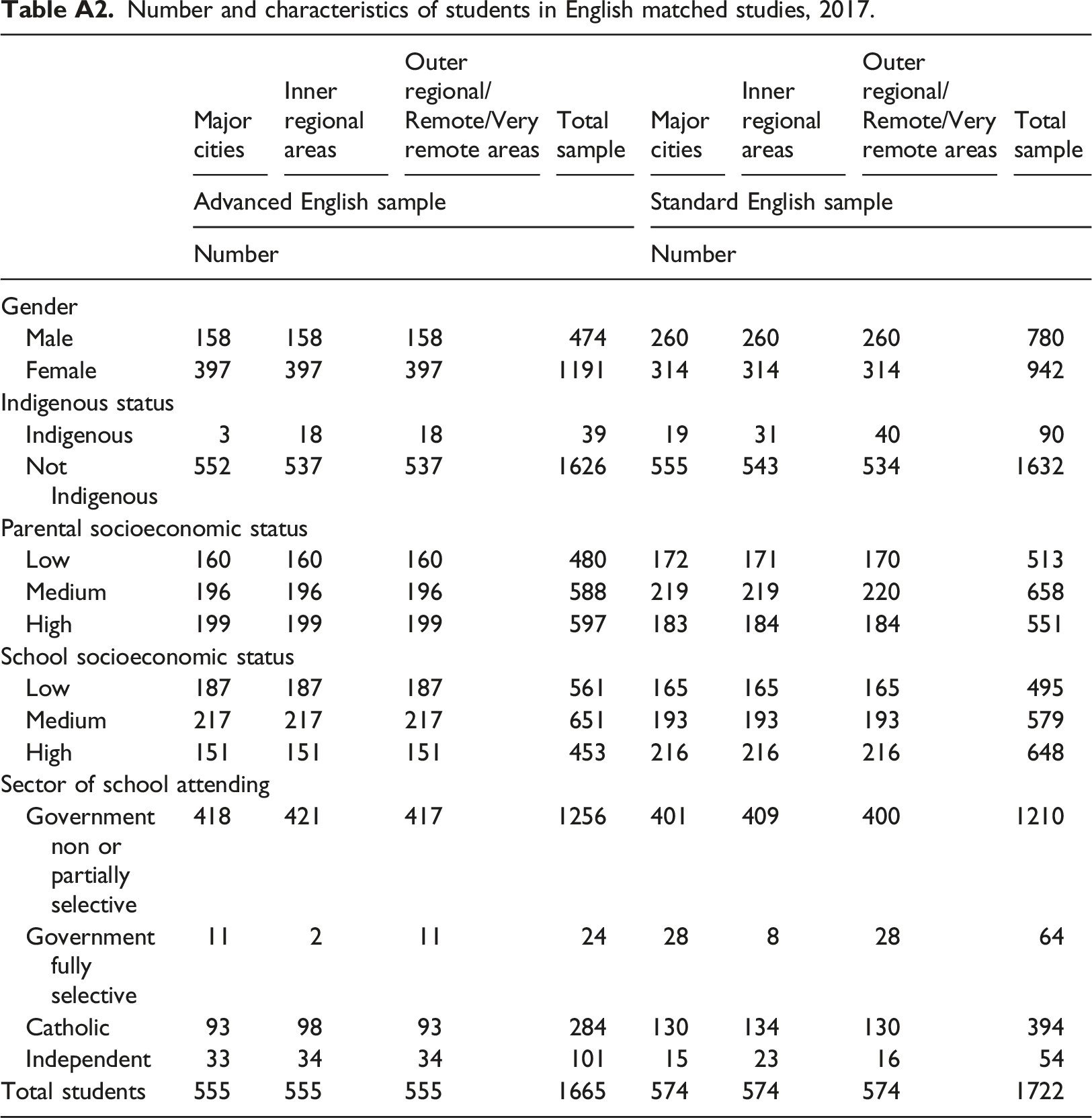
Major cities
Inner regional areas
Outer regional/Remote/Very remote areas
Total sample
Major cities
Inner regional areas
Outer regional/Remote/Very remote areas
Total sample
Advanced English sample
Standard English sample
Number
Number
Gender
Male
158
158
158
474
260
260
260
780
Female
397
397
397
1191
314
314
314
942
Indigenous status
Indigenous
3
18
18
39
19
31
40
90
Not Indigenous
552
537
537
1626
555
543
534
1632
Parental socioeconomic status
Low
160
160
160
480
172
171
170
513
Medium
196
196
196
588
219
219
220
658
High
199
199
199
597
183
184
184
551
School socioeconomic status
Low
187
187
187
561
165
165
165
495
Medium
217
217
217
651
193
193
193
579
High
151
151
151
453
216
216
216
648
Sector of school attending
Government non or partially selective
418
421
417
1256
401
409
400
1210
Government fully selective
11
2
11
24
28
8
28
64
Catholic
93
98
93
284
130
134
130
394
Independent
33
34
34
101
15
23
16
54
Total students
555
555
555
1665
574
574
574
1722