



Abstract
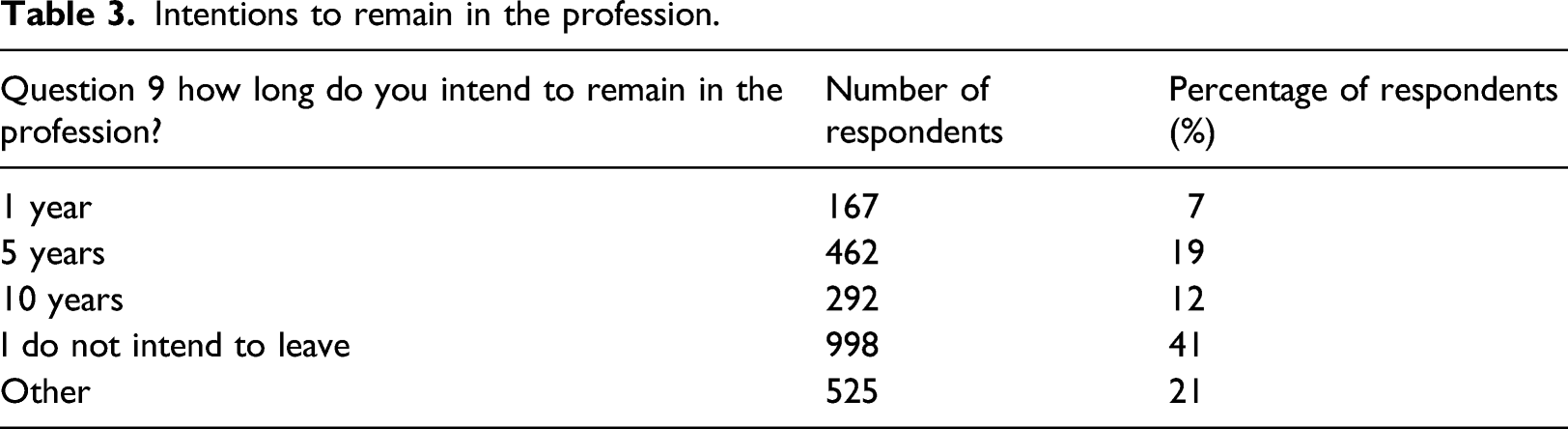
Concerns are mounting about the attraction and retention of teachers in Australian schools. This study draws upon a questionnaire of 2444 Australian primary and secondary school teachers, which revealed that only 41% of respondents intended to remain in the profession. Through a thematic analysis of the qualitative data within the questionnaire, we use employee turnover theory to enable an understanding of the reasons 1446 of the respondents described as influencing their intentions to leave the profession. These reasons included heavy workloads, health and wellbeing concerns for teachers and the status of the profession. We also use turnover theory to analyse responses from all 2444 respondents and explore possible mitigating strategies or practices that might reduce turnover intention, including meaningful reductions in workload and raising the status of the teaching profession. In doing so, we contribute nuanced qualitative empirical insights which can inform policy and practice.
Keywords
Introduction
The problem of teacher turnover
The negative impacts of teacher attrition and turnover have been well documented, with teacher turnover having a significant impact on student achievement and engagement (Kelchtermans, 2017; Ronfeldt et al., 2013). Teacher attrition also has negative consequences for relationships among staff and students (Arnup & Bowles, 2016) and for community engagement and cohesion (Ronfeldt et al., 2013). Teacher turnover also has direct and indirect financial implications, with research estimating a cost of close to USD$18,000 (approximately AUD$25,000) per teacher, in addition to the time and energy required to recruit, induct and support new teachers in a school, and the cost of disruption to school improvement policies and efforts (Ryan et al., 2017). Indirect impacts are also felt by the ‘stayers’, teachers who remain and take on responsibility for mentoring new staff while maintaining consistency in teaching and learning practices (Ronfeldt et al., 2013). The opportunity cost for teachers who leave the profession is also significant, particularly when they leave due to ill-health, burnout or dissatisfaction with their work (Madigan & Kim, 2021). Teacher attrition has been attributed to a range of factors including increasingly complex workloads (Kelchtermans, 2017), stress, emotional exhaustion and burnout (Lee, 2019; Rajendran et al., 2020), policies driven by accountabilities and external high stakes testing (Ryan et al., 2017) and concerns about status and remuneration (Rice, 2005).
Importantly, a body of literature has highlighted that particular schools, areas and students are more affected by turnover or attraction and retention issues than others. For example, hard-to-staff schools report higher rates of teacher turnover and more challenges in recruiting new staff to replace teachers. These schools tend to be in communities with higher rates of socio-educational disadvantage (Carver-Thomas & Darling-Hammond, 2017) or rural areas (Downes & Roberts, 2017). Concerns have also been reported about recruiting and retaining teachers in specialist teaching areas (Mason & Matas, 2015). Students who are already vulnerable within current education systems, policies and practices are, therefore, more likely to be affected by the problem of teacher attrition than their already-advantaged peers are. These issues are evident in research undertaken across the globe, including in Australian education systems (Arnup & Bowles, 2016).
There is an increasing awareness of issues of early career attrition (Rajendran et al., 2020) and, of particular concern, a shortage of aspirant teachers looking to enter the profession (for discussion about recommending teaching as a career, see McKay et al., 2019). Exact figures for early career teacher attrition in Australia are contested (Mason & Matas, 2015). However, recent research suggests that between 40% and 50% of Australian teachers might leave in their first 5 years (Arnup & Bowles, 2016; George et al., 2018; Weldon, 2018). Policy initiatives have attempted to address issues of teacher attraction, recruitment and retention through financial incentives, fast-tracked career development or leadership pathways and formal recruitment programmes that seek to fill pockets of need by bypassing traditional qualification pathways. However, it is important to note that attraction is just one piece of the puzzle. Of importance – and of particular interest to us – is not just how we get people into the profession or simply retain them as teachers, but how they can be better supported to thrive when they are in the profession. As such, any investigation into these issues needs to be considered in tandem with research into teacher stress and burnout.
Teacher wellbeing, stress and burnout
Increasing rates of teacher stress, ill-being and burnout have been attributed to external pressures, ongoing reform and the increasing complexity of the role of both the teacher and the school. At the same time, research has documented a worsening of public perceptions about the profession, including predominantly negative portrayals of teachers in the media and by politicians (Baroutsis & Lingard, 2017; Shine, 2020).
This article contributes important new perspectives on these issues of attraction, retention and burnout that paint a concerning picture for the future of Australia’s teaching workforce. Previous studies have explored the problem quantitatively and have provided important insights into the scale of the issue (for example, Arnup & Bowles, 2016). The insights from this study provide a unique contribution to the field, given the relatively large respondent sample size and the qualitative insights from respondents’ comments that we are able to bring to our analysis of these issues.
The study addresses two key research questions
RQ1 – What reasons do teachers cite for intending to leave the profession?
RQ2 – What possible mitigating factors or strategies could address the challenges identified by teachers?
Methodology
This study comprised an anonymous online questionnaire targeted towards Australian teachers, conducted in 2019. After receiving ethical clearance from our university, we advertised the questionnaire through our own professional networks, our own social media accounts and our university’s social media and alumni networks. We anticipated a small number of illustrative responses which would provide us with basic insights into teachers’ experiences. However, we received 2444 responses during August and September, 2019. The brief questionnaire was designed to develop an understanding of teachers’ perceptions of their work, experiences and satisfaction with their roles. The focus of the current article is on responses to a set of questions about teachers’ intentions to leave or stay in their profession, their reasons for leaving; challenges to their profession and their suggested solutions (see Appendix A).
Sample and population proportions of teachers in Australia by location in 2019.
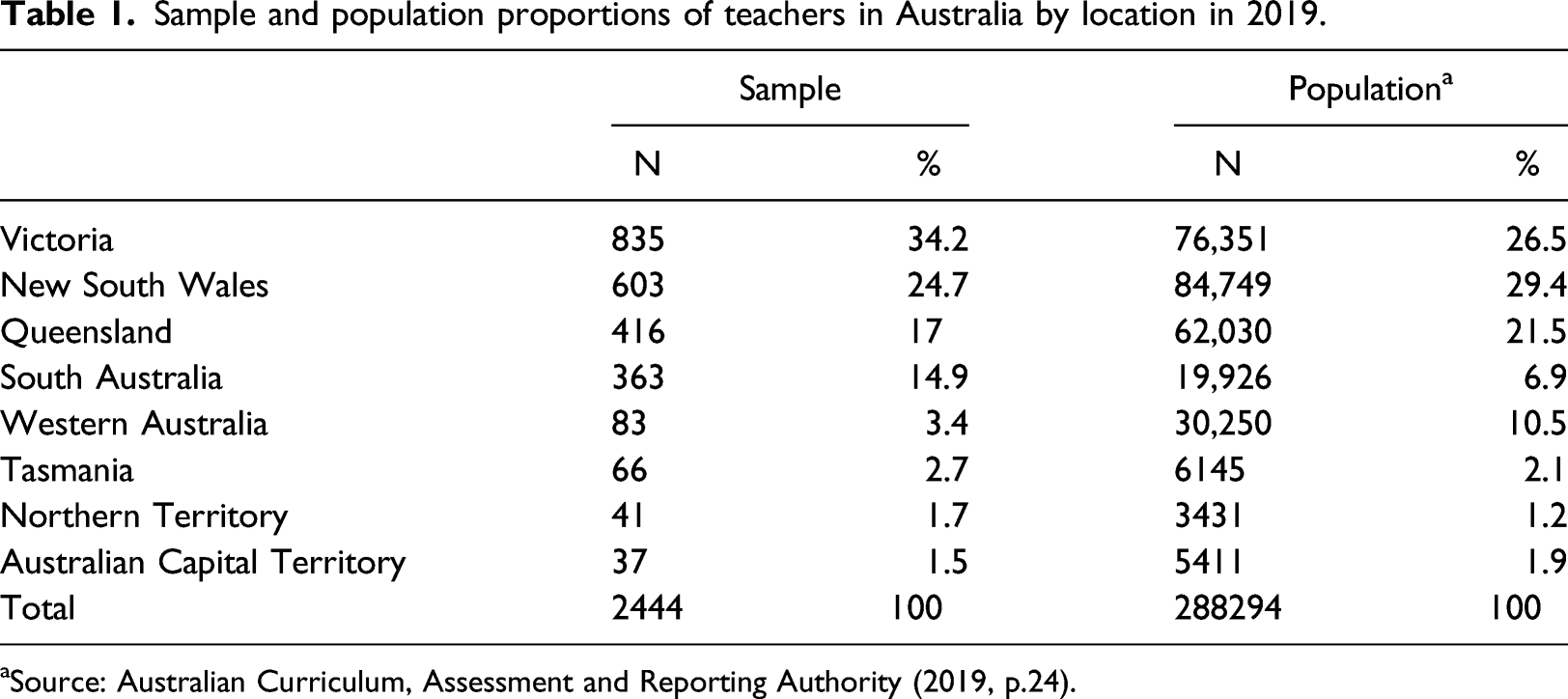
aSource: Australian Curriculum, Assessment and Reporting Authority (2019, p.24).
Respondents’ career phases and educational settings and sectors.
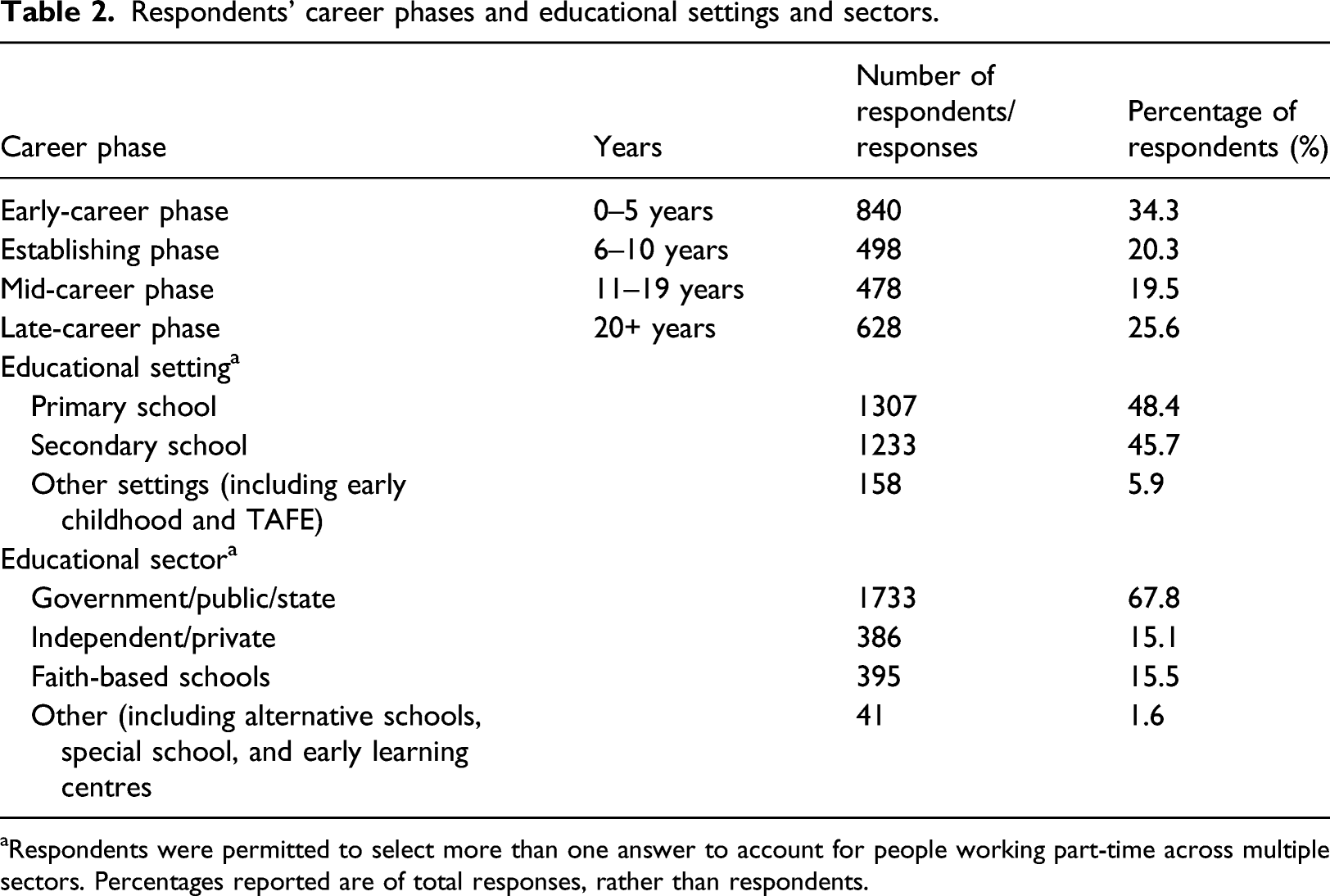
aRespondents were permitted to select more than one answer to account for people working part-time across multiple sectors. Percentages reported are of total responses, rather than respondents.
Intentions to remain in the profession.
Theoretical framework
We employ turnover theory to analyse the data within this paper. In particular, the Push, Pull, Mooring Theory provides a way of understanding the things that push employees from a role or profession (usually negative experiences), what pulls them into a new role (usually enticing them into better conditions or new opportunities) or the reasons employees stay – or are moored – in a role (Fu, 2011). This theory has been applied in a range of fields including hospitality and tourism (Choi & Park, 2020; Haldorai et al., 2019), but studies of push and pull factors have seen increasing interest in the field of education to understand turnover patterns in educators and administrators in schools and universities (e.g. Boyce & Bowers, 2016; Farley-Ripple et al., 2012; McKay, 2021).
We focus this paper particularly on the push factors: the reasons teachers cited as wanting to leave the profession. We also analysed the data through the mooring factors lens to understand the suggestions of practices, policies or strategies that respondents suggested might make them more willing or able to stay within their jobs.
Analysis
We undertook two deductive thematic analyses of the data (Braun & Clarke, 2006, 2019). The deductive thematic analysis required us to read and re-read the data in order to manually generate a shared understanding of overarching themes and patterns of meaning from within the data. Initial themes were generated by three individual coders who then negotiated and refined a final set of themes used to code the data. The main analysis reported within this paper was guided by deductively generated themes, specifically the reasons teachers cited for wanting to leave the profession (the push factors), after it became clear that a large proportion of respondents reported an intention to leave teaching. Respondents’ comments about possible solutions to these issues were examined through the mooring lens, identifying possible approaches, practices or solutions that might encourage teachers to stay. The following discussion is structured around these two lenses.
Results and discussion
In this discussion, we focus largely on the factors that pushed respondents to leave the profession, as described by respondents with a stated intention to leave their profession. We then move on to an analysis of possible mooring factors that might encourage retention, as expressed by all respondents. It is important to note that while we have separated key issues that recurred throughout the data, these were often cited in tandem. For example, heavy workloads were often noted in concert with the toll workloads were taking on health and wellbeing, or described in terms of frustration around perceptions of the core business or central purpose of teaching.
Push factors
The push factors nominated by the 1446 respondents who indicated that they intended to leave the teaching profession included overwhelming workloads, negative impact of the job on respondents’ health and wellbeing and a sense of a lack of appreciation or poor treatment of teachers and the wider profession. A number of other themes were generated in this analysis including frustration with the precarity of work, concerns about working conditions and finally a disillusionment regarding system priorities and practices alongside the rising complexity of teachers’ work and increased scope of teachers’ responsibilities. We have chosen to focus on the three most commonly recurring themes within the data and explore each of these in turn below.
Workload
Workload was the most commonly cited reason for intending to leave the profession. Among teachers who intended to leave the profession, 62% referred to workload pressures and their impact on health, wellbeing and other aspects of respondents’ non-working lives. Teachers routinely described their workload as ‘excessive’, ‘unrealistic’ and ‘unsustainable’. Respondents pointed to the intensification and extension of their work and the negative consequences of those changes over time, akin to issues raised by McGrath-Champ et al. (2018) and Stacey et al. (2020). Teachers pointed to the sheer quantity of work required of them, and the challenges of trying to fit the requirements of their work into a reasonable working day or week. For example, one respondent described intending to leave the profession because, ‘Workload pressure, particularly administration requirements and the expected amount of time I spend doing school things outside of direct teaching (co-curriculum hours, meetings, etc) seems to increase; however, the number of hours in a day is finite’.
In particular, teachers expressed frustration with ‘administrivia’ – what they saw as unnecessary or overburdening paperwork, administration and reporting. Reporting was seen as a mechanism for compliance and control of teachers, who expressed a lack of trust in their work. Supporting previous findings noted by McGrath-Champ et al. (2018), there were particular challenges for teachers who could not see a connection between the work they were being required to do, and student learning outcomes. The following comment indicates a sense of lost professional autonomy alongside increasing expectations for administrivia and reporting: Administrivia, just another data collection, just another form to complete, just another record of incident, just another job on top of an already very demanding workload. I arrive at school at 7:00 and very rarely leave before 5:30 but my work is never finished. I love the children and programming and implementing exciting, positive, challenging learning outcomes for all children is my delight but I cringe when yet another email comes into my inbox or senior staff present yet another data set to be collected. I know the children that I teach. I keep comprehensive anecdotal records but these are not the latest test, phonics assessment or peer classroom review which must be completed each month. Help, I am snowed under and must now leave the children and profession that I love because I ‘just’ cannot fill out another form. Having won teacher of the year I now feel inadequate along with most of my colleagues. Teaching is a calling but for too many it is a calling to loneliness and ill health in old age.
This loss of professional autonomy is a direct consequence of the standardisation and steering of educators’ work from a distance (Darling-Hammond, 2004; McGrath-Champ et al., 2018). Also reflecting on a perceived lack of connection was a respondent who noted that they remained in the profession because they still felt they could make a difference, indicating that motivations for entering the profession remain a key element of mitigating the negative effects of the role for some respondents: The workload and pressure to perform to standardised testing is unbearable. The pressures from management and the government in accountability […] and all the administrative jobs that we are required to do every day take away from the core of what we are meant to do, teach children. It’s getting harder every year for teachers and if I didn’t feel so passionate about making a difference to young people’s lives, I would have left the profession already.
This reflects findings from Ryan et al. (2017) which indicated that the pressures of standardised testing and high stakes accountabilities contribute to teacher attrition. These pressures, existing alongside intensified workloads (Kelchtermans, 2017), have direct consequences for teachers’ work–life balance. Indeed, similar themes were evident from respondents who reported a lack of opportunity to strike a work–life balance. Not only has work–life balance been shown to improve teachers’ performance (Johari et al., 2018), the lack thereof remained an important way for respondents to be able to describe the intensification and extension of their work, and the unsustainable workloads involved for many in teaching, ‘Workload is unsustainable and work–life balance is non-existent. The government continues to cut funding and our workload continues to increase while teaching quality decreases because of the sheer amount of non-teaching related admin that is required’.
Other respondents were explicit about the extension of their work into their personal time; one comment which exemplified the theme was from a respondent who said: ‘I am always working-at night, before school, on the weekends, during school holidays. It is not manageable long term, and there is too much pressure and stress involved in the career’.
The intensification and extension of work in and beyond education careers have been cited as having a significant impact on workers’ health and wellbeing. In addition to the sheer quantity of work, it is important to recognise that teaching is emotionally intense work, and that emotional labour has an impact on a teacher’s own health and wellbeing (e.g. Lee, 2019). A lack of time to rest and recuperate from intense and emotionally taxing work has serious consequences for teachers’ ability to remain within the profession and thrive.
Health and wellbeing
Ongoing concerns have been raised about the impact of teaching on the physical and mental health and wellbeing of educators. Issues relating to health and wellbeing, including relationships, exhaustion, stress and burnout, were mentioned by 21% of respondents who planned to leave the teaching profession. One respondent described the impact on their health and wellbeing thus: […] I am an extremely hardworking person, but excessive workload, constant emotional and mental fatigue plus a young family at home have all brought me crashing down this year […]. Even today I am on sick leave because I just can’t be fucked. How many people think that of a morning and then end up getting on with it anyway? I couldn’t. I can’t get out of bed and put on my teacher face and be responsible for 200 students every day. […] We are being knocked down one brick at a time and it’s taking its toll on me. Being actors all day long, suppressing emotions and not having any time to ourselves; as teachers, we are often lost.
Respondents frequently used the terms ‘stress’ and ‘burnout’ as part of their descriptions about why they intended to leave the profession, also referring to concerns about students’ health and wellbeing as an additional pressure. One respondent exemplified this theme when they said ‘[…] students' mental health and wellbeing adds to our concerns and sleepless nights. We worry about our young people’.
Importantly, even within the pool of respondents who indicated that they had no intention of leaving the profession, health, wellbeing and burnout were still recognised and nominated as significant challenges in their profession. Comments such as ‘I love teaching, but burnout is real and completely understated’ indicated a sense that the toll taken by teaching has not been fully recognised. Another respondent who did not intend to leave teaching commented that: The only reason I do not see myself leaving teaching is because I don’t know what else I can do with my skills and training. Teacher burnout is a real issue. My family suffered because of all the hours I work.
Role-family conflict is a commonly cited impact on teachers’ health, wellbeing and their sense of being able to do their job. Respondents described long working hours impeding on family time in comments such as: ‘Most of my planning happens over the weekend when I should be spending time with my family’. One respondent described the connection between workload pressures and the impact on their family: You work all day long, smiling, explaining and making decisions for you and the rest of your class with no time to go to the toilet or eat your lunch. Then when the bell goes you have got meetings left right and centre, but then you have to be home to feed your own kids and put them to bed. By the end of it, you have literally no strength to complete any of the work you've accumulated during that day (or week) so you put it off and go to bed yourself. Everything gets behind, students and parents ask where their assignments are and then the anxiety sets in. Instead of spending a nice weekend with your own family, you are sitting on your own for hours assessing the work your students did 3 weeks ago. If we were given more time through the week to actually complete our work, there would be fewer teachers like myself contemplating leaving the profession. It really is the best and worst thing I have ever done, but things seriously need to change.
There is a gendered element to these issues of role-family conflict that our data was not able to capture, and which should be considered in future research. Given that teaching is a profession dominated by women, and the gendered nature of family, care and responsibilities still primarily falls to women (Sullivan, 2015), there is an additional burden and sense of responsibility felt by many teachers when their work spills into their personal lives and family time. When analysing the data we noted that family was both a push factor and a pull factor. For example, some respondents wrote about leaving the profession to be able to raise a family in the future, with their phrasing or other responses indicating that this was a positive move for them, rather than a push factor. Others, however, described not being able to see a way to balance both work and family responsibilities, or not having the energy to continue to do both.
Status of the profession and under-appreciation of teachers
The final ‘push’ theme we explore in this paper is the impact of the perceived low status of the profession and associated treatment from school community members, the wider public, politicians and the media. As with the previous two themes, respondents made explicit connections between issues of workload, wellbeing and the way their work is perceived and discussed in the public discourse about education. We developed an understanding through our analysis of this data that many respondents described a sense of demoralisation due to these perceptions, which made the issues of workload and wellbeing more difficult to cope with.
Respondents commented frequently on negative media portrayals of teachers and schooling, and on negative discourses about teachers such as long holidays, light workloads, working 9 a.m. to 3 p.m., a lack of teacher quality and teachers being ineffective or out of touch (Shine, 2020). These were cited among others as having a negative effect on respondents’ experiences and their subsequent turnover intentions. Alongside those negative discourses was a sense that teachers’ professional expertise was undervalued and that policy did not reflect best practice. The following comment from one respondent exemplifies this theme: Having been both a classroom teacher and in leadership […I am…] struggling with parents who immediately assume that teachers are always in the wrong. The public perception of teaching is often extremely negative and the media portrayal of teachers and teaching as a profession, often leaves me feeling quite despondent about my chosen career. I feel very disheartened for those entering into the profession currently and in the future, as they will carry the burden of the current government’s lack of respect for what we really do within educational settings.
A lack of appreciation or respect for the profession was a recurring theme. Respondents referred to feeling undervalued, under-appreciated and disrespected by the ‘community, public and media’. The negative portrayal of teaching or schooling in Australia has been highlighted in previous research (Baroutsis & Lingard, 2017; Mockler, 2020; Shine, 2020) and holds direct consequences for the way members of the public, including students and parents/carers interact with schools and teachers (Baroutsis, 2019). There is also an important connection to be made between the devaluing of teacher expertise and professional autonomy, described earlier, and the sense of being under-appreciated and undervalued more broadly. It is important that the complexity of teaching as a profession is recognised as part of a shift in discourse, in an effort to raise the status of the profession. Importantly, our own research has shown that members of the public do trust and respect teachers, but this analysis emphasises that there is a clear disconnect between that sense of trust and the way teachers are experiencing their work (McKay et al., 2019). This echoes previous research that suggests ‘teachers’ estimations of their standing in society appear to be consistently more negative than their actual standing’ (Rice, 2005, p. 192).
We shift now into an exploration of the solutions proposed by respondents, beginning with an analysis of this issue of public discourse and respect for the teaching profession and for schooling more broadly.
Possible mooring solutions
To structure our analysis of the possible solutions or approaches that might address the challenges raised in this study and moor teachers in the profession, we have elected to separate this section into two of the same themes that recurred most strongly throughout our analysis of the push factors: workload and status of the profession. We note at the outset that these mooring factors are drawn from the data and developed in response to the push factors identified by respondents. We recognise that there is a long history of policy being done to teachers rather than developed with teachers’ voices at the centre of decisions and development (Lingard et al., 2002). Other research has shown that teachers are frequently positioned as being at the bottom of the policymaking hierarchy (Ellison et al., 2018). As such, teacher expertise and voice are at the centre of the development of these strategies. Rather than imposing external ideas of what might work to support teachers, we advocate in this section for teacher-identified solutions to the looming retention crisis.
Meaningful reduction in workload
Through analysing the data, it became evident that respondents were making suggestions that were ultimately aimed towards reducing workload, even when this was not explicitly described as the purpose. Suggestions included ‘decluttering’ the curriculum, reducing class sizes, returning a focus on ‘the basics’, clarifying the role of a teacher and reducing the social and support services that have been subsumed into the work of schools over time. There were clear connections between these suggestions and the challenges that had been raised. For example, a connection can be made between respondents’ comments about feeling overwhelmed by the quantity of marking, reporting, assessment and differentiating for complex classrooms, and their suggested solutions of smaller class sizes. The suggestion that those elements that are currently overwhelming teachers (planning, marking, reporting, assessment, differentiation and paperwork associated with teaching accountabilities among others) would be more manageable if they were responsible for fewer students is a logical argument. However, this is unlikely to be addressed at a systemic scale. More likely to make a difference is reducing the tangential tasks related to the surveillance and monitoring of teaching and learning. These extraneous tasks, frequently referred to as ‘administrivia’ by respondents, have previously been described as threatening teachers’ capacity to focus on student learning (McGrath-Champ et al., 2018).
Comments from respondents about ‘decluttering’ the curriculum and clarifying the role of a teacher were analysed as having similar goals of re-focussing teachers’ work. Specific references were made to removing requirements to teach highly prescriptive curricula or assessment practices, and enabling teachers to get back to ‘what really matters’. These comments from teachers clearly align with previous research and recommendations about supporting teachers to reclaim their professional autonomy over their teaching and learning practices (e.g. Reid, 2019), and that they would have a positive ‘mooring’ effect on members of the profession.
Status of the profession: Trusting and respecting teachers
Alongside a meaningful reduction in workload, the other major factor that could potentially influence respondents’ decisions to not leave the profession would be an increased understanding or awareness of the complexity of teachers’ work, and a subsequent shift in the way schools are perceived and teachers are treated by the wider public, including students, parents/carers and in the public discourse. This is reflective of research which has shown significant concerns from within the teaching profession regarding status and perceptions of their work (Shine, 2020). One respondent noted: The public perception challenge is more difficult and results from a combination of factors, including past engagement with the system and deep-seated beliefs […] about the value and role of education; these require ongoing engagement and education about the complexity of teaching which many people are unwilling to do.
A number of respondents specifically suggested a campaign to raise the status of the teaching profession, noting the connection between status, satisfaction and the way teachers are perceived and treated by the wider public, (including the media and politicians, who were both specifically noted as contributing to negative perceptions and discourses of the profession). Excerpts from responses emphasise the need for a shift in narrative and portrayal of the profession. One respondent noted: ‘Society needs to change student attitudes to teachers. How can students respect us properly when politicians and parents are constantly badmouthing the profession?’
The media portrayal of teachers was a common refrain in these qualitative comments, with another respondent commenting that ‘[t]he media need to pay their part in lifting the respect levels towards teachers. The number of negative stories compared to positive is exponentially higher’. Other respondents reflected on a sense of being under-appreciated and untrusted, noting that ‘[t]eachers are unappreciated from both parents, school leadership and the department. There is no trust in us to do our job anymore!’ Reflections on trust were interwoven with a sense of a lack of respect for the profession more widely, with the following comment representative of a theme of respect: ‘[t]eachers are absolutely copping it at the moment. There is minimal respect from the broader community for what we do’.
While we are not suggesting that raised awareness about the complexity of teaching, or a raised status of the profession, would alone be sufficient to reduce turnover, it could mitigate against some of the issues of stress and burnout in a number of ways. First, it could provoke a shift in the ways people interact with schools and teachers – raised respect and awareness of the work being done by teachers could correlate with more positive interactions and understanding between teachers and students, parents/carers or the wider community (c.f. Baroutsis, 2019). Raised awareness of the demands and responsibilities of teaching has previously been cited as a way to raise the status of the profession (Hargreaves et al., 2007). Second, the issues raised as push factors could potentially be reduced in scale and impact if teachers feel that their work is appreciated and that the workload and emotional intensity of their work is being recognised (in contrast to current suggestions that this is invisible work or work that is not appreciated). Indeed, Hargreaves et al. (2007) found in their study of teachers in England that teachers gained a sense of positive status when they felt trusted and appreciated by colleagues and parents/carers.
We are not suggesting that raised appreciation for the ‘unsustainable’, ‘untenable’ or ‘unbearable’ workloads described by respondents would be sufficient on its own to improve teacher satisfaction and retention. Rather, a more positive portrayal of the profession
Conclusion
This study has provided important insights into the elements of the teaching profession, and schooling in Australia more broadly, that are influencing teachers’ intentions to leave. Given our established understanding of the impacts of teacher turnover, and the economic, social, and opportunity costs associated with prematurely losing teachers from the profession, the paper’s contribution of identifying key areas of discontent for teachers provides critical areas for policy, practice and further research to target. The mooring factors suggested within the findings, drawn from teachers’ suggestions about how to address the most pressing challenges they face, provide a starting point for potential action from systems, researchers and other stakeholders.
There is scope for future research to focus on the reasons teachers move within systems or between schools. Turnover of teachers who remain within the profession still has an impact on student outcomes and is an area where future research could provide nuanced perspectives into the reasons or motivations for these moves. Future research should also investigate the noted increase in pace and scope of concerns about teacher burnout given the immense pressures faced by teachers during the COVID-19 pandemic, with many teachers reporting exhaustion, fatigue and disillusionment with a system that appeared, to many, to treat them as frontline workers in ways they had not signed up for (Beames et al., 2021).
This study contributes qualitative insights that complement the quantitative work that has been done in the past, and contributes to a growing body of research into this important topic. Importantly, the scale of the responses here provides insights into wider important trends that could potentially impact on teacher retention in Australia. Addressing these push and mooring issues in particular will have important consequences for policy and practice and potentially contribute to the strengthening of Australia’s teaching workforce, as well as to improving conditions and experiences for Australian teachers.
Footnotes
Declaration of conflicting interests
The author(s) declared no potential conflicts of interest with respect to the research, authorship, and/or publication of this article.
Funding
The author(s) received no financial support for the research, authorship, and/or publication of this article.

Appendix
Questionnaire items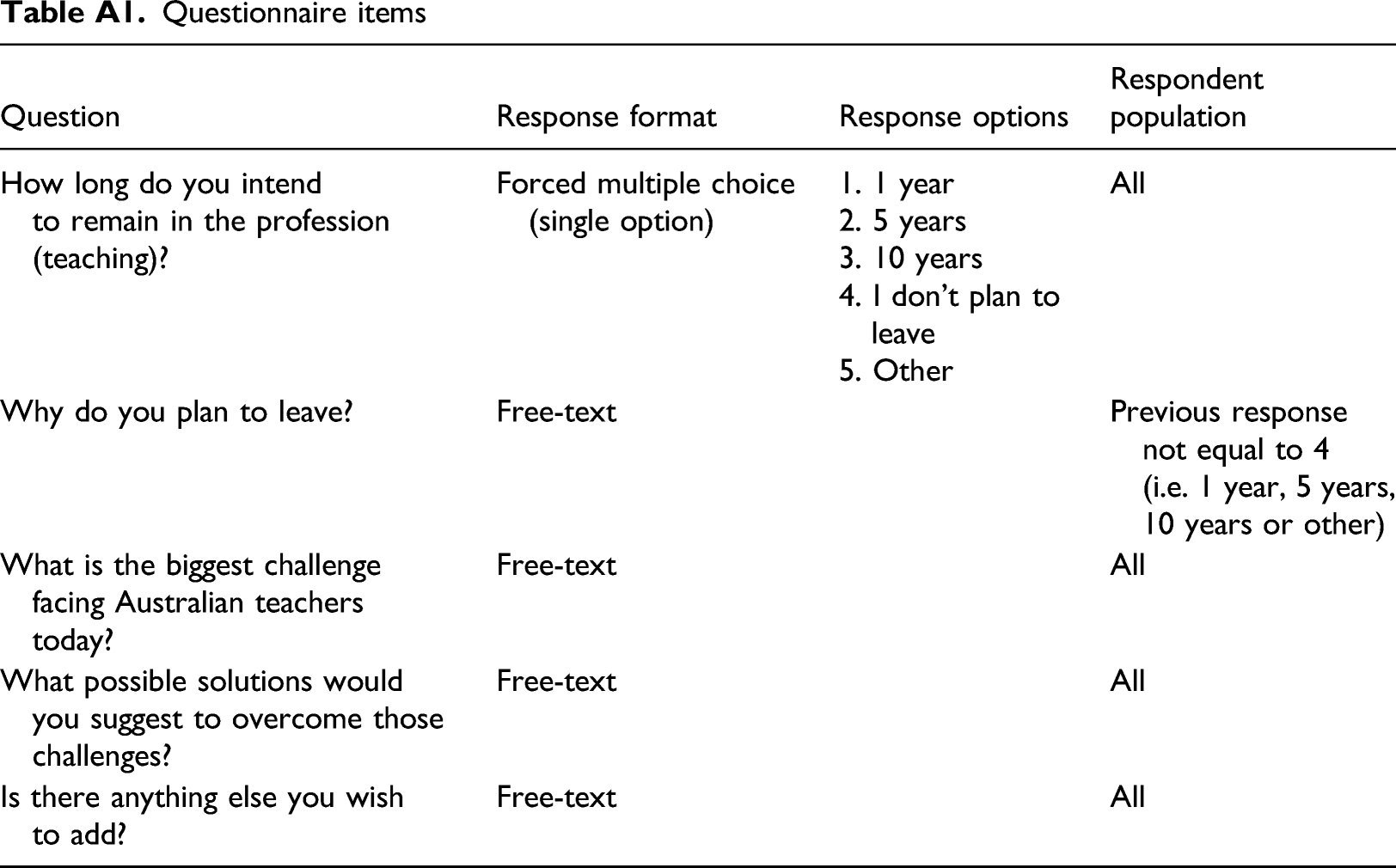
Question
Response format
Response options
Respondent population
How long do you intend to remain in the profession (teaching)?
Forced multiple choice (single option)
1. 1 year
All
2. 5 years
3. 10 years
4. I don’t plan to leave
5. Other
Why do you plan to leave?
Free-text
Previous response not equal to 4 (i.e. 1 year, 5 years, 10 years or other)
What is the biggest challenge facing Australian teachers today?
Free-text
All
What possible solutions would you suggest to overcome those challenges?
Free-text
All
Is there anything else you wish to add?
Free-text
All