




Abstract
This article aims to contribute new, longitudinal evidence on teacher self-efficacy (TSE) by investigating changes in TSE over the last 2 years of an Australian initial teacher education program. Two hundred and one pre-service teachers were surveyed at three timepoints: (1) after the first professional experience placement, (2) before and (3) after the final placement, using the Scale for Teacher Self-Efficacy. Data were analysed using multilevel modelling. TSE for the domains of classroom management and student engagement decreased significantly between the first and before the commencement of the last professional experience placements. All three dimensions of TSE – instructional strategies, student engagement and classroom management – increased significantly during the final placement.
Keywords
Introduction
Teacher self-efficacy (TSE) describes how teachers perceive their capability to achieve goals in daily teaching and much research has been conducted around this construct. TSE can influence teachers’ behaviour. Highly self-efficacious teachers have stronger intentions to apply innovative instruction methods, such as collaborative learning and integrating technology into teaching (Perkmen & Caracuel, 2016). High TSE is also associated with teachers’ positive emotions, such as feelings of joy, whereas low TSE is associated with anger and anxiety (Hagenauer et al., 2015). Among pre-service teachers (PSTs), TSE influences their motivation to complete initial teacher education programs (ITEPs) and their commitment to the teaching profession (Chesnut & Burley, 2015). TSE can fluctuate, especially during the initial phases of the teaching career, including the pre-service stage, after which it tends to stabilise (Klassen & Durksen, 2014).
Professional experience placements are known to be a particularly stressful component of ITEPs and one of the periods during which TSE is most likely to change (Fitchett et al., 2018). During the last two decades, little longitudinal research on changes in TSE has been conducted, particularly involving three or more repeated observations (Thomson et al., 2019). This study, which was conducted as one part of a larger research project, assesses the changes in pre-service TSE in relation to coursework and professional experience placements among teaching students in the final 2 years of their initial teacher education program.
Theoretical foundation
Self-efficacy is not a unidimensional construct and its development is uneven (Bandura, 2019). For example, individuals may feel efficacious in one daily activity but not in another; at a finer grained level of an activity an individual might feel certainty about completing certain elements while simultaneously feeling anxious about completing other skills required for the same activity. Furthermore, varying levels of self-efficacy for different elements might affect the general evaluation of one’s capability to accomplish the whole task (Perera et al., 2019). For this reason, self-efficacy can be measured in various domains reflecting our beliefs about our capability in different areas of our lives. Self-efficacy has also been regarded as not static but relatively more malleable and changeable in its initial developing stages. It becomes resistant to change once established; although change is still possible, it requires extra effort (Bandura, 1997).
According to social-cognitive theory, change in self-efficacy occurs because human beings evaluate their capability based on information from four main sources: mastery experiences, vicarious experiences, verbal persuasion and physiological/affective states (Bandura, 1997). These sources operate interactively, according to Bandura (1997), and provide information to support the self-efficacy of the individual. The role of professional experiences or practicums in ITEP functions as a source of the developing self-efficacy in all four forms or sources, with mastery experience being particularly relevant as a source of pre-service TSE. These professional experiences provide the opportunity to experience successes or failures in various activities or domains of the teacher’s work and these mastery experiences are believed to provide the most reliable information about one’s ability to perform a task (Bandura, 1997). Thus, the investigation of the professional experience as a source of self-efficacy provides insight into the development of pre-service TSE through positive and successful professional experiences (Klassen & Durksen, 2014).
Pre-service teacher self-efficacy: Changes during professional experience placements
Results from previous research focussing on changes in TSE during professional experience placements have been inconsistent. In some studies, pre-service TSE was found to diminish as participants gained more exposure to classroom teaching contexts, purportedly caused by the mismatch between PSTs’ unrealistically optimistic expectations about their ability and the challenging reality of teaching (Winters, 2012). A significant decrease in TSE was also found during placement periods preceding the formal practice when PSTs were observing teachers and had fewer teaching responsibilities, as well as in later periods when the PSTs’ teaching responsibilities were increased (Yüksel, 2014).
Other researchers (Han et al., 2017) found a gradual growth in TSE during the professional experience, reporting that TSE reached the highest level at the end of the placement, possibly due to the accumulation of teaching experience (or sense of mastery). These findings, however, may have been biased due to the small sample of 55 (out of the original 156) PSTs who completed both pre- and post-measurements. Klassen and Durksen (2014) reported that having more experience in dealing with teaching challenges, including disruptions and difficulties in classrooms, during the final placement contributed to higher TSE. However, this study did not provide information on changes of pre-service TSE in the initial or earliest stages of ITEPs. The study also employed a three-item measure of TSE based on the Teachers’ Sense of Efficacy Scale (TSES; Tschannen-Moran & Woolfolk Hoy, 2001) and treated TSE as a unidimensional construct.
Other researchers (e.g. Knobloch, 2006) have reported no change in the TSE of PSTs during their professional experience placement. Knobloch (2006) considered two possibilities for these results – first, that the levels of TSE formed during the ITEP may have recovered from an unobserved drop after exposure to challenges during the initial period of the placemen; second, that high levels of TSE were retained over the ITEP because of the protective practice environment. Meichtry and Smith (2007) also did not find any significant changes in their study of professional placements. The authors suggested that the duration of teaching practice was too short and not able to provide PSTs with sufficient opportunities to reflect on their teaching ability. As such, the practicum experience, as a potential source of self-efficacy, was not given time to integrate into the PSTs’ sense of self.
Pre-service teacher self-efficacy: Changes during coursework experiences
Although the professional placement provides opportunities for mastery experiences and vicarious experiences, these placements form only a fraction of time spent in pre-service teacher education. The potential influence of coursework activities and experiences on the self-efficacy of PSTs has also been investigated and changes to TSE levels during coursework were noted. The design of ITEP appears to influence the development of pre-service TSE during these courses. Cheong (2010) examined the effects of a teaching method course using virtual reality practicum experiences. PSTs in the course were divided into two groups, one of which comprised PSTs who worked collaboratively and the other comprised PSTs who worked individually. TSE scores of participants in the collaborative group increased, on average, while there was no significant change in the average TSE of participants who worked as individuals. The author suggested the vicarious modelling experiences in the collaborative group were important for the TSE increases. Palmer (2006) found that high TSE after completing a science teaching method course was retained for approximately 9 months. This was attributed to the relevance of the content to school contexts and the inclusion of hands-on activities. In contrast, Charalambous et al. (2009) investigated the effect of two semester-long courses on the history of the teaching subject (specifically, mathematics). No changes in TSE were found in this cohort, leading the authors to suggest that the content of the course content was less applicable to the teaching context and thus less influential on TSE. The opportunity to develop a sense of mastery or experience vicarious modelling may be particularly important for the development of TSE through coursework experiences.
Woolfolk Hoy and Burke Spero found in their 2005 study that PSTs tended to have high levels of TSE during theoretical courses, especially before taking any practice placement, but that levels of TSE decreased after practical placement. Transfer from theoretical courses into professional practice is not always associated with a decrease in TSE, however, particularly when these courses featured constructive pedagogy, field observations and opportunities to practise teaching (e.g. Utley et al., 2005). Examining PSTs who transitioned from a methods course to a practice teaching placement, Utley et al. (2005) found pre-service TSE increased during the methods course and did not significantly decrease by the end of the professional practice placement. The method course was integrated with practical elements, such as tutoring and teaching experiences. Similarly, Deehan et al. (2017) investigated the durability of TSE developed through a two-session science teaching method course, scheduled in the first 2 years of a 4-year ITEP, which included in-class teaching exercises and inquiry learning. They found that initial levels of TSE were retained and increased even after the completion of their placement at the end of their program.
A lack of a connection between the theoretical content of ITEPs and relevant mastery building experiences appears to be particularly prohibiting for the development of pre-service TSE. O’Neill (2016) studied TSE changes through an elective 10-week course with a specific focus on managing behaviours in regular classroom contexts. The course included a 3-week placement in inclusive classes (i.e. containing students both with and without special needs) held after the first 7 weeks of the course. No significant changes in TSE were recorded during the professional practice placement, although moderate growth in TSE was observed at the end of the course. O’Neil suggested that the disparity between the course content and practicum context failed to improve the pre-service TSE. The small sample size of this study (n = 20), however, must also be considered when interpreting the findings.
Dimensionality of measures of self-efficacy in pre-service teacher studies
Many of the published studies treat TSE in pre-service teachers as a unidimensional construct and so are unable to provide information on self-efficacy in specific subdomains of teaching. Other research that has investigated TSE based on a three-dimensional construct according to the Teachers’ Sense of Efficacy Scale (TSES; Tschannen-Moran & Woolfolk Hoy, 2001) may be problematic given that the three-factor structure of the TSES has not been validated with pre-service teachers (Fives & Buehl, 2009).
Consequently, Pfitzner-Eden et al. (2014) adapted the TSES to assess pre-service TSE, developing the Scale for Teacher Self-efficacy (STSE). The STSE was found to have a three-dimensional structure: instructional strategies, student engagement and classroom management.
Research gaps and the present study
It is notable that the reviewed studies show that pre-service TSE varies as a result of different experiences in the initial teacher education programs. Most studies investigated TSE changes occurring after a single practice placement or a specific period of course work. Few studies have investigated TSE changes across multiple courses within ITEPs, such as subjects covering educational theories and pedagogies and/or professional experience placements such as those occurring during the completion of a teaching qualification. The present study uses the STSE (Pfitzner-Eden et al., 2014) to investigate the research question, namely, how does teacher self-efficacy change across the period encompassing the first and final professional experience placements?
Method
Participants
The participants were 201 PSTs enrolled in either primary or secondary ITEPs at a university in Sydney, Australia. Ethics approval to conduct the study was obtained from the Human Research Ethics Committee at the relevant university and all participants provided informed consent. At the start of the study, all PSTs were in the third year of a 4-year undergraduate bachelor degree or the first year of a 2-year graduate degree. All participants had completed the relevant discipline-specific study and had completed a short, ‘micro-teaching experience’ (delivering a lesson in tutorial classes upon which they received feedback from their tutors and peers) and their first 20-day supervised professional practice experience. During this professional practice experience, PSTs were expected to apply the principles of classroom management and student assessment that they learned from coursework into their teaching practice under the supervision of an experienced school teacher. The final placement was scheduled at the end of the final year of their degrees and lasted for 30 or 20 days, for undergraduate and graduate-entry PSTs, respectively.
Contextual questionnaire
Demographic information was collected including participants’ gender, level of teaching focus (primary or secondary), degree that they were enrolled in (undergraduate or graduate degree), cultural background, informal teaching experiences and prior occupations. The postcode where they completed the majority of their school education was used as an indication of their socioeconomic status (SES), coded according to the Socio Economic Index for Areas (SEIFA) Index of Relative Social-Economic Disadvantage (IRSAD) (Australian Bureau of Statistics, 2011).
TSE was assessed with the STSE (Pfitzner-Eden et al., 2014). The STSE has been validated with PSTs in Germany and New Zealand across two different ITEPs, demonstrating a stable three-factor structure for PSTs who were in the first year and at least the third years of their ITEPs (which was of four to 5 years’ duration). There are 12 items in the STSE, with four items each related to three domains: instructional strategies (e.g. adjust lessons to the proper level for individual students), classroom management (e.g. control disruptive behaviour in the classroom) and student engagement (e.g. help students value learning). A nine-point response scale is used, with (1) being labelled as ‘Not at all certain can do’ and (9) being labelled as ‘Absolutely certain can do’. The sum of the four items within each domain is averaged to create the score for each domain. The STSE demonstrated satisfactory internal consistency in the present study at each of the timepoints of the repeated measures – instructional strategies (α = 0.82, 0.80 and 0.79), classroom management (α = 0.86, 0.88 and 0.88) and student engagement (α = 0.79, 0.81 and 0.77).
PSTs completed a paper version of the questionnaire in their tutorials or were sent an electronic version if they had not attended on-campus tutorials. The questionnaire was sent at three timepoints, namely, after the first professional experience placement, before the final placement, and after the final placement. Paper and electronic versions were sent at approximately the same time for each time point.
Analysis
Analysis was conducted by using listwise deletion when the latter two observations of TSE were both missing. Bias was assessed by comparing those who submitted questionnaires at all three timepoints (included in analysis) with those who did not participate at all timepoints but who did submit some responses (excluded from analysis). Separate sets of comparisons were made using the available demographic information and scores on the three TSE subdomains.
To examine TSE change, a four-step procedure of multilevel modelling was applied to analyse the data in SPSS (see Heck et al., 2013). A null model was fit first to explore whether multilevel modelling was warranted. Because the intraclass correlation coefficient (ICC) was significant, a random intercept was included in subsequent analysis.
Model 1 is a random intercept, fixed slope growth model with the growth term split into two parameters representing the average growth from Time 1 to Time 3, and Time 2 to Time 3. 1
Level 2


Level 1 (substituting level 2 into level 1)

Here,
Model 2 is a random intercept, fixed slope random effects model with one change: fixed effect predictors are added to the intercept term.
Level 2


Level 1 (substituting level 2 into level 1)

Models 1 and 2 use the scaled identity matrix which assumes constant (residual) variance across timepoints with no covariance between the (residual) covariance. In Model 3, the covariance assumptions of level 1 residual correlation were adjusted by applying a first-order autoregressive assumption, as indicated by Shek and Ma (2011). It assumes unit variances and estimates covariances for the level 1 residual variance-covariance matrix. The benefit of such an approach is that the magnitude of the residual covariances is allowed to be smaller for less temporal-related (more distant or spaced-out) repeated observations.
Both Akaike’s information criterion (AIC) and −2 times log-likelihood [-2LL] were employed to indicate the model fit. AIC is derived from the likelihood and is penalised for the number of parameters estimated. It is robust with the small sample size (Dziak et al., 2019) and a smaller value of the indicator, for example, Δ ≥ 6 as suggested by Harrison and colleagues (2018), refers to a better model fit. -2LL was calculated as the models for each subdomain were nested sequentially. Smaller values of -2LL indicate a better fit and the significance of improvements (Δ -2LL) were tested based on the chi-square distribution with degrees of freedom equal to the additional parameters estimated (Field, 2013; Heck et al., 2013). Results are reported based on the best-fit model.
Results
Participant retention and representativeness
A total of 201 participants returned questionnaires at Time 1. Of these participants, 180 (89.5%) returned questionnaires at Time 2, resulting in attrition of 21 (10.4%). At Time 3, 131 (65.2%) questionnaires were returned. This process resulted in 191 participants (95%) who completed the questionnaires at Time 1 and either Time 2 (n = 180) or Time 3 (n = 131), among whom 120 (59.7%) completed the questionnaire at all three timepoints.
No statistically significant differences were found in demographic variables or any of the three TSE subdomains at Time 1 between the 81 participants who did not reply to all questionnaires and the 120 who returned all questionnaires: gender, χ2(1, N = 201) = 3.50, p = .061; level of teaching, χ2(1, N = 201) = 0.43, p = .511; degree in which they were enrolled, χ2(1, N = 201) = 0.26, p = .612; cultural background, χ2(1, N = 201) = 0.52, p = .472; informal teaching experience, χ2(1, N = 201) = 2.42, p = .12; prior occupation, χ2(1, N = 201) = 0.01, p = .918; socioeconomic status, χ2(1, N = 176) = 0.71, p = .14. Nor were there any significant differences in TSE subdomains for participants with full data and those with missing data: TSE in instructional strategies t(199) = 0.63, p = .532; TSE in classroom management t(199) = 0.33, p = .74; and TSE in student engagement t(199) = 0.27, p = .789.
The same independent sample t-tests were applied to Time 2 and 3 data, with nonsignificant results examined between a sample of 120 participants who replied to all questionnaires and those who participated at either Time 2 or Time 3 but not all three time points. Therefore, data from the 191 participants who completed questionnaires on at least two of the three time points were included in the final analysis.
Descriptive findings
Among the 191 participants whose data were included for the final analyses, most (n = 151, 78%) were female and were studying for a 4-year bachelor’s degree (n = 179, 93.3%). There were 101 (52.9%) primary and 90 (47.1%) secondary PSTs. There were 161 (85.9%) PSTs were from the Oceania region, 173 (85.8%) were born in Australia, and 153 (75.7%) reported they used English as the only language for communication at home. A majority (n = 157, 82.2%) reported that they had prior informal teaching experience. Thirty-four (17.8%) participants had a formal occupation before enrolling in their ITEPs. Most (n = 134, 70.2%) reported a postcode which indicated they lived within regions classified as the upper half of socioeconomic status as classified by the Australian Bureau of Statistics (2011). PSTs studying a secondary education degree were majoring in history (n = 23, 25.6%), languages other than English (n = 20, 22.2%), mathematics (n = 13, 14.4%), science (n = 18, 20%) and social sciences (n = 18, 20%).
Description of Sum, Mean, Skewness, Kurtosis and Correlation of measures at three timepoints.
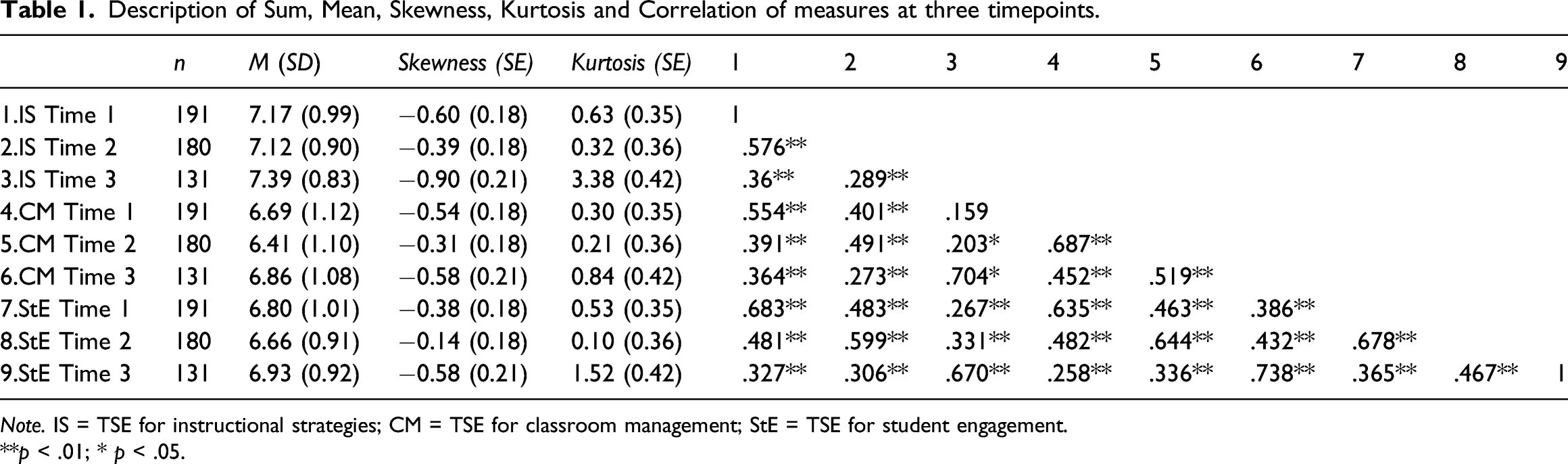
Note. IS = TSE for instructional strategies; CM = TSE for classroom management; StE = TSE for student engagement.
**p < .01; * p < .05.
Pre-service teacher self-efficacy trajectories across three timepoints
The model fits of TSE for classroom management and student engagement improved significantly for Model 3 relative to Models 2 and 1. Improvements between Model 3 and Model 2 for TSE for instructional strategies were nonsignificant (e.g. Δ AIC < 6; Δ -2LL < 3.84, df = 1, p > 0.05). Despite the nonsignificant improvements in Model 3 for TSE for instructional strategies, all results are reported based on Model 3 for all TSE subdomains for two reasons. One is to report results consistently and the other is the results in the last two models of TSE for instructional strategies were almost identical.
Model parameters and goodness of fit for multilevel modelling of TSE for instruction strategies.
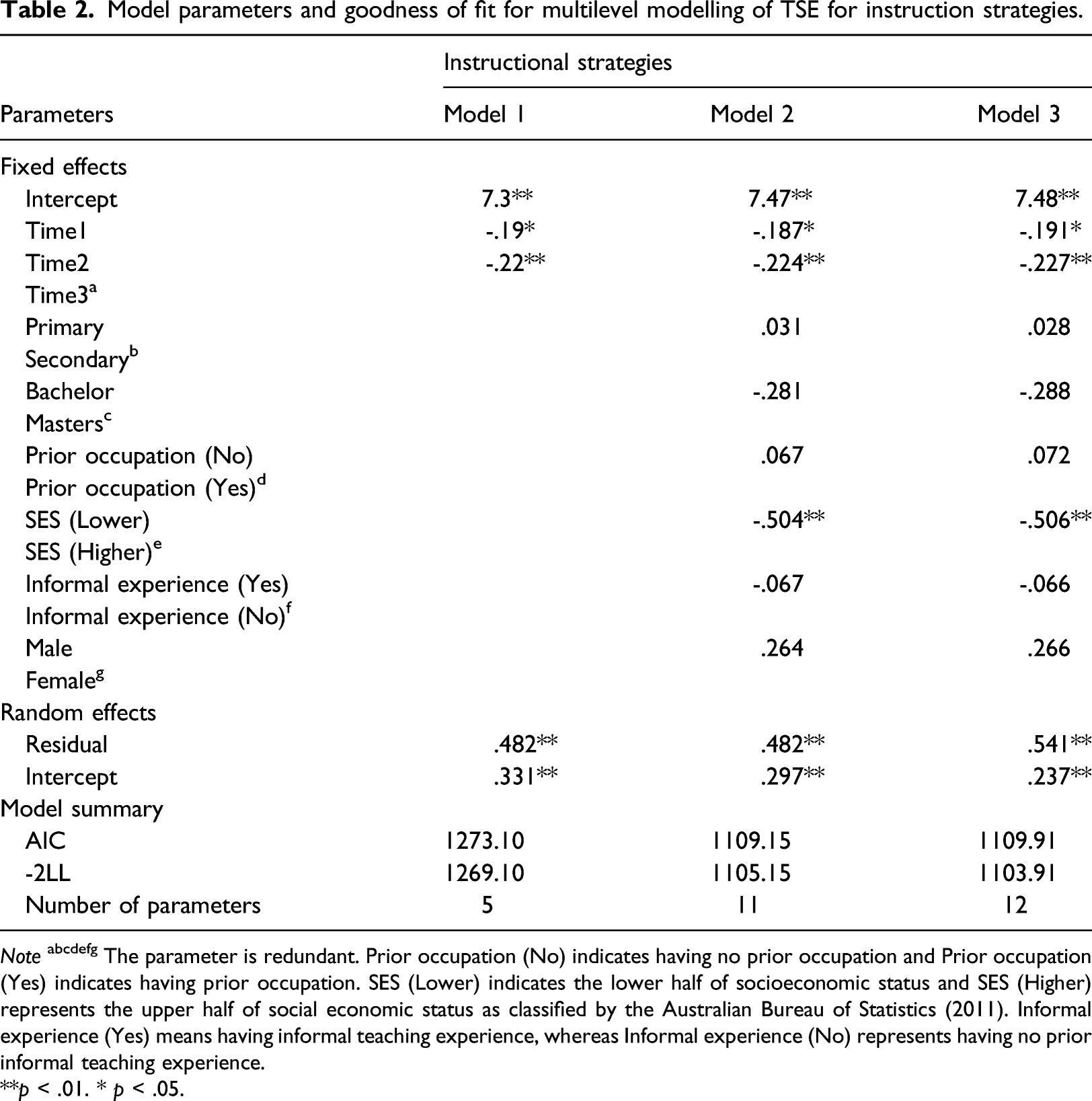
Note abcdefg The parameter is redundant. Prior occupation (No) indicates having no prior occupation and Prior occupation (Yes) indicates having prior occupation. SES (Lower) indicates the lower half of socioeconomic status and SES (Higher) represents the upper half of social economic status as classified by the Australian Bureau of Statistics (2011). Informal experience (Yes) means having informal teaching experience, whereas Informal experience (No) represents having no prior informal teaching experience.
**p < .01. * p < .05.
Model parameters and goodness of fit for multilevel modelling of TSE for classroom management.
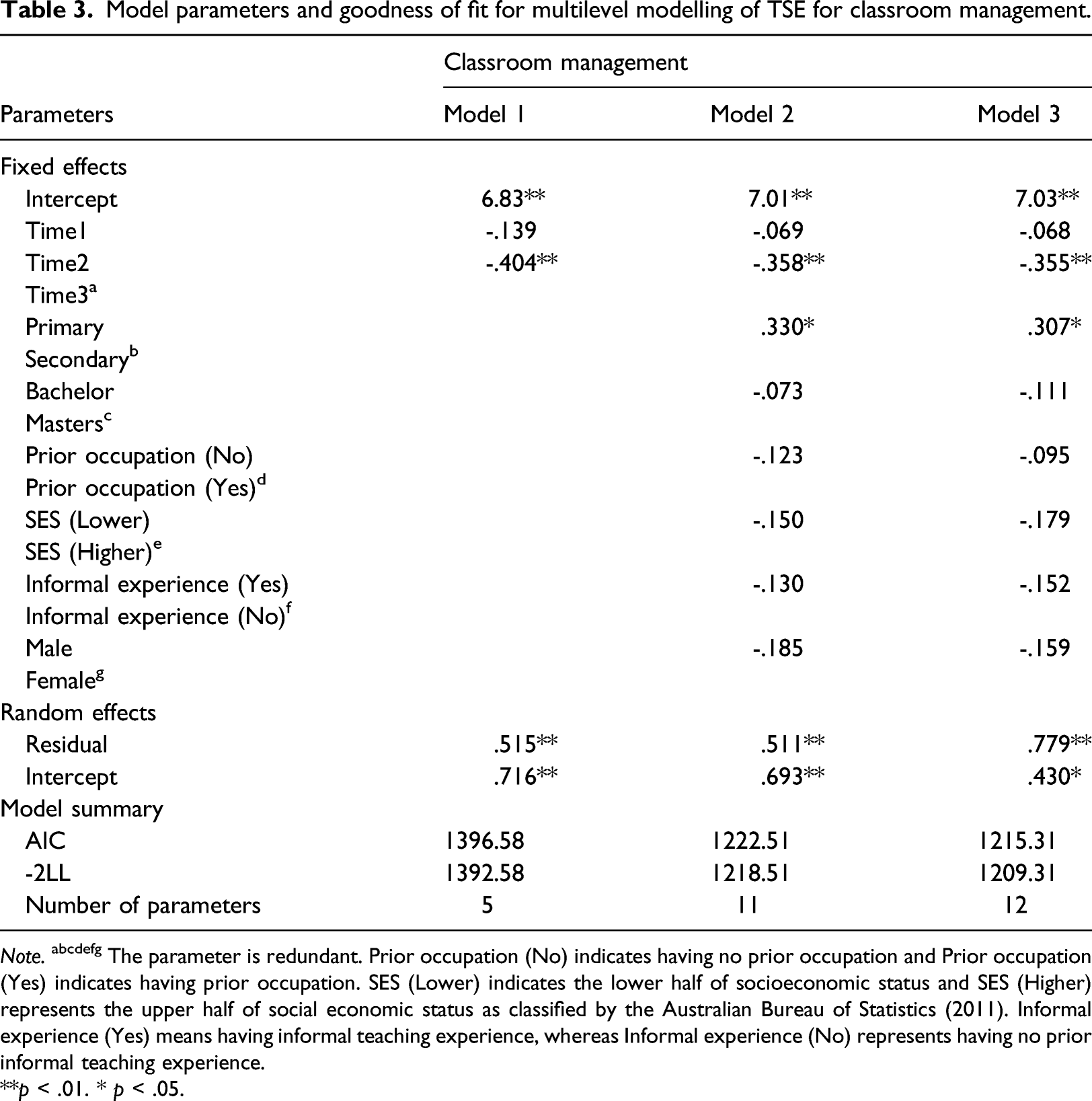
Note. abcdefg The parameter is redundant. Prior occupation (No) indicates having no prior occupation and Prior occupation (Yes) indicates having prior occupation. SES (Lower) indicates the lower half of socioeconomic status and SES (Higher) represents the upper half of social economic status as classified by the Australian Bureau of Statistics (2011). Informal experience (Yes) means having informal teaching experience, whereas Informal experience (No) represents having no prior informal teaching experience.
**p < .01. * p < .05.
Model parameters and goodness of fit for multilevel modelling of TSE for student engagement.
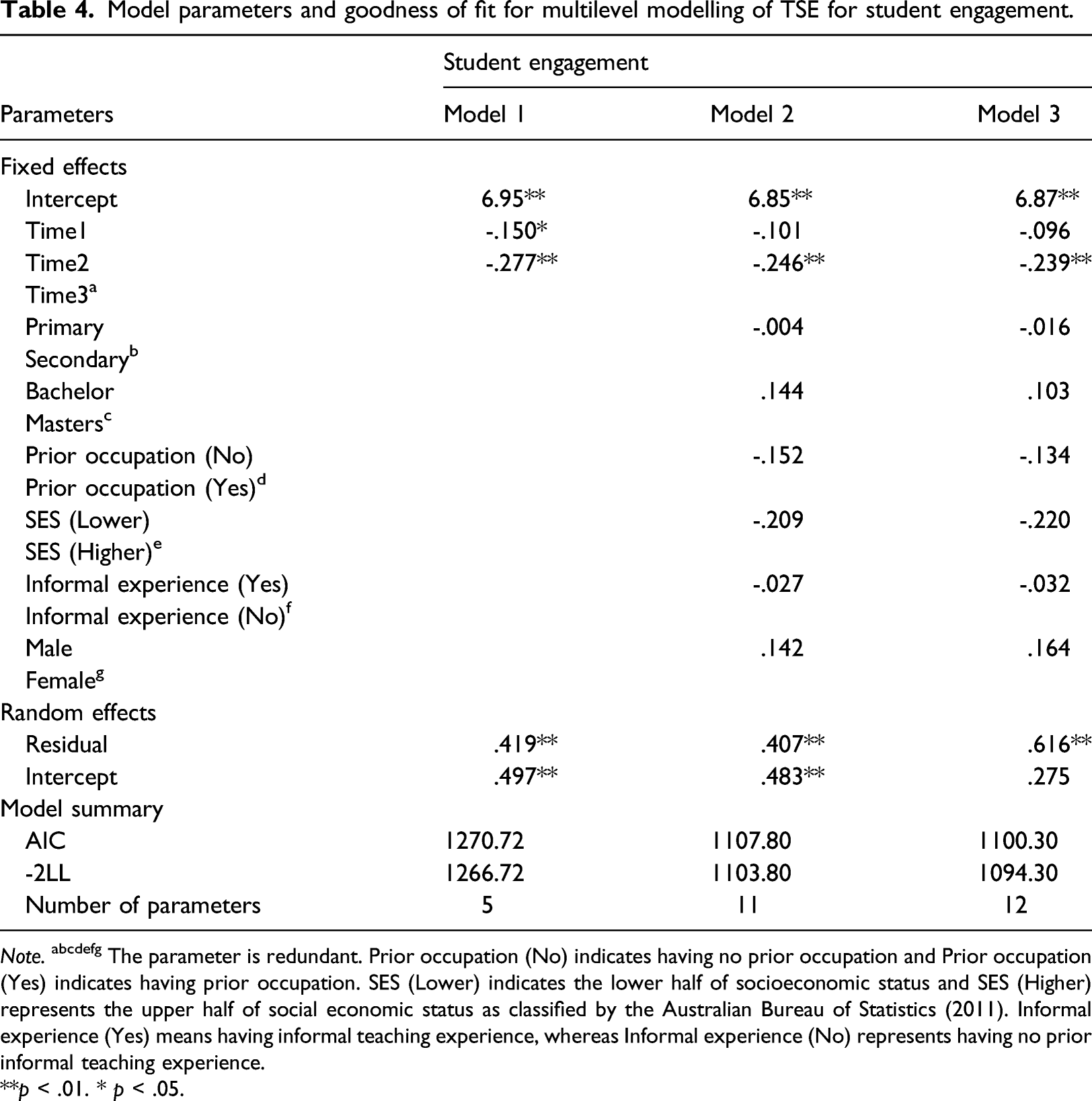
Note. abcdefg The parameter is redundant. Prior occupation (No) indicates having no prior occupation and Prior occupation (Yes) indicates having prior occupation. SES (Lower) indicates the lower half of socioeconomic status and SES (Higher) represents the upper half of social economic status as classified by the Australian Bureau of Statistics (2011). Informal experience (Yes) means having informal teaching experience, whereas Informal experience (No) represents having no prior informal teaching experience.
**p < .01. * p < .05.
The patterns of TSE change in all three subdomains are depicted in Figure 1. Trajectories of TSE for Three Subdomains Across Three Timepoints. Note: Error bars represent standard errors.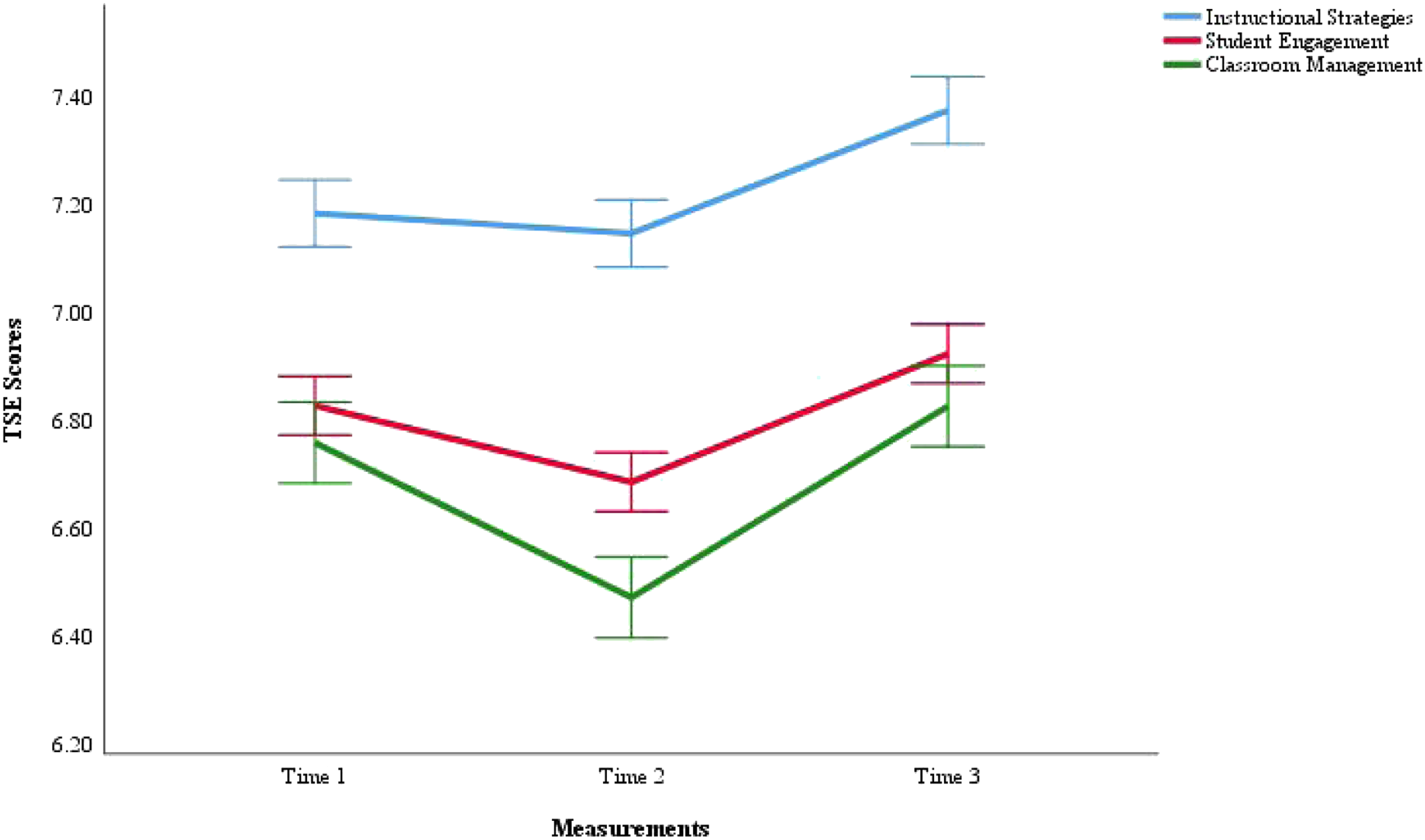
Discussion
PSTs in the current study reported their TSE at three timepoints over a period of time that included coursework following their initial practicum (Time 1 to Time 2) and the final practical teaching experience (Time 2 to Time 3). The trajectories generally show a decline in overall TSE during the coursework period and increased overall TSE following the final practicum. This result is consistent with previous findings that PSTs’ overall TSE reached its highest level after PSTs had finished all of their placements in an ITEP (Thomson et al., 2019; Hoy & Spero, 2005).
The significant increases across the three TSE domains during the final placement, compared with that during the ITEP coursework period, appear to indicate the role of mastery experience in influencing TSE. This is consistent with the findings of Han et al. (2017), who found that PSTs’ overall TSE tends to increase as long as they spend sufficient time in schools. Similarly, the PSTs in the study of Atici (2007) considered the practicum experience as the main reason for the growth in their TSE. It is also consistent with the assumption that the accumulation of experience in formal teaching contexts can assist PSTs, especially those who have little prior experience, to develop their overall TSE (Yüksel, 2014). The overall trajectory of TSE observed in this study is in line with the views expressed by Fitchett et al. (2018), with the greatest change in TSE occurring during professional placements and relatively less change during coursework periods.
The increases in the TSE of PSTs in the final placement found in the present study might have resulted from them being required to take on more teaching responsibilities and work more independently than in the first placement. Also, the present increase could be due to the protective environment of the practicum, where PSTs may have accesses to assistance from their supervisors (Klassen & Durksen, 2014), thereby reducing the challenges the PSTs faced in their practice (Swan et al., 2011).
TSE for classroom management and student engagement might be more reliant on the practicum experience in the present study because both subdomains decreased significantly during the coursework period between Times 1 and 2, compared with the significant increase after the final practical experience placement. This aligns with the findings of other studies that have examined the impact of methods courses on TSE levels. For example, Atici (2007) found that most PSTs reported a method course focussing on classroom management to be unhelpful with making them feel better about their ability to manage student misbehaviour – they felt the course was theoretically oriented and lacked applicability to real teaching contexts. For students in the present study, it may be that the coursework period did not address any classroom management concerns they may have held or may have decreased their sense of efficacy around their concerns. In contrast, these same students reported a consistently higher level of self-efficacy for instructional strategies and this did not decline during the coursework period. This finding is congruent with previous findings that TSE for instructional strategies improved as a result of taking method courses, even in the initial stage of ITEPs, whereas the other two subdomains were less likely to either improve during coursework or remain at the initial levels in the following placement (Pfitzner-Eden, 2016).
Limitations
Certain limitations exist in the current study. First, no measurements of TSE prior to the first professional experience placement were available. Second, although data did not vary on any of the tested variables, it remains possible that there were unaccounted for differences in the group of participants who were not included in the final analysis (the attrition group). Third, although the study applied multilevel analysis, the outcome is based on observed raw scores that are implicitly assumed to be linear (which they are not) and are then summed to yield composite measures that assume no measurement error. This is likely to over-estimate reliability, and therefore yield biased standard errors and increased risk of Type 1 error. And finally, the participants were from one single institution offering the ITEP, and so their experiences of practical placements and coursework may be more similar than would be found in a sample of PSTs from a range of institutions.
Conclusion
This study contributes a longitudinal perspective of change in three pre-service TSE domains and adds support to the vital role of professional experience in increasing pre-service TSE. Several implications can be drawn from the evidence arising in the present study. First, professional experience practice plays a vital role in enhancing pre-service TSE compared with the period of taking coursework. Second, PSTs need more assistance with classroom management, as evidenced by lower self-efficacy in this domain, whereas instructional strategies could be improved by taking specifically designed methodology courses. Third, increasing the practical content of ITEP courses, by incorporating more hands-on activities or role-playing activities, for example, could be beneficial for PSTs, and allow them to develop a well-grounded sense of TSE before they are engaged in actual teaching.
The study has certain implications for future research. First, it is valuable to assess pre-service TSE across the combined periods of both coursework and practical experience. As such, extending the longitudinal timeframe by including an assessment of TSE before the first placement or by following participants into their first years of teaching would provide valuable insights. Second, alternative analytical approaches including full information methods or multiple imputation could be used in the future analysis of data that includes missing data. Third, efforts could be made to investigate TSE changes in different domains of teaching using validating and applying domain-specific scales. Fourth, more sophisticated scaling of the three domains (e.g. confirmatory factor analysis or item response theory) would allow for the modelling of measurement error as well as simultaneous estimation of latent correlations and regression parameters. Finally, qualitative methods could be included to investigate the influential factors of TSE change and improve our understanding of TSE changes. It is assumed in the present study and other similar studies, that the practicum experience is so valuable because it offers mastery opportunities, but to be certain, the sources of TSE should be specifically investigated.
Footnotes
Declaration of conflicting interests
The author(s) declared no potential conflicts of interest with respect to the research, authorship, and/or publication of this article.
Funding
The author(s) disclosed receipt of the following financial support for the research, authorship, and/or publication of this article: This work was supported by the Ministry of Education of the People’s Republic of China [Grant number BIA180184].

Notes
1. The modelling was repeated to compare measures at Time 1 and Time 2, and Time 2 and 3. For these comparisons of levels, Time 2 was used as the reference by coding Time 2 as Time 3 which is then used as the reference by default.
2. M indicates marginal mean.