




Abstract
Australia has legislation in the form of the Disability Discrimination Act 1992 (Cth) and the Disability Standards for Education 2005 (Cth) that has the objective of eliminating disability discrimination. The purpose of this scoping review was to determine the extent to which this legislation is achieving the elimination of discrimination against students with disability in primary and secondary schooling. The review reports on the findings of a systematic search of law and education databases that identified 18 peer-reviewed articles discussing the legislation, relevant literature and related case law in the context of the education of students with disability in Australia. Content analysis of the articles indicated the existence of problems in several areas of the intersection between the law, policy and practice. These are outlined under five key themes: inclusion/exclusion, jurisdictions and definitions, the complaints-driven system, legislation clarity and reasonable adjustments. The review concludes with recommendations and suggestions for action.
Keywords
In Australia, it is unlawful to discriminate against students on the basis of their disability (Rees, Rice, & Allen, 2018). Australia’s pledge to non-discrimination in education is reflected in the Disability Discrimination Act 1992 (Cth) (the DDA) and the Disability Standards for Education 2005 (Cth) (the Standards). However, Australia does not have legislation that mandates inclusive education. Australia has ratified the United Nations Convention on the Rights of People with Disabilities 2006 (CRPD), which in Article 24 sets out obligations to ensure inclusive education that provides accommodations and supports for persons with disabilities to access the general education system ‘on an equal basis with others in the communities in which they live’ (United Nations General Assembly, 2006). Yet, the participation and inclusion of students with disability in education continues to be influenced by discrimination (Australian Institute of Health and Welfare, 2017; Commonwealth of Australia, 2016).
In 2018, there were 3,893,834 students enrolled in 9477 schools in Australia (Australian Bureau of Statistics, 2019). It can be difficult to ascertain the exact number of students with disability as figures vary according to definitions, but the Nationally Consistent Collection of Data on School Students with Disability, which incorporates a broad definition of disability based on the DDA and the Standards, reported that in 2017 18.8% of students received an educational adjustment due to disability. Government schools enrol more students with disabilities as the levels of adjustment increase (Education Council, 2018).
Given the ongoing concerns about the education of students with disability in Australia, this scoping review was designed to examine the peer-reviewed literature to determine the extent to which Australian disability discrimination legislation is achieving the elimination of discrimination for students with disability in primary and secondary schools, and the difficulties that might exist in the interplay between the legislation, policy and practice.
Legislative framework
The legislative regime designed to eliminate discrimination against students with disability comprises the Disability Discrimination Act 1992 (Cth) and the Disability Standards for Education 2005 (Cth). The Standards are subordinate legislation formulated by the Attorney-General under the parent Act. As well as the Commonwealth regime of anti-discrimination Acts, all states and territories of Australia have enacted omnibus anti-discrimination legislation. None of that legislation contains an equivalent to the Standards formulated under the DDA.
The objects of the DDA are set out in Section 3 of the Act. They are, among other things, to eliminate, as far as possible, discrimination against persons on the ground of disability in various areas of public life, including education. The Standards share these objectives and according to the Introduction to the Standards serve to ‘clarify and elaborate’ the legal obligations of schools under the Act. It is unlawful to contravene the Standards (DDA s 32), and observance of the Standards amounts to compliance with the Act’s prohibition of discrimination (DDA s 34). The Standards cover five areas in education: enrolment; participation; curriculum development, accreditation and delivery; student support services; and harassment and victimisation.
Section 22 of the Act prohibits direct and indirect discrimination in education. As defined in s 5(1), direct discrimination occurs when a school treats, or proposes to treat, the student less favourably than the school would treat a student without the disability in circumstances that are not materially different, and when that less favourable treatment is because of the student’s disability. As defined in s 6(1), indirect discrimination occurs when a school requires, or proposes to require, a student with a disability to comply with a requirement or condition, and the requirement or condition has, or is likely to have, the effect of disadvantaging persons with that disability.
Since amendments to the DDA in 2009, and as expressed in the Standards, discrimination also occurs when a school fails to make reasonable adjustments for a student with a disability. As defined in s 5(2), direct discrimination of this kind occurs when a school does not make, or proposes not to make, reasonable adjustments for a student with a disability and the failure to make reasonable adjustments has, or would have, the effect that the student is, because of their disability, treated less favourably than a student without the disability would be treated in circumstances that are not materially different. As defined in s 6(2), indirect discrimination of this kind occurs when a school requires, or proposes to require, a student with a disability to comply with a requirement or condition, and, because of their disability, the student would be able to comply with the requirement or condition only if the school made reasonable adjustments for the student, and where the failure to make the reasonable adjustments has, or is likely to have, the effect of disadvantaging persons with the disability. Section 6(3) prescribes that indirect discrimination does not occur where the requirement or condition is reasonable in all the circumstances of the case.
In the context of this scheme of negative prohibitions, the Standards articulate positive obligations that schools must observe if they are to avoid a claim of discrimination based on the failure to make reasonable adjustments. The DDA (s 4) defines ‘reasonable adjustment’ in negative terms: an adjustment is a reasonable adjustment unless making it would impose an unjustifiable hardship on the education provider. However, the Standards clarify that it is not necessary to make unreasonable adjustments (s 3.4.2 Note). Only when it has been determined that an adjustment is reasonable may it be considered whether the making of that reasonable adjustment would impose an unjustifiable hardship on the provider (s 3.4.2 Note).
The purpose of this scoping review was to determine the extent to which this legislation is achieving the elimination of discrimination for students with disability in primary and secondary education in Australia. Specifically, the research questions were as follows:
What does the recent peer-reviewed literature report about the effects of the DDA and the Standards on the education and inclusion of students with disability in Australian primary and secondary schools? What does the literature report about any issues or difficulties in the interplay between the legislation, policy and practice?
Method
It was clear from a preliminary examination of the literature on the topic that the research question necessitated a wider reach than empirical research studies alone could provide, and an examination of analysis of relevant legal cases and expert opinion would be necessary. Consequently, a scoping review with inductive thematic analysis was chosen as the most appropriate approach.
Scoping reviews are increasingly being used to map the body of literature on a topic area in ways that differ somewhat from systematic reviews, while using similarly rigorous and transparent methods (Arksey & O’Malley, 2005; Pham et al., 2014). Scoping reviews typically cover a variety of sources of evidence and can include review articles and non-research sources such as expert opinion, as well as grey literature not published in scholarly journals (Arksey & O’Malley, 2005; Davis, Drey, & Gould, 2009). Critical quality appraisal of identified sources of evidence is not always appropriate and consequently is optional in scoping reviews (Tricco et al., 2018). Critical quality appraisal was not performed in the current review; however, the inclusion of only articles that were published in peer-reviewed journals ensured that domain-specific experts had vetted manuscripts, maintained quality and merit, and minimised author bias.
Search strategy
With assistance from the fourth author, a University research librarian, a systematic search was conducted of the databases Proquest Education Collection, Proquest Australia and New Zealand database, EBSCO Education Research Complete, Informit A+Education, Informit Agis Plus Text and HeinOnline Law Journal Library. The databases were chosen to achieve comprehensive coverage in the disciplines of both education and law and to ensure maximum access to Australian content.
Search terms used included education AND disability AND discrimination AND Australia AND legislation (with slight variations depending on the database). A search of Google Scholar was also conducted, and the reference lists of identified documents were searched for additional articles.
Inclusion criteria
Documents selected for the review were limited to those directly related to the effects of Australian federal disability discrimination legislation (the DDA and the Standards) on the inclusion of students with disability in primary and secondary education in Australia. Studies focusing on other aspects of the education of students with disability, such as pedagogical methods or educators’ attitudes towards or training in the inclusion of students with disability, were considered to be not directly relevant to the research questions and were excluded from the review.
Documents focusing on preschool education, vocational education and training, and higher education were excluded from the review. Although the DDA and the Standards cover these sectors, the issues involved in them can differ considerably from those in the primary and secondary education sectors and were deemed outside the scope of the review.
Articles were included if they reported original research studies or if they were literature reviews, discussion papers, expert opinion pieces or case law analysis pieces in peer-reviewed journals.
The aim of determining the effect of Australia’s disability legislation on the education of students with disabilities meant that the focus of the review was on recent years, in particular since the introduction of the Standards in 2005, which clarified and elaborated on the legal obligations imposed by the DDA. In addition, the 2009 DDA amendments also clarified some of the obligations in relation to educating students with disability. Thus, the search was limited to documents published between January 2010 and July 2019.
Through the database searches, 186 records were identified. After the removal of 37 duplicates, the titles and abstracts of the remaining 149 were independently reviewed by the first two authors, who excluded a further 116 articles as they did not meet the review criteria. Two additional articles were identified from the reference lists of the 33 remaining articles and added, giving a total of 35 articles that were examined by reading the full texts. Seventeen of these were found not to meet the inclusion criteria and were excluded, giving a total of 18 articles to be included in the review. Figure 1 presents the search strategy with the number of articles at each stage, including reasons for exclusion of full-text articles.
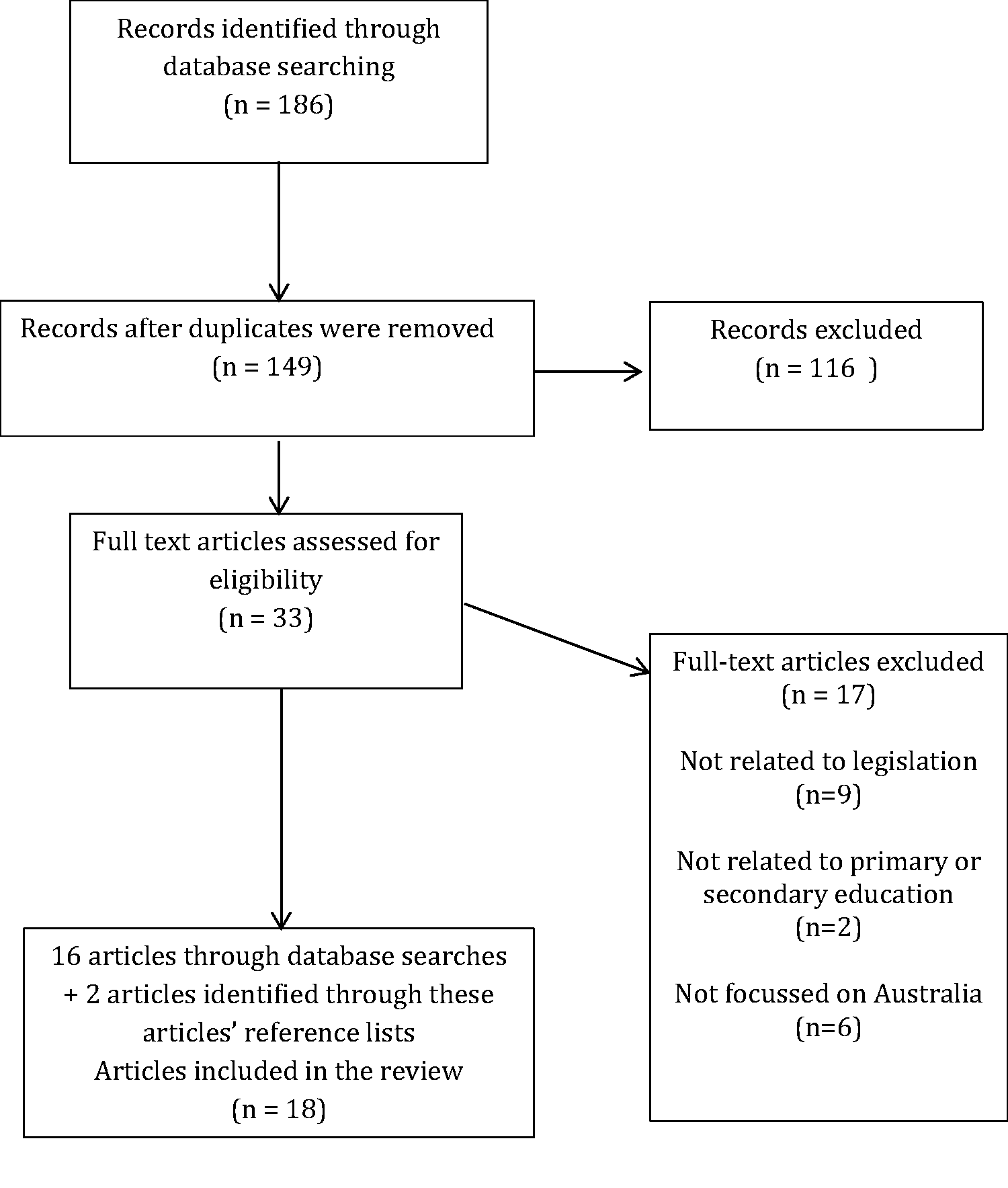
Flow chart of article screening and selection.
Data extraction
The first two authors conducted a content analysis of the 18 articles independently, identifying key issues and themes that were relevant to the research questions. Any differences were resolved through discussion and further reading of the articles, resulting in a consensus.
Results
Article characteristics
The key properties of the 18 articles meeting the criteria for inclusion in the review are presented in the Appendix. While most of the articles related to students with disability in general, some focussed on specific cohorts in relation to discrimination legislation, policies and practice; these were students with challenging behaviours (O’Connell, 2016, 2017), communication disorders (Dickson, 2019; McLeod, Press, & Phelan, 2010), health conditions (White, 2015), autism spectrum disorder (ASD) (de Bruin, 2019; Lilley, 2013) and attention deficit hyperactivity disorder (ADHD) (Mulholland, 2017).
The majority of the articles were expert opinion pieces that described and analysed the relevant legislation and/or policy, with many also using an analysis of case law to elucidate ways in which the courts have applied the legislation. Three articles reported primary research: Lilley (2013) reported a qualitative research study involving interviews with mothers about their experiences enrolling their children with autism in primary schools; O’Connell’s (2017) legislation and case law analysis included some qualitative findings from interviews with education, disability and legal professionals; and Walsh (2012a) reported findings from a quantitative study of primary school educators. Apart from three articles dealing with primary schooling only (Lilley, 2013; Walsh, 2012a, 2012b), the included articles covered both primary and secondary schooling. Most articles specifically discussed at least one Standard. The Appendix indicates the themes identified and the particular Standards specifically discussed in each article.
Key themes identified in the analysis
The findings of the content analysis were organised into five key themes, some with sub-themes. The themes are (1) inclusion/exclusion (sub-themes: inclusion/exclusion in assessment; inclusion/exclusion of specific student cohorts), (2) jurisdictions and definitions, (3) the complaints-driven system, (4) legislation clarity and (5) reasonable adjustments (sub-themes: reasonable adjustments in assessment; reasonable adjustments and specific student cohorts; unjustifiable hardship).
Inclusion/exclusion
Two of the articles contended that Australia’s primary and secondary education systems have failed to become more inclusive since the introduction of the DDA and the Standards and reported that segregation of students with disability has increased (Anderson & Boyle, 2015; de Bruin, 2019). Anderson and Boyle (2015), who reviewed relevant literature, educational policy and reports, pointed out that there is no agreed definition of inclusive education, and there is no Australian legislation that mandates it. These authors concluded that Australia’s existing discrimination legislation has not sufficiently produced inclusive education for students with disability. They reported that the number of students placed in segregated settings in regular schools was increasing, and there were growing rates of suspension and exclusion of students, many of whom were students with disability. De Bruin (2019) also maintained that segregation of students with disability was increasing in Australia. Her analysis of Australian Bureau of Statistics student placement data indicated that special school placement increased by 115.9% in the decade after the DDA and rose a further 84% after the introduction of the Standards.
Iacono, Keeffe, Kenny, and McKinstry (2019) reviewed the grey literature of reports of government inquiries and policy reviews, including the most recent review of the Standards, in the context of Australia’s disability discrimination and education legislation. They concluded that ‘the needs of students with disability are not being met according to the intent of education and disability policy and legislation’ (p. 4). These authors found that exclusionary practices including gatekeeping (such as attempts to dissuade families from seeking enrolment in a mainstream setting) and restrictive interventions (such as seclusion to manage challenging behaviours) were commonly reported in the literature they reviewed.
Some of the articles discussed the problem of inadequate resources in the context of achieving inclusion and non-discrimination for students with disability. Hodgson (2012) maintained that the provision of educational inclusion requires large amounts of human and material resources, and a significant obstacle for Australia (and other countries) is that the resources that are provided are insufficient. Iacono et al. (2019) spoke of a policy to practice gap, which needs to be addressed with appropriate resourcing and models of support. Lilley (2013) maintained that although students with ASD are eligible for funding, in the opinion of educators and parents, funding and supports are inadequate. Walsh’s (2012a) survey results from 60 Brisbane schools indicated that although staff positively supported the inclusion of students with disability, they struggled to resource their inclusion efforts. Dickson (2014) emphasised that an ongoing commitment by government to the ‘proper funding of schools to provide for students with disabilities’ is essential if the aims of the Standards are to be met (p. 13).
Inclusion and exclusion in assessment
Anderson and Boyle (2015) reported that many students with disability were being excluded from Australia’s national school testing regime, the National Assessment Program for Literacy and Numeracy (NAPLAN). Cumming and Dickson (2013) also maintained that equitable inclusion of students with disability was not occurring in educational assessment testing and went into further detail about exclusion from national school tests. They explained that in the national and international comparison sample tests, students with disability are eligible for exclusion if randomly selected to be part of the sample population. In the NAPLAN tests, which are for full cohorts of students, students with disability unable to participate using available accommodations are exempted after consultation with the caregiver and student, if possible; these students are deemed to be below the minimum standard for their Year level. Exclusion from assessments can disadvantage students because they are not enabled to demonstrate their knowledge and competencies and because such exclusion can contribute negatively to students’ social and affective outcomes (Cumming, Dickson, & Webster, 2013). Cumming and Dickson (2013) stated that in England and the USA, more flexible arrangements and alternative assessments are used to allow students who are unable to complete external tests (even with accommodations) to demonstrate their levels of achievement.
Inclusion and exclusion of specific student cohorts
Articles focusing on students with specific disabilities reported that these cohorts were not being well-served by current legislation and policy. Among them, White (2015) asserted that, although chronic health conditions are covered by the definition of disability in the DDA, education systems have not developed policy to adequately address the inclusion of this cohort, which is now sizeable. Dickson (2019) and McLeod et al. (2010) expressed the view that the needs of children with communication impairment were not adequately addressed by current legislation and policy.
O’Connell (2017) stated that disability discrimination legislation does not sufficiently protect the rights to education and inclusion of students with challenging behaviours. Although the DDA, particularly since its 2009 amendments, clearly covers people with challenging behaviours resulting from a disability, in practice the rights of students with challenging behaviour have been contentious. It appears from the legal cases involving challenging behaviours that have been brought against State education departments, that courts are reluctant to allow the discrimination law to protect students whose behaviour includes even minor acts of aggression (O’Connell, 2016).
In her qualitative study of the experiences of mothers enrolling their children with ASD in primary schools in New South Wales, Lilley (2013) reported exclusionary practices and an overall failure to deliver inclusive education to students with ASD. According to parental report, some schools acted as gatekeepers, using informal exclusion strategies to resist the enrolment of these students. Strategies included insisting that the child would be better served elsewhere, claiming inadequate resources and the school having physically inappropriate environments. Mothers and their children with ASD experienced pervasive stigmatisation during their enrolment efforts. De Bruin (2019) reported that students with ASD were more likely to experience educational segregation or exclusion than students with other disabilities. De Bruin analysed Australian Bureau of Statistics data specific to students with ASD and found that, in the period from 2009 to 2015, there was a sharp drop in regular class placements and an increase of 41% in special school placements for this cohort.
Jurisdictions and definitions
Several of the articles’ authors discussed difficulties arising from the differences between federal, state and territory jurisdictions (Anderson & Boyle, 2015; Cumming & Dickson, 2013; Dickson, 2012, 2014, 2019; Mulholland, 2017; White, 2015). Across Australia’s eight educational jurisdictions and three education sectors (public, independent and Catholic), there are differences in interpretation of the federal legislation, in the development of inclusive education policies and in identifying and providing supports to students with disability. This contributes to inconsistent levels of access and outcomes for students (Anderson & Boyle, 2015). Particularly problematic is the discrepancy between the definition of disability in the federal legislation (the DDA and the Standards) and the definitions used by the states and territories to drive their policies and practices. O’Connell (2017) pointed out that the definition of disability in the federal disability legislation is broad and was designed to be as inclusive as possible, while education departments in states and territories have more restrictive definitions that govern access to funding. Furthermore, although the DDA does not require that a person have a medical diagnosis to meet the definition of disability, the medical approach is entrenched in education policy. Many students with challenging behaviours may meet the DDA’s broad definition of disability but would not meet the narrower definitions used by education departments.
In a similar vein, Mulholland (2017) pointed out that ADHD is covered by the broad definition of disability in the DDA, but definitions used by states and territories are narrower and fall into strictly medically based categories. Consequently, most students with ADHD are ineligible for disability funding and unlikely to receive the additional learning and behaviour support they need. The disparity of definitions between jurisdictions can result in ‘disputes over whether in fact a student has a disability, what category the disability falls under, and whether they are entitled to funding and/or accommodations’ (p. 16). Mulholland emphasised that, although the purpose of the Standards was to clarify the obligations of educators under the DDA, such clarification is difficult to achieve ‘when the fundamental concept of disability is defined differently in various jurisdictions in Australia’ (p. 6).
Two authors discussed the issue of definitions in relation to students with communication disorders. McLeod et al. (2010) stated that the divergence among definitions in states and territories in Australia leads to different, and often ambiguous, policies related to services for children with communication disorders. Dickson (2019) emphasised the inconsistencies among the jurisdictions and educational sectors in school's provision of speech pathology services to these students.
Anderson and Boyle (2015) and O’Connell (2017) discussed the labelling of students that can accompany the policies of the different jurisdictions’ education departments. According to Anderson and Boyle (2015), the number of students receiving labels is increasing, in part because the provision of supports is dependent on students having a label or medical diagnosis. Furthermore, the practice of labelling and categorisation leads to inconsistencies in support provision and unintended negative consequences for the students. Similarly, O’Connell (2017) maintained that differing definitions of disability and the requirement for medical diagnosis could have negative consequences for students with challenging behaviours. Although they may benefit from having a label or diagnosis of disability by gaining access to supports and the protection of anti-discrimination law, this may come at the cost of assuming a ‘stigmatised social identity’ (p. 117). In addition, using categories and labels as a basis for the provision of supports can fail to account for the range of needs of individual students, some of whom may have high abilities in some areas and can lead to the inadequate support provision in some cases (Cumming et al., 2013).
The complaints-driven system
According to many of the articles, the complaints-based nature of the system is problematic in several ways that can impede the achievement of the aims of the disability discrimination legislation. There is no independent compliance framework to ensure that educators are not discriminating against students with disability, and the onus is on individual students and their families to enforce compliance with the Standards (Dickson, 2014). The complaints-based system places a heavy burden of proof on parents (de Bruin, 2019), many of whom feel powerless or unprepared to address their concerns through the lengthy and difficult processes involved (Iacono et al., 2019; White, 2015).
Many complaints are resolved in conciliation, and few cases proceed to court (White, 2015). Conciliations are confidential, meaning that complaints are resolved ‘behind closed doors’ (White, 2015, p. 1298). Because so few matters proceed to litigation, the existing case law is ‘not representative of the scope or nature of discrimination practice’ (O’Connell, 2017, p. 112).
Walsh (2012a, 2012b) contended that the system whereby parents have to bring a claim of discrimination to conciliation, and perhaps on to litigation, is failing to ensure the rights of children with disability. Disability discrimination in education is difficult to prove, and most decisions of courts and tribunals have gone against the complainant (Walsh, 2012a). Walsh (2012b) suggested that one reason few disability discrimination complaints related to primary schools have proceeded to the courts or tribunals is that parents lack knowledge about disability discrimination laws and may not even recognise their situation as discrimination. Walsh (2012b) concluded that ‘discrimination law is an inappropriate mechanism for addressing disputes regarding the provision of special arrangements for children with disabilities’ and that these rights should be enshrined in state and territory education legislation (p. 39).
Legislation clarity
Dickson (2012, 2014), Iacono et al. (2019), Mulholland (2017) and Smith (2012) all emphasised the lack of clarity in the Standards and the difficulty of interpreting their meaning and intent. In particular, key terms such as ‘on the same basis’, ‘reasonable adjustment’ and ‘unjustifiable hardship’ cause confusion. These terms are ambiguous and are often only tested in court (Mulholland, 2017). Dickson (2014) maintained that there is evidence that students, their families and education providers do not adequately understand the details of the Standards and how they are to be applied in practice, and that there is a particular lack of clarity about the interaction of ‘reasonable adjustment’ and ‘unjustifiable hardship’, which are not clearly explained in the Standards. Mulholland (2017) further asserted that the meaning of ‘on the same basis’ is a point of confusion for education providers, particularly in its implication of equality rather than equity. It is important that ‘same’ is not interpreted as meaning identical or equal when, in fact, students with disability will often need non-identical treatment to ensure their equitable access to education.
The Standards are supported by Guidance Notes, which are intended to assist in clarifying education providers’ obligations (Smith, 2012). However, there is a concern that these are insufficient to explain the Standards to educators and students adequately, and that they lack practical examples of key concepts of the Standards (Mulholland, 2017). Smith (2012) contended that the lack of clarity causes ongoing dilemmas for educational leaders in discharging their obligation. One result of this difficulty, as described by Iacono et al. (2019), is that schools frequently develop local-level policies, resulting in a broad range of interpretations and applications across the education sector.
Dickson (2014) pointed out that the federal government and other jurisdictions were developing and making available training resources to promote educators’ understanding of the Standards. To be effective, training must be actively supported by school administrators and made available to staff on a regular basis. Similarly, Iacono et al. (2019) discussed the available resources, stating that their uptake and use are dependent on school leadership.
Reasonable adjustments
A recurring theme throughout most of the documents is the problematic nature of the requirement of reasonable adjustments. A reasonable adjustment is what Mulholland (2017, p. 8) termed a ‘cornerstone’ of the Standards, but the Standards do not explain the concept clearly, and it has proved complex and confusing for all parties (Dickson, 2012, 2014).
The Standards impose a positive duty, not found in the initial drafting of the DDA, to make reasonable adjustments, and the DDA Amendments of 2009 underlined the obligation to make reasonable adjustments (Smith, 2012). Cumming and Dickson (2013) and Dickson (2012, 2014) stressed that this means education providers need to be pre-emptive in their duty to avoid discrimination rather than reacting to a complaint.
A hurdle to the making of reasonable adjustments is that many educators do not understand this obligation and may not be well prepared to make decisions about reasonable adjustments (Smith, 2012; White, 2015). Dickson (2014) maintained that the Standards would be more effective if ‘there were greater understanding of how they oblige education providers to make reasonable adjustments to their policies and practices to support access for and participation by students with disabilities’ (p. 5).
Cumming et al. (2013) and Dickson (2014) explained that although the Standards require that students or their families must be consulted about potential adjustments, they do not prescribe how the consultation process should occur, and this can lead to confusion and inconsistency in implementation. Furthermore, the Standards do not dictate that the parties agree on the implementation of the reasonable adjustment. Cumming et al. (2013) pointed out that in the available case law, the court determined that the educators were best placed to determine whether a particular adjustment would be implemented, and the ultimate decision about adjustments to be implemented lies with the school.
Smith (2012) reported that the Standards ‘do not prescribe what must be done to meet students' needs’ in the area of making adjustments, and it can be difficult for education providers to ensure compliance (p. 12). Smith surmised that complaints most often arise not because the education provider refuses to make a reasonable adjustment, but because of disagreement over the type or magnitude of the adjustment. In addition, Iacono et al. (2019) reported that needed in-class adjustments are not sufficiently adopted and that education support staff, who have limited professional qualifications, often choose and implement curriculum adjustments.
Cumming and Dickson (2013) explained that an adjustment is considered reasonable if it realises its intended purpose while balancing the needs of all parties, including other enrolled students and education personnel.
Reasonable adjustments in assessment
Many of the articles explicated the challenges of reasonable adjustment in school assessment practices (Anderson & Boyle, 2015; Cumming & Dickson, 2013; Cumming et al., 2013; Dickson, 2012, 2014). As mentioned above in the section on inclusion and exclusion, upon consultation with caregivers, and where possible the student, many students with disability are excluded from participating in national school testing regimes, potentially a contravention of the Standards (Anderson & Boyle, 2015; Cumming & Dickson, 2013). Cumming and Dickson reported that in terms of adjustments, permissible accommodations to these tests are strictly limited, and although some modifications are available, practice tests are not available in modified forms.
Dickson (2012) explained that most cases of discrimination in assessment are related to indirect discrimination, whereby explicit or implicit standard conditions are imposed on the student as they undertake an assessment task. Dickson emphasised that, under the Standards, adjustments cannot be made if they compromise academic integrity and cited case law to show that adjustments considered to do so have not been deemed reasonable. In light of this, Dickson discussed the difficulty for educators of ascertaining the reasonableness of adjustments in assessment.
Cumming et al. (2013) maintained that when existing legislation, policy, and research in best practice are considered, it is clear that more needs to be done to ensure equitable assessment for students with disability than merely meeting minimal levels of legal compliance. Implementation of high-quality adjustments in assessment is necessary but is often particularly difficult to achieve. Although consultation with the student or family is required under the Standards, students and parents have limited knowledge about possible assessment adjustments, and many teachers and other professionals may also lack adequate knowledge. There is no available body of systematic evidence on how effective assessment adjustments have been undertaken for students with disability to provide guidance for policy-makers, educators, students and families.
Reasonable adjustments and specific student cohorts
In the case of students with health conditions, White (2015) maintained that the interpretation and enactment of reasonable adjustments could be particularly difficult because these conditions are often invisible but can lead to complex needs, and there are no systematic guidelines for schools concerning reasonable adjustments required.
Dickson (2019) stated that the diagnosis of communication impairment is not straightforward and can take considerable time, and some school systems do not provide funding until a diagnosis has been verified. In these cases, schools may be failing in their obligation to provide reasonable adjustments to these students in a timely fashion.
In the case of students with challenging behaviour, Smith (2012) reported that the requirement to make reasonable adjustments might include modifying individual behaviour codes. The school can then require the student to comply with the modified behaviour code. Smith further stated, ‘to treat a student less favourably because of their failure to comply with an unmodified behaviour code will amount to direct discrimination as a result of the failure to provide a reasonable adjustment to the behaviour code’ (p. 15).
Unjustifiable hardship
As Cumming and Dickson (2013) made clear, ‘caveats apply’ in the legislation because even if an accommodation is determined to be reasonable, it may still be avoided if the education provider can establish that it would cause unjustifiable hardship (p. 229). De Bruin (2019, p. 814) suggested that this exemption is ‘controversial’ and Dickson (2014, p. 11) called it ‘problematic’ and ‘powerful’. Dickson (2012) explained it as a ‘thick protection’ which is afforded to schools if the removal of discrimination may cause the institution unjustifiable hardship (p. 53).
From the case law that has interpreted the Standards, Dickson (2014) suggested that there are two main situations in which a school may claim unjustifiable hardship: where reasonable adjustments cannot remove the risk of harm from a student’s behaviours and when the cost of adjustments or supports would be unaffordable. Some of the articles (Dickson, 2014, 2019; Smith, 2012) pointed out that, while it has been difficult for State education providers to claim unjustifiable hardship because of financial costs, recent case law, such as Sievwright v State of Victoria (2012), indicates that there has been some shift towards the view that State education resources are finite, and there will be instances where adjustments will be deemed not reasonable because of their cost. In some legal cases, detailed examinations of budget allocations have been conducted and contributed to findings of non-discrimination on the part of State education departments refusing to commit expenditure to, for instance, one-on-one full-time teacher aide support (Walsh, 2012b).
Smith (2012) pointed out that the exception of unjustifiable hardship ‘recognises that an adjustment should not create an undue burden on an education provider. However, the exception also recognises that some hardship will be justifiable’ (p. 14). Furthermore, unjustifiable hardship can only be determined on a case-by-case basis, making it difficult for education providers to use previous decisions to assist them in determining whether particular adjustments would be deemed necessary.
Discussion
The findings of this scoping review reveal a level of disquiet that the intent of Australia’s disability discrimination legislation is not adequately being achieved in primary and secondary education policy and practice. From the examination of the legislation itself, relevant literature and case law arising from complaints made under the legislation, the articles’ authors reported serious problems in several areas of intersection between the law, policy and practice. To summarise, the five major themes identified in the review were as follows:
Inclusion/exclusion: Authors reported failures in inclusion of students with disability and the continuing existence of discrimination in the form of exclusionary practices. Jurisdictions and definitions: Inconsistent levels of access and outcomes for students result from Australia’s eight educational jurisdictions differently interpreting the federal legislation, developing policy and identifying and providing supports to students with disability. Difficulties arise from the discrepancy between the broad definition of disability in the DDA and the Standards and the narrower, more medically based definitions used by education departments in the states and territories. The complaints-driven system: Enforcement of compliance with the legislation depends on the willingness and ability of often vulnerable individual complainants to pursue a claim of discrimination or breach of the Standards. Few cases proceed to court and conciliation outcomes are confidential. Legislation clarity: The legislative framework aimed at eliminating discrimination against students with disabilities is complex, and it is difficult for both schools and students and their families to understand and navigate. The legislation lacks clarity in its key terms and it is difficult for all parties to interpret how the Standards are best applied in practice. Reasonable adjustment. The matter of reasonable adjustment in general, and reasonable adjustments in assessment in particular, is especially problematic, and there is a lack of systematic guidelines to assist schools to determine reasonable adjustments. It is unclear if the move to transition the NAPLAN online (National Assessment Program, 2016) will create more barriers or facilitate accommodations for students with disability. The exception of unjustifiable hardship that can be claimed by education providers is contentious, and the interaction between the concepts of reasonable adjustment and unjustifiable hardship is unclear and difficult to establish. Although the Standards require schools to consult with a student about reasonable adjustments, it is in the end left to the school to determine what measures should be taken, what constitutes a reasonable adjustment, whether the implementation of reasonable adjustments would involve an unjustifiable hardship, and whether the school’s legal obligations have been met.
Recommendations
In response to these major findings of the review, the following 12 recommendations address the urgent need for change. These recommendations focus on achieving non-discrimination in primary and secondary schools and highlight the need for consideration of legislative reform.
Government-level recommendations
That the Act and the Standards are amended so that the requirement to make reasonable adjustments is a genuinely unambiguous, positive obligation. That the Act and the Standards are amended to shift away from the complaints-based system of enforcement. That an independent statutory agency be established to monitor legislative compliance, so the burden of enforcement is lifted from aggrieved students and their associates, and schools are relieved of the need to second-guess their decisions about adjustments and their implementation. That disability definitions are standardised among the federal legislation and the education departments of states and territories. That the Commonwealth formally investigate the merits of inclusive education legislation so that children are educated in regular, age-appropriate classes to the maximum extent possible. That governments ensure ongoing school-based funding is allocated to provide financial and human resources for the proper provision to students with disability.
System-level recommendations
7. That system-level administrators ensure policy and practice are linked to the Act and the Standards.
8. That system-level administrators ensure the Act and the Standards have easily accessible supporting documents and training resources for use in schools.
Principal-level recommendation
9. That primary and secondary school principals undergo mandatory professional learning in meeting education providers’ obligations under the Act and the Standards.
Teacher-level recommendations
10. That initial teacher training includes comprehensive instruction on the application of the Act and the Standards within the classroom context.
11. That ongoing teacher registration includes evidence of capacity in understanding and applying the Act and the Standards.
Associate-level (parent) recommendation
12. That national free-of-charge standardised online learning modules be available to associates (parents) that comprehensively explain the rights of students with disabilities in schools and assist parents in navigating the legal requirements associated with non-discrimination in schools.
Limitations
The scoping review did not include the many recent reviews, reports and submissions that have been conducted by governments and stakeholder groups on the topic of Australia’s education of students with disability. While such documents may have added usefully to the review’s findings, their inclusion was outside the scope of the review, the purpose of which was to provide an overview of the peer-reviewed analysis and opinions of experts in the fields of law and education. Many of these authors themselves drew on some of the available reviews, reports and submissions in their articles.
Conclusion
This scoping review identified weaknesses in Australia’s legislative requirement of non-discrimination in primary and secondary schools. Despite the good will and good intentions of many educators, countless children and young people with disability experience school as a series of barriers to participation instead of a place of learning. Parents struggle to understand the rights of their children under the Act and the Standards. Teachers and principals flounder in the application of the Act and the Standards. Systems are required to apply state and territory disability definitions, but at the same time must implement the Act and the Standards to achieve non-discrimination. Australia has missed the mark in achieving non-discrimination in primary and secondary schools. The time is right for change.
Footnotes
Declaration of Conflicting Interests
The author(s) declared no potential conflicts of interest with respect to the research, authorship, and/or publication of this article.
Funding
The author(s) disclosed receipt of the following financial support for the research, authorship, and/or publication of this article: This research was funded by the Office of the Pro-Vice-Chancellor, Faculty of Education and Arts, University of Newcastle, Australia.

Appendix
Key properties of publications included in the review

| Author (year) | Document type | Themes (sub-themes) | Standards sections discussed |
|---|---|---|---|
| Anderson and Boyle (2015) | Review of literature and related policies and reports | Inclusion/exclusion (assessment) Jurisdictions and definitions Reasonable adjustment (assessment) |
None specifically discussed |
| Cumming and Dickson (2013) | Legislation analysis; case law analysis | Inclusion/exclusion (assessment) Reasonable adjustment (assessment; unjustifiable hardship) |
Part 3 Reasonable adjustments Part 5 Participation Part 6 Curriculum |
| Cumming et al. (2013) | Legislation analysis; case law analysis | Inclusion/exclusion (assessment) Jurisdictions and definitions Reasonable adjustment (assessment) |
Part 3 Reasonable adjustments Part 5 Participation Part 6 Curriculum |
| De Bruin (2019) | Legislation analysis; analysis of student placement data | Inclusion/exclusion (specific student cohort) Complaints-driven system Reasonable adjustment (unjustifiable hardship) |
None specifically discussed |
| Dickson (2012) | Legislation analysis; case law analysis | Jurisdictions and definitions Legislation clarity Reasonable adjustment (assessment; unjustifiable hardship) |
Part 3 Reasonable adjustments |
| Dickson (2014) | Legislation analysis; case law analysis | Complaints-driven system Legislation clarity Reasonable adjustment (unjustifiable hardship) |
Part 3 Reasonable adjustments Part 4 Enrolment Part 5 Participation Part 6 Curriculum Part 7 Student support services Part 8 Harassment and victimisation |
| Dickson (2019) | Legislation analysis; case law analysis | Inclusion/exclusion (specific student cohort) Jurisdictions and definitions Reasonable adjustment |
Part 3 Reasonable adjustments |
| Hodgson (2012) | International rights analysis; legislation analysis | Inclusion/exclusion | Part 3 Reasonable adjustments Part 4 Enrolment Part 5 Participation Part 6 Curriculum Part 7 Student support services Part 8 Harassment and Victimisation |
| Iacono et al. (2019) | Review of literature, including legislation, policy, policy reviews, government inquiries and original research | Inclusion/exclusion Jurisdictions and definitions Complaints-driven system Legislation clarity Reasonable adjustment |
Part 3 Reasonable adjustments |
| Lilley (2013) | Report of a qualitative research study | Inclusion/exclusion (specific student cohort) Jurisdictions and definitions |
Part 4 Enrolment |
| McLeod et al. (2010) | Legislation analysis; policy analysis | Inclusion/exclusion (specific student cohort) Jurisdictions and definitions |
None specifically discussed |
| Mulholland (2017) | Legislation analysis; policy analysis | Jurisdiction and definitions Legislation clarity |
Part 3 Reasonable adjustments |
| O’Connell (2016) | Case law analysis | Inclusion/exclusion (specific student cohort) | None specifically discussed |
| O’Connell (2017) | Legislation analysis; case law analysis; qualitative data reported | Inclusion/exclusion (specific student cohort) Complaints-driven system |
Part 3 Reasonable adjustments |
| Smith (2012) | Legislation analysis; case law analysis | Jurisdictions and definitions Lack of clarity Reasonable adjustment (specific student cohort) |
Part 3 Reasonable adjustments |
| Walsh (2012a) | Analysis of conciliation determinations; report of a quantitative research study | Inclusion/exclusion Complaints-driven system Reasonable adjustment |
Part 3 Reasonable adjustments |
| Walsh (2012b) | Legislation analysis; case law analysis | Inclusion/exclusion Jurisdictions Complaints-driven system Reasonable adjustment (unjustifiable hardship) |
Part 3 Reasonable adjustments |
| White (2015) | Legislation analysis; literature review | Inclusion/exclusion (specific student cohort) Complaints-driven system Reasonable adjustment (specific student cohort) |
Part 3 Reasonable adjustments |