




Abstract
Positive psychology and positive education aim to broaden the definition of prosperity and success to include well-being. This qualitative study sought to explore whether students in a school with a school-wide approach to positive education expressed different ideas about prosperity and success than students who have not received explicit positive education training. Using thematic analysis techniques and with reference to Seligman’s PERMA and Cummins’ Personal Well-being Index (PWI) frameworks, the writing tasks of 205 Year 10 students were analysed. Results showed that positive education students attributed success and prosperity to relationships more frequently than students who had not participated in the positive education programme, and discussed money as indicative of success less frequently. Social equity, health and collective well-being did not feature prominently in positive education students’ responses, suggesting potential for further development of positive education programmes to promote these elements of prosperity and engender a more social definition of success.
Keywords
Introduction
Positive psychology, from which positive education emerged, is a branch of psychology originally created by Seligman in 1998 to shift the focus in psychology towards increasing flourishing rather than solely on ameliorating illness (Seligman & Csikszentmihalyi, 2000). This goal expanded to embrace the aim of creating a worldwide economy of well-being where national prosperity is measured in terms of levels of human flourishing rather than economics alone (Diener & Seligman, 2004; Seligman, 2008).
In schools, this extends to the goal of changing the metrics towards valuing schools based on their ability to nurture student well-being and flourishing rather than solely supporting academic success (Waters, 2011). The field builds on the work of humanistic psychologists such as Marlow and Rogers (Friedman, 2008), but separates itself from these and other predecessors. Positive psychology is defined by its empirical base, examining what makes life worth living with the aim of creating a science of well-being. It explores the strengths, virtues, conditions and processes that contribute to well-being and positive function (Rusk & Waters, 2013). Importantly, it purports that it does not assume that the rest of psychology is negative (Norrish & Vella-Brodrick, 2009). Positive education, the school-based incarnation of positive psychology, aims to challenge notions of success and prosperity by augmenting an education system where schools are measured on their ability to help students flourish and a world where the prosperity of a nation is measured based on the well-being of citizens (Rusk & Waters, 2013; Seligman, 2008, 2012, 2018; Waters, 2011).
Despite promising results in schools (Gillham et al., 2011; Norrish, 2015; O’Connor & Cameron, 2017), positive education, positive psychology and well-being science in general have not escaped criticism, partly due to positive psychology’s huge umbrella under which many scientific and some pseudo-scientific interventions claim to reside. Points of contention include alleged individualism, lack of philosophical or theoretical grounding, a ‘faddish’ nature, elitism and the suggestion that many of its interventions existed previously under different names (cf. Biswas-Diener, 2011; Christopher & Hickinbottom, 2008; Lazarus, 2003; Suissa, 2008; White, 2016; Wong & Roy, 2017).
Positive education looks different in different schools. Most commonly, schools will introduce a dedicated programme where students are taught skills based on positive psychology interventions (PPIs) that boost their resilience, hope and gratitude. Many have named their individual programmes ‘positive education’ but some have avoided this ‘branding’ and utilised the same PPIs on a smaller, ‘unbranded’, scale. This is sometimes conducted as a one-off by their teachers or visiting specialists but many successful programmes have been ongoing and have become a regular part of school culture, which arguably is closer to what the founders of positive education envisaged in their goal of creating positive institutions (Seligman & Csikszentmihalyi, 2000). Although there is value in engaging the services of visiting specialists in various PPIs, it has been shown that interventions can be successfully run by students’ regular classroom teachers (Elfrink, Goldberg, Schreurs, Bohlmeijer, & Clarke, 2017).
Schools that have embraced positive education have incorporated the goal of increasing well-being into their school strategic plan and implemented a whole-school shift that more closely resembles the aims set out by Seligman and colleague Csikszentmihályi at positive psychology’s inception (Csikszentmihalyi, 2014; Seligman & Csikszentmihalyi, 2000). This includes training all staff in the use of positive education interventions, an emphasis on embedding positive education in the classroom and a focus on measuring well-being (Hoare, Bott, & Robinson, 2017). The positive education (PosEd) school participating in the present study has implemented a school-wide positive psychology programme (Norrish, 2013, 2015).
In 2008, the year the PosEd school introduced positive education to its curriculum, Seligman expounded the aim of these programmes in wealthy nations such as Australia: The aim of wealth should be to produce more well-being…. Public policy can be aimed at increasing general well-being and the successes or failures of policy can be measured against this standard. Prosperity-as-usual has been equated with wealth. The time has come for a new prosperity, a prosperity that combines well-being with wealth. Learning to value this new prosperity must start early – in the formative years of schooling – and it is this new prosperity, kindled by positive education that Australia can now choose. (Seligman, 2008, p. 20) What are young peoples’ conceptions of national prosperity and success? How do conceptions of national prosperity and success differ in young people who attend a school with a whole-school approach to positive education, when compared with others of a similar demographic? How do young peoples’ conceptions of national prosperity and success reflect the Positive Emotions, Engagement, Relationships, Meaning and Accomplishment (PERMA) domains (Seligman, 2011), and the Personal Well-being Index (PWI) (Cummins, 1997; Tomyn & Cummins, 2011)? To what extent do student definitions of success and prosperity reflect the goal of creating a ‘new prosperity’, as expounded in positive education literature? What elements of community-mindedness can be found in adolescents’ writings about prosperity and success?
The PERMA domains are described by Seligman as the ‘building blocks’ of well-being (Seligman, 2018, p. 333). The domains of Positive Emotions, Engagement, Relationships, Meaning and Accomplishment are identified as elements of a flourishing life and explicitly taught as part of positive education programmes in schools. The PWI similarly spells out essential elements of living well. These are health, accomplishment, relationships, safety, community connectedness and future security (Cummins, 1997; Tomyn & Cummins, 2011). This framework is developed within a quality of life framework and is not considered to be under the positive psychology umbrella and is therefore not generally taught (explicitly) to students of positive education. Nonetheless, we considered both frameworks relevant to redefining success and national prosperity.
We predicted that students of positive education would be more likely to look beyond traditional academic or financial goals in their discussion of success and prosperity than students who had not participated in a whole-school positive education programme. This is due to their studies of elements of the PERMA as part of the school’s ‘Learning to Flourish’ programme, as well as the embedding of positive education in their school (see Norrish, 2013; Norrish & Huppert, 2015). Despite the PWI framework not being included in their school’s programme, we predicted that their writing would also align with this framework due to an increased focus on elements of quality of life in their school. We could not find any similar studies exploring students’ knowledge of quality of life on which to base our hypotheses, but other studies have shown that learning about well-being may increase well-being literacy (Campbell, 2016; Oades & Johnston, 2017).
Method
Participants
Two hundred and seventeen students participated in the written task analysed in the present study. Twelve responses were excluded from further analysis due to being blank, too short (less than one sentence) or off-task. Of the remaining usable written responses, 146 were from the PosEd group (A), 35 were from comparison group (B) and 24 from comparison group (C). Length of responses ranged from one sentence to 497 words. The task was not part of the curriculum and was not assessed. Students were not offered an incentive to participate, which may have been why some students did not complete the task or were off-task.
All participants were in Year 10. The exact ages of participants were not available to the researchers, but students at this stage are usually between 15 and 16 years old. As the current study is a secondary analysis of existing data, the collection of other potentially relevant information about the students who participated was not possible.
Students in the PosEd group (A) attended a large, co-educational independent (private) school in a regional city near Melbourne, Australia, with an Index of Community Socio-Educational Advantage (ICSEA) value of 1150 (ACARA, 2014). Students in comparison group (B) attended an independent (private) school for boys in urban Melbourne with an ICSEA value of 1156 (ACARA, 2014). Students in comparison group (C) attended a co-educational independent (private) school in regional Victoria with an ICSEA value of 1110. The ICSEA value is a calculation of the average educational advantage of students within Australian schools, and is calculated based on a school’s geographical location, parents’ education, parents’ occupation and proportion of Indigenous students. The median ICSEA in Australian schools is 1000 with a standard deviation of 100. The range is typically 500 to 1300 (ACARA, 2014). The ICSEA values for the three participating schools indicate that they are attended by students with higher-than-average educational advantage. Although the schools that agreed to participate were well-matched in terms of educational advantage, the disparity between these schools in terms of location and gender balance may introduce some systematic bias. For example, students attending the regional school might experience different levels of stress, or a single-sex school may see quality of life through a gendered perspective. We could not find any specific evidence of this, but a replication of this study might aim to recruit schools with more similar cohorts.
Description of interventions
The PosEd school has a strong positive education focus, with an established programme of explicitly taught positive psychology interventions (PPIs) that commenced in 2011, three years prior to our data collection in 2014. At least 90 minutes per week was dedicated to the explicit teaching of PPIs throughout the school year. One such intervention was a positive education programme entitled ‘Learning to Flourish’ which draws primarily from the science of positive psychology (O’Connor & Cameron, 2017). The programme included activities based on the Values in Action character strengths framework (Peterson & Seligman, 2004), developing a growth mindset (Dweck, 2006), hope (Lopez, 2013), flexible thinking, meaning, purpose, gratitude and optimism. The dedicated programme took students through a range of activities designed to promote well-being, increase emotional literacy and specifically to help students to flourish at school. Additionally, six years prior to the data collection for the present study, the PosEd school had undertaken a whole-school shift towards positive education. This is reflected in the school’s strategic plan, in teacher training and in the creation of an Institute for Positive Education, which provides training for teachers in and outside of the school.
Comparison groups attended schools that indicated they did not explicitly teach any particular positive education framework or use PPIs. It is noteworthy that well-being education in these schools did cover similar topics such as flourishing, character strengths, resilience and relationships. Both schools implemented positive education in 2015, the year subsequent to the data collection, but even then their exposure was lower, with 70% and 30% fewer minutes per week, respectively, devoted to positive education in these schools.
Data collection
Data for the present study were collected in 2014 as part of an Australian Research Council Linkage study into the impact of positive education at the school. The Linkage programme is a government funded initiative that promotes partnerships between researchers and organizations. Students completed the writing tasks at school using an online survey tool (SurveyGizmo). Responses were collated using SurveyGizmo and imported into NVivo for analysis.
Students were instructed to design a research project about success and national prosperity. The guiding questions asked:
What are the research questions to be examined? How do you define success (prosperity)? What would you measure and how? What group of people would you be interested in studying (e.g., children, adolescents, young adults, working adults, elderly, a general sample) and why? How would you run the study, and why? What is the practical importance of the research study? For example, how would the findings of this research be used in the real world? Potential issues that you will need to consider as a researcher.
These questions were designed to invoke responses that reveal students’ knowledge of scientific process and inquiry, and also demonstrate their views about the definition of success and prosperity. The current study focusses on the latter, as well as what is revealed about their community-mindedness and knowledge of elements of quality of life and flourishing.
Procedure
The process for data analysis was adapted from Braun and Clarke (2006), who describe both theory-driven and data-driven generation of codes as part of a thematic analysis. The present study employs both techniques to ensure an adequate analysis of all relevant themes within the data. The steps taken in interpretation and analysis are described in the following paragraphs.
The first step involved reading through the narratives to gauge a general understanding of the types of responses the task generated. At this stage, we were mindful of the PWI and PERMA frameworks that would later be used for classifying the themes, but other themes were also noted. There were a small number of outliers, or claims attributing success and prosperity to contributors that did not relate to the PWI or PERMA framework. Examples were noted and then a list of the top 50 most frequently used words was generated using NVivo and word clouds created after eliminating two-letter words. This was not used for analysis per se because single words in isolation may be taken out of context. However, it provided an impression of the types of themes that may be interpreted from the texts.
The next stage involved the generation of nodes (themes) for coding (see Appendix 1). These were initially created using both the PERMA and PWI frameworks and then informed by the first reading of the data. This allowed for a more appropriate categorisation of sub-themes within the PWI or PERMA themes (or ‘parent nodes’) and the addition of added parent nodes in accordance with Braun and Clarke’s (2006) recognition of the importance of coding as many potential themes and patterns as possible. This being said, we were careful to include only the themes that students considered to be part of their definition of success. Students often discussed other factors that they did not consider central to success or prosperity. Many initial themes were separated into new categories; for example, many students discussed ‘accomplishment’ as something entirely separate from ‘money’, and ‘money’ was also often implied to be independent of ‘living standard’. Therefore, the theme of ‘money’ was added as a separate ‘parent node’ along with ‘governance’, since students discussed the current government as an independent contributor to success and prosperity.
Themes were then reviewed and extra sub-nodes were added to some parent nodes, or moved to others, to further capture the nuances of meaning in some students’ discussions. ‘Safety’, for example was originally classified as a sub-node within ‘living standard’ but was moved to ‘governance and political stability’ because students tended to imply that safety was the result of living in a peaceful country. Additional parent themes were added to more accurately capture important themes that may not fit entirely within the PERMA or PWI frameworks. For example, many students discussed money or the economy as a factor independent of ‘future security’. Similarly, governance and environment were discussed by some students but did not fit neatly within the PERMA or PWI frameworks.
Text was coded into nodes. Importantly, only text from which we inferred meaning about success or prosperity was coded. This makes the analysis more accurate than a simple text search in NVivo or the word frequency list, as many keywords are mentioned without implying any meaning with regard to the individual student’s conception of success, or some are mentioned negatively. For example, a student writing ‘success is not about money but about happiness’ would be coded into the ‘positive emotions’ node but if using a text search alone, this response may be erroneously added to ‘money’. Some single statements referring to more than one theme were coded into several categories. For this reason, we chose not to utilise the ‘coverage’ calculation in NVivo as this would yield inaccurate results. Calculations were based on the number of references rather than the percentage of coverage. These were mapped and tabulated, with the comparison groups combined into one chart for ease of interpretation (see Appendix 1 for separate comparison group results). Nodes were grouped into relevant PWI or PERMA ‘parent’ themes to create a visual representation of the data for comparison. Themes with negligible results and outliers were not included in the visual representation of data. The total number of mentions in each parent theme was calculated as a percentage of the total for all parent themes to create a pie chart for comparison. This chart is designed for visual comparison of weighting of main themes, but is not a main tool for analysis.
Findings were analysed to deduce the ‘story’ each theme told about the data, along with the word frequency. Observations about the types of language used were noted, including the use of individual versus collective language. Finally, responses were re-read and categorised according to whether the student used individual or collective language to respond to task questions. Responses that used both were sorted into a third category. When coding responses for individual versus collective language, the number of student responses serves as the denominator.
Results
The representations of the elements of the PERMA domain in participants’ writing tasks is compared across the PosEd and comparison groups in the following sections.
General observations
Students recognised the complexity of success and prosperity, with most giving multi-faceted definitions. Some examples: I would define success as the accomplishment of a task or goal, but I would also define it by knowing that you are happy, that there are people in the world who truly care about you. (PosEd group participant) I define success as how happy you are and it just depends on what makes you happy and how you would like to lead your life. This maybe be [sic] different for different people but on the majority I think that you measure happiness by your number of friendships and how good you feel your relationships are. (PosEd group participant) A nation's success and prosperity is measured not only through economic gain but also through more significant aspects that are vital to a healthy society, such as happiness. (Comparison group participant) Determining the success of a nation may depend on things like their economy and their crime rate and unemployment rate, these are all things that can be quantified to see if the nation and its government have used their resources well to succeed and have a stable and healthy population. (Comparison group participant)
Positive emotions (PERMA domain 1)
A large proportion of students in all groups associated success with happiness, with 23.06% of data coded falling within the ‘positive emotions’ category in the PosEd group, and 20% in the comparison groups (Figure 1). This category included life satisfaction, general happiness, joy, luck, pleasure and a sense of purpose. Discussion of what comprises ‘happiness’ is minimal, with many students simply using the word happiness in general terms.
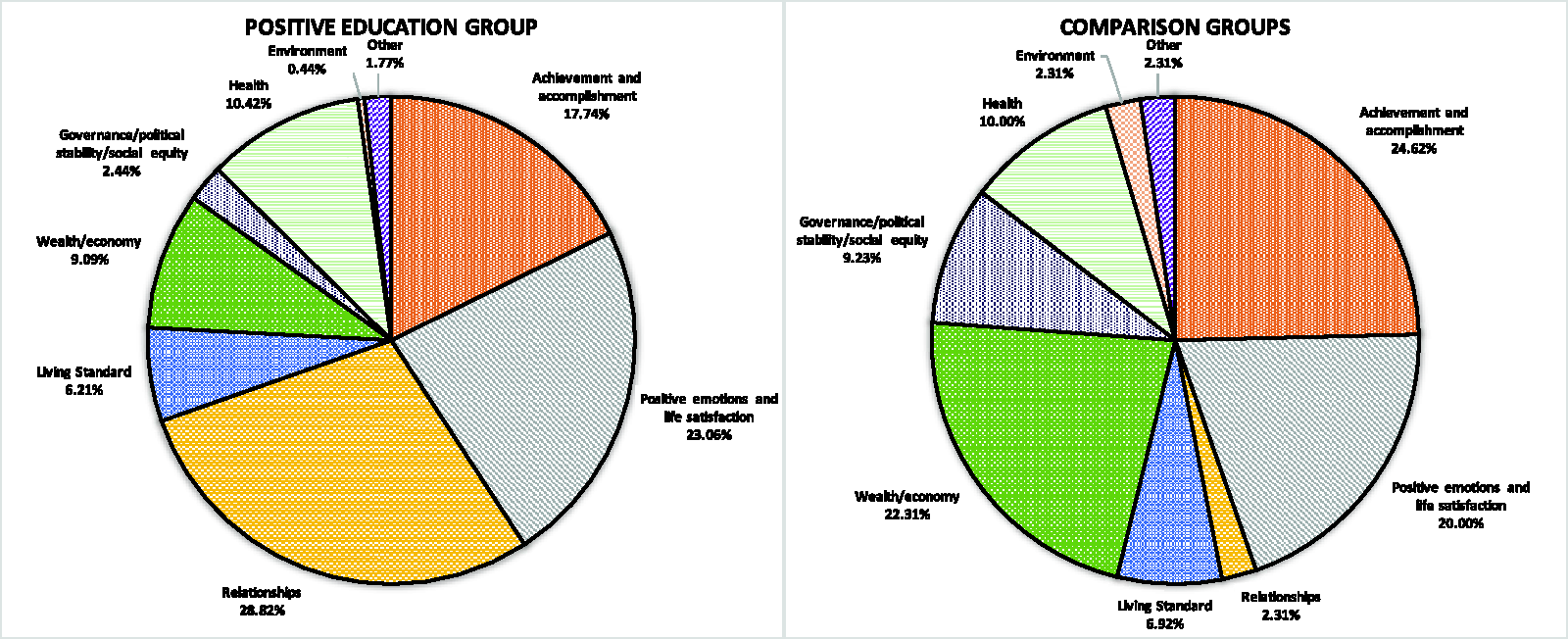
Coded references by percentage of total per group.
Happiness-related terms featured third in the PosEd group word frequency query (Figure 2), contrasted with tenth in the comparison group. This may indicate that students in the PosEd group are more likely to associate success with positive emotions. Nonetheless, many comparison group participants also equated happiness with success or prosperity, with many students in these groups referring to collective rather than individual happiness: ‘…. a nation's prosperity is in modern terms defined by its wealth in relation to its economy, but in more realistic terms, happiness is more important than anything else. Money doesn't buy happiness’ (Comparison group participant).
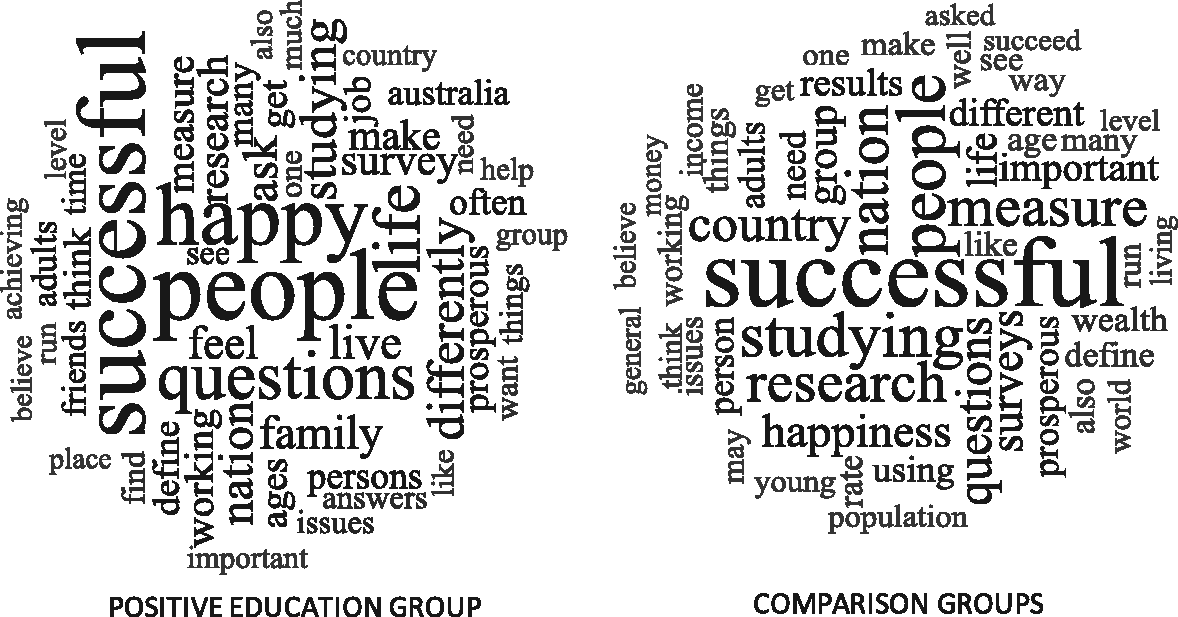
Word frequency.
Achievement and accomplishment (PERMA domain 4, PWI 2)
Students in all groups associated success with achievement and accomplishment, with a higher proportion of references in the comparison groups equating success with achievement (Figure 1). There was some acknowledgement of the achievement of lifelong happiness, as described in the Aristotelian account of eudaimonia (Aristotle & Sachs, 2002), but most descriptions of success referred to particular goals rather than lifelong achievement. Although there were a higher proportion of coded references to achievement in the comparison group, these references more frequently referred to national success when compared with the PosEd group, which included more references to individual success, discussed further in the individual/collective language section. I would define success as an accomplishment of a goal/aim. It is your own goal that you set out to complete. (PosEd group participant) Success is based on how satisfied they are with achieving their goals and being happy. (PosEd group participant) I would define success and prosperity as the wealth and achievements of the nation. (Comparison group participant)
Relationships (PERMA domain 2, PWI 3)
The greatest contrast between the PosEd group and the combined comparison groups was the prevalence of discussion about the role of personal relationships, with 28.82% of references coded in the PosEd group attributing success or prosperity to connections with family, friends and the community, compared with only 2.31% in the comparison groups. The word frequency query showed that family and friends were discussed frequently in the PosEd group responses, with 147 mentions of family and 86 mentions of the word friends. Comparison groups mentioned the word family only four times and friends only once.
Wealth, economy and living standard
Although wealth was mentioned by students in both groups, it was discussed more frequently in the comparison groups, with 22.31% of coded references falling into the wealth or economics category in that group, contrasted with only 9.09% in the PosEd group. Also interesting was the way wealth was discussed in both groups, with the comparison groups more likely to discuss wealth and economic success of the nation. Few students referred specifically to the value of money for future security, as in the PWI (Tomyn & Cummins, 2011), with most references describing the value of money in terms of improving living standards. For this reason, the themes ‘living standard’ and ‘money’ could have been combined under the same parent node, but the decision was made to keep them separate as the inferences are slightly different. Many students in the comparison group discussed economic success and the impact this might have on a nation’s prosperity: ‘When we discuss the idea of what makes a nation great, we can look for example at the country's rate of unemployment, how successful its economy is, and the size of its army’ (Comparison group participant).
Governance, political stability and social equity (relates to PWI 4)
More students in the comparison groups considered issues of governance, political stability and social equity in their discussion of prosperity and success. These themes were discussed in 9.23% of references coded in the comparison groups. In contrast, the PosEd group discussed these themes in 2.44% of coded references, although wealth is discussed separately by many students. I would say that success (or prosperity) in my opinion would be a general measure of the economic, political and social stability and wealth across the nation. (Comparison group participant) I would define success as a country as having a minimal wealth gap between the rich and the poor. (Comparison group participant)
Health, environment and sustainability (relates to PWI 1)
All groups discussed the importance of health as a measure of success and prosperity, with 10.42% of references coded in the PosEd group falling into this category, and 10% in comparison groups (Figure 1). Students described both the health of the nation, as well as individual good health. The environment and sustainability only featured once in the PosEd group (less than 1%), compared with four references in the comparison groups. I would define a nation's prosperity by both its infrastructure (e.g. Wealth, Growth, Safety, etc.) as well as the state of its citizens (are they happy, healthy, wealthy or poor, etc.) because both have an equally important impact on a countries [sic] well-being. (PosEd group participant) If a nation can get everyone clean food and water, access to a medical care and a job as well as keeping the environment healthy and reducing CO2 emissions at safe levels, ten [sic] a nation has truly been successful. (Comparison group participant)
Individual versus collective language
Students’ responses to the writing task were also coded for their use of collective, as opposed to individual language, with some responses coded as reflecting both forms of language (Figure 3).
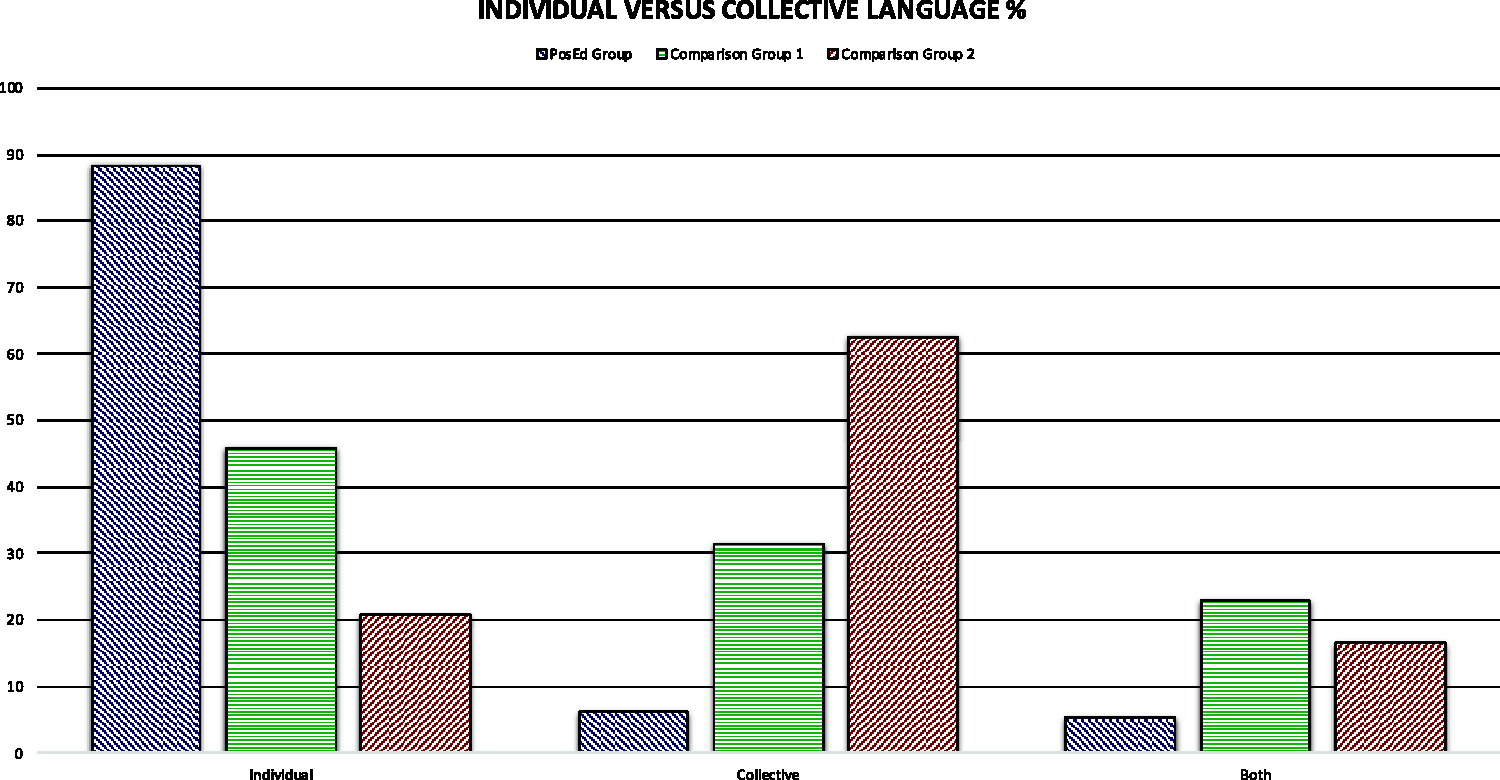
Individual versus collective language.
More students in the PosEd group interpreted success and prosperity in individual rather than collective terms, with 88.36% in the PosEd group discussing success exclusively as it pertained to the individual, 6.16% discussing success in collective terms and 5.48% referring to both collective and individual success in their written discussion. Some students described methods of gauging national prosperity by measuring individual success while many others explicitly defined success as individual happiness or achievements: Ideally, success is someone who fulfils their personal achievements and have the financial means they desire whilst having a good network of friends and family. (PosEd group participant) Some questions that I would consider asking would be: How old are you? Where do you live? How would you define prosperity? Have you found prosperity? (PosEd group participant) I would measure the collective success of the country through efficiency of economy, politics, and population well-being…. (Comparison group participant) Success, as an umbrella term, is used ... to describe a multitude of factors ranging from and including average wage or salary (including taxes), economic stability, public service quality, market growth and demand, and worth of ownership of goods. (Comparison group participant)
Discussion
Young peoples’ conceptions of national prosperity and success
The students’ accounts of national prosperity and success in this study extended beyond the traditional association of prosperity with wealth or success with financial or academic goals. Although these students discussed accomplishment, economics, career success and wealth in their definitions, many students considered the importance of relationships, happiness and environment when thinking about success or prosperity. This might indicate that the language used in the teaching of positive education has influenced the way these adolescents think about success and prosperity. However, many students in the comparison groups also referenced these themes in their discussions, so not all discussions of an expanded view of success or prosperity can be attributed to the influence of a positive education programme.
Do conceptions of national prosperity differ in young people who attend a school with a whole-school approach to positive education?
The findings suggest that students who have completed a positive education programme may possess an understanding of the human element of national prosperity and success, as opposed to limited metrics such as GDP and economic growth. Family and friends were discussed more frequently in the writings of the positive education group than in the comparison groups, reflecting positive education’s emphasis on building strong connections and on gratitude. Students in the positive education group invariably referred to at least one of each of the PERMA domains, as well as the PWI framework, when considering national prosperity and success, possibly indicating that positive psychology is succeeding in generating thought about a redefined idea of success. Although this has somewhat confirmed our prediction that students in a positive education school would be more likely to look beyond academic or financial definitions of success and prosperity than students who had not participated in positive education, there is more work to be done in this area.
Reflections of the PERMA and PWI domains in adolescents’ conceptions of prosperity and success
Elements of PERMA such as positive emotions, relationships and accomplishment appear to be valued by these young people when they consider how to measure prosperity and success. However, fewer students gave in-depth explanations that directly discussed engagement or meaning, indicating a possible area for expansion of the positive education programme. PWIs including health, community-connectedness, safety and future security were discussed less frequently as part of a definition of success, but were discussed in the context of a broader discussion of prosperity.
Limitations
There was a disparity between the sample sizes in the PosEd group compared with the much-smaller comparison groups. Although patterns and themes could be detected in all groups, with the two comparison groups sharing more similarities with each other than with the PosEd group (most notably the lack of discussion of personal relationships), a further study should aim to compare groups of similar sizes (i.e. a larger comparison group).
There is a possibility that the comparison group had been exposed to PPIs through their usual well-being programme; however, the amount of exposure would have been considerably less than the Positive Education school participating in this study. In addition, the broad aim of this study was to explore the impact of a whole-school positive education approach on students’ ideas of prosperity and success. The Positive Education school had adopted this whole-school positive education approach for several years prior to this study and this would have been well established by the time this research was conducted. The aim of challenging ideas of success and prosperity are arguably strongest in schools that have adopted the ‘whole school’ model of positive education. Individual PPIs such as resilience training, peer support, gratitude or mindfulness exercises contribute to well-being but may not necessarily engender the whole school aim of shifting the metrics in education.
At the same time, it should be noted that students in the PosEd group had participated in various studies as part of their school’s positive education pilot programme (Vella-Brodrick, Rickard, & Chin, 2014; Vella-Brodrick et al., 2017), were probably aware of the fundamental goals of positive education study and therefore demand characteristics for such a study might appear in their responses. In this paper, however, we have examined evidence of an ideological shift that is not explicitly part of the students’ positive education training. Most other studies undertaken by researchers working with these students involved assessing the students’ levels of well-being (Vella-Brodrick et al., 2014, 2017). Therefore, students could not have been aware that this is what we would examine. In addition, the use of a framework (PWI) unfamiliar to the students may insulate this study against this type of response bias.
There is also the possibility of social desirability bias in the type of study that deals with moral or normative subjects. Students might feel that a response about happiness or one that reveals their social responsibility makes them appear to researchers to be better people. Students completing the task in the positive education (PosEd) group were also aware of the purpose of the ARC Linkage project and that the data were being collected as part of a larger positive education study. These students had provided previous data and were aware that they were ‘living’ the positive education experience on which the study was focused. The potential impact of this is inescapable and could produce a study bias. We sought to combat this to some extent by examining questions that extend beyond the scope of positive psychology interventions explicitly taught to this group, using both the PERMA framework (Seligman, 2011) and Cummins’ Quality of Life framework (Cummins, 1997; Tomyn & Cummins, 2011) in the analysis. Cummins’ framework existed prior to the inception of positive psychology and is not typically considered to be under the umbrella of positive psychology. Although it reflects similar values as the PERMA framework (Seligman, 2011), it comes from an arguably different tradition than positive psychology and, therefore, has the potential to show that the values and ideas instilled by positive psychology interventions, or specifically by a positive education programme, hold up to scrutiny beyond the field.
We were aware that the potential for insularity within a field is a reality within this type of education research that seeks to analyse ideas and attitudes taught as part of a specific programme. A researcher looking specifically for knowledge of the PERMA domains (Seligman, 2011) might teach students about the domains and then test them on their knowledge, and this would primarily be an exercise in comprehension. In this study, the student writing task did not indicate what we would examine and many of the main themes were not explicitly mentioned in the writing task question. In our analysis we sought to move beyond the ideas within the writing task question put to the participants and infer themes that potentially have a broader practical impact on students’ lives and communities.
Relevant, too, is the active role of the researcher in interpreting these data, including Ely, Downing, Vinz, and Anzul’s (1997) observation that themes do not reside in the data, but rather in the mind of the researcher. With this in mind, we adopted an essentialist/realist epistemological standpoint in interpreting data, assuming that the language used by the students reflects the students’ real beliefs, meaning and experience. We approached the data with the ethical assumption that ‘success’ and ‘prosperity’ are inherently good things and that this alone provides the imperative for participants to act in a way (or desire to act in a way) that will bring such success to their own lives or to their own communities. Interpretation of data is informed by the PERMA domains (Seligman, 2011) and PWI (Cummins, 1997; Tomyn & Cummins, 2011), which provided an objective lens.
In addition to these lenses, we interpreted the data within the context of the goals of positive education: to establish an ‘economy of well-being’ which privileges some paths to prosperity above others. The inherent normativity of any quality of life study also cannot be ignored, and we are mindful that although positive psychology literature acknowledges that there are many paths to a good life, the most fulfilling path generally involves a contribution to the community. The ‘values-neutral’ position or moral pluralism of some positive psychology proponents is, in fact, an area of contention (Kristjánsson, 2012; Wong & Roy, 2017) but this study sought to move beyond this in the hope of encouraging a more collective and community-minded approach to flourishing, as described by Wong (2011), Biswas-Diener (2011) and others.
A new prosperity? Moral and social concerns
Looking deeper into the moral messages the writing tasks convey, a sense of individualism pervades even those that referred to ‘helping others’ or contributing to society. Positive psychology has been criticised for its ostensible individualism (Biswas-Diener, 2011; Wong & Roy, 2017), and at times seems to promote community service almost as a side effect of the pursuit of personal happiness or as a means to attain individual happiness, but not as an end in itself. These student responses do tend to put the individual at the forefront of their conception of prosperity. It is interesting that even though more students in the comparison groups included more references to economic contributors to success and prosperity, more of these students discussed social equity and the gap between rich and poor than in the positive education group. The references to wealth and the economy were also more likely to be in collective terms. Despite the superficiality of defining success in terms of wealth, this might be considered a more social view of prosperity.
Further study is needed to determine whether the apparent individualism and superficiality is the result of a limited timeframe or scope of the question presented, or whether there is something lacking in their education about what social equity might contribute to a truly prosperous nation. A writing task question that specifically asks for depth and greater clarity might reveal more detail about what students think comprises a successful nation. Nonetheless, even under time pressure, the first response of most students in the PosEd group was to consider individual happiness. Even if their deeper understanding extends beyond this, they have clearly privileged this above a more collective view of prosperity and this warrants further research.
On the other hand, the tendency for positive education students to value personal connections like family and friendships as a sign of success is a promising indication that positive education programmes can have an impact, not only on mental health but conceptually. This might be harnessed to achieve the most important purposes of schooling: community harmony and the collective good.
In light of the present social and political climate, one might suggest that Seligman’s (2008) proclamation that Australia is a ‘wealthy’ country that therefore needs to focus on well-being as a mark of prosperity has become a little less relevant. There is something paradoxical in declaring that we are wealthy so we should therefore be happy, whilst simultaneously claiming that wealth is not the most important mark of success. In the past 10 years our world has arguably become more nationalistic, disharmonious and tumultuous and a less ethnocentric, more existential, positive education may have a role to play in helping young people to navigate that. Students of positive education now need an awareness of their responsibilities as part of a social whole and a harmonious community. This can be reflected in the school community, where students can develop skills that encourage active participation in a community which supports social cohesion. Further, positive education has the opportunity to impart an existential awareness of our relative smallness in the world as humans but yet our power to change it for the better, through contributions to our community, sustainability and the environment.
Positive education is growing and evolving. This study reveals a possible need for a more social positive education, drawing from educational philosophers such as Noddings (2010) and Dewey (1923), and from work that encourages a more ethical positive psychology (Wong, 2011). Within this new framework, there needs to be a new, more social, idea of success and prosperity that informs not only the teaching within positive education, but ideas about the purpose of schooling. Our need to create a ‘new’ prosperity, as expounded by Seligman (Diener & Seligman, 2004; Seligman, 2008) is as relevant as it ever was, but the actual path towards this new prosperity is far more complicated, less ethnocentric, and is more firmly grounded in social harmony and collective well-being than in current positive education frameworks. A proposal for this new definition of prosperity for the common good, and an examination of the role positive education might play in it, is beyond the scope of this study but is an exciting avenue for further study that will serve to consolidate the goals of positive education into the 2020s and beyond.
Footnotes
Acknowledgements
We gratefully acknowledge all participating schools and students.
Declaration of Conflicting Interests
The author(s) declared no potential conflicts of interest with respect to the research, authorship, and/or publication of this article.
Funding
The author(s) disclosed receipt of the following financial support for the research, authorship and/or publication of this article: This project was funded by an ARC Linkage grant-LP130100357. (2013-2016) Vella-Brodrick, D. A., Rickard, N. S. Cross, D. S; Hattie, J. A. Robinson, J. & King, C. A. Enhancing adolescent mental health through positive education and supported by an Australian Government Research Training Program (RTP) Scholarship.