




Abstract
This literature review critically synthesizes 10 years of international teacher expectations research using a simplified “expectation effect process” model. New developments in teacher expectation research are outlined, including effects of teacher expectations on students, teachers’ development of expectations, teachers’ differential treatment of students, and students’ reactions to teacher expectations. A brief overview of pre-2008 research presents the foundations of the post-2008 research using the same “expectation effect process” model. A separate section about Australian research is also included. Results of the literature review show that while qualitative research on the topic has increased from 2008 to 2018, quantitative studies still prevail and qualitative studies on the topic—particularly those which consider students’ perspectives—are rare. Hence, this article argues that the development of a more holistic, in-depth understanding of how teacher expectations affect student outcomes is possible through contextually embedded qualitative research that includes exploration of students’ reactions to teacher expectations. In this way, further understandings about how and why expectation effects vary between students could be gained.
Keywords
Change the way you look at things, and the things you look at change.
Wayne Dyer
Introduction
Students are likely to be affected by what their teachers expect of them. Educational research about teacher expectations has illustrated this relationship over the last century and more than 50 years of research since the infamous Pygmalion Study (Rosenthal & Jacobson, 1968) has highlighted that teacher expectations influence students’ attainment of educational outcomes. This article synthesizes teacher expectation research from 2008 to 2018 in order to describe new developments since the significant findings of seminal studies earlier in the new millennium such as Weinstein’s (2002) deep exploration of the power of teacher expectations and Rubie-Davies’ (2007) findings about the practices of high and low expectation teachers. In addition, this article offers a historical lens of pre-2008 research on the topic.
The phrase “teacher expectations” has various meanings across studies, leading to inconsistent implicit and explicit definitions used to shape research. In this article, teacher expectations are defined as inferred judgments that teachers base on their knowledge of students about “if, when, and what” students can achieve at school (Good, 1987; Rubie-Davies, 2014). Teacher expectations have been measured through teachers’ projections for students’ future attainment at school or teachers’ ideas about students’ present capacity for academic success (Friedrich, Flunger, Nagengast, Jonkmann, & Trautwein, 2015). Although the overall effect of teacher expectations is small (Jussim & Harber, 2005), expectations can become powerful self-fulfilling prophecies when teachers base their interactions with students upon these expectations (Jussim, Eccles, & Madon, 1996; Rubie-Davies, Peterson, Sibley, & Rosenthal, 2015). This simplified explanation of the term “teacher expectations” captures a complex process that is dependent on many layers of contextual factors (Weinstein, 2008). The phrase teacher expectations also encapsulates a promising field of educational research, with Australian and international research showing that increased teacher expectations lead to increased student outcomes (D'Warte, 2014; Rubie-Davies et al., 2015; Weinstein, 2008; Weinstein & Worrell, 2016).
This review of the literature from 2008 to 2018 provides a critical synthesis of research on teacher expectations and how they are linked to student outcomes as it stands in 2018. The synthesis starts with a historical overview of the Pygmalion effect which is followed by a review of the last 10 years of research on teacher expectations. This structure enables an emphasis on illustrating where opportunities for future research and practical implications exist.
A brief history of the Pygmalion effect
The idea of expectations affecting a person’s lot in life is ancient, dating back to Western culture’s oldest stories. In Ovid’s Metamorphosis, Pygmalion felt so much love towards the image of a woman he had created that the gods made his statue come to life to become Pygmalion’s wife. Pygmalion’s ideas about the perfect woman became a reality through his actions and feelings, just as teachers’ expectations can become a reality for their students. More modern manifestations of this age-old story are apparent in literature and pop culture, with stories like Great Expectations and films like Million Dollar Baby. This genre features young, hopeful characters who excel through a more privileged mentor’s belief in them. Modern self-help books and management guides often refer to the power in setting high expectations for oneself and of others. This enduring theme reveals an underlying confidence in the power of expectations and a belief that people can change as a result of how others see them.
Educational research shows that students can change as a result of how their teachers see them. Promising developments from 2008 to 2018 have built upon a long history of research showing that students’ educational outcomes are influenced by their teacher expectations. Educational research since the 1960s has shown that high expectations for student achievement result in better academic outcomes (Rist, 1970; Rosenthal & Jacobsen, 1968). Teacher expectations research has raised much controversy, with criticisms that inconsistent methods have been used by researchers in this field (Raudenbush, 1984) and that the influence of teacher expectations is too often overstated (Wineburg, 1987). Another criticism asserts that teacher expectations do not have much influence on students’ academic outcomes but that they are accurate predictors of students’ academic outcomes (Jussim, 1986; Jussim & Harber, 2005). Criticisms abound, but even critics agree that teacher expectations are influential and can have substantial effects on students’ outcomes (Jussim & Harber, 2005; Raudenbush, 1984; Wineburg, 1987).
Despite criticisms, the majority of research demonstrates that when teachers set high expectations, their students follow suit (Alvidrez & Weinstein, 1999; Weinstein, 2002, 2008). Students can also follow suit when teachers set low expectations, especially when they are from already disadvantaged backgrounds (McKown & Weinstein, 2008; Rubie-Davies, Hattie, & Hamilton, 2006). The period 2008–2018 has seen 10 years of continued research on teacher expectations that supports these findings and new research continues to add insight into the complex processes through which teacher expectations effects occur.
The following diagram (Figure 1) illustrates a process model to outline the research into how students come to be affected by their teacher expectations, adopted from the original six-step model by Brophy and Good (1970). This model is intentionally over-simplified and does not fully illustrate the complex, contextual influences on the teacher expectation effect process, which are non-linear and multi-faceted. The purpose of the model here is to scaffold the overall shape of the literature about teacher expectations in order to emphasize new developments and areas for further research. The simplified, four-step version of an “expectation effect process” model (Figure 1) provides a framework for the current review of the research relating to teacher expectations. Brophy and Good’s original model has more detail, including areas of teacher differential treatment (instruction, feedback, and opportunities for learning) and student reactions (student self-concept and motivation). Other additions and omissions to the expectation effect process which have been put forward by other researchers 1 have not been included here for the sake of the clarity of this literature review.
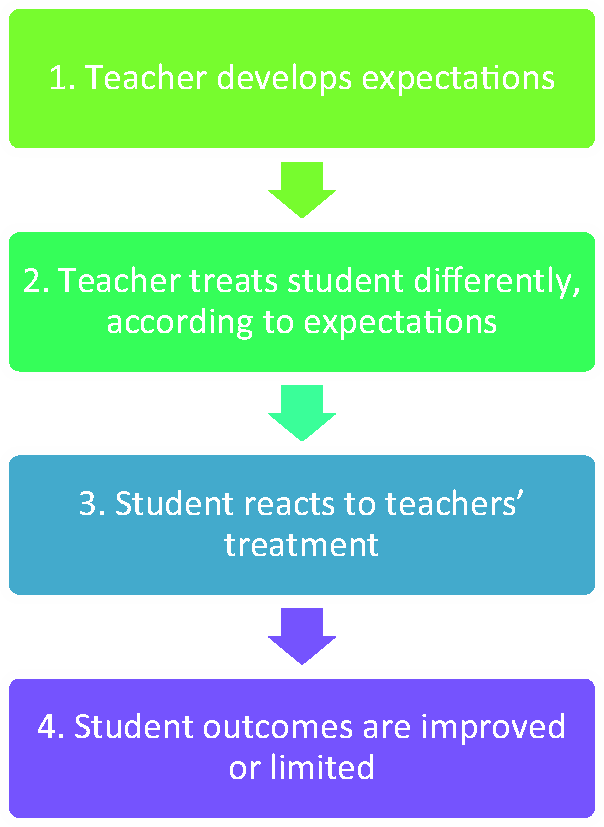
Expectation effect process model (adapted from Brophy & Good, 1970).
The synthesis of the literature presented in this article reveals that much research has investigated the four steps in the expectation effect process. The connection between teachers’ development of expectations and student outcomes has historically been emphasized in teacher expectations research because of the dominance of quantitative research. Such research has found numeric representations of relationships between teacher expectations and student outcomes, with meta-analyses concluding that teacher expectations can affect student achievement substantially (Hattie, 2008; Jussim & Harber, 2005). Yet little qualitative research explains how and why this occurs.
Research has also historically focused on the first step in the expectation effect process, finding that teachers develop their expectations of students through students’ characteristics. Factors that can influence teacher expectations of their students have been investigated, such as prior academic achievement (Rist, 1970), effort (Helwig, Anderson, & Tindal, 2001), ethnicity (Tenenbaum & Ruck, 2007), socio-economic status (SES) (Alvidrez & Weinstein, 1999; Rubie-Davies et al., 2006), and gender (Dusek & Joseph, 1983; Van Duzer, 2006). Teachers vary in the ways in which they develop expectations of their students, with some tending towards more stratified expectations than others (Babad, Inbar, & Rosenthal, 1982; Donohue, Weinstein, Cowan, & Cowan, 2000). Qualitative research in this area has suggested that school differences in composition and culture also influence teacher expectations of students (Diamond, Randolph, & Spillane, 2004). Many quantitative studies have contributed to knowledge about how teachers form expectations for students and a few qualitative studies have added complexity to the picture, emphasizing the role of context.
A large portion of historical research has focused on the second step in the expectation process. Results of this research indicate that teachers treat their students differently according to their expectations. This research showed that teachers communicate differential expectations through differential treatment, categories of which have been developed, including ability grouping, work and activities offered, questioning of students, establishing classroom climate, use of praise and/or criticism, behavioral expectations, amount of student autonomy, and offering assistance (Babad et al., 1982; Marshall & Weinstein, 1984; Rosenthal, 1994; Weinstein, Marshall, Brattesani, & Middlestadt, 1982; Weinstein & Middlestadt, 1979). Teacher differential treatment can be verbal but much of it is covert and non-verbal (Babad & Taylor, 1992; Rosenthal, 2003).
In another study, students identified that some teachers used a lot of differentiating behavior in the class and some teachers did not use much differentiating behavior, which led to the distinction between “high differentiating” and “low differentiating” teachers (Weinstein & Middlestadt, 1979). This was followed by confirmation that teachers who used more differential treatment had more expectation effects on their students (Kuklinski & Weinstein, 2001). Shortly after, a landmark study confirmed that teachers held class-level expectations for groups of students that were more strongly related to student achievement than teacher expectations of individual students (Rubie-Davies, 2007).
Teachers who have generally high expectations for students practice flexible grouping, offer students choices, use a facilitative approach, give all students the same opportunities to learn, continually monitor students’ progress, and encourage student autonomy (Rubie-Davies, Hattie, Townsend, & Hamilton, 2007; Weinstein, 2002). Practices of teachers with generally low expectations include using more directive instruction, offering less student choice, giving less feedback, asking more closed questions, and grouping students inflexibly into ability groups (Rubie-Davies, 2007). Historical attempts to apply these findings to raise teachers’ expectations have seen some success in improving student outcomes (Weinstein, Collins, Cone, Mehlhorn, & Sintontacchi, 1991). Research about how different “types” of teachers can have different expectancy effects shaped much of the pre-2008 teacher expectation research, offering explanation about why the impact of teacher expectations can vary between students dramatically.
Students also react to teacher expectations in ways that improve or limit their educational attainment. This third step in the expectation effect process has historically been implied or discussed in theoretical terms, but seldom directly empirically linked with teacher expectations. Reactions that students may have were theoretically linked to psychological constructs such as “self-concept” and “self-esteem” (Brattesani, Weinstein, & Marshall, 1984; Jussim, 1986; Rubie-Davies, 2006; Weinstein et al., 1982). Further research explored student reactions to singular teacher differential behaviors, such as the influence of teachers’ praise/criticism on students’ initiation of interactions with teachers (Cooper, 1979) or how teachers’ verbal feedback influences students’ academic self-concepts (Burnett, 2003). Tests of how students react to these singular behaviors show significant, but weak connections with student reactions and results. Research on students’ perceptions of their teacher expectations began to suggest a relationship with students’ “self-expectations” (Brattesani et al., 1984), “morale” (Babad, 1995), and students’ “self-perceptions” (Rubie-Davies, 2006). Older students were found to be more likely to perceive and mediate teacher differential behaviors, suggesting that students could be helped to develop self-appraisal strategies to boost their confidence if faced with low expectations (Kuklinski & Weinstein, 2001; Weinstein, Gregory, & Strambler, 2004). Quantitative studies like these offer evidence that students react to their teacher expectations in ways that are crucial to the expectation effect process, but they do not explain how and why this is so.
Before 2008, very few studies included qualitative descriptions of how and why students react to their teacher expectations. Some researchers encountered teacher expectations as relevant for students when qualitatively researching aspects of education that students find to be important (Bishop & Berryman, 2006; Brophy, 1998), but qualitative investigation of student reactions to teacher expectations were not the foci. Rhona Weinstein’s research, discussed in her 2002 book Reaching Higher: The Power of Expectations in Schooling, was one unique exception. Her research included deep consideration of the differing experiences of children in elementary school classrooms where teachers had varying expectations. Her accounts led to new theory about students’ reactions to teacher expectations by describing students’ perspectives of where teachers saw them in the classroom achievement hierarchy. Students saw their position as more or less static depending on how much perceived differential behavior they experienced. Students described hurt feelings, eroded motivations and efforts to ignore teacher differential treatment that communicated low expectations. In response to teachers’ communication of high expectations, students described feeling pride, pressure to maintain position, and concern about slipping in performance. Students’ approaches to learning also varied across classes where teachers were high or low differentiating, as students perceived that their efforts would make more of a difference in some teachers’ classes than others. Students reacted to their teacher expectations by adopting ideas and beliefs about their long-term learning prospects, with low achievers feeling hopeless and seeing little point trying to learn in classes of high-differentiating teachers. Weinstein’s work was unique, opening a door to research that described students’ reactions to their teachers’ expectations. So far, her research has never been replicated in either primary or secondary school contexts.
The outline of historical research on teacher expectations presented in this article so far has been framed according to a four-step expectation effect process, showing a solid foundation of teacher expectation literature before 2008, but that the field has been dominated by quantitative research. Research from 2008 to 2018 has been able to build upon this long history of inquiry and understanding, drawing on opportunities left by previous researchers. The rest of this article will synthesize international and Australian educational research from 2008 to 2018 according to the four-step expectation process to reveal those aspects of teacher expectations on which new research has focused and what new opportunities and understandings have arisen over the last 10 years.
A synthesis of teacher expectation research from 2008 to 2018
This literature review was conducted through a consistent methodological approach so that its results can be replicable and withstand the same scrutiny as primary research. Database searches and search results have been accounted for carefully (see summary in Appendix 1 and an example of more detailed summary in Appendix 2), with a total of 119 inclusions. Consistent inclusion and exclusion criteria were applied (see Table 1).
Inclusion and exclusion criteria.
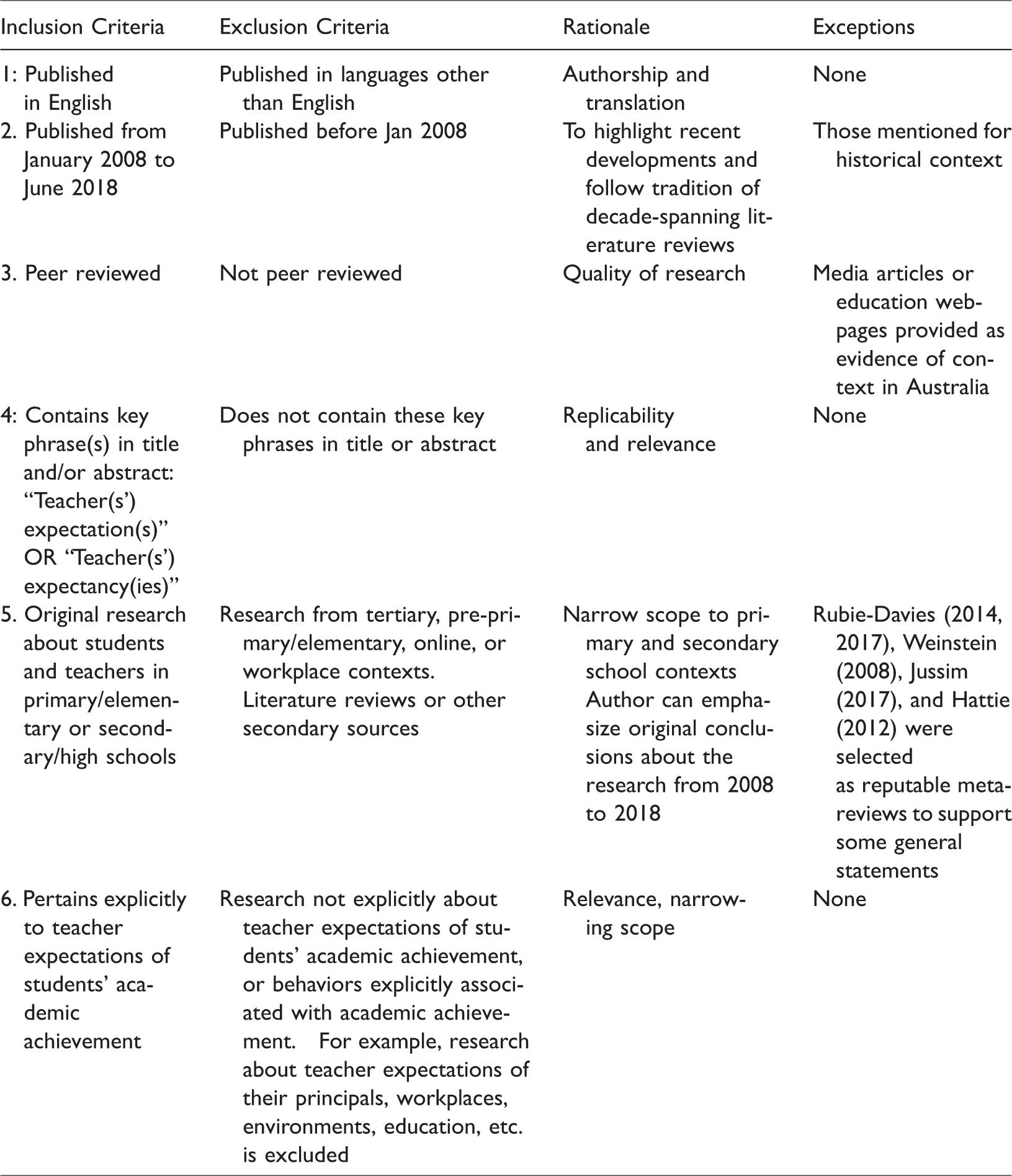
The inclusion and exclusion criteria in Table 1 allow for a replicable and consistent synthesis of the literature in the following review. The first section of the synthesis outlines research which has focused on the first and last steps of the expectation effect process model from 2008 to 2018 (Figure 2).
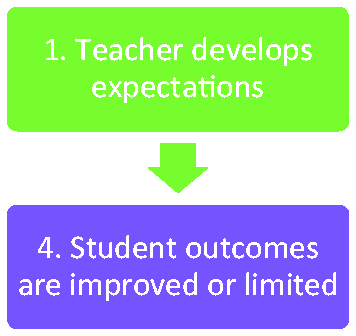
First and last step of the expectation effect process model.
Quantitative research and the missing middle steps (Step one to step four: Teacher expectations can improve or limit student outcomes). Teacher expectations continue to influence students’ educational outcomes. Ten years of research from 2008 to 2018 demonstrated quantitatively the overall effect of teacher expectations. Results from research continued to show inconsistent effects of teacher expectations across contexts and methodologies, supporting the recently renewed argument that the power of teacher expectations is too often overstated (Jussim, 2017). Research focused on the first and last step of the expectation process has still glossed over the complex processes through which teacher expectations impact upon student outcomes, using predominately quantitative methods. New developments include increasing use of longitudinal data and evaluations of interventions designed to improve student outcomes. Studies confirmed teacher expectations effects, while a few qualitatively considered the voices and viewpoints of students.
One major development in research into teacher expectations regards the possibility of enduring effects that last beyond one school year. Research from 2008 to 2018 found some evidence that the influence of teacher expectations can dissipate over multiple years of schooling (Archambault, Janosz, & Chouinard, 2012; Hinnant, O'Brien, & Ghazarian, 2009) and that teachers of different year levels had expectations of their students that were only slightly related to one another over nine years of school (Jamil, 2013). Yet, other longitudinal studies showed evidence of teacher expectations accumulating, providing evidence of a single teacher’s expectation effect on students over multiple years of schooling (de Boer, Bosker, & van der Werf, 2010; Rubie-Davies et al., 2014). Contextual reasons for these varying results can be gathered from longitudinal findings that the influence of SES on teacher expectations compounds over students’ years of education to increase disparity between the results of student SES groups (Hinnant et al., 2009; Mistry, White, Benner, & Huynh, 2009), and that expectation effects are greater for students who are mature (Jamil, 2013), are females, or are members of minority groups (Jamil, 2013). These new research findings use longitudinal data, sometimes showing that the effect of teacher expectations last more than one year of school, but with inconsistent results across studies.
Teacher expectations have also been shown to be associated with students’ long-term academic pathways in research from 2008 to 2018. The increasing availability of data from wide-scale longitudinal studies has allowed researchers to compare students’ post-secondary outcomes with projections made by teachers during earlier years of schooling (Dabach, Suárez-Orozco, Hernandez, & Brooks, 2018; Sciarra & Ambrosino, 2011). Students considered not finishing high school more often when their teachers held low expectations for their ability to succeed at school, according to research in the Flemish context (Van Houtte & Demanet, 2016). However, students graduated more often when their teachers had high expectations of them (Samel, Sondergeld, Fischer, & Patterson, 2011; Van Houtte & Demanet, 2016). Teacher expectations were also related to students’ university aspirations and academic attainment for Taiwanese students, but with no relationship to students’ SES (Wu & Bai, 2015). However, in other contexts, teacher expectations for students’ future college attendance were shown to be particularly influential for students from low-income backgrounds, for example in a study of Year 10 students’ future educational pathways from the United States (Gregory & Huang, 2013). Expectations for post-secondary academic pursuits can also be pronounced according to students’ ethnicities. Interviews with teachers of students who had recently immigrated from Central America revealed modest long-term projections for students’ post-secondary academic pursuits, which teachers attributed to factors outside of the schools’ locus of control—family-, cultural-, or poverty-related problems (Dabach et al., 2018). Such suggestions that long-term effects of teacher expectations may be due to confounding variables outside of school were addressed in research which found external input (from family, culture, or otherwise), during holiday periods made no difference for the enduring effects of teacher expectations on American kindergarten students (Kim, 2015). Nonetheless, research from 2008 to 2018 has added a long-term dimension to the historical finding that students from low SES and historically disadvantaged ethnic groups are more vulnerable to the influence of their teacher expectations than others, but results have continued to vary across contexts.
This synthesis of research from 2008 to 2018 also reveals studies which concluded that teacher expectations were important for student educational outcomes, even in research that did not set out to explore teacher expectations at the outset. For example, some studies have identified teacher expectations as a mark of quality teaching and an influencing factor for student academic outcomes (Boston, 2012; Buckley, 2010; Joseph, Viesca, & Bianco, 2016; Pantaleo, 2016). Stark differences in achievement between Hong Kong and England also resulted from differences in teacher expectations across the two countries, according to a study that set out to consider the reasons for stark differences in PISA international mathematics achievement data (Browne & Richard Wong, 2017). Further studies of inequalities between and across educational systems have found teacher expectations to be relevant. Qualitative evidence illustrated student awareness of their teachers’ low expectations and that low expectations were pivotal in their academic experiences and outcomes of inequality (Joseph et al., 2016; Korp, 2012). Students equated low expectancies for African American students with racism (Joseph et al., 2016; Strayhorn, 2010). These qualitative studies offered students a voice and inadvertently uncovered student perspectives of teacher expectations in larger conversations about overall educational experiences. Such research that did not set out to examine teacher expectations still encountered their relevance for student outcomes.
Recent interventions in education have demonstrated practical applications of teacher expectation research. A school founded on the principles of high expectations called CALPrep has opened in the United States, partnering with a local university and accepting only students from families whose parents had not attended university (Weinstein & Worrell, 2016). The school became one of the top academically performing schools in the area, despite its difficulties including high rates of disadvantage (UBCPsychology, 2018). Another intervention was in New Zealand, where a Teachers’ Expectation Intervention which focused on the expectation-related behaviors of teachers resulted in improved student academic results (Rubie-Davies et al., 2015). Smaller studies have affirmed that teachers’ consciously adopting high expectations for students from groups that have been historically disadvantaged can result in a narrowing the achievement gap between Latino and non-Latino students (Liou & Rojas, 2016; López, 2017). In these examples, education has been intentionally shaped so that students experience the benefits of high teacher expectations. Practical applications of teacher expectations research to improve student academic outcomes through intervention will be discussed in further detail later in this article.
Overall, research focusing on the first and last step of the expectation effect process has shown that teacher expectations can accumulate over years and that teachers’ projections for post-secondary outcomes can be influential for students’ attainment of academic outcomes. Some research affirms the influence of teacher expectations for students’ school outcomes despite initially setting out to explore educational inequalities. Interventions that have sought to improve student outcomes by raising teacher expectations have seen success, further reinforcing the relevance of teacher expectations in research from 2008 to 2018. Research that provides evidence of the effect of teacher expectations on students’ academic outcomes has continued to be predominately quantitative, although a few studies have offered students a voice through qualitative research.
The next section synthesizes research from 2008 to 2018 which focuses on the first step of the expectation effect process (Figure 3).
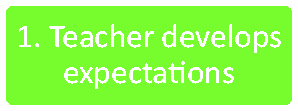
First step of the teacher expectation effect process.
New ways of judging student potential (Step one: How teachers form their expectations). Further research over the last decade added to understandings about the first step in the expectation effect process: teachers’ development of expectations. New research from 2008 to 2018 confirmed that factors considered traditionally in research, such as SES (Namrata, 2011; Tobisch & Dresel, 2017), ethnicity (Rubie-Davies & Peterson, 2016), and gender (Auwarter & Aruguete, 2008) can influence the development of teacher expectations in ways that vary according to context. Some new behaviors and characteristics upon which teachers can base their judgments about students’ academic potential have been added (Wellborn, Huebner, & Hills, 2012). Ways of measuring teachers’ implicit prejudices have been developed (E. R. Peterson, Rubie-Davies, Osborne, & Sibley, 2016; van den Bergh, Denessen, Hornstra, Voeten, & Holland, 2010). Studies about this first step in the expectation effect process also primarily used quantitative methods and little research qualitatively gave students voices and considered their viewpoints.
Pre-conceived beliefs contribute to teachers’ formation of expectations, including those relating to gender, SES, and ethnicity. Research from 2008 to 2018 has shown that ideas teachers hold about gender can influence their expectations of students but these findings are not consistent across cultural contexts (Lazarides & Watt, 2015; Shepherd, 2011; Yiu & Adams, 2013). Cultural factors are crucial to how teacher expectations are formed and research has continued to emphasize that teachers develop beliefs through their previous experiences of attributes. For example, in a French study, previous experiences of gender influenced teachers’ development of expectations for future students according to gender (Chalabaev, Sarrazin, Trouilloud, & Jussim, 2009). Teachers also held higher expectations for students with whom they were demographically matched by ethnicity (Gershenson, Holt, & Papageorge, 2015) or SES (Jamil, Larsen, & Hamre, 2018). Qualitative evidence has confirmed that teachers held low expectations for some traditionally disadvantaged ethnic groups, including African American and Hispanic students (Contreras, 2011; Harris, 2012), but racially biased expectations could be mitigated through teachers’ development of critical awareness about history and race (Liou & Rojas, 2016; López, 2017). Further ethnic minorities such as Turkish students in the Netherlands (van den Bergh et al., 2010), South-Asian students in England (Crozier, 2009), and New Zealand’s Maori students (E. R. Peterson et al., 2016) have been established as subject to teacher racial-bias, leading to low expectations and negative influences on achievement.
Teachers also use students’ behavioral cues to develop expectations for academic outcomes. Research from 2008 to 2018 has explored student behaviors that contribute to teacher expectations (Timmermans, de Boer, & van der Werf, 2016; Wellborn et al., 2012). Teachers were more likely to report high academic expectations on surveys when information about students’ behavioral strengths was included in vignettes (Wellborn et al., 2012). Student behaviors including self-control and cooperation were also regarded by teachers as essential to success at school, and thus informed American teachers’ academic expectations (Lane, Pierson, Stang, & Carter, 2010). On the other hand, students who were unable to control tempers during conflict or comply with teacher instructions did not attract high expectations for academic success (Wellborn et al., 2012). These studies about students’ behavior as cues for teacher academic expectations all used surveys and hypothetical vignettes to determine which students’ behaviors were relevant.
Research has also expanded on the array of student characteristics that influence teacher expectations, including disabilities, aspects of physical appearance, perceived maturity, computer skills, parental involvement, and parental incarceration. Research drawing on methods including case studies and retrospective narratives have found that students with emotional behavior disorder and deafness experienced low academic expectations from their teachers (Smith, 2013; Teklu & Kumar, 2013). Another study used hypothetical vignettes to find lower teacher expectations for students who had a diagnosis of attention deficit hyperactivity disorder of which their teachers were aware (Batzle, Weyandt, Janusis, & DeVietti, 2010). Findings from 2008 to 2018 have added that teachers held lower expectations for achievement in Physical Education classes for females when they were overweight and not when they were not overweight (J. L. Peterson, Puhl, & Luedicke, 2012). Other student attributes related to family background have contributed to teachers’ formations of expectations, such as perceived parental involvement in high school (Kuperminc, Darnell, & Alvarez-Jimenez, 2008), parental aspirations (Crozier, 2009; de Boer & van der Werf, 2015) or the incarceration of parents, and especially mothers (Dallaire, Ciccone, & Wilson, 2010). Further student characteristics that influenced teacher expectations include the age of perceived puberty onset (Carter, Mustafaa, & Leath, 2017) and perceived skills with computers (Paino & Renzulli, 2013). New research from 2008 to 2018 added these student characteristics that contribute to teachers’ formations of expectations.
Teachers also form their expectations based on their perceptions of students in groups. Rubie-Davies’ (2010) seminal work on class-level expectancies included findings that teachers can have class-level expectations that they base upon perceived attributes according to students’ attitudes to schoolwork, interpersonal relationships, and home support. Research in the Netherlands also found that teachers’ expectations for individual students were higher, on average, when the student was in a classroom with high achievers and less socio-ethnic disadvantage (Timmermans, Kuyper, & Werf, 2015). Further connections between research about ability grouping and research about teacher expectations illustrated how when secondary students were streamed into classes by ability, teachers saw them as more homogeneous than mixed ability class groups and planned to teach them according to class-level expectations (Johnston & Wildy, 2018). Teacher expectations were also more biased according to ethnicity when classes were more ethnically homogeneous, but less so when they were more ethnically diverse (McKown & Weinstein, 2008). These studies have begun to consider how class-level expectations are formed.
Larger groups such as entire school populations inform teacher expectations as well. Research from 2008 to 2018 included examples of schools with large proportions of ethnic minority or socio-economically disadvantaged groups being faced with a culture of teacher “deficit” attitudes towards students, resulting in low expectations for students and a consequential lack of academic rigor (Rodriguez, 2012). These schools’ cultures, or “expectation climates,” influenced teachers to have lower expectations of their students (Thys & Van Houtte, 2016). School composition and climate explained as much as 21% of variance in expectations between teachers in Canadian low SES high schools (Brault, Janosz, & Archambault, 2014). Teachers in a high ability “gymnasium” school in Germany had high expectations for students’ cognitive ability, behavior, and discipline, which was statistically linked to teachers’ perceptions of their collective efficacy and self-efficacy (Knigge, Nordstrand, & Walzebug, 2016). Such quantitative research established that the effect of demographic factors like SES and ethnicity on the formation of teacher expectations can be indirect, but qualitative research has told stories of principals’ success in challenging and changing deficit cultures (Clayton, 2016; Khalifa, 2011). Perceived level of support from school and community was also linked with teachers’ expectations (Doyle, 2014). This research shows that teacher expectations are developed with influence from school populations and school cultures.
Further understanding of how teacher expectations are formed has been gained through new ways of measuring implicit prejudice. Teachers are not always accurate reporters of their own beliefs about students, so alternative ways of measuring the implicit attitudes on which teachers base their expectations are useful (van den Bergh et al., 2010). For example, modern researchers have measured implicit bias in teachers by tasking teachers with computer-based random association tests (Hornstra, Denessen, Bakker, van den Bergh, & Voeten, 2010). In these tests, teachers are asked to respond to fictional vignettes or drawings (Carter et al., 2017) or to grade fictional student papers or oral presentations (Van Ewijk, 2011). A New Zealand study found no link between explicitly stated teacher expectations and the ethnic achievement gap between Maori and Caucasian students, but statistical analysis showed that ethnicity was more related to student achievement results in Mathematics when teachers scored more highly on a test designed to measure implicit prejudice (E. R. Peterson et al., 2016). Further international research validates implicit measures of teacher prejudice as indicative of how teacher expectations are formed and how the resulting prejudiced expectations go on to create ethnic achievement gaps in student outcomes (Van den Bergh et al., 2010). These new measures continue to suggest that implicit prejudices may be even more influential on student outcomes than explicit expectations and self-reported prejudices.
Few studies have sought students’ perspectives of how teachers develop expectations. Qualitative research has provided insight into how students conceptualize teacher expectations being formed. For example, in studies by Carter et al. (2017) and Pringle, Lyons, and Booker (2010), African American students attributed teachers’ low expectations to students’ race and the history of racism in the United States. A study using focus group interviews to explore students’ perceptions of their teacher expectations showed black and Latino students had feelings of being stereotyped as having low intelligence which they perceived to lead to low expectations even when there was contrary evidence from academic performance (Carter et al., 2017). African American students also attributed low teacher expectations to their race and perceived that teachers expected lower quality work from them (Pringle et al., 2010). These students’ ideas about how teachers develop expectations provide a different lens on how teachers develop expectations.
The factors that influence teachers’ development of expectations for students’ learning remained a major focus for research from 2008 to 2018. Findings add to an understanding of how teachers develop expectations through student attributes such as membership in class and school groups, diverse minority groups, and according to student behavior. Ways of investigating implicit biases have also continued to expand. Much quantitative data are included, and few student views.
The next section discusses research on teachers’ differential treatment of students: the second step in the expectation effect process (Figure 4).
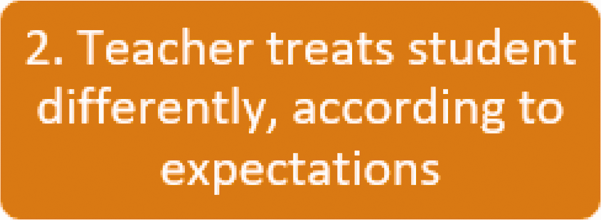
Second step of the expectation effect process model.
Increasing perspectives from students (Step two: Teachers treat students differently, according to expectations). The second step in the expectation effect process is another part of teacher expectation research that has expanded, but with more focus on practical applications than theoretical knowledge. New contributions from research in this area have increasingly considered students’ perspectives, but still few qualitative studies give students a voice. Intervention studies have aimed to affect positively student achievement through teachers’ expectation-based behaviors, with promising results when teachers develop the practices of high expectation teachers.
New knowledge has emerged regarding measurement of the many ways that teachers treat students differentially. Specific differential classroom behaviors have developed as research areas in their own right, including investigations into differences in teachers’ use of oral feedback (Chen, Thompson, Kromrey, & Chang, 2011) or the use of rote learning programs (Odabasi Cimer & Cimer, 2010). Some teachers in England limited the tier of national tests allocated to their Black Caribbean students for whom they had low expectations (Strand, 2012). A new tool for measuring teacher differential behavior was introduced with the Classroom Ability-based Practices (CAP) observation tool—a 30-item scale designed to gather observation data of teachers’ differential treatment (Bohlmann & Weinstein, 2013). Classroom observations and teacher surveys are used to gather information about teachers’ differential treatment, but other research has further explored using students as sources of data.
Students are the subjects and perceivers of their teachers’ differential treatment in the classroom. Students’ perspectives have offered rich data sources for this research (Rio, 2017; Segedin et al., 2012), with findings from 2008 to 2018 that showed teachers reported more equitable classroom behavior than indicated by student perspectives (van den Bergh et al., 2010). Teachers reported giving higher order assessments—in terms of Bloom’s Taxonomy—than those actually assigned to students (Odabasi Cimer & Cimer, 2010). Teachers perceived their treatment of students to be less differential than students, who reflected on teacher differential treatment astutely from as young as six years old (Le, 2014). Such findings from 2008 to 2018 show value in research that considers student viewpoints of their teachers’ differential treatment but few studies actually use students’ perspectives.
Research which has identified teachers’ differential behaviors that influence student results has had practical implications for improving classroom teaching. Experimental studies from 2008 to 2018 aimed to raise teacher expectations, with positive effects on students’ academic outcomes. In the Netherlands, 35 teachers were led by researchers to construct “well-considered” performance goals for students, which led to improved student outcomes in mathematics for those students (Ritzema, Deunk, Bosker, & van Kuijk, 2016). The Teachers’ Expectation Project in New Zealand included giving an experimental group of teachers four days of professional development that aimed to help them to adopt the practices of high expectation teachers, such as goal setting and flexible grouping (Rubie-Davies et al., 2015). Results showed that the intervention was successful in improving the experiment groups’ student academic outcomes in mathematics and that where teachers adopt the practices of high expectation teachers, students can benefit (Rubie-Davies, 2017).
Research from 2008 to 2018 has contributed to the teacher expectation field through employing intervention studies, developing new tools for research, and expanding knowledge about teachers’ differential treatment. Recent studies include some students’ perspectives and validate the importance of doing so. However, to provide a full picture of the expectation effect process, links with how students react to differential treatment are crucial.
The next section discusses research from 2008 to 2018 on student responses to teachers’ differential treatment (Figure 5).

Third step of the expectation effect process model.
A crucial step in the expectation effect-process (Step 3: How do students react to teacher expectations?) Research on student reactions has made explicit ties with concepts from educational psychology such as “self-concept,” “perceived self-efficacy,” “motivation,” “self-esteem,” “engagement,” or “self-belief.” The impact of these psychological states on academic outcomes is implied through the link to these other fields of research, but it is not within the scope of this article to fully describe all of the research areas that have been theoretically linked to teacher expectation research. Other research established psychological outcomes as mediators in the expectation-effect-process by showing their importance numerically. Few studies have discussed student reactions to teacher expectations or differential behaviors with students, using qualitative methods to provide a deeper understanding of how students react.
A few qualitative studies explore how students react to their teacher expectations, although not all make explicit connections with teachers’ differential treatment. New research has added that bi-racial, Latino and African American students’ feelings of being misunderstood and marginalized in education were, in part, because of perceived low teacher expectations (Andrews & Gutwein, 2017; Bae, Holloway, Li, & Bempechat, 2008; Pringle et al., 2010; Williams, 2013). Students may react differently to their teachers’ treatment according to culture, as Latino students reported in interviews a strong belief in the association between effort and achievement regardless of teacher differential treatment (Bae et al., 2008) whereas previous interviews with American students associated high teacher differential treatment with less belief in the power of effort over ability (see outline of Weinstein’s, 2002 work earlier). A New Zealand study included qualitative data from students who felt that teachers’ high expectations helped while low expectations hindered their obtainment of academic scholarships (Horsley, 2012). These recent qualitative studies have added to previous literature by focusing on students’ points of view. Participant students reacted to their teacher expectations or differential treatment in ways that they perceived impacted upon their educational results.
Teacher expectations can also cause students to react by experiencing stress. New findings from 2008 to 2018 have added to historical descriptions of how expectations can create worry and concern among high achieving students (Weinstein, 2002). Conflicting international results included that children as young as six in Hong Kong saw their potential inability to meet teachers’ academic expectations as a source of stress (Wong, 2014), yet students in a secondary school for high achievers in Sweden did not experience teachers’ academic expectations as a source of stress (Låftman, Almquist, & Ostberg, 2013). A direct link to effects on students’ academic outcomes was not made in these studies, nor was a direct link made with teachers’ differential behaviors, but the findings reinforce that psychological effects of teacher expectations on students can vary according to contextual factors such as age, school type, and culture.
One approach to measuring students’ reactions to teacher expectations is to ask teachers how they perceive hypothetical students’ reactions to differential behavior. A unique study from the Netherlands followed this approach by presenting teachers with hypothetical vignettes which described teacher differential behaviors and asked teachers to respond on a questionnaire about how their students would react (De Jong, Van Tartwijk, Verloop, Veldman, & Wubbels, 2012). Findings indicated that teachers predicted that hostile behavior invited hostile responses from students, dominant behavior led to submissive response from students while friendly behavior invited friendly responses from students. Thus, De Jong and coworkers explored their theory about how students responded to teachers’ differential behaviors and found evidence in support of a complementary principle of student reactions. However, no direct link with student outcomes was made.
Students’ reactions to teachers’ differential treatment are discussed in terms of psychological reactions. Research from 2008 to 2018 continued to link students’ perceptions of differential treatment with their self-perceptions of academic ability. Students used teachers’ oral academic feedback more than oral non-academic feedback to develop academic self-concepts, according to a wide-scale study of Taiwanese students’ perspectives of differential treatment (Chen et al., 2011). Students were also more likely to self-perceive their ability to succeed academically when their teachers used less differential treatment than when they use more differential treatment (Bohlmann & Weinstein, 2013) or when students are in classes of “high expectation” versus “low expectation” teachers (Rubie-Davies, 2008). Use of the CAP measurement tool confirmed that teachers who used more differentiating behaviors tended to have students whose academic self-beliefs were more congruent with teacher expectations, while teachers who used less differentiating behaviors tended to have students with higher academic self-beliefs, although less in line with teacher expectations (Bohlmann & Weinstein, 2013). These findings from recent research used surveys and observations to affirm that teachers’ differential behavior results in students adapting their academic self-belief. If students adapt their self-belief, this could have an impact on their academic outcomes but research does not always explicitly make this connection to the last step in the expectation process.
Other psychological reactions to teacher expectations that students have also involve them adapting their ideas about themselves as learners. “Self-concept,” “self-esteem,” or “self-expectancy” are all terms which refer to ideas that students have about themselves as learners. Researchers from 2008 to 2018 have employed these terms to make explicit connections with various fields in psychology that have been well established as being connected with students’ academic results. “Self-concept” studies from 2008 to 2018 used quantitative research to find that students’ self-concepts partially mediate the Pygmalion effect on student achievement, according to an analysis of large-scale longitudinal data from Germany (Friedrich et al., 2015). Students’ “self-esteem” and “self-expectancy” also mediated results for students’ end of high school exams in a retrospective study from Poland using student indicated teacher expectancies (Trusz, 2018). These studies used different terminology such as “self-concept,” “self-esteem,” or “self-expectancy” to reference fields of psychological research on students’ ideas about themselves as learners (Friedrich et al., 2015; Trusz, 2018).
Other research identifies two main types of “cognitive antecedents” that are discussed as student reactions to teacher expectations which impact upon performance: perceptions of academic self-efficacy and engagement (Tyler & Boelter, 2008, p. 36). Poor engagement with school was statistically linked to student perspectives of low teacher expectations for students’ academic achievement in research on behavioral misconduct among students in Flemish secondary schools (Demanet &Van Houtte, 2012). Other researchers have used the term “motivation” instead of engagement (Woolley, Strutchens, Gilbert, & Martin, 2010), finding that “students’ motivation” was a mediating factor in expectation effects on academic outcomes for Chinese students (Zhu, Urhahne, & Rubie-Davies, 2018). However, evidence from the Netherlands did not support that teacher expectations affected student motivation (de Boer & van der Werf, 2015) whereas other evidence from the Netherlands suggested that the effect of teacher expectations on motivation for reading may be different for girls than boys (Boerma, Mol, & Jolles, 2015). Research in Greece has also suggested a stronger effect of teacher expectations on girls’ “self-efficacy” beliefs for Information and Communications Technologies (ICT) (Vekiri, 2010). In the United States, student perceptions of academic “self-efficacy” as well as behavioral and emotional engagement were statistically related to teacher expectations (Tyler & Boelter, 2008). These studies continue to primarily use surveys to generate quantitative data, finding numeric relationships between teachers’ expectancies or differential behaviors and student reactions including engagement and perceptions of academic self-efficacy.
Overall, research on student reactions to teachers’ expectations from 2008 to 2018 has shown that students react to teachers’ differential treatment or expectations in ways that differentially affect their educational outcomes. Such research has employed terminology and concepts from educational psychology to connect students’ reactions to their teachers’ expectations. Research has also established that students react to the amount of differential behavior used by teachers, with more expectancy effects when more differential behavior is used. However, little of this research has used qualitative methods to deeply explore how and why students react to their teachers’ expectations, and how and why this might result in different expectation effects for different students.
The next section outlines Australian contributions in teacher expectations from 2008 to 2018.
Australian contributions in teacher expectations research from 2008 to 2018: continued practical implications. Researchers in Australia have made some contributions to teacher expectations research, including Australian researchers who have contributed to research on teacher expectations in international contexts (Hornstra et al., 2010; Seah, 2016; Tan & Yates, 2011). Research within Australian contexts has generally had an applied focus.
Educational research in Australia has included practical efforts to mitigate the effect of low teachers’ expectations for minority students. Aboriginal (Sarra, 2011) and English as a Second Language (ESL) students (Dumenden, 2012) have experienced low teacher expectations, although not all Australian teachers have deficit views of such students (Sharma, 2011). However, a narrative example tells of a Burmese refugee ESL student who experienced limited academic outcomes because of low teachers’ expectations, but was able to overcome limitations through one-on-one tutoring (Dumenden, 2012). High teacher expectations are also beneficial for improving educational outcomes of Aboriginal Students (Hurst & Sparrow, 2010) and the “Stronger Smarter Learning Communities” program was designed to lead school principals to raise expectations for Aboriginal students through a hub school mentoring approach. Anecdotal evidence from the leader of “Stronger Smarter” includes that Aboriginal students and their educators have benefited from the approach (Sarra, 2017). Thus, some studies have been successful in improving educational outcomes for minority groups in Australia through increased teacher expectations.
Australian research from 2008 to 2018 also includes studies about teacher practices that result from teacher expectations. High teacher expectations for young children are outlined in the Early Years Learning Framework (“Belonging, Being & Becoming,” 2009), and researchers have challenged teachers to adopt high expectations by offering examples of situations where students benefit from high expectations (Coles, 2016; Devlin, 2012). Studies in Australia have explored differences in teachers’ expectations and resulting practices for groups of students. Higher teacher expectations were found in a high SES school than in a low SES school, which resulted in teachers using different pedagogies (Dulfer, 2015). Teachers also had differential expectations for students in low and high streams, informing their decisions about pedagogy, pace, and curriculum (Dulfer, 2015; Johnston & Wildy, 2018). These studies associate teachers’ expectations with teachers’ practices.
Further Australian research confirms the benefits for students when teachers have high expectations. Teacher expectations were identified as the key component in research that developed a model for “excellent teachers’” thinking (Hamzah, Mohamad, & Ghorbani, 2008). Findings showed that students benefited from cooperative learning when there was clear communication about teacher expectations for learning outcomes (Gillies & Boyle, 2010). Teachers with high expectations also had class climates with more emphasis on mastery goals, but less emphasis on performance goals, which resulted in participant Year 10 students having more ambitious future career goals (Lazarides & Watt, 2015). These studies also show the academic benefits for students when teachers practice communicating clear and ambitious expectations.
Further Australian studies have aimed to raise teacher expectations. Teachers in a Sydney school raised their expectations for student achievement when they were led to understand and value their students’ diverse language backgrounds through an experimental study (D'Warte, 2014). Other Australian teachers independently developed and communicated high expectations to students, consciously endeavoring to increase students’ academic self-concepts (Ali, 2009). These research findings show teacher expectations research being applied to educational practice within Australia to improve student achievement.
Australian educational research has explored how teacher expectations influence teacher practice, applying research findings so teachers adopt high expectations that increase student outcomes from education. Practical implications for teacher expectations research have shown promise in Australia and students in Australia will continue to benefit from efforts from educational researchers to raise teacher expectations.
The final section concludes the article by summarizing and discussing directions for future research.
New directions and future pathways
Teacher expectations can substantially affect student results but the effect is not consistent across contexts or students. Teacher expectation effects can account for anywhere from 3% to 60% of variance in student achievement, according to meta-analyses (Hattie, 2012; Jussim et al., 1996; Jussim & Harber, 2005; Rubie-Davies, 2014). This article has provided an overview of new developments in research from 2008 to 2018 that added to our knowledge that expectancy effects on student academic outcomes vary. Findings show that variations are according to student background, teachers’ level of differentiation, and an array of other setting related factors.
Research from 2008 to 2018 has expanded traditional areas of teacher expectations research, including findings that different teachers have different expectation effects on student academic outcomes (Bohlmann & Weinstein, 2013; Ritzema et al., 2016). The possibility of a “different students, different expectation effects” process is suggested by quantitative research that continues to show students are affected differently according to an increasing range of background factors (Dabach et al., 2018; Gregory & Huang, 2013). Further qualitative research has explored how students respond to, and are affected by, their teachers’ expectations (Andrews & Gutwein, 2017; Pringle et al., 2010) in terms of student “self-concept,” “engagement,” and “motivation” (Friedrich et al., 2015; Trusz, 2018), implying a theoretical link with academic outcomes that is seldom shown by the studies themselves (Boerma et al., 2015; Vekiri, 2010).
Overall, evidence from 2008 to 2018 continued to show that students react to teachers’ differential treatment in ways that improve or limit student achievement, and that this effect can vary substantially across students and groups of students. Research also continued to establish that this process happens through teacher effects on students that vary according to teacher and context. Interventions designed to raise teacher expectations have seen some success in improving student academic outcomes. However, still few qualitative studies have deeply described how and why expectation effects on academic outcomes occur through teachers’ differential treatment, how and why students react to differential treatment, and how and why this improves or limits their academic success. Such research would offer students a voice and viewpoint in teacher expectation research. It may also clarify students’ roles in the expectation-effect-process, offering new ways to maximize the impact of teacher expectation interventions to improve student outcomes.
It would appear limiting that much research—historically as well as in the recent period of this literature review, from 2008 to 2018—has relied heavily on quantitative research. New theory about students’ role in the expectation process could add to our understanding of the expectation effect process and why it can vary drastically in effect. In depth, contextually based accounts of how and why students react to teachers’ differential treatment and how and why this affects their achievement might explain how and why individual students are affected differently by their teacher expectations. Qualitative research offering students a voice and viewpoint could help complete the picture of the teacher expectation effect process.
Footnotes
Authors’ Note
All of the References listed below are cited in text in the article.
No preceding asterisk: Referenced in text as a historical reference (pre-2008).
One preceding asterisk: One of the 115 that are referenced in the review of literature from the decade spanning 2008–2018.
Two preceding asterisks: Contextual or general reference, not part of the literature about teacher expectations.
Declaration of Conflicting Interests
The author(s) declared no potential conflicts of interest with respect to the research, authorship, and/or publication of this article.
Funding
The author(s) disclosed receipt of the following financial support for the research, authorship, and/or publication of this article: This research was supported by an Australian Government Research Training Program (RTP) Scholarship