




Abstract
The scholastic success of Bolongaia (Maria Lock), at the Parramatta Native Institution in 1819, arguably positions her as an academic giant. Bolongaia’s exam results challenged the opinions of the day when she ‘bore away the chief prize’. Bolongaia’s academic success was based purely on her acquisition of western based knowledges and values. In contrast, I was awarded a Masters of Indigenous Education in 2016. This academic achievement draws attention to a significant change in the positioning of Aboriginal Knowledges in the academy. This article is a letter to my ancestral grandmother, Bolongaia, to tell her about the Aboriginal women who have challenged the status quo of western based educational frameworks and research paradigms. This article honours the Aboriginal women who have paved a way for Aboriginal knowledges in mainstream educational institutions in ways that Bolongaia was unable to experience and perhaps even imagine in her lifetime.
Keywords
Introduction
Dear Grandmother Bolongaia,
I write this letter to you in response to this year’s NAIDOC Theme, ‘Because of Her We Can’. First, I want to thank you for leaving a legacy that enables us – Dharug mob – to stand proud. I also want to tell you about some of the women over the last three generations that continue to challenge dominant views about who we are and what it means to be an Aboriginal person living in Australia today. This year – 2018 – marks the 201st year since your incarceration in the Native Institution and although your story is not shared or taught in our schools, your grandchildren, eight generations later, know who you are and how your actions have shaped the opportunities they actually have today. As one of your many descendants, I wish to thank you for your strength, resilience, wisdom and spirit that see me raising my voice with our people about our Ways of Knowing, Being and Doing.
Grandmother Bolongaia, I want you to know that your Dharug descendants are walking many paths and fill many roles in society today. Together, we keep alive the spirit, knowledge and culture of our Country and peoples and I want you to know that it is your strength and actions that helped to lay the foundations of the path we now walk. In honouring cultural protocols, I identify my position and place in relation to you, Bolongaia. My connection to Dharug Country is through my maternal Grandmother Win, Winifred Harkins nee Locke (see Figure 1). I am a seventh generation descendent of Yarramundi, your father, Kuradji (chief) of the Boorooberongal clan of the Dharug Nation. I acknowledge my responsibility and accountability to my relations and ancestors to tell the truth and to advocate their wisdom, strength and resilience.
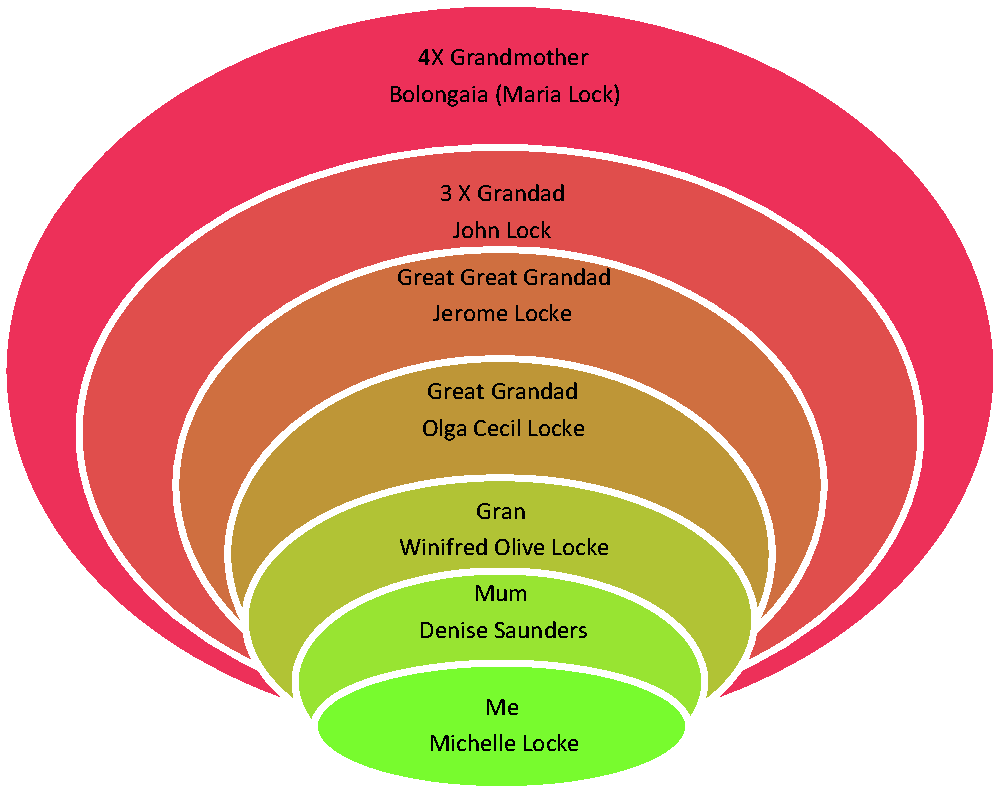
Family line with maternal grandmother.
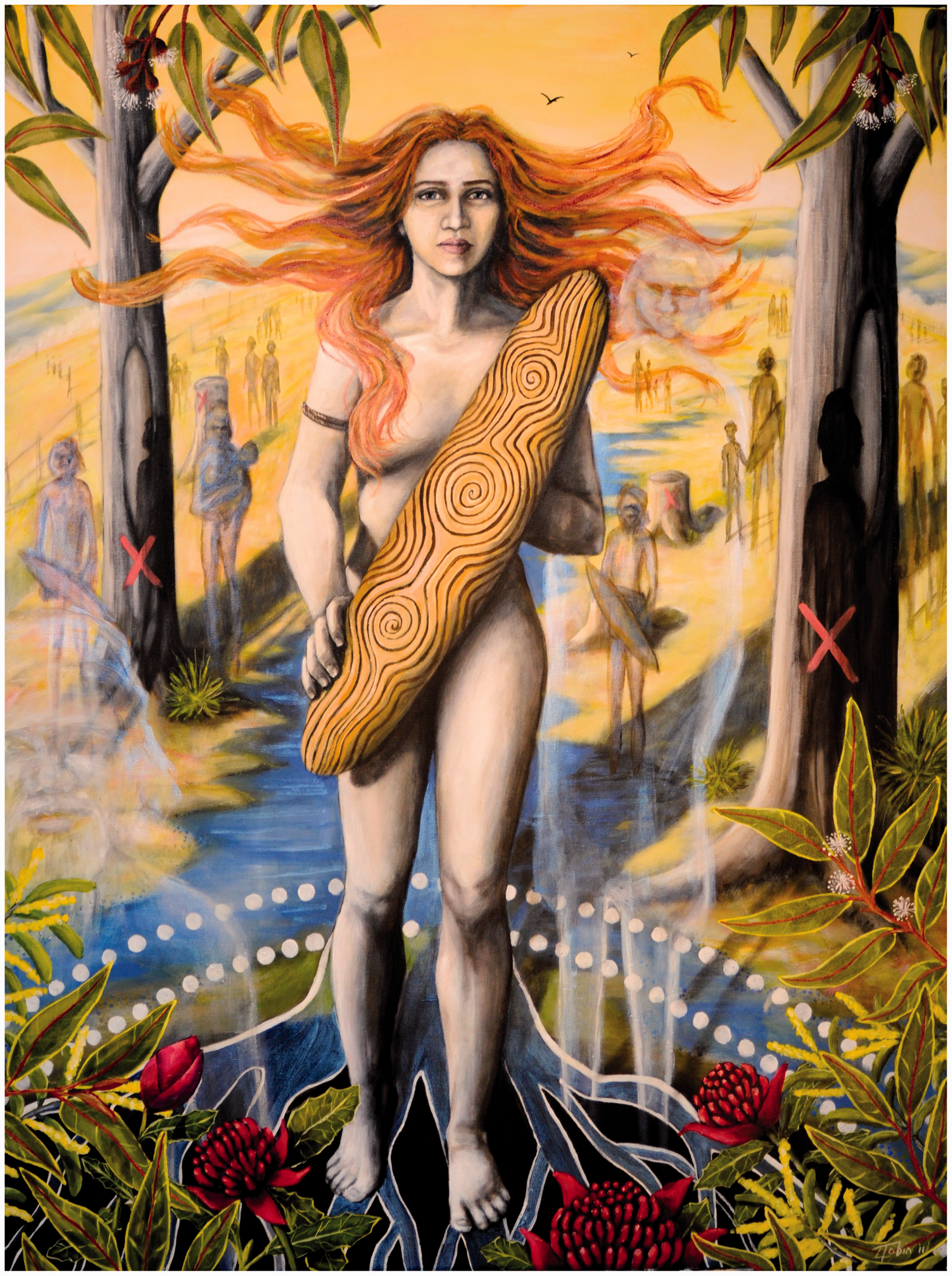
Defending country 2011. © Leanne Tobin.
Prior to the Academy
Dear Grandmother Bolongaia,
The main theme of this article that I address to you has a focus on the achievements and influence of Aboriginal and Torres Strait Islander women in the academy. 1 However, from the outset, I wish to acknowledge and proffer my gratitude to the many women who, for a variety of reasons, have not been able or have not chosen to engage in academic careers but have enabled myself and others to follow such a path. These women I speak of are our mothers, sisters, aunts and grandmothers whose Aboriginal and Torres Strait Islander voices were silenced by colonisation, resulting in the absence of Indigenous perspectives and knowledges in mainstream society and the academy for many generations (Battiste, 2005; Smith, 2012).
To begin, I wish to share with you a story of my maternal Grandmother Win (Winfred Olive Harkins – nee Locke). Born in 1921, she was an only child and was not told about her connection to this Country and did not learn this truth until she was in her eighties. On learning about her father’s identity and her connection to Dharug Country, my Grandmother Win cried, saying, ‘there are things in my childhood that make sense to me now’.
I know that in your time, Grandmother Bolongaia, being Aboriginal attracted shame and disrespect and that your experience of western education was in the form of an experimental school known as the Parramatta Native Institute. It was established in 1814 by Governor Macquarie with the specific intention of ‘civilising’ Aboriginal children through the provision of western knowledge and the indoctrination of Christianity (Christie, 1994; Cruickshank, 2008). Despite your documented success in this institution (Sydney Gazette, 1819), Aboriginal children were excluded from mainstream schools by legislation that identified Aboriginal children as uneducable. In 1848 in New South Wales, it was deemed, ‘impracticable to provide any form of educational facilities for the children of the Blacks’ (Parbury, 2011, p. 133). This type of legislation contributed to stereotypical attitudes surrounding Aboriginal intellect and social acuity.
The exclusion of Aboriginal children in mainstream schools was compounded by the exclusion of Aboriginal Ways of Knowing in mainstream education curricula (Morgan, 2006; Parbury, 2011). Under the guise of ‘protection', many Aboriginal and Torres Strait Islander children were forcibly removed from their families and communities (Wilkie, 1997). This was a deliberate and an effective act that severed crucial Aboriginal and Torres Strait Islander links to Country. Your children, Grandmother Bolongaia, and others like them were expected to conform to the values and expectations of non-Aboriginal mainstream society at the cost of Indigenous Ways of Knowing, Being and Doing (Battiste, 2005; Moreton-Robinson, 2009). In an attempt to protect children from abduction, many Aboriginal parents kept silent about their Aboriginal identity and, worse still, many Aboriginal parents stopped speaking Aboriginal languages and sharing cultural practices with their children and grandchildren. Hence, as a result of segregation and silencing, many Aboriginal children such as Grandmother Win grew up not knowing who they were and/or which Aboriginal Country they were connected to.
My beautiful Grandmother Win was 94 years young when she left her physical body in April 2016. On many occasions before her passing, she expressed much pride in learning about her father’s heritage and openly expressed her joy in meeting family she did not know she had. I will never stop missing her and I feel responsibility to use my privilege of participating in the academy to speak the truth that was kept from her for so long. Grandmother Win’s story gives me strength and determination to participate in the academy to ensure the life she lived does not go untold or unnoticed.
Grandmother Bolongaia, it is a true story that without the support and love of my mother, Denise and my sister, Julie I would not be in the position in which I am now. Their knowledge, wisdom and life experiences have guided, supported and strengthened my own learning and sense of belonging. Their faith in me never wanes and their sense of humour and blatant honesty keeps me real. Together, we share, celebrate, and grieve many experiences and events and it is for this reason that I know that my achievements to attend and succeed in the academy are equally their achievements.
Grandmother Bolongaia, I attest to the wealth of cultural knowledge, wisdom and commitment my Dharug Sisters and Aunties hold for family and community. They remind me that education is not confined to the academy and that responsibility, accountability and reciprocity to family and community are at the core of all teaching and learning. To me, they are warrior women (Bunda, 2018) as they speak the truths of Dharug experiences and knowledges to audiences that are often misguided about the reality of Aboriginal lives past and present (Behrendt, 2016; Heiss, 2012). Our Dharug and other Aboriginal Aunties and Sisters talk and work to raise Aboriginal voices and influence political agendas so that our children can be proud and engage with Aboriginal Ways of Knowing and Being well into the future.
This painting (Figure 2) ‘Defending Country’ by Leanne Tobin was awarded the 2011 Parliament of New South Wales Aboriginal Art Prize. It is her depiction and tribute to you, Grandmother Bolongaia. In an interview, Leanne explained, ‘it’s saying we’re still here, we’ve changed colour but our ancestry’s here, it’s connected to here, we haven’t gone away, we’re not going away, and … we’re going to defend country no matter what’. (Torpey, 2013)
The Academy and Beyond
Dear Grandmother Bolongaia,
It is exciting to tell you Grandmother Bolongaia that in 2018 Aboriginal and Torres Strait Islander peoples fulfil many roles in Australian society and despite these roles being embedded in a dominant western system (Behrendt, 1995; Hogarth, 2017; Page, Trudgett, & Sullivan, 2017; Smith, 2012), Aboriginal Ways of Knowing are evident in many areas. Example of these areas includes the Arts where Aboriginal perspectives of Australian history, politics and society are given voice through art, dance, music and film.
In the academy, female Indigenous scholars such as Kovach (2010), Martin (2008), Moreton-Robinson (2009) and Smith (2012) are developing, advocating and implementing Indigenous research methods that aim to dismantle the short-sighted views of western research paradigms and methodologies that serve to categorise and devalue Indigenous Ways of Knowing, Doing and Being. Also, Aboriginal scholars are developing and successfully implementing Aboriginal Ways of Knowing into western systems of education. Aboriginal Ways of Knowing such as the ‘Aboriginal Eight Ways Pedagogy’ (Yunkaporta and Kirby, 2011), Indigenous Ways of Knowing, Being and Doing (Martin, 2003, 2008) and programmes such as ‘Young Doctors for Life’ (MALPA, 2017) are moving beyond non-Aboriginal ‘objectifying’ and ‘dehumanising’ approaches (Behrendt, 2016; Hogarth, 2017) to embedding Aboriginal and Torres Strait Islander knowledges and perspectives into contemporary curricular. These and similar programmes are actively engaged in the validation of Indigenous Ways of Knowing to both Indigenous and non-Indigenous teachers and students.
My re-entry into the academy came unexpectedly. Having attended an information session about a new master’s degree, I found myself filled with that nervous energy that comes with the excitement and fear of a new adventure. Looking back, I know, Grandmother Bolongaia, that my journey and completion of the Masters of Indigenous Education would not have been possible without the dedication and ongoing support of Professor Michelle Trudgett and Professor Susan Page.
Grandmother Bolongaia, this was a very challenging time in my life. It is not unusual for Indigenous scholars to juggle commitments to family, community, work and study (Fredericks, White, Bunda, & Baker, 2011; Trudgett, 2009) and the unexpected loss of my youngest sister, Dannie, further effected my family and, in turn, my academic journey. I would not have progressed to be the PhD candidate I am today if not for the environments designed and supported by Professor Michelle Trudgett and Professor Susan Page.
This is a true story Grandmother Bolongaia and a story that is not unique. The research of Asmar, Page, and Radloff (2015), Barney (2016) and Trudgett (2009) illustrate that Indigenous students experience challenges not necessarily experienced by non-Indigenous students, there are additional factors that impact the success of Indigenous Australian doctoral students that are dissimilar to those that impact most non-Indigenous doctoral students. Notably, community and family responsibilities can have a tremendous impact on the student, and supervisors must be mindful of such expectations. (Trudgett, 2014, p. 1047) the commitment to supporting Indigenous students comes from the desire to contribute to the emancipation of Indigenous communities. Our research indicates that the work people do in this area continues to be unnoticed and unrewarded, with the personal costs uncounted. (Page & Asmar, 2008, p. 116)
Aboriginal Ways of Knowing, Being and Doing in the Academy
Dear Grandmother Bolongaia,
It is important to note that as a consequence of invasion, Indigenous Ways of Knowing from our old people – like your father, Yarramundi – have been fractured and, in some cases, lost. This reality has given strength and credit to a non-Aboriginal view that Indigenous Ways of Knowing are ‘traditional’ ways of living, and an assumption that Indigenous Knowledges are therefore extinct or without merit in contemporary society (Behrendt, 1995; Fredericks, 2013). But, Grandmother Bolongaia, you and I both know that Indigenous Knowledges are and have always been inclusive of past, present and future practices and life experiences of Indigenous People (Watson, 2007).
Indigenous scholars such as Karen Martin (2008) have made significant contributions to the recognition, representation and inclusion of Indigenous Ways of Knowing in the academy. Her work titled, ‘Please knock before you enter: Aboriginal regulation of outsiders and the implications for researchers’ (Martin, 2008) has been instrumental in advocating an Indigenous perspective to non-Indigenous scholars and has guided my own research into the inclusion of Indigenous Knowledges and Perspectives in Early Education and Care Services. For this reason, I will use this Indigenous Framework of Knowing, Being and Doing (Martin, 2008) to share with you the thoughts and strength of Indigenous women who continue to challenge stereotyped assumptions made about Indigenous peoples in the academy and across society.
Indigenous Ways of Knowing
Indigenous peoples view their own Indigenous knowledges from a very different perspective to that of non-Indigenous peoples (Semann, Proud, & Martin, 2012). As the very foundation of Indigenous Ways of Knowing is entrenched in the land (Dudgeon. Herbert, Milroy, & Oxenham, 2017; Heiss, 2018; Kwaymullina, 2017; Watson, 2017), the only way to dismantle western based misrepresentations of Indigenous Ways of Knowing is to privilege, if not centre, the voices and experiences of Indigenous Australians in research and education institutions (Martin, 2003; Santoro, Reid, Crawford, & Simpson, 2011; Semann et al., 2012; Sherwood, Keech, Keenan, & Kelly, 2011). Martin (2008) explains that Indigenous Ways of Knowing involve understanding your own connection to Country. The core conditions of Ways of Knowing are to know, as fully as it is possible, ‘who your People are’; ‘where your Country is’ and ‘how you are related to the Entities’. That is to know your Stories of relatedness, the individual and communal Stories and through this, your identities unfold. (p. 78)
For example, Larissa Behrendt’s (1995, 2016) work challenges the non-Indigenous views and assumptions which purport that Aboriginal people who live and work in urban spaces are not ‘traditional’ or ‘real Aborigines’. Likewise, Fredericks (2013) states that, We don’t leave our identities at a petrol station, bus stop, jetty or airport when we enter the city limits. When we live in a city or town, we don’t become any less or any more Indigenous. Some of us even belong to the Country where huge cityscapes and towns have been built. (p. 1) This is what I grew up to believe it meant to be Aboriginal: to be Aboriginal meant that you were smart, intelligent, inventive and resilient – just like my dad. I had no idea that I should be ashamed of being Aboriginal and hide it like the family I read about in Sally Morgan’s Book, ‘My Place’. Where I lived you didn’t have to be shamed – you just had to be silent. Just never mention it. (Foster, 2018, p. 87)
Indigenous Ways of Being
Grandmother Bolongaia, a recently published book (Dudgeon et al., 2017) provides the voices of 15 Indigenous women all of whom share their own stories of ‘Being’. Whilst each story is unique in content and detail, the underlying core of each story revolves around the role that relationships with people and places play in their lives. These include relationships with self, family, community, society and in the case of this particular book, the relationships that these women have to one another as Indigenous academics (Oxenham & Milroy, 2017).
The themes and topics that are presented by these Indigenous women range in diversity from identity, gender, sexuality and Indigenous role models, to storytelling, colonisation and self-reflection. Each chapter in this book (Dudgeon et al., 2017) illustrates three conditions of ‘Being’, as described by Martin (2008) from a Quandamooka epistemological perspective. According to Martin (2008), the conditions of ‘respect’, ‘responsibility’ and ‘accountability’ enable Indigenous peoples to confirm and retain their relatedness with ‘self and the Entities’; the ‘Entities’ meaning all aspects of Country (animals, plants, earth, waterways and sky). From this perspective, Ways of Being are not confined by specific acts or experiences; rather they are the ‘attitude’ in which one shares knowledge, stories and themselves. A quote by Kwaymullina (2017, p. 100) in the above mentioned book provides an example in which all three conditions of respect, responsibility and accountability are visible. what stories can we as women now tell to ourselves and our children that will enable us to value our holistic Indigenous selves? That will equip us to perceive and sustain the connections between people and people, and people and country, which have always been the core of an Indigenous way of being? And that have allowed us to so far overcome the devastation of colonisation so that we can imagine the possibility of a better world for ourselves and for future generations of Indigenous people. (p. 100)
Of course, there is more than one way in which to enact our Ways of Being as they have been reframed by the effects of invasion. This point has been clearly articulated by another Aboriginal scholar, Aileen Moreton-Robinson (2000) when she states that, Individuals learn to acquire new knowledge in order to act and function in contexts not of their choosing or control within the dominant culture. Indigenous women have had to gather knowledge about white people and use it in order to survive in white Australian society. The accumulation of such knowledge does not mean that we have become assimilated. Instead, what it points to is that Indigenous subjectivity is multiple because of the conditions under which it has been and is shaped. (p. 89)
Indigenous Ways of Doing
Finally, Grandmother Bolongaia, Indigenous Ways of Doing is the third aspect of the Quandamooka epistemological framework identified by Martin (2008). It is reliant on ‘knowing’ how one is related to Country and the associated entities, as well as ‘being’ clear on the expectations of respect, responsibility and accountability within that same space. From Martin’s (2008) point of view, it is a complex system which involves both the process and the practices of engaging and enacting relatedness to Country with all entities across all paradigms – from physical to spiritual. It necessitates an understanding of Indigenous Ways of Knowing and Being as well as of all entities to engage and enact with each one in their own relevant and meaningful ways. This undoubtedly requires knowledge of Indigenous stories that explain the relationships and responsibilities of people to a given place.
From this perspective, Indigenous Ways of Doing could be considered as restrictive for Indigenous people who have been displaced by government policies such as assimilation and protection. For these Indigenous people, access to the stories of one’s relatedness to Country and the entities is limited at best which, in turn, severely restricts engagement on Country in the manner that has been prescribed by Martin (2008). Although the Australian social, political and physical landscapes have changed as a result of invasion, practices such as respecting Elders, caring for and connection to Country and responsibility to community are all evidenced in the literature authored by Indigenous scholars (Behrendt, 1995; Fredericks, 2013) as well as in the lives of Indigenous People. The existence of practices and protocols such as Acknowledgement and Welcome to Country and the use of Yarning Circles (Bessarab & Ng'andu, 2010) are clear examples of Indigenous Ways of Doing. In mainstream society, and in Indigenous communities across Australia, Aboriginal and Torres Strait Islander people actively fulfil a wide diversity of roles from politicians to artists, and film makers to homemakers.
Because of Indigenous women scholars, Indigenous Ways of Doing are not restricted to non-Indigenous assumptions about Aboriginal art and culture. For me, a Boorooberongal woman of the Darug Nation, the very act of writing and engaging in Indigenist Research is a genuine expression of my Indigenous Ways of Knowing, Being and Doing. Whilst I am in some ways confined by the Western requirements of the PhD process, I remain ever respectful, responsible and accountable to my Aboriginal ancestors, family and community.
Conclusion
Dear Grandmother Bolongaia,
As I conclude this letter to you, I express my gratitude to Aboriginal and Torres Strait Islander women who have fought for the recognition and inclusion of Indigenous knowledges in western based academic systems and societies. I believe that we have come a long way from the exclusion of Indigenous knowledges and voices to an ever-growing strength and volume. This is evidenced in the increasing presence and achievements of Indigenous women scholars in the very educational institutions that once excluded and belittled us. I acknowledge that my contributions to these voices has only been possible because of the choices and actions you, Grandmother Bolongaia, made when you were taken into the Native Institution so many years ago and to the strong and brave women who came after you and before me. I hope that my contributions will help to increase the volume and validity of our people’s knowledges and culture into the future. Surely, if the work I do today validates, motivates and strengthens the knowledge and journey of our Dharug children in seven generations to come, then I will have walked our Dreaming right way.
Didjurigur Grandmother Bolongaia
One of your many Granddaughters, Michelle xxx
Footnotes
Declaration of conflicting interests
The author(s) declared no potential conflicts of interest with respect to the research, authorship, and/or publication of this article.
Funding
The author(s) received no financial support for the research, authorship, and/or publication of this article.