




Abstract
While research on adolescent occupational expectations is voluminous, it either ignores students who do not report any career plans or imputes their answers. Consequently, little is known about the potential consequences that not having clear occupational expectations in adolescence might have for educational and occupational attainment in young adulthood. Therefore, this article presents evidence from the Longitudinal Survey of Australian Youth (LSAY), which followed students between 2006 and 2016, to consider whether occupational uncertainty in this cohort is better understood as strategic role exploration or structured aimlessness. Uncertainty persists over time as students who do not report career plans at age 16 tend to be occupationally uncertain also seven years later. However, it is occupational uncertainty in young adulthood, not in adolescence, that better predicts the lack of university degree and lower expected life-time earnings at age 26.
Keywords
Introduction
Scholars have long been in consensus that occupational expectations in adolescence predict later educational and occupational attainments (Croll, 2008; Looker & McNutt, 1989; Sabates, Harris, & Staff, 2011; Saha, 1983; Staff, Harris, Sabates, & Briddell, 2010). Young people with more ambitious occupational expectations have been shown to achieve higher credentials in education and to succeed in entering more prestigious jobs even when their educational plans, socio-economic characteristics, and prior histories of academic achievement were comparable (Staff et al., 2010). However, in most of this literature, youth who failed to report their occupational expectations, or simply did not know what kind of job they would like, tend to be overlooked even though they usually constitute a sizeable proportion of their cohort (Gemici, Bednarz, Karmel, & Lim, 2014; Jung, 2013; Sikora & Biddle, 2015). For instance, in over 50 countries which participated in the Programme for International Student Assessment (PISA) 2006, the proportions of young people who did not answer the question about occupational expectations ranged from 8 to 53%, with the average of 25% across countries (Sikora & Pokropek, 2011). Similar patterns were reported for PISA 2015 (Blasko, Pokropek, & Sikora, 2018). In Australia, 19% of PISA 2006 respondents did not know what job they wanted at age 30, so they either skipped this question or gave unspecific, and thus uncodable, answers. In qualitative studies, as many as one-third of adolescents have been reported to be uncertain about their vocational futures (White, 2007).
Given that the schooling trajectories of younger generations into the labor force often are non-linear and less predictable than those typical for their counterparts 20 or 30 years ago (Arnett, 2006; Bynner, 2005), it is important to examine whether, for the most recent cohorts of Australians, occupational uncertainty has any implications for subsequent educational and occupational outcomes. The key question addressed in this article is, therefore, whether occupational indecision in adolescence should be seen as manifestation of “overall aimlessness in educational and career pursuits” (Staff et al., 2010, p. 4) or a beneficial strategy to explore a range of educational and occupational roles which predicate personal and labor market success (Kerckhoff, 2003).
Occupational expectations as role exploration versus structured aimlessness
Several arguments single out occupational expectations of adolescents as essential predictors of their later educational and occupational attainments. Social psychological theories of motivation, e.g., value expectancy theory (Eccles, 2011) or social cognitive career theory (Bandura, 1986) see occupational expectations as an integral part of subjective task value embedded in individual goals, academic self-concept, and the sense of vocational enjoyment. In sociology, occupational expectations are seen as the key link between socio-economic origins and attainment. Following Bourdieu, sociologists have proposed (Dumais, 2002) that occupational expectations reflect habitus, which is a stable disposition to view one’s place in the world in a specific way that reflects one’s position in the social structure. Habitus, which is unconsciously internalized through socialization, shapes individual aspirations, demeanor, and routine practices (Dumais, 2002). The operation of gender as a structural constraint is a particularly pertinent dimension of habitus, given that educational and occupational aspirations and attainments continue to vary systematically between men and women. These structural factors are overlooked in the rational choice perspective exemplified by human capital theory (Becker, 1993) which conceptualizes occupational expectations as individual motivators or investments into optimal career pathways. None of the above arguments explicitly deals with occupational uncertainty but this void was filled in the last decade by the debate over whether occupational uncertainty should be seen as social disadvantage or, conversely, a potentially desirable and necessary life stage for most young people.
Role exploration versus normal phase of indecision
Sociologists (Staff et al., 2010) argue that, with more fluid and transient careers, occupational uncertainty could be a manifestation of purposeful strategy to try out various occupational options and to develop versatile work skills. Creativity, teamwork, and adaptability, to name some such skills, do not necessarily originate from specific work experiences but accumulate as youth undertake various activities during longer formal education, such as volunteering, extracurricular activities, and social activism. As youth explore, they postpone entry into committed partnerships, do not orient themselves to specific careers and co-reside longer with parents. This process, prevalent in post-modern societies, has been dubbed emergent adulthood. The debate between Bynner (2005) and Arnett (2004, 2006) highlighted the potential desirability of occupational uncertainty which can benefit emergent adults as a purposeful strategy to accumulate valuable educational and work-related skills. Thus understood uncertainty signals flexibility and readiness to take up unexpected opportunities.
Corresponding arguments in psychology focus on occupational indecision deemed to be a normal developmental stage “through which adolescents may go prior to reaching an occupational decision” (Jung, 2013). Indecision is linked to the temporary conflict of values attached to the ongoing evaluation of diverse options fueled by relative lack of information, deliberations over expected success or the perceived utilities and costs. As youth evaluate their options, family support comes to the fore as an important influence that helps conclude the phase of indecision and make optimal choices about the future (Jung, 2013).
Uncertainty as purposeless drift
Conversely, occupational uncertainty could be seen as aimlessness (Staff et al., 2010) characterized by a prolonged period of education without obtaining competitive credentials while being locked into irregular, lower-wage employment. This interpretation of occupational uncertainty views co-residence with parents as a signal of weaker chances for future socio-economic success, stable long-term partnerships, and career development. Important in this approach is recognition that the ability of young people to succeed depends on their age, gender, ethnicity, and socio-economic origins (Staff et al., 2010). Therefore, occupational aimlessness is structured as it correlates with fewer resources possessed by culturally or economically disadvantaged youth (Bynner, 2005). Class, ethnicity, and gender operate as powerful structural constraints. Given that men and women face different expectations at school and are socialized to aspire to different occupations (Correll, 2004), structured aimlessness can have different determinants and consequences for young men and women who differ with respect to class and ethnicity (Sabates et al., 2011; Staff et al., 2010). Structured occupational uncertainty is associated not only with spending a longer time in education without obtaining competitive educational credentials, or with continued co-residence with parents but also with a discernible wage penalty. Hence, studies that found a positive association between teenage occupational uncertainty and diminished labor market returns, viewed vocational indecision as social disadvantage or aimless drifting (Staff et al., 2010).
Prior research on adolescent occupational expectations in Australia
Empirical studies on occupational expectations in Australia date back at least to the 1980 (Currie, 1982; Saha, 1983) and focus primarily on the differences between ambitious and less ambitious students (Gemici et al., 2014; Gore et al., 2017; Sikora & Biddle, 2015). Usually, educational ambition is operationalized as the goal to complete university (Kerkhoff, 1977), while occupational ambition is a plan to enter a high-prestige professional occupation (Gemici et al., 2014; Sikora & Saha, 2011). In this research, the concepts of aspirations and expectations are closely related but distinct. Aspirations are plans unadjusted for the perceived structural constraints, while expectations are more realistic plans which take into account what youth think is possible to achieve (Patton & Creed, 2007; Saha, 1983; Sikora & Biddle, 2015). Therefore, expectations are better predictors of attainments. Studies systematically find that the more ambitious youth succeed in securing higher educational credentials and more prestigious jobs and that this holds even when academic ability, socio-economic origin, ethnicity, or gender differences are taken into account.
Almost without exception (but see Baxter, 2017; Sikora & Saha, 2011), students who did not report their occupational plans are not directly considered in these studies. Research is based only on valid answers or on imputed answers for the uncertain respondents (Gemici et al., 2014). In one study occupationally uncertain students who were in Year 10 in 1999, and made up 17% of their cohort, were found to attain lower status jobs, which could not be attributed to other differences between them and their peers (Sikora & Saha, 2011). The consequences of occupational indecision varied by gender, in that uncertainty more adversely affected young women. To put this in context, in Australia and elsewhere, usually more males than females are uncertain about their future career plans (Blasko et al., 2018; Sikora & Pokropek, 2011; but see Baxter, 2017 for an opposite account). This contradicts theories that link the fear of a potential family–work conflict to greater vocational indecision among girls (Staff et al., 2010) but confirms the need to separately assess the outcomes for men and women.
Operationalization of occupational uncertainty in survey research
The studies based on survey data that considered the effects of occupational uncertainty paid attention to the problems of heterogeneity in its indicators. Uncertainty is manifested through missing occupational expectations data. In PISA and LSAY studies, missing data arise from at least two sources. Some students answer the question about their expected occupation with little precision, for instance, “Unsure,” “Don’t know,” “Anything that pays well” and, in a handful of cases, a little more specifically “Unsure, but something to do with animals” (Blasko et al., 2018; Sikora & Pokropek, 2011). Other respondents leave the answer line blank, because they find providing a verbatim answer difficult, which most likely reflects indecision unless they have reasons not to share their clearly formulated plans in the survey (Tourangeau, Rips, & Rasinski, 2000). Researchers cannot know the reasons for non-response or imprecise answers, so an analysis of outcomes that stem from uncertainty is helpful for deciding to what extent uncertainty makes conceptual sense as an analytical category. Finally, such an analysis suggests whether indecision is better conceptualized, for particular cohorts of youth, as disadvantage or beneficial role exploration.
Research questions
To contribute recent Australian evidence to the discussion of vocational uncertainty as flexibility or aimlessness, this article explores data from a recent cohort of Australian men and women with view to ascertaining to what extent uncertainty:
persists from adolescence into young adulthood, affects the likelihood of obtaining a bachelor’s degree by age 26, and predicts expected life time earnings, based on occupation held at age 26.
Data, measurement, and method
The 2006 cohort of the Longitudinal Study of Australian Youth (LSAY), known as Y06 (National Centre for Vocational Education Research [NCVER], 2017), is optimal to study occupational uncertainty as it covers a decade and contains information about students’ occupational plans in 2006 and 2013. Starting with 14,170 PISA 2006 participants who were nearly 16 years of age, Y06 collected data on educational and work experiences each year until 2016 when most respondents were about 26 years old. As Y06 is subject to attrition, with only 3343 participants in the 2016 wave, weights that adjust for the complex PISA sampling design and attrition have been used (for details of weight construction, see Lim, 2011; NCVER, 2017). The final weight that reproduces the sample size in each wave has been used. While LSAY attrition weights might correct for some but not all the attrition-related bias, the bias in later waves of LSAY is towards academically successful youth from affluent backgrounds (Lim, 2011). Therefore, the results of this analysis can be treated as conservative estimates of how uncertainty affects attainments. This is because LSAY respondents in later waves represent more young people with material and non-material resources that can counter adverse effects of earlier occupational aimlessness. To provide optimal models, the selection of dependent and independent variables in this analysis aligns with prior extensive research on the consequences of occupational uncertainty in the USA (Rindfuss, Cooksey, & Sutterlin, 1999; Sabates et al., 2011; for a review of literature, see also Staff et al., 2010).
Dependent variables
Occupational uncertainty
Students were asked in which occupation they expected to work when they reached 30 years of age twice, namely in 2006 and 2013. Their 2006 verbatim responses were coded into the four-digit titles of the International Standard Classification of Occupations ISCO88 (International Labour Office, 1990). Their 2013 responses were coded to the Australian and New Zealand Standard Classification of Occupations (Australian Bureau of Statistics, 2006). These codes were converted into categorical variables. In analyses where finer distinctions did not matter (i.e. models of persistence in occupational uncertainty and its effects on expected life-time earnings), a dichotomous occupational uncertainty variable, which contrasts the students who did and did not report an occupational plan, was used. In contrast, the analyses of factors related to obtaining a bachelor's degree distinguished plans to become professionals, non-professionals versus all students with uncodable answers or who skipped this question. It is important to note that while 19% of students were occupationally uncertain in 2006, nearly all of them reported educational plans and only 2% failed to answer any questions about their expectations for the future. Thus, those who skipped the question about their future occupation were more likely to have been uncertain rather than unwilling to share their plans in the survey.
Completion of bachelor’s degree by 2016
Respondents who completed at least one bachelor’s degree by 2016 were identified by a dummy variable coded “1” with other participants coded as “0.”
Expected life-time earnings based on occupation in 2016
In the USA, respondents’ hourly earnings at 26 years of age were used as an indicator of economic disadvantage attributable to occupational uncertainty in adolescence (Staff et al., 2010). However, in Y06, the reported hourly earnings are missing for over 40% of respondents who worked for pay. Therefore, the expected life-time earnings have been used as the dependent variable to estimate occupational outcomes. To this end, data from Australian 2011 Census data on full-time workers, aged between 25 and 64, were used to estimate average lifetime incomes for each of the four-digit ANZSCO occupations in the Census. These incomes were then matched with occupations in which Y06 respondents worked in 2016. Dollar amounts that were derived in this way indicate the respondents’ expected lifetime earnings under the assumption that they continue to work in their 2016 occupation under labor market conditions that broadly resemble those in 2011. Thus estimated earnings, after conversion into natural logs, are informative indicators of expected lifetime wage differentials.
Independent variables
Family socioeconomic origins are captured by the PISA’s economic and cultural status of family (ESCS) which is a composite index. It comprises the International Socio-Economic Index of Occupational Status (ISEI), the highest level of education of the student’s parents—converted into years of schooling—the PISA index of family wealth, the PISA index of home educational resources, and the PISA index of possessions including cultural assets such as books of poetry or works of art in the family home (Organisation for Economic Co-operation and Development [OECD], 2007). This ESCS index is standardized to a mean of 0 and a standard deviation of 1.
In certain situations, one of the five PISA's plausible values can be used as an indicator of academic performance (OECD, 2009, p. 44), which, for the purpose of the current analyses,reflects students’ scientific literacy. PISA uses an incomplete balanced matrix design, which means that students answer a subset of test questions only and they are used to impute other performance values. In 2006, science literacy was the main testing domain and only science literacy items were delivered to all tested students (for details see OECD, 2009, pp. 28–29) while scores in mathematics and reading were partially imputed from science scores. This is why science test scores are the best indicator of academic achievement in PISA 2006. However, the results presented here remain substantively the same regardless of which learning domain is used as a control variable. As using one rather than five plausible values leads to the same results in large samples (OECD, 2009), one science plausible value was used after standardization to a mean of 0 and a standard deviation of 1.
Enjoyment of school at age 16 was a scale derived by averaging, following factor analyses, the agreement scores for the following items: My school is a place where (1) I like learning, (2) get enjoyment from being here, (3) I really like to go each day, and (4) I enjoy what I do in class. This scale has the Cronbach’s alpha of 0.83 and was used in prior research (Sikora & Biddle, 2015). Here, it represents, after standardization, a proxy for students’ effort and engagement, considered crucial in prior studies of occupational uncertainty (Staff et al., 2010).
In lieu of students’ ethnicity, the fine distinctions of which are impossible to apply in the Y06 data set, three indicators of migrant status were used: students born in Australia with both parents also born here were the reference category which was contrasted with the first- and second-generation migrants. The latter comprised students born in Australia with at least one parent having been born overseas, while the former were students born overseas with both parents also born overseas. Indigenous students were identified by a dummy variable coded as “1” for all who reported that they considered themselves an Aboriginal or a Torres Strait Islander.
Method
All analyses are conducted separately for males and females. As information on gender diversity of students is not available in Y06, it is assumed that respondents are cis-gendered i.e., their sex corresponds to the cultural construction of gender with which they identify.
While some preliminary analyses for this article were based on multinomial logit models, the final models are based on logistic and ordinary least squares (OLS) regressions weighted with wave-specific LSAY weights (for details of how these weights were computed, see Lim, 2011; NCVER, 2017, p. 32).
Descriptive statistics: Means and standard deviations.
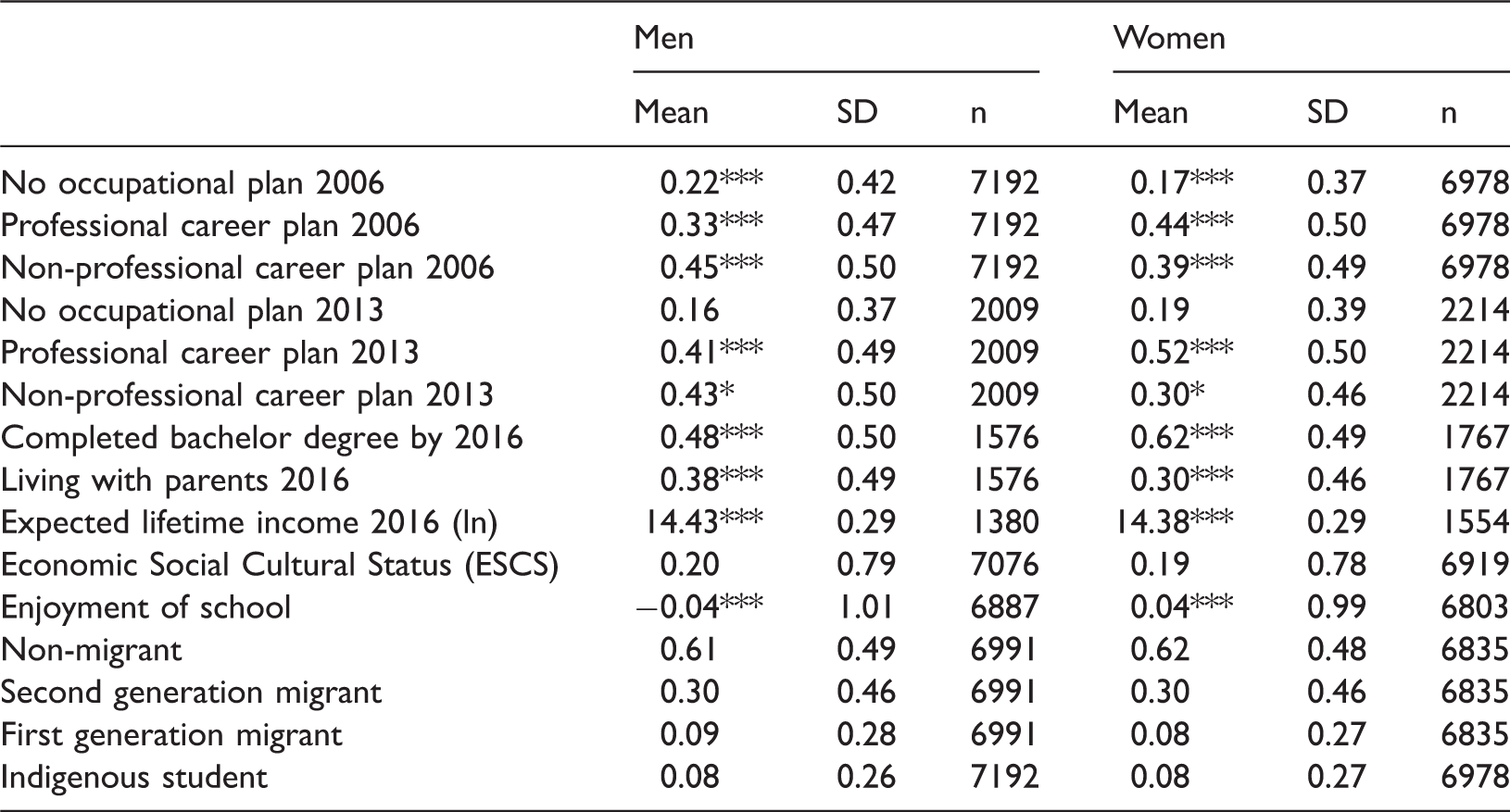
Note: Unweighted estimates, different at *p < 0.05, **p < 0.01, ***p < 0.001 between men and women.
Predictors of uncertain occupational expectations in 2006 (at age 16) and in 2013 (at age 23) by gender.
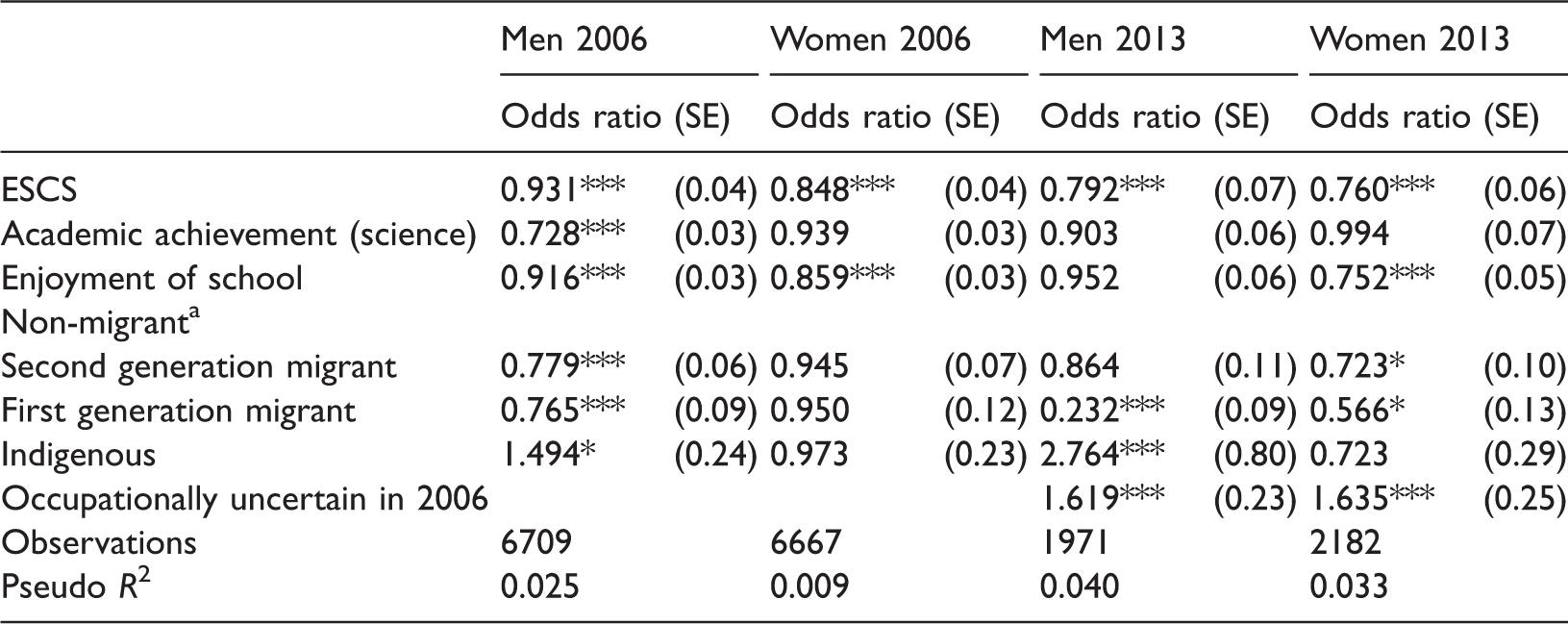
Note: Exponentiated coefficients from logistic regressions: odds ratios; standard errors in parentheses; weighted estimates.
aReference category.
*p < 0.05, **p < 0.01, ***p < 0.001.
Completion of a bachelor’s degree by 2016 regressed on occupational uncertainty by gender.
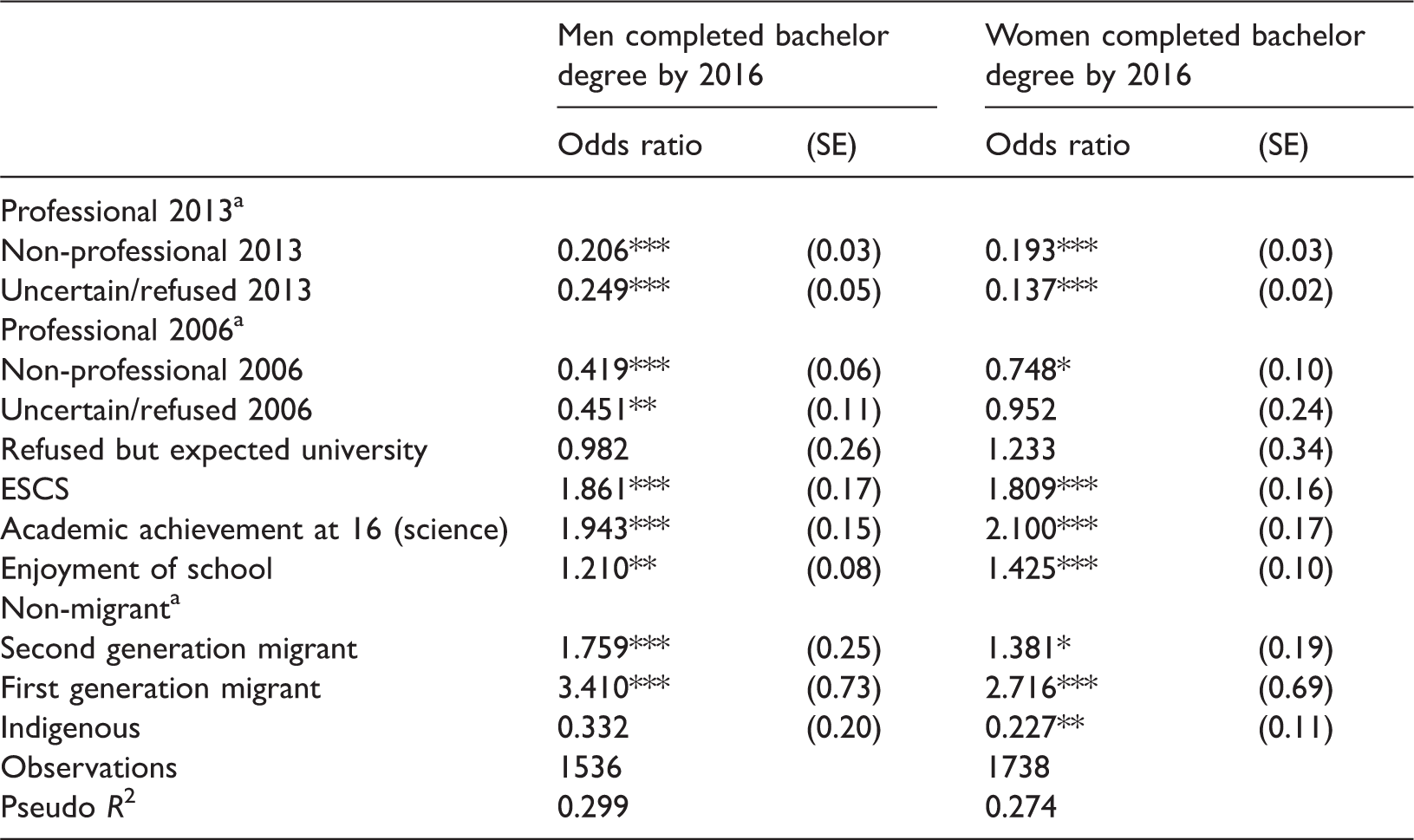
Note: Exponentiated coefficients from logistic regressions; standard errors in parentheses, weighted estimates.
aReference category.
*p < 0.05, **p < 0.01, ***p < 0.001.
Expected life-time earnings, based on the 2016 occupation, regressed on occupational uncertainty by gender (OLS estimates).
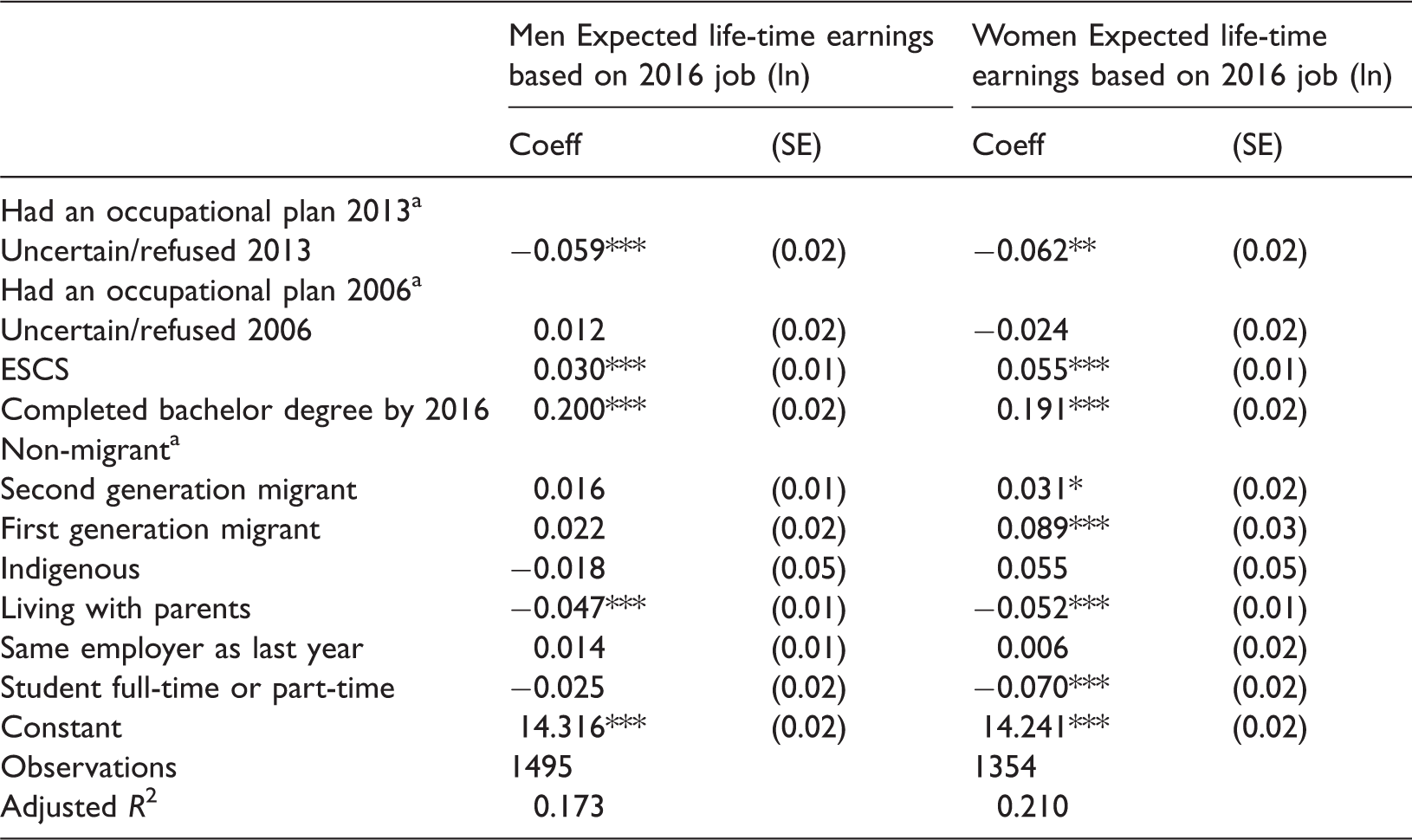
Note: Exponentiated coefficients from logistic regressions; standard errors in parentheses; weighted estimates.
aReference category.
*p < 0.05, **p < 0.01, ***p < 0.001.
Specifically, descriptive statistics are based on unweighted estimates. The predictors of occupational uncertainty in 2006 and 2013 which illustrate how uncertainty persists over time are modeled using logistic regressions (Long & Freese, 2014), weighted with LSAY weights for 2006 and 2013. The weights used, known as final weights in LSAY documentation, combine adjustments for both the sample design and attrition. The analyses which predict the odds of obtaining a bachelor’s degree by age 26, are logistic regressions weighted with the LSAY 2016 final weight. The model that predicts the expected lifetime earnings involves an OLS regression, suitable for continuous dependent variables, also weighted with the LSAY 2016 final weight (Lim, 2011; NCVER, 2017).
Results
A considerable proportion of adolescents have no clear occupational plans (Table 1). In 2006, 22% of adolescent men and 17% of women did not provide codable information about their expected careers (Table 1). In this group, 5% provided verbatim answers which directly attested to their uncertainty i.e., “not sure,” “no idea” while 14% skipped the question or indicated they did not know (not shown in Table 1). About one-fourth of students who did not articulate their occupational plan indicated, however, elsewhere in the survey that at some point they planned to go to university. Only 2% of students provided no information about either educational or occupational plans.
At 16 girls are more vocationally certain than boys (Table 1), which is also typical in other countries (Sikora & Pokropek, 2011). By 2013, however, the proportion of occupationally uncertain males and females evened out, as 16% is not statistically different from 19%.
At both stages of life, women were more oriented towards professional employment than men (44% versus 33% in adolescence and 52% versus 41% in young adulthood). As data in Table 1 are unadjusted for attrition, the focus on the professions seems stronger among older respondents even though with age occupational plans become more realistic and less oriented towards the professions (Sikora & Saha 2011).
Women in this cohort were more likely to complete a bachelor’s degree by 2016, while their expected life-time earnings at age 26 were lower (by about AUD 90,000 in 2011 dollars) than those of men. At 26 years of age, women were less likely than men to live with their parents and had a history of having enjoyed more their adolescent schooling. Men and women in this cohort, however, did not differ with respect to other characteristics in Table 1.
Occupational uncertainty persists from adolescence to young adulthood
A crucial issue in considering occupational uncertainty is the degree to which it persists over time (Table 2). Implications for attainment are less serious if youth intermittently go through stages of having and not having precise plans. The odds ratios shown in Table 2 compare those who had precise occupational plans with those who were uncertain at two time points: 2006 and 2013. The latter model also shows whether uncertainty in 2006, i.e., in adolescence, continued into 2013 i.e., into young adulthood.
Respondents who had no occupational expectations in adolescence had 1.6 times higher odds of being still uncertain seven years later, compared to their peers with clear plans. The odds were comparable for men and women being 1.619 and 1.635, respectively (Table 2, bottom row). Odds ratios of 1 indicate no difference between compared groups, while odds lower than one mean that uncertain students had significantly lower values on particular predictors.
However, odds ratios are not as informative as average partial effects which denote typical probabilities when predictors are kept at their means (Williams, 2012). These effects, computed for Table 2 but not shown in it, reveal that uncertain adolescents are 45% more likely than their peers to be still occupationally uncertain as young adults.
Occupational uncertainty not only persists over time but also correlates with lower socio-economic origins, even though the relationship here is rather weak, as seen in low R2 values. There are minor gender differences in predictors of uncertainty. Males who were uncertain in 2006 had less academic success than occupationally decided students, they enjoyed school less and were less likely to be first- or second-generation migrants. Indigenous males were more likely than other males to be uncertain, at 16, about the job they would have at age 30 (1.494). Among female students, only lack of enjoyment of school and lower ESCS background predicted occupational uncertainty and these variables had little explanatory power.
By contrast, lower ESCS status had more pronounced effects on occupational uncertainty in 2013 for both men and women, while migration status effects suggest that migrant students tend to be more occupationally focused than their native peers regardless of gender. Moving to other minorities, Indigenous males in 2013 had nearly three times as high odds (2.764) as other males of being occupationally uncertain but Indigenous women were as occupationally decided as other women, which corresponds to prior findings for this cohort of youth (Sikora & Biddle, 2015).
Given that early uncertainty adds to later occupational uncertainty 45%, the question that arises is whether this degree of persistence is sufficient for uncertainty to affect educational or occupational attainment at age 26. This is considered in Tables 3 and 4.
Occupational uncertainty lowers chances of university completion
The effects of early and later occupational uncertainty on the completion of a bachelor’s degree by 2016 degree are negative and vary by gender (Table 3). Compared to students who, in 2013, expected to become professionals, uncertain young adults had lower odds of university completion. The odds for men were 0.249 and the odds for women only 0.137. When average partial effects, which are predicted probabilities, are computed (Williams, 2012), Table 3 suggests that, all else being equal, 54% of men who said in 2013 that they would enter professional jobs, obtained a bachelor degree by 2016, while the corresponding proportion among uncertain students was only 29%. For women, the corresponding predicted proportions were 71% versus 33% so occupational indecision in young adulthood is even more consequential for them than it is for men.
Adolescent uncertainty contributes to adult uncertainty, but its net effects are not quite the same for men and women. Adolescent men who did not answer the question about their occupational plans in 2006 had the odds of university completion equal to only 0.451 of the odds for their peers who planned professional employment (Table 3).
For women adolescent uncertainty did not matter, once adult uncertainty was taken into account.
Overall, where completion of a university degree by respondents’ mid-20s is the outcome of interest, enduring uncertainty has adverse consequences for men and women, but for the latter adolescent uncertainty on its own is less of a concern.
The 2006 data make it possible to identify students who refused to answer the question about their future jobs but indicated that at some point they would definitely go to university. Both men and women in this situation had odds of completing university that were comparable to, i.e., not statistically different from the odds for their peers who planned to become professionals (Table 3). Hence, early vocational uncertainty is not a problem for the minority who are determined to go to university but cannot name their future job. Yet, for all other adolescents, occupational uncertainty lowers the probability of university completion.
Occupational uncertainty lowers expected life time earnings
When expected life time earnings are estimated based on an occupation held by the Y06 respondents in 2016, results of the analysis indicate that occupational uncertainty in young adulthood generates lower life time earnings for men and women (Table 4). However, adolescent uncertainty has no adverse effects.
To ensure that occupational uncertainty is not confounded with other factors that affect the expected earnings in young people’s lives (Sabates et al., 2011; Staff et al., 2010), the models in Table 4 control for the economic, social, and cultural status in the family of origin, whether the respondent completed a university degree, or was still a student, whether they had employment stability in the preceding year, whether they still live with their parents and their migration as well as Indigenous status. It would have been optimal to control for different types of educational credentials but the 2016 wave of Y06 is affected by attrition to a degree that prevents finer distinctions than the one between university graduates and all others.
The average partial effects, computed for the models in Table 4, suggest that students who were occupationally uncertain in 2013, under the assumption that all other predictors are kept at sample means, should expect about 6% earnings penalty over their life-time, which is about AUD 100,000 in 2011 dollars.
While this might seem moderate, no natural comparison benchmark is available to decide whether this difference in predicted life-time earnings should be a cause for concern. There is little doubt, however, that occupational uncertainty is associated with discernible wage penalty for respondents, both men and women. This speaks against conceptualizing indecision as beneficial role exploration.
Supplementary analyses, not reported in Table 4, but based on similar models, also support this conclusion because uncertainty in young adulthood raises the likelihood of co-residing with parents for men, although not for women, at 26 years of age. However, adolescent uncertainty has no implications for living with parents at 26.
Apart from co-residence with parents, prior research in the USA (Sabates et al., 2011; Staff et al., 2010) took early marriage as a sign of successful role exploration but the Australian data reveal no relationship between occupational uncertainty and the chances getting married by age 26, regardless of whether only marriage or also de-facto relationships are considered (not shown in Table 4).
Thus, while occupational uncertainty in young adulthood adversely affects the chances of university completion and the expected lifetime earnings at around 26 years of age, Australians are not hit as hard by it as their older counterparts in the USA, whose vocational indecision in adolescence significantly curbed economic and social attainments in young adulthood (Sabates et al., 2011; Staff et al., 2010).
It is important to bear in mind that occupationally uncertain youth differ more significantly from youth with professional employment plans than youth who aim to work in non-professional jobs. This is illustrated in Table 3 where the odds of university completion for students with uncertain plans and non-professional plans deviate from the odds of other students by a comparable margin. Therefore, occupational uncertainty in adolescence matters mostly for men and women for whom it is important to enter the path leading to professional employment. In contrast, for other young Australians adolescent uncertainty matters less and thus can be seen in a positive light as a beneficial stage of role exploration which is unlikely to hinder their later attainments.
Conclusion and discussion
Vocational uncertainty in adolescence may appear as a necessary element of role exploration which enables young people to work out what their strengths and long-term preferences are. Uncertainty could also be seen as the result of increasingly unpredictable economic conditions combined with “volatility in timing and sequencing of family, school and work roles” (Staff et al., 2010, p. 18), which is typical for modern emergent adulthood. As vocational uncertainty more often affects youth from disadvantaged backgrounds and leads to educational and economic disadvantage in their educational and occupational attainments, it deserves attention even if its effects seem only moderate.
The analyses presented here support the view of occupational uncertainty as structurally conditioned and potentially detrimental lack of direction rather than purposeful role exploration with extended beneficial consequences. A tendency to lack vocational direction persists from adolescence into young adulthood. In line with arguments made in the USA, occupationally uncertain men and women seem to flounder in their educational and work-related pursuits and have weaker chances of securing early financial independence.
The results of this study indicate that a vocationally undecided teenager is 45% more likely to be still undecided at 23 years of age, compared to youth with early aspirations for a professional job. Persistent occupational uncertainty is most consequential for youth who could have pursued pathways into the professions, had they been more certain at 16. Youth whose aims and aptitudes fit in with careers in non-professional jobs can move between uncertainty and aiming for one of the non-professional occupations with relatively little impact on their educational or occupational attainment at age 26. For these young people, occupational uncertainty can indeed be an inconsequential role exploration which involves trying out different work and life options.
Uncertainty and its consequences deserve more attention in the context of the discussion on emergent adulthood, the fluidity and non-linearity of transition from adolescence into adulthood and the accepted social markers of the latter. Whether mid-20s or mid-30s are better conventional thresholds to evaluate the impact of vocational uncertainty is open to discussion. The evidence for Australians born around 1990, however, counters the view that occupational uncertainty benefits either teenagers or young adults.
Footnotes
Declaration of conflicting interests
The author(s) declared no potential conflicts of interest with respect to the research, authorship, and/or publication of this article.
Funding
The author(s) received no financial support for the research, authorship, and/or publication of this article.