




Abstract
While the benefits of interactive reading opportunities, such as reading aloud and being read to, are well established, little is known about children’s attitudes toward, and perceptions of these practices beyond the early years. Research in this area can inform literacy instruction aimed at encouraging enjoyment and continuance of this practice. The 2016 Western Australian Study in Children’s Book Reading explored the attitudes of children aged 8–11 toward infrequency and cessation of interactive reading, their experiences of interactive reading with siblings, and the social and emotional effects that they felt listening to reading had on them. Children also described what they learned from listening to reading and reading aloud, as well as their attitudes toward reading aloud at school. Interactive reading experiences are complex and diverse social and educational events, with opportunities for shared reading experience related to growth in skill and confidence, and early cessation at home and at school heightening anxiety toward reading aloud.
Keywords
Introduction
Interactive reading opportunities are social exchanges, which include reading aloud to children, and children reading aloud to others. While children’s reading aloud and being read to are usually considered separately, they can also be investigated together, as both activities involve social interaction around reading. Interactive reading opportunities are social exchanges, which include reading aloud to children and children reading aloud to others. Amongst heavy competing educational demands, teachers may struggle to allocate time for interactive reading beyond the early years of primary school (Merga, 2016; Sanacore, 1992; Wasiuta, 2011). However, these opportunities remain extremely valuable for young people, as illustrated herein.
Despite the importance of interactive reading, where children read aloud or are read to, relatively little is known about older children’s experiences of interactive reading beyond the period of initial independent reading skill acquisition.
The benefits of reading aloud to children in the home and at school are acknowledged. Reading aloud facilitates enriched language exposure, fostering the development of receptive language (Sénéchal & LeFevre, 2002), spelling (Mol & Bus, 2011) and vocabulary (Farrant & Zubrick, 2012), and establishing essential foundational literacy skills (Duursma, Augustyn, & Zuckerman, 2008; High et al., 2014; Mol & Bus, 2011). Reading aloud to young children is positively related to cognitive development and skills (Kalb & Van Ours, 2014), with parent–child reading activating brain areas related to narrative comprehension and mental imagery (Hutton et al., 2015).
The advantages of being read to are closely related to reading frequency. Children who are read to regularly score higher on average across a range of assessments and standardised tests, with benefits extending beyond literacy into areas such as numeracy (Kalb & Van Ours, 2014). An analysis of 29 studies noted “significant, positive effects for read aloud interventions on children’s language, phonological awareness, print concepts, comprehension, and vocabulary outcomes,” with read aloud interventions found to be particularly beneficial for children at risk of reading difficulties (Swanson et al., 2011, p. 13). Teachers’ reading aloud may not only model positive attitudes toward reading (e.g. Merga, 2016); it may also be of particular benefit for fostering reading comprehension in students who speak English as an additional language (Amer, 1997), and it has also been linked to fostering positive attitudes toward reading in older children (Beers, 1998; Ivey & Broaddus, 2001; Merga, 2015). The advantages conferred by reading aloud can influence the lives of children as they grow into adulthood, as cognitive skills can exert significant impact on socio-economic success in academic and vocational outcomes (Kalb & Van Ours, 2014). However, teachers may not feel they have sufficient time in the school day to justify allocating time to reading aloud (Hoffman, Roser, & Battle, 1993). The educative benefits of the practice beyond the primary years need to be recognised and valued.
In addition to being read to, children may read aloud at home and at school to support development of oral reading proficiency and literacy skills. Children’s reading aloud provides insight into children’s reading skill level (Pinnell et al., 1995), with oral reading fluency a “salient characteristic of skilful reading” (Fuchs, Fuchs, Hosp, & Jenkins, 2001, p. 253). Children’s oral language skills, which are further developed through reading aloud, make a key contribution to the development of reading comprehension and sight vocabulary (Nation & Snowling, 2004). Archer, Gleason, and Vachon (2003) urge the regular dedication of class time to oral reading practice, to improve the reading performance of students who struggle with decoding and fluency beyond the early years of schooling. Reading aloud to an interested audience can provide opportunities for children to improve their oral fluency and pronunciation, and to allow for opportunities to check comprehension.
Recent findings suggest that children continue to enjoy being read to well beyond the early years of schooling, and reading aloud at home may be being curtailed prematurely (Scholastic, 2015, 2016a, 2016b). For example, more than a third of Australian respondents aged six to 11 whose parents had stopped reading to them wanted it to continue (Scholastic, 2016a, p. 30). As reading aloud and being read to are social activities, and socially interactive readers may be more likely to be engaged readers (Gambrell, 1996), interactive reading cannot be understood without reference to its experiential components. Attitude toward reading can be viewed as a “behavioural by-product on individuals’ experiences” in reading situations in both home and school contexts, with a positive attitude toward reading related to success in reading, and positive self-concept (Cothern & Collins, 1991, p. 84). Understanding children’s perceived experiences of and attitudes toward interactive reading is crucial to identify how children feel about these beneficial practices, and their opportunities to engage in these practices.
Method
Participants
This article reports on findings from the 2016 Western Australian Study in Children’s Book Reading (WASCBR). While the study collected data in response to a range of research concerns, this article reports on the data relevant to exploring children’s perceptions of reading aloud and being read to, termed as interactive reading.
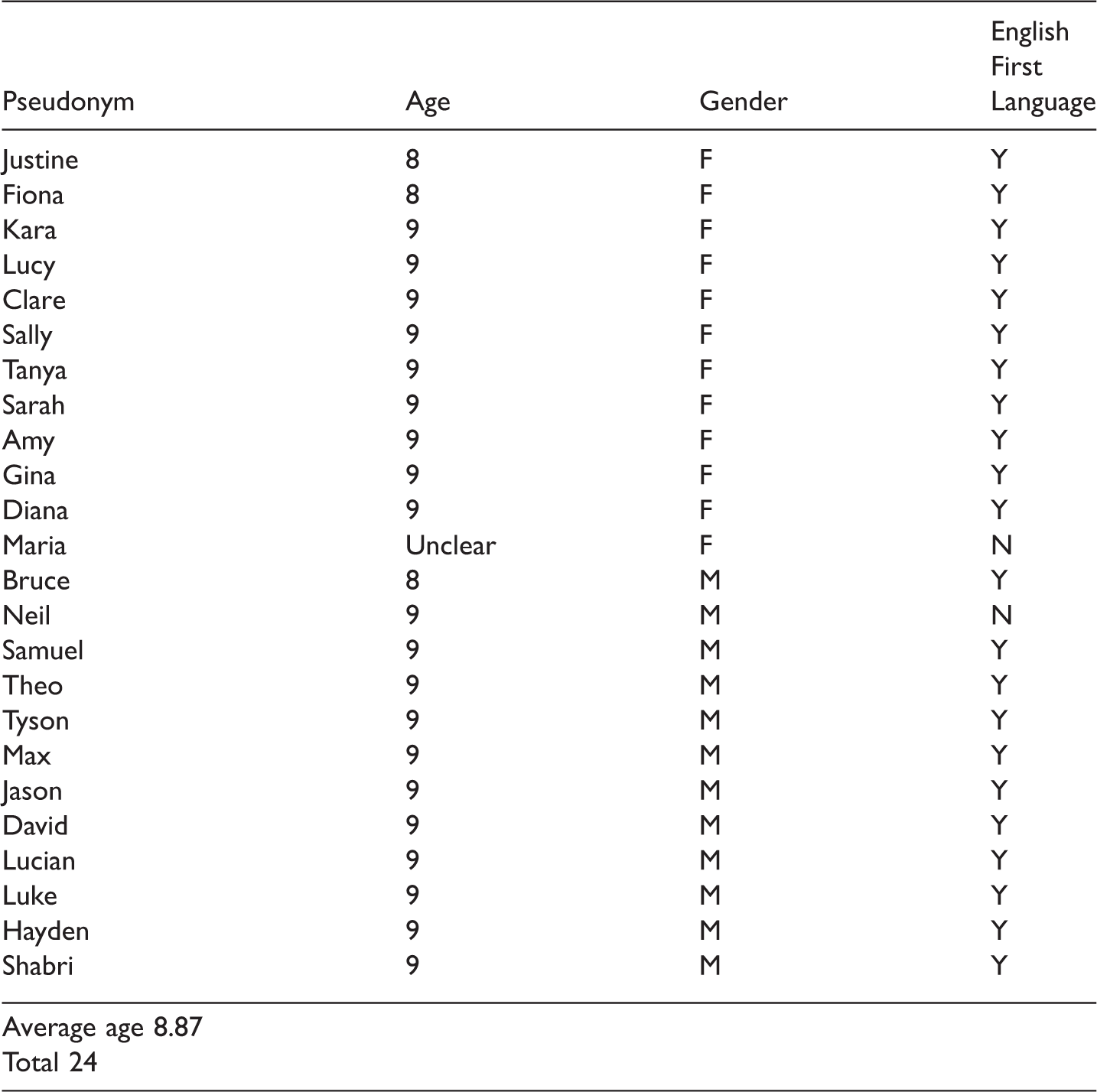
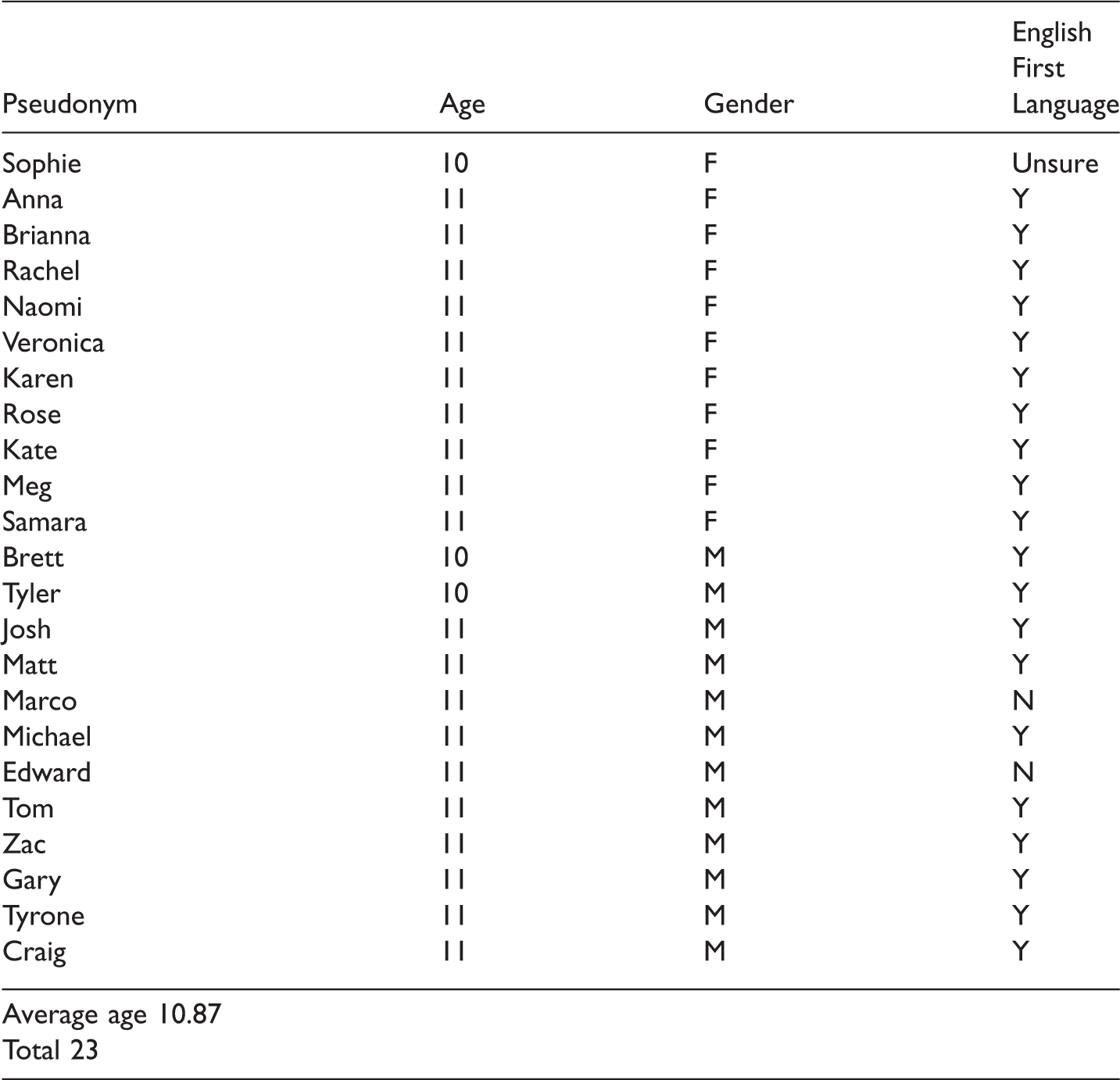
These data were primarily qualitative and were derived from semi-structured interviews with 47 respondents from across 24 schools in Western Australia. All respondents were children in the upper primary school grades of Year 4 and 6 in Australia, with these students generally aged 8–11. Interview respondents were a smaller subsample within the study; a survey primarily investigating other research questions was also undertaken with the whole group (N=997). Further details about the composition of the interview subsample can be seen in Tables 1 and 2; to protect the identity of the participating minors, these data are limited to prevent identification via deductive disclosure (Kaiser, 2009).
Characteristics of Year 4 interview participants.
Characteristics of Year 6 interview participants.
The study was granted ethics approval, and rigorously piloted at a local school before implementation. Interviews were conducted between 23 March and 21 June 2016, with two children randomly selected from each school to participate, controlled only for gender. While 46 children were to be recruited in this manner across 23 schools, an additional school was added due to recruitment issues at one school, which prevented recruitment of children in Year 6. As a consequence, 47 children were recruited across 24 schools, with one school providing only one Year 4 student. The sample was diverse, including rural and metropolitan schools, and both public and private schools. These schools came from a range of socio-economic and geographic contexts. As Australian schools are ranked on an Index of Community Socio-Educational Advantage (ICSEA), and these values can be readily obtained online at the My School website (ACARA, 2016), the average ICSEA for participating schools at the time of the research was calculated (1040.9) and found to be only slightly higher than the overall Australian average of 1000.
The number of respondents in the qualitative subsample engaging in interactive reading at home was not quantified, because as mentioned previously, the interview sample was a subset of the larger body of survey respondents (N=997). Students were asked “Does anyone read books to you at home?”, with 41.2 percent indicating yes, and 58.8 percent indicating no. As such, the following qualitative exploration of children’s perceptions of interactive reading exchanges occurred in a context where more than half of respondents were probably no longer being read to at home.
Instrumentation
Interview data were collected with a purpose-developed semi-structured interview tool used to guide the inquiry. Responses were in relation to interview items which asked children to describe the nature and frequency of their experiences of reading aloud and being read to at home and at school, and if they enjoyed these experiences.
Method and analysis
This study used a qualitative method to reach the depth required to enable a greater understanding of children’s experiences of interactive reading exchanges, as highlighted herein, with implications for supporting continued opportunity for interactive reading emerging from the rich data.
This study draws on grounded theory to inform the methodological and analytical approach. An emergent study design is used which allows the children’s views and ideas to identify the key issues in this area (Birks & Mills, 2015), facilitating a deeper understanding of the nature of practices that may occur broadly in society, but have not been interrogated from this perspective (Van Manen, 1990). This emergent method “begins with the empirical world and builds an inductive understanding of it as events unfold and knowledge accrues” (Charmaz, 2008, p. 155).
This approach was adopted to refresh considerations of a well-known practice, interactive reading, in order to consider the experience of this practice from the perspectives of young, and therefore comparatively marginalised participants. This gives voice and dimensionality to those who are not mere recipients of the pedagogical practice of interactive reading, yet whose perspectives on this practice are not frequently sought, and therefore relatively unknown, within the limitation of such research being “an incomplete or partial translation of the reality of others’ lived experiences” (Alvermann, O’Brien, & Dillon, 1996, p. 117). This is responsive to the increasing degree of importance given to “listening to children’s voices to gain understanding of their learning, lives, and experiences” (Harcourt & Einarsdóttir, 2011, p. 302) in contemporary educational research.
This grounded theory approach also aligns with the informing theoretical framework of symbolic interactionism, which is concerned with “the meanings human beings construct in their social settings” (Blase & Blase, 2000, p. 131). Symbolic interactionism conforms to a constructivist epistemology (Crotty, 1998), and it situates individuals’ conduct and experiences as being the products of their interactions with the social group (Mead, 1925; Mead & Morris, 1934). Children’s perceptions of shared reading experiences can thus be viewed as a product of socialization to attribute values and meanings to the experience. Symbolic interactionism situates children’s attitudes toward shared reading as a product of their interactions with influential social agents such as parents and teachers (Mead, 1925; Mead & Morris, 1934).
The children’s experiences and perceptions as self-reported were closely and iteratively analysed and coded, using the constant comparative method, in order to identify the key problems and issues in the field (Holton, 2011). An audit trail was actively maintained throughout the coding process, moving through annotated drafts from the earliest stages of coding, to the write up of the research (Birks & Mills, 2015). The review of the literature in this area was delayed to post-coding, to avoid imposing existing knowledge on the study processes (Birks & Mills, 2015). In this regard, the analysis was responsive to the “balancing act between drawing on prior knowledge while keeping a fresh and open mind to new concepts as they emerge from the data” (Goulding, 2005, p. 296).
Results
Attitudes toward infrequency and cessation of interactive reading
In this study, not all children were being read to, as anticipated from the aforementioned quantitative component, and students’ attitudes toward infrequency and cessation of interactive reading in the home and at school were explored. Some of the children in this study had no one reading to them at home and at school, and in the analysis in this section children are not considered who self-excluded from this activity due to a stated dislike of being read to, in recognition of the bi-directional nature of influence, whereby children’s behaviours and attitudes influence their parents, and the reverse (Baker, Scher, & Mackler, 1997).
In addition, not all students in this sample were being read to at school. For example, Max’s teacher did not read to him at all, and Samuel’s teacher “only reads books when it’s for a task or something”. Zac really enjoyed his teacher reading to him, but reading was discontinued, with The Hobbit remaining unread on the teacher’s table.
Parental availability seemed to be an issue in determining the quality of reading aloud at home, which could also lead to its infrequency or cessation. The quality of the interactive reading experience was also poor in some instances. Diana described the difficulty faced finding time to read at home. Reading aloud experiences with her mother were not particularly enjoyable, as “most of the time I have to read to her while she’s cooking dinner”. This experience lacked both intimacy and fluidity, as “I have to sit at the kitchen table while she’s cooking”, and “sometimes I have to pause so she can put something on loud, and then have to restart”.
While some children had never been read to at home, others had experienced cessation of being read to, primarily due to perceived independent reading skill acquisition, and time constraints. While some children welcomed this break, or were stoic in the face of the change, others regretted the lost opportunities. These regrets were primarily concerned with the loss of valuable dyadic social time. Anna’s mother read to her frequently when she was younger, but “not so much now”. She regretted losing the “one on one time with my mum”. Similarly, Jason shared this regret, stating, “They kind of stopped when I knew how to read. I knew how to read, but I just still liked my mum reading it to me (sic)”.
Children who welcomed this transition primarily did so due to a frustration with being constrained to the reading pace of their parents or teachers, and related the cessation to their maturation. Matt felt that reading aloud slowed him down, and reading independently allowed him to read more, stating “sometimes they stop at one chapter, and you have to wait to the next day to read on”.
In some cases, reading difficulties raised by the children could be related to reading cessation or infrequency. No one read to Hayden at home or at school. He found his pronunciation and comprehension issues particularly frustrating, causing him to relegate himself to the status of a “middle” reader, rather than a highly skilled reader: Because some words I can’t understand. I just try to sound them out, but once I sound them out, I can’t get it. But some of the words are so easy that I just read. Read them. But I…when I’ve got a word that’s bad, I just skip it, go back, and once I see the same word, I’ll skip it, and I’ll go back pages. I’ll try to sound it out. Then I’ll go back. Then I might read the whole thing again.
As such, the impact of cessation of sharing books is worth considering, with infrequency and cessation found to lead to a loss of opportunity to build skills and confidence in this study. The quality of the interactive reading experience was also sometimes lacking. For students who value the social aspects of reading, shifting interactive reading to fully independent reading is accompanied by an inherent risk of disengagement from the practice of reading.
Interactive reading experience with siblings
While “research on the influence of siblings on literacy development, and especially on at-home reading, is scarce” (Knoester & Plikuhn, 2015, et al., p. 1), recent research suggests that children can exert a significant positive influence on the literacy growth of their siblings, that was felt to positively influence both literacy skills and attitudes toward reading (Knoester & Plikuhn, 2015). When describing their interactive reading practices, children were often readers sharing the experience in interactive reading exchanges with their younger siblings, with some showing marked flexibility and generosity in order to engage their younger siblings. For instance, Tyler would read outside his preferred genre, and Sophie tried to engage her brother when reading to him at home by allowing him to select the reading material, and using accents and a theatrical voice.
In this study, siblings could also be used as part of, on the one hand, a reading avoidance strategy or, on the other, for reading support. Shabarinath occasionally outsourced his reading homework by having his younger brothers read aloud to him, “because sometimes I can’t be bothered reading, so I get them to read my book”. Rose also found educative benefit in reading aloud to her little brother and sister, as “I like it when I might say a word wrong, and then my sister is like, ‘Are you sure?’ And she helps me as well as me helping her”. Rose valued this reciprocity of skill acquisition support.
However, not all interactive reading experiences with siblings could be characterised as educative or enjoyable. Diana’s sister’s behavioural issues were challenging. Diana explained that when tired, her sister “gets a bit angry, so she can’t sit and she won’t read”. When this happens, Diana was left to autonomously mediate the situation, with limited parental support. Rough play or even violence marred the interactive reading experience in some instances; Jason also described reading aloud to his brother as challenging, as “sometimes he’s being annoying, rolling all over me when I have to lay in bed with him, to read it to him”, and Bruce’s brother frequently kicked him. Karen felt that her unpleasant experience reading to her little brother was probably due to her being viewed as an unacceptable replacement for her mother.
The findings in this article suggest that far more research is needed in this area before interactive reading experiences with siblings are broadly encouraged by educators as a beneficial strategy, due to these widely varying experiences. While outsourcing reading support to older peers or siblings is intuitively an efficient division of labour for busy schools and families, and one which could be highly mutually efficacious, parents and guardians should still exercise some supervisory capacity when fostering these support dyads, so that the responsibility of managing the success of the experience does not fall solely on the older sibling or student.
The social and emotional effects of listening
Affective elements of literacy experiences, particularly in the context of home literacy, have been recognised as being important for fostering both developmental and educational outcomes (Leseman & Jong, 1998). Shared reading in school has been associated with increasing student learning, engagement, motivation and enjoyment (Albright & Ariail, 2005). However, research that deeply explores children’s social exchanges and the emotional impact of being read to from their own perspective is limited.
The social and emotional effects of listening to reading emerged from the data, as enjoyment of sharing the reading experience, and use of reading aloud as a panacea, to raise the mood of listeners. As such, a number of the children in this study could be categorised as social communal readers, for whom reading exists in a “virtuous circle” in which reading is encouraged and used as a basis to solidify relationships. It differs though from Howard’s (2010) construct developed from older children (p. 36), in that the relationships are not constrained to friendships, with parent–child relationships also strengthened. Social interactions and shared experiences are acknowledged as an important impetus to the enjoyment of books for social readers, with reading holding a valuable social purpose (Baker & Wigfield, 1999; Nieuwenhuizen, 2001). For example, though Sophie no longer read aloud at school, she remembered enjoying this, as “if there’s someone in there listening to you, you feel like you can share your imaginations, and then you get to hear from their opinion (sic) about the book”.
Listening to books being read seemed to have a regulatory emotional impact on the children in this sample. This was perhaps best explained by Marco, who found opportunities to be read to at school or home ideal, as “I like how like sometimes I don’t have to be the one that actually reads it, sometimes I like having someone else read to me… ‘cos it’s also very relaxing when someone else reads to you”. Relaxation was also sometimes related to suspension of physical discomfort experienced during sustained independent reading. For example, Tyrone enjoyed being read to by his teachers, “because sometimes when you're reading a big book for a long time it hurts your eyes”. While social interactions and shared experience are acknowledged as an important impetus to the enjoyment of books for social readers, with reading holding a valuable social purpose (Baker & Wigfield, 1999; Nieuwenhuizen, 2001), comparatively little attention has been given to the role of listening to books on relaxation, and implications, if any, for skill acquisition and development. For example, while it is understood that “motivation and engagement may influence the development of reading comprehension” (Guthrie et al., 2004, p. 403), no extant research could be found that explores an association between degree of relaxation and reading comprehension.
Children in this study also described pleasure from using their reading to bring relaxation and happiness to others. Marco read aloud to his mother at home, which involved re-reading parts that he already read. Marco nonetheless enjoyed this, as “she gets happy, like really happy when I read to her”. Kara also felt that she would rather read aloud with others, than read by herself, because she enjoyed the social aspect of this reading interaction, because “they might be feeling upset, and if it’s a happy book, they can listen to a happy book”. As such, some children made generous use of the mood-mediating effects of reading.
What children felt that they learned from listening
Compared with the other “profile components” of the English subject area, talking, reading and writing, listening receives limited attention in terms of its educative benefit (Alexander, 2008). As with the discussion about what children felt they learned from reading aloud, these insights arose from inquiry into enjoyment of being read to and reading aloud. It is important to establish that these children are explaining that part or all of what they “liked” about engaging in interactive reading practices was the learning and skill acquisition they afforded. This is significant in itself, as it could not be anticipated that any comment about skill acquisition would emerge from the data, in the context of contribution to enjoyment; it shows that children’s subjective task valuing (Wigfield, 1997) of listening to reading, and subsequent positive attitudes toward the experience, can be associated with perception of learning.
Children appreciated exposure to a wider range of genres than they might typically access, and exposure to a model of reading fluency and enthusiasm. Rose wished to emulate her teachers’ high skill level in reading, explaining that “I think it was the teachers reading me the stories that really got me interested more about them, and how they seemed so confident in reading it, and so I wanted to be able to read good (sic)”. Rose’s association between her positive in-class listening experiences and her motivation to read illustrated how these opportunities can extend student’s understanding of genre, giving them supported access to new tastes, and also set a benchmark that children can strive toward.
Listening provided an opportunity to extend vocabulary, and improve pronunciation. Gina regretted her parents’ decline in reading to her at home, as “when they did read to me when I was younger, I learnt the words; I would like to learn more words in the bigger books and know what they are so I could talk more about them”. Similarly, Brett enjoyed being read to at school, as “it’s much easier for you to learn newer words because they might know the words that you don’t know”. The advantages of these opportunities for skill benefits were recognised; Craig explicitly linked being read to by his parents and his high literacy status, explaining how it enabled his academic extension in this area, as “they were teaching me how to say more words and that (sic), that’s why I’m ahead of everyone in spelling and reading and English”. When this stopped “just because my mum thought I was smart enough to read on my own, and (I) started to read chapter books” Craig was disappointed as, if it had been his choice, “I would have kept reading for a little bit longer”. There was understanding of the educative possibilities that emerged from listening to readers with more advanced skills, and reliance on these readers to extend their own skills. As such, there was some understanding of what was lost through infrequency and cessation of these opportunities.
What children felt they learned from reading aloud
Children explained the benefits of reading aloud for improving reading skills, particularly in comprehension and pronunciation. Again, some children’s enjoyment arose from their learning. Sarah used self-initiated reading aloud opportunities to develop her reading comprehension, relying on her mother’s support, in that if Sarah read a book “not my age group, and like, I can read every word, she can help me like understand, like what I’m saying, and she can help me think of what I’m reading and stuff in my head, instead of having to stop and think and think and think about what I’m reading.” The opportunity to seek clarity around meaning, when required, was an invaluable advantage, and Sarah was able to develop both fluency and comprehension skills.
Inability to pronounce words aloud, particularly in the classroom, generated a degree of fear in this sample, which I will also discuss further in the following section, underpinning the importance of opportunities to practice pronunciation through reading aloud experiences with limited, safe audiences and contexts. A safe context can be viewed as one in which students feel they can freely attempt challenging tasks with potential risk of failure as part of their learning experience, without fear of experiencing negative repercussions, and as such, they are protected from “psychological or emotional harm” in a safe context (Holley & Steiner, 2005, p. 50). For instance, Theo appreciated the opportunity to read aloud to his mother at home, as she gave him confidence to develop his pronunciation, and positive reinforcement so that he could track his progress. He would “sound out” difficult words with his mother, who provided strong support, as “if it’s right, she says ‘Good boy’, or she says the word, or otherwise she says ‘Good try’”.
However, these opportunities were not always available at home. Tyrone had no recollection of ever being read to at home, and he appreciated the opportunity to read aloud to his teacher, “because when I’m reading quiet (sic) I might not be saying something right, and then when I’m reading with Miss (Name), I know that if I say something wrong she can correct me”. Tyrone explained that this is important, “because I could be saying something wrong and then I’ll always think that that’s right, and if I go somewhere I need to say that word and I’ll say it, and people won’t understand what I’m saying”. Tyrone understood the benefits of opportunities to read aloud for fostering his communicative competence.
Fear and enjoyment in reading aloud
Embarrassment and fear clouded the prospect of reading aloud when children in this study lacked the confidence and skills to read well. Naomi explained the distinction between errors in independent reading and reading aloud, as “if I mess up everybody hears it. If I mess up in my head I just smile and just go back and read it”. She did not like reading out loud at school or at home due to its perceived difficulty, illustrating the relationship between anxiety and skill level. Brett had similar fears, “because I always say the word wrong, and then I get really scared that they’ll laugh at me”, though he did not have the same reservations about reading aloud at home, which was seen as a safe space. Hayden’s anxiety around reading aloud at school related to his lack of confidence, and his propensity for comparing his skill level with that of his peers, “because I’m always standing up there shivering, my hands are shivering, I just don’t want to read, so I just start reading. And I sound pretty weird”. Not only was he extremely anxious about reading aloud in front of the class, this anxiety was compounded by his consciousness of his comparative lack of fluency and expression in reading, which would appear to trap him in a mutually re-enforcing circle of comparative skill deficit and fear. It is worth noting that in this study, reading aloud was often closely, and even exclusively, associated with reading for the purposes of assessment. Reading in this context was entirely dissociated with pleasure, and its purpose was regulatory, rather than shared enjoyment.
In contrast, Clare enjoyed reading aloud at school. Her teacher was extremely supportive, and was “always like encouraging other people to read, because we read to like other children…other people like our class. And he’s always saying, people who haven’t had a go, it’s not that scary and stuff, and it helps you”. As a consequence, she felt that “it’s actually sort of fun, like…’cos I, I used to like not speak at all (sic), and read in front of people, but now it’s sort of fun now”. Clare was also extrinsically motivated, as her teacher also expected her to read aloud regularly at home, as part of a class challenge, which made her want to read more. Safe classrooms offer “protection from psychological or emotional harm”, allowing “students to feel secure enough to take risks” (Holley & Steiner, 2005, p. 50). By being very encouraging, and supporting children to overcome their fears, Clare’s teacher helped her transition from an apprehensive reader to one who found it relatively enjoyable. A link was also made between home-based reading aloud and confidence to read aloud at school.
Animals such as dogs and birds sometimes played a role in reading for relaxation in this study. While in these instances children were not reading to humans, it can be contended that these reading experiences were still social exchanges, though of the human/animal variety, and they were sometimes enacted to circumvent less successful social interactions. For example, Lucy found reading aloud to her father stressful, as he did not always understand her, and was quick to correct her, and she also noted that she read less frequently to her parents than she used to. However, she enjoyed reading to her dog around once a week, as “it just calms him down, and it calms me down”. While she enjoyed this, it was not always successful, as she needed to gauge his mood before beginning, as “sometimes he’ll just be too excited, because he’s a border collie. He’ll just run in the backyard and maybe steal the book from me, so I just look at him before I start reading”. Where children read regularly to dogs, they do not run the risk of exposure to adult disapproval or critique (Jalongo, 2005; Shaw, 2013); in this way, Lucy avoided the frustration of being misunderstood by her father, choosing a more positive reading partner, though the issues with the dog’s energy levels did interfere with the experience on occasion.
Interactive reading beyond the early years: What educators need to consider
The perspectives of the children in this study can be used to generate a framework that highlights the importance of continued opportunity for interactive reading at school and at home beyond the early years.
In Figure 1, opportunity refers to regular exposure to high-quality experiences for engaging in interactive reading, which foster skill development and extension, leading to outcomes of confidence, competence and security. As we know that opportunity is highly variable both at home and at school, as found both here and in previous research (e.g. Scholastic, 2015, 2016a, 2016b), opportunity then must be made central to interventions that seek to improve engagement in this area. However, for this to be enacted, the influential facets of opportunity, as illuminated in this research, need to be better understood.
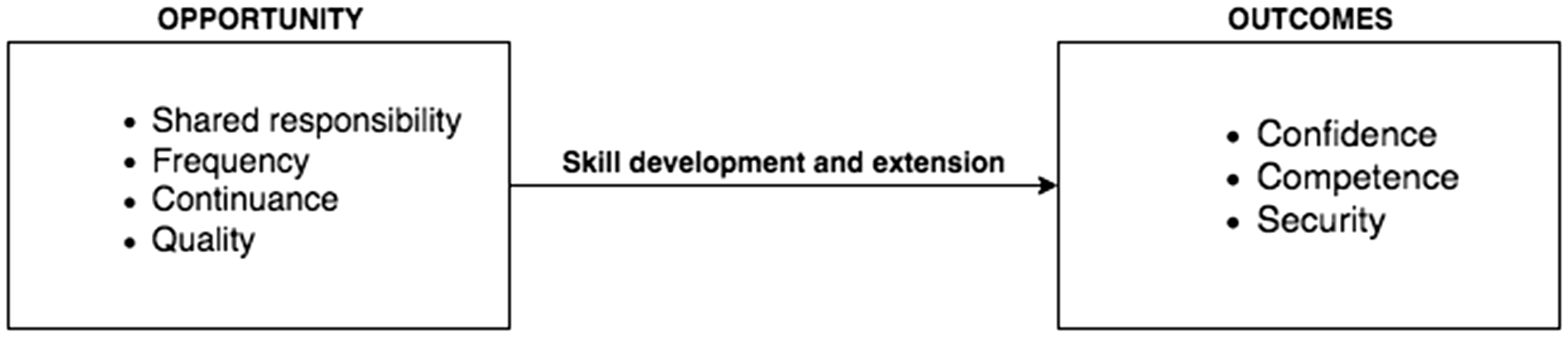
The influence of interactive reading opportunities on student outcomes.
The shared responsibility element of opportunity highlights the requirement that interactive reading occur both at school and at home, where possible, with both parents and teachers taking responsibility for supporting the practice. It can be argued that teachers may have the greater responsibility, as parents may face additional challenges such as low literacy, or other issues such as high workloads leading to high home absenteeism, or health conditions that impact upon their capacity to support intergenerational transmission of literacy through interactive reading (e.g. McCarthey, 2000). As such, it can be contended that it is an equity imperative that teachers not assume that parents can take primary responsibility for interactive reading opportunities, though teachers and schools should continue to support and encourage the greatest parental contribution possible.
Opportunity also relates to frequency, as interactive reading should be engaged in with regularity for optimal benefits, and continuance beyond skill acquisition is essential; both parents and teachers need to understand the importance of these experiences beyond the achievement of independent reading proficiency, with many of the children in this study clearly articulating their disappointment in early cessation. Continuance clearly relates closely to shared responsibility. While it can be assumed that teachers must be cognizant of the importance of continued engagement in reading practices that foster reading motivation beyond skill acquisition, such as interactive reading, previous findings from the WASCBR suggest that “it may be erroneous to assume that teachers still value the acquisition of reading will as well as reading skill, and that teachers still view it as one of their many responsibilities to support the development and maintenance of this will in their students” (Merga, 2016, p. 267).
The children’s contributions toward the development of quality indicators are noteworthy; and these encompass instructional quality, safety and enjoyment, which are closely interrelated. All of the quality indicators had related affective implications. Parents, guardians or caregivers need to be encouraged to find time for face-to-face reading, as simply attempting to assimilate it into the busy schedule around competing work and domestic demands may lead to a poor quality experience for children who seek connection with their parents. Whether at home or at school, interactive reading experiences are about more than completion of a set task; social interaction and nurturance during this time are also invaluable, and play a key role in establishing positive attitudes toward reading, which are essential for encouraging life-long reading, and also beneficial to facilitate skill acquisition. As such, these factors also influence the interactive reading experience of siblings, although a degree of supervision and support may be needed. As such, this research supports the questioning of assumptions about home and school based interactive reading, also indicating a need for further research in this area to explore both teacher and parent attitudes toward all of the factors of opportunity.
These practices need a privileged position in the teaching and learning environment. Teachers need to actively and consciously dissociate reading aloud purely with testing regimes, which are leading to the practice being perceived by students as unpleasant and in some instances, terrifying. There needs to be more opportunities for safe reading aloud; reading aloud should not solely occur in front of the whole class, further compounding disadvantage for children who do not have the opportunity to practice these skills at home. These implications should be addressed in pre- and post-service teacher training, with greater attention to how pedagogy can influence children emotionally as well as shape their perceived self-efficacy in this context.
This research highlights the relationship between key facets of opportunity and outcomes that extend beyond skill competence to include affective dimensions of confidence and security. The effects and benefits of interactive reading experiences are not solely concerned with skill, though children are aware of and appreciate the role of these practices in their skill development. Beyond skill, there are potentially very real impacts on both social and emotional dimensions, which are in some cases closely linked to skill achievement. A tendency for children to associate skill acquisition and learning with enjoyment in this context, underpins the role of skill development in contributing to their sense of self-efficacy, safety and capability within the classroom and beyond. Interactive reading supports skill development, which facilitates confident reading aloud and communicative competence, with these three elements exhibiting the potential to be mutually re-enforcing.
As such, this research suggests a need for greater emphasis on quality interactive reading experiences at school and at home, which can improve student skills, and offer social and emotional advantages. However, these beneficial possibilities are relative to opportunity, highlighting the importance of continuance and frequency of children’s interactive reading at home and at school.
Footnotes
Declaration of conflicting interests
The author(s) declared no potential conflicts of interest with respect to the research, authorship, and/or publication of this article.
Funding
The author(s) disclosed receipt of the following financial support for the research, authorship, and/or publication of this article: It was funded by the Ian Potter Foundation (20160013).