




Abstract
In this article, we interrogate the policy assumptions underlying a significant South Australian public education re-engagement initiative called Flexible Learning Options, formulated within South Australia’s social inclusion policy agenda, beginning in 2006. To this end, we applied Baachi’s ‘What’s the Problem Represented to be?’ policy analysis framework to a historical range of departmental Flexible Learning Options policy documents and evaluations to uncover how Flexible Learning Options (1) understands the problem of early school leaving, (2) defines the notion of being an ‘at risk’ young person and (3) interprets and enacts the intervention process for young people identified as ‘at risk’ of early school leaving. Our policy analysis indicates re-engagement in learning – as measured by improved retention – to be the key Flexible Learning Options policy driver, with schools ‘silently’ positioned as a significant part of the retention in learning problem. The Flexible Learning Options engagement in learning intervention directed at ‘high-risk’ students’ works to remove them from schools into places where personalised support and an alternative curriculum are made available. ‘Lower risk’ students are given a combination of in-school and off-school learning options. Our What’s the Problem Represented to be? analysis also reveals that (1) the notion of ‘risk’ is embodied within the young person and is presented as the predominant cause of early school leaving; (2) how the educational marketplace could work to promote Flexible Learning Options enrolment growth has not been considered; (3) schools are sidelined as first choice engagement options for ‘high-risk’ young people, (4) secondary school redesign and family intervention as alternative reengagement strategies have largely been ignored and (5) through withdrawal from conventional schooling, the access of many Flexible Learning Options to students to an expansive curriculum delivered by teachers within well-resourced school learning architectures has been constrained.
Keywords
Background: Early school leaving
Despite increasing attention on the part of policy makers across the Organisation for Economic Cooperation and Development (OECD) to address early school leaving school dropout still remains a serious issue (De Witte, Cabus, Thyssen, Groot, & van den Brink, 2013; Lamb & Markussen, 2011). The rationale for this concern involves constrained life opportunities for early school leavers (Foundation for Young Australians [FYA], 2011; Lamb, Jackson, Walstab, & Huo, 2015), and associated state concerns about loss of economic productivity and competitiveness. According to the European Commission (2012), those who leave school early are deemed to lack ‘the right skills for employment’ while in Australia, Deloitte Access Economics (2008) calculated that Interventions that reduce youth disengagement (by improving secondary education attainment levels) could potentially return 23.6 times the government’s initial investment to society and 7.6 times directly to the government through increased taxation levels. (p. ii)
Economic productivity therefore presents as a powerful driver of state concerns about early school leavers. Within the school non-attainment literature in Australia, patterns of disadvantage are implicated as key reasons behind students’ non-completion of schooling. For example, the 2011 FYA report claims: Patterns of secondary attainment among young adults provide clear evidence of the disadvantage experienced by particular groups of young people especially Indigenous students, those from rural and remote areas, those with a disability and those from low SES backgrounds. (p. 65)
How best to address the learning needs of young people from largely significantly disadvantaged backgrounds presents as a seemingly intractable public policy problem across OECD jurisdictions with concerns about people’s well-being, societal cohesiveness and economic costs presenting within the early school leavers challenge. The growing literature on early school leaving indicates that school dropouts, compared with their graduated peers, are more frequently associated with long-term unemployment, poverty, bleak health prospects, sustained dependence on public assistance, single parenthood (in females), political and social apathy, and (juvenile) crime. (Allen Consulting Group, 2003, pp.7–8; 2002; Christenson, Sinclair, Lehr, & Hurley, 2000; Kaufman, Alt, & Chapman, 2004; Rumberger & Lamb, 2003; Vizcain, 2005 in De Witte et al., 2013, p. 14)
In relation to early school leavers in Australia, an extensive array of historical and contemporary school-based attempts across all states to better meet the educational needs of ‘at-risk’ young people through ‘second chance’ schooling initiatives (Smyth & McInerney, 2013; te Riele, 2006, 2007, 2012, 2014), also known as ‘alternative educational’, ‘learning choice’ or most recently, ‘flexible learning programs’ (te Riele, 2014) have been tried. Typically, flexible learning programs operate both within and outside of conventional secondary schools. They often provide personalised learning approaches situated within adult learning environments, imbued with individualised holistic support (educational, social, emotional and health) for students, invoking more inclusive schooling relations that appear to work for young people disenfranchised from the conventional logics of secondary schooling (Smyth & McInerney, 2013; te Riele, 2006, 2007, 2012, 2014). According to te Riele (2006) research in Australia into second-chance educational initiatives indicates that such programs have had limited success and indeed may serve only to further ‘marginalise the marginalised’ (p. 1). The primary reason for the lack of success appears to be that second chance programs are invariably localised endeavours, lacking an on-going public or private funding commitment. Generally under-resourced, with consequent narrowed curricular choice and a reduced complement of experienced teachers, these programs have been described as initially blooming brightly but then quickly fading away (Giles, 2006). Eventually, funding shortfalls or the curricular and emotional demands placed upon the teachers and stakeholders who venture into their development reaches a ‘tipping point’ where the educational project becomes too difficult to deliver.
The important point here to consider is that early school leaving continues in Australia and more policy-interested research is needed to better understand how policy works (or does not work) to promote the educational engagement of young people for greater life opportunity. According to Smyth (2010), this research ‘need’ must consider the tensions and silences within the approach towards SI in Australia. He argues: There is a chasm between the more nuanced, multi-faceted and seemingly informed views of social inclusion and the pragmatic way in which governments in Australia are approaching this issue. (Smyth, 2010, p. 125)
The focus of this article concerns how the early school leaving challenge in South Australia (SA) has been addressed. This challenge was taken up within renewed activity during the South Australian government’s SI agenda beginning in 2002. For 14 years, the Department for Education and Child Development (DECD) has embraced a bold SI experiment seeking to address the phenomenon of early school leaving. Its ‘flagship’ SI program called Flexible Learning Options (FLO) is a whole of State re-engagement and retention initiative positioned within the philosophy of the Innovative Community Action Networks (ICANs) departmental office within DECD (ARTD, 2012, 2013; DECD, 2014). The FLO program facilitates and organises schools and community agencies to work closely together to attend to the learning needs of young people deemed to be significantly ‘at risk’ of early school leaving (DECD, 2015a).
The longevity of the FLO school retention and engagement approach to address early school leaving and its policy positioning within SI presented to us an important case study for policy-interested research. We used Baachi’s, ‘What’s the problem represented to be?’(WPR) policy analysis framework to uncover the policy logics and associated assumptions pertaining to early school leaving manifesting in the FLO ‘policy settlement’ to early school leaving. Our intention is to offer potentially new SI policy insights to improve educational opportunity for FLO-enrolled young people through the analysis. In the next section, we briefly discuss the SA context and then the design and intent of the WPR framework, our methodological framework for analysis, and then an application of the WPR questions to FLO, marshalling departmental policy documents, evaluations, and relevant research to the analysis, which structures the ensuing policy investigation.
Socio-economic context of SA
The socio-economic context of SA warrants some consideration before we commence our analysis, given that many FLO students are referred from SA’s most socio-economically disadvantaged regions (ARTD, 2013) and that they may be competing for jobs within an economic environment that is characterised by significant social disadvantage (Australian Bureau of Statistics [ABS], 2011). According to Wilson and Sphoehr (2015), there is an increasing percentage of South Australians living below the poverty line manifesting in a widening gap between the rich and the poor. A recent Brotherhood of St Laurence analysis (BSL, 2014) claims that young people’s employment predicaments in Australia have reached ‘crisis point’. The report shows an average of 12.4 per cent of young people unemployed nationally between the ages of 15 and 24 in the year to January 2014, which is twice the overall unemployment rate. The BSL analysis also indicates that the region of northern Adelaide, the region with the largest percentage of FLO referrals (ARTD, 2013), has a youth unemployment rate close to 20 per cent.
Locating ourselves
The use of interpretative policy analysis in this case study, requires us to locate ourselves as researchers in relation to the phenomenon being researched. Both authors have had public education careers spanning 30 years in various roles; as school leaders, teacher educators, educational bureaucrats and researchers. Our educational background and agenda has been in special education, pursuing inclusive educational practices and alternative schooling to make schooling a more inclusive and rewarding experience for young people, particularly those from low socio-economic backgrounds who, in our experience, have often found the social relations of schooling to be alienating. While attention has been given to the development of engagement approaches to address early school leaving throughout our career, we have found ourselves wondering why students from low socio-economic backgrounds still struggle to be successful within the accreditation processes of schooling. An ongoing dialogue between the two authors as to the nature of inclusive secondary schooling and finding ways for marginalised young people to ‘win’ at the game of schooling sparked our interest in the current study.
Methodology: WPR
The WPR approach rests on a basic premise- that which we say we want to do about something indicates what we think needs to change and hence how we constitute the “problem”. (Bacchi, 2012, p. 4)
Adapted from Baachi (2009).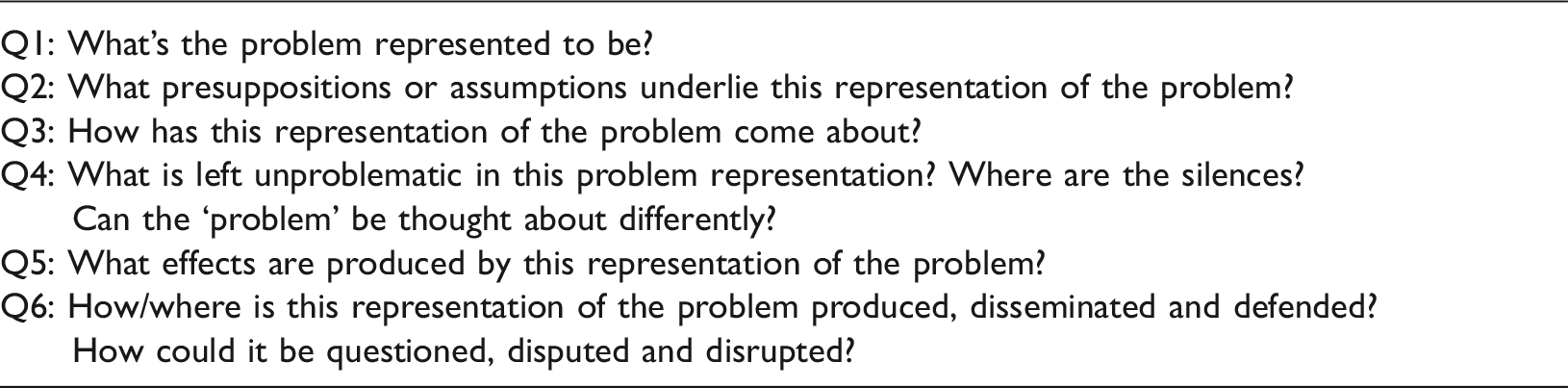
Bacchi-based WPR upon two central propositions, namely the need to study the way policies construct problems and the premise that problematisations are central to the practice of government – to governing (Bacchi, 2009, xxiii) and therefore worthy of analysis.
Our policy-interested case study applied a form of policy discourse analysis configured by both Ball (2015) and Bacchi (2009) ‘to recognise the non-innocence of how problems get framed within policy proposals, how the frames will affect what can be thought about and how this affects possibilities for action’ (p. 50). To this end, we conducted a document analysis across an extensive publicly available archive of data sources including FLO policy statements, FLO program updates, FLO newsletters, FLO departmental data as well as secondary data sources including FLO evaluation reports and news stories. We also considered international public policy research in social exclusion during the time of the UK Blair Labour Government – which preceded the SA SI agenda – considering the influence of UK social exclusion policy upon the policy logics of SA’s SI initiative, to better understand the policy assumptions underlying the FLO policy ensemble and its policy effects.
Using WPR as our policy questioning framework, we engaged in document analysis, which according to Labuschagne (2003), yields data including excerpts, quotations or entire passages that, through content analysis, can be organised into major themes, categories and case examples. To obtain the documents, we accessed publicly available FLO policy documents and evaluation reports generated by DECD and the SI Unit, situated under the umbrella of the Government of South Australia, spanning 11 years of the program’s development from 2002 to 2015. In addition, our public policy inquiry method sought to apply a meaning-making interpretative lens to the FLO policy documents, aligning with what Gardiner (1999) called the hermeneutic approach. This method involved rigorous on-going conversations fortnightly over a two-year period about the FLO policy materials, which we describe as a ‘hermeneutic circle’ of FLO policy discussion (Gadamer, 1996).
We began our analysis by reading the policy documents broadly, discussing key themes that emerged from this reading, and then coded the gathered data into ‘chunks’. These ‘chunks’ formed the basis of the coding frame that emerged from our ongoing hermeneutic reading and discussions of the policy documents. Next, the codes were used to develop sub-themes and then progressively a smaller number of overall themes. In an iterative fashion, we checked and rechecked the elemental codes and concepts with each other during discussion. We scrutinised and compared data with data in order to organise ideas and pinpoint concepts that seemed to cluster together.
We acknowledge studies of this kind that draw upon documentation are obviously constrained by what is available. However, we argue the following DECD policy and evaluation documents, which we were able to access were sufficient in policy detail to form the basis of a robust WPR analysis:
‘Student Engagement Matrix Guidelines’ (DECD, 2015b); ‘Flexible Learning Option Enrolment Policy’ (DECD, 2015c); ‘Flexible Learning Enrolment Strategy’ (DECD, 2015d); ‘FLO Data Collection Term 3 Census’ (DECD, 2015e); ‘Innovative Community Action Networks (ICANs) – Schools working in partnership with the community’ (DECD, 2014); ‘Impact of ICAN Flexible Learning Options on Participant Offending Behaviour’ (Commissioned by the Government of South Australia, 2014); ‘Innovative Community Action Networks (ICAN) Final Evaluation Report’ (ARTD, 2013) ‘DECD Annual Report’ (Government of South Australia, 2013), ‘My Path My Future-Flexible Learning & Transition Plan Portfolio User Guide’ (DECD, 2012); ‘Innovative Community Action Networks (ICAN) Evaluation Interim Report’ (ARTD, 2012) http://www.ican.sa.edu.au/pages/What is FLO/Risk factors/ (DECD, 2011); ‘Innovative Community Action Networks- an innovation of South Australia’s Social Inclusion Initiative’ (Social Inclusion Board, 2009); and ‘Making the Connections’ (Social Inclusion Board, 2004).
In the next section, we offer a brief contextual overview of FLO and then present our WPR analysis of the FLO Social Inclusion Initiative (SII).
FLO
FLO is described in the policy and evaluation literature (ARTD, 2012, 2013; DECD, 2013, 2015a, 2015c; Government of South Australia, 2014) as a highly individualised learning program that offers students, depending upon identified areas of need, tailored levels of mentoring support provided by non-government organisations (NGOs) and educational support to help students identify and attend possibilities from a range of accredited learning options. FLO was operationalised within DECD in 2006 and has been supported by a large departmental section within the DECD central office called ICANS.
Eligibility for FLO program participation is negotiated with students and their parents/caregivers, taking into account educational, social, emotional, health and well-being considerations (DECD, 2015b, 2015c, 2015d). FLO can be offered entirely within the eligible student’s own school, or be a combination of in-school and off-school site learning activities, often involving youth workers or youth stakeholder staff from NGOs. In the case of diagnosed ‘high-needs’ or ‘high-risk’ students (DECD, 2015b), FLO can be offered entirely off the school site, with students participating in accredited community-based learning programs facilitated by social workers, youth workers and/or accredited employment trainers with some teaching staff involvement. Typically, FLO programs offer case management provided by NGOs, facilitating joined-up service delivery including vocational skills training, negotiated individualised learning and on-line learning activities. FLO enrolled students in secondary school have individually tailored timetables based on their Flexible Learning and Transition Portfolio which may include a mix of accredited and non-accredited courses or modules, offered at different locations including school, flexible Learning Centres and other sites. The timetable may include part-time work or other agreed activities. (ARTD, 2013, p. 43)
Across our marshalled historical range of policy documents, FLO is declared to be ‘an innovative government school enrolment funding model where students remain enrolled in their home school, but are likely to access learning beyond the school walls’ (Koen & Duigan, 2011, pp. 142–143). Since 2006, the FLO DECD team has developed diagnostic approaches to assess student learning needs, which are used to place students into personalised learning options (DECD, 2015b). Student enrolment procedures have been tightened since the commencement of FLO (DECD, 2015c) and the roles of the bureaucracy and associated FLO NGO stakeholders overseeing and delivering services within the program have been given greater clarity (ARTD, 2013; DECD, 2015e). It is worth noting here that the vast majority of FLO students come from the most socio-economically disadvantaged regions of SA (ARTD, 2013). We will return to this point later in the discussion, but now turn our discussion to the six key WPR policy questions in the Baachi framework that will structure the ensuing FLO policy inquiry.
Q1: What’s the problem represented to be in FLO?
The FLO initiative originated during a period when the SA Social Inclusion Board (SIB), a newly introduced advisory arm of the South Australian Labor Government in 2002, identified the issue of languishing SA school retention rates compared to the rest of Australia. This is articulated in the 2004 released ‘Making the Connections’ policy report where it states; In October 2003, as part of the Social Inclusion Initiative, the South Australian Government launched ‘Making the Connections’, a new strategy to increase school retention rates. (Social Inclusion Board, 2004, p. 4)
The subsequent introduction, growth and development of FLO was therefore driven by a key SIB mandate: the ‘removal of barriers and to provide people in disadvantage with access to secure housing, learning and employment, health and other services, social support and connections’ (Cappo & Verity, 2014, p.27). The SIB’s principal operational domains were ‘learning, employment and health’, which encompassed the sphere of schooling. According to Monsignor Cappo, who acted as the chairperson of the SIB, which worked as an advisory arm to the Premier on SI policy, the key area of the SIB’s involvement in education was ways to address the problem of school retention: From the outset, the Social Inclusion Board stressed that ‘school retention’ had to be seen as a whole of-government and community issue if there was to be real change to systems of lasting benefit for young people, rather than being a problem solely for the institution of education to address. (Patterson, 2011, p.10)
SA’s poor school retention rate, which had been trending lower than the Australian average, hovered around 67 per cent for the years 1999–2003 (Social Inclusion Board, 2004). The report stated that the proportion of Aboriginal young people finishing Year 12 was even lower (Social Inclusion Board, 2004, p. 4). The report then argued that ‘the notion of leaving education before completing year 12 or its equivalent will not serve our young people well in a dynamic and changing environment’, which was accompanied by a rationale that ‘non-participation in education also increases the risk of social isolation, poor health, offending and drug misuse’. (p. 5)
Therefore, the SI policy lens was firmly turned towards addressing SA’s student retention problem. From the perspective of the SIB, improved retention, or keeping all young people engaged in formalised education, offered the best chance of improving their educational attainment, reducing societal costs into the future and building community connectedness and well-being for young people. In other words, by addressing retention through FLO, improved educational attainment would follow. This economic and societal benefit of FLO is highlighted in a report conducted by the SA Office of Crime and Statistics Research titled, ‘Impact of ICAN Flexible Learning Options on Participant Offending Behaviour’ (Aird, Ranson, & Marshall, 2014) commissioned to: Determine the offending profile of a group of ICAN Flexible Learning Options (FLO) participants before, during and after enrolment in FLO; and examine the impact of the ICAN FLO strategy on participant offending behaviour. (p. 3)
The report surmised that FLO may help reduce the severity of offending. The fact that this report was commissioned indicates that FLO policy in its later years was also concerned with publicly demonstrating the rehabilitation of young offenders. In a sense then, for some FLO students, there was a policy hope behind the commissioning of this report that their lives could be made ‘good’ through FLO participation, providing individual, societal and economic benefits.
Q2: What presuppositions or assumptions underlie FLO’s representation of the problem?
Throughout the FLO policy literature, evaluations and research archive (ARTD, 2012, 2013; DECD, 2015a, 2015b, 2015c, 2015d, 2015e) key assumptions pertaining to FLO eligible young people and their participation in schooling are provided. A careful reading across the FLO policy literature reveals habitually used terms like (1) ‘at risk’ young people and how they face (2) ‘barriers’ to their participation in schooling that together impacts their ‘engagement in learning’ (ARTD, 2014; DECD, 2012, 2013; 2015b, 2015c, 2015d; Newman, Biedrzychi, Patterson, & Baum, 2007). An example of the use of the ‘young people at risk’ discourse is provided in the extract below with bold emphasis added. A FLO enrolment provides resources to successfully re-engage
Underlying assumptions about ‘youth at risk’ and conventional schooling
Whilst the extract above indicates that FLO offers young people diagnosed as ‘at risk’ (DECD, 2011) a meaningful and accredited learning pathway, one of the silences in the extract concerns the capability of conventional schools to provide ‘young people at risk’ with a meaningful and accredited learning pathway. It would appear that being a young person significantly ‘at risk’ in conventional schools is viewed as problematic in this discourse, hence the introduction of the FLO intervention alternative. In other words, a loud silence concerns the capability of conventional schools to successfully engage young people significantly ‘at risk’ within school-based learning. Through applying WPR to the FLO SII extract provided above, we can infer that conventional schooling is rendered as lacking in ‘meaningful’ learning pathways for some ‘young people at risk’.
In more recent DECD FLO SI policy documents, the term ‘at risk’ has been removed and replaced with a softer discourse (bold emphasis added). ICAN (under the FLO regime) is currently working with about 5000 secondary and upper primary aged students anxiety and depression learning difficulties social and behavioural problems bullying homelessness and transience family difficulties. (DECD, 2014, p. 1)
Therefore, another key assumption underlying the FLO policy discourse provided above is ‘individualization of risk’ (renamed ‘students who have multiple complexities’), which is attributed as residing within the FLO eligible young person. In other words, an FLO student is diagnosed as embodying these ‘things’ preventing engagement in conventional schooling. This individualisation of risk is also where the engagement in schooling problem resides because of the high-risk factors attributed to the student. Returning to the extract, these ‘complexities’ present as a variety of ‘things’. These presenting ‘things’ belong to the student and present as a policy logic that assumes ‘successful engagement’ within conventional schools for ‘at-risk’ youth or ‘students with multiple complexities’ is highly unlikely. The key policy discourse term ‘at risk’ may have gone but the meaning behind the term ‘multiple complexities’ appears to remain the same as ‘at risk’. With FLO presented as the best schooling program option to address students presenting with multiple complexities what is implicitly inferred is that conventional schools are not the best option.
Q3: How has this representation of the problem come about?
In considering how this representation of the problem of ‘at-risk’ students and their engagement in learning (retention) came about, we turn to a consideration of the historical origins of SA’s SI policy agenda. In the UK, the Blair Labor Government embraced a SI-exclusion policy framework in the late 1990s establishing a Social Exclusion Unit. According to Marston and Dee (2015) Blair’s policy response to social exclusion was heralded in his ‘joined-up solutions to joined-up problems’ policy creed (Blair, 1997, p. 4). Levitas (1999) claimed that in practice the Blair government adopted a social integration approach to inclusion, privileging paid employment, while neglecting a more redistributive approach to addressing social inequality. This approach ignores the nature and effects of an unfairly structured society that lies at the heart of social exclusion. Without ample health, housing and education safety nets, the competitive employment market remains out of reach for many.
The South Australian State Labor Government borrowed key elements from the UK SI experiment to frame their SI policy agenda in 2002, illustrated in the following extract with boldface emphasis added which indicates, the SA Labor Government pursued an ‘integrated (joined up) policy and programs initiative’ that held the earmarks of Blair’s ‘joined-up solutions to joined up problems’ mantra. In 2002 the South Australian Labor Government headed by Premier Mike Rann (2002–2011) who also had the role of Minister for Social Inclusion (the first person to hold such a Ministerial position in Australia), established the Social Inclusion Initiative (SII) immediately upon coming to office, and gave it a
The introduction of the SIB with its SI mandate therefore represented a case of transnational ‘policy borrowing’. (Ball, 1998, p. 126), configured by Ball (1998), as ‘a process of bricolage’ (p. 126). Similar to Blair’s social integration approach to addressing social exclusion, the SIB’s Chair Monsignor Cappo et al. (2014), social exclusion was defined as ‘the process of being shut out from the social, economic, political and cultural systems which contribute to the integration of a person into community’ (Newman et al., 2007, p. 11).
Marston and Dee (2015) argue that the Australian National Government also borrowed key aspects of the UK SI experiment during the Rudd-Gillard-Rudd Federal Labor government years from 2007 to 2013 to frame their social policy interventions. They claimed Labor’s SI policy agenda represented a social integration approach to inclusion similar to the Blair agenda, privileging paid employment and neglecting a more redistributive approach marked by increased government investment in low socioeconomic status (SES) schools to better address social inequality. The negation of a redistributive approach to addressing SI is consistent with the FLO policy response. Schools with high FLO referrals are predominantly the most disadvantaged schools in SA (ARTD, 2013). FLO enrolments access the historical school student enrolment funding base, with enrolment funds following the student as he or she participates in FLO. This funding arrangement therefore represents a ‘thin’ SI policy response because it is premised on an inclusion logic of participation and retention through joined up service delivery within FLO, but ignores an injection of government funds into conventional schools situated in disadvantaged community contexts, to encourage more socially just inclusive schooling approaches to flourish. the political commitment for implementing a multi-dimensional social inclusion agenda has been lacking in Australia. (Marston & Dee, 2015, p. 1)
Q4: What is left unproblematic in this problem representation? Where are the silences? Can the ‘problem’ be thought about differently?
The ‘thin’ DECD SI policy response manifesting in FLO (the educational engagement answer to early school leaving) concurs with what Hamilton (2014) identifies as a policy approach that individualises risk. She described risk individualisation as ‘a consequence of the normative power of neoliberal principles with their growing emphasis on individualized risk-bearing’ accompanied by, citing Beck (2002), a ‘discourse of blame for social misfortunes’(p. 454). Hamilton argued that the process by which risks have been individualized through government policy have been largely neglected in the literature. Other critical sociology scholars have also challenged the undisclosed pathological meaning within the term ‘students at risk’. They assert that young people are marginalised by unfair societal structures of which schooling is one, and turn the problem upon schools and educational systems rather than allowing the problem to reside solely with the student (Bills, Cook, & Wexler, 2015; Smyth, 2010; Smyth, Angus, Down, & Mcinerney, 2008; Smyth & Hattam, 2002; Smyth, Hattam, & Cannon, 2004, Smyth et al., 2003). There can be little doubt from the accumulating research evidence that as conditions conducive to learning in schools deteriorate through emphases on accountability, standards, measurement, and high stakes testing, that increasing numbers of students of colour and those from urban, working class, and minority backgrounds are making active choices that school is not for them. (Smyth, 2006, p. 279)
Resonating with Smyth’s redirection of the problem, te Riele’s (2006) scholarship into alternative and second-chance schooling programs argues that the dominant conceptualisation of youth ‘at risk’ draws attention to what is wrong with youth, rather than to what may be wrong with schooling. For us, it is an ‘othering’ logic that draws attention to young people and away from the structural and institutional arrangements of society that may contribute significantly to the problem. In effect, this ‘othering’ of the problem to young people, hides other areas pertinent to SI that should be considered. Going further with this analysis, we argue that this individualised view of what is wrong represents a deficit notion of being a young person who finds the social geographies of schooling to be alienating (Smyth & Hattam, 2002), which is captured by Valencia (1997) with McInerney (2009) claiming; there can be little doubt that many students’ experience of alienation is profoundly shaped by personal and psychological factors, including physical and mental disabilities, but a good deal of the causes of disconnection and powerlessness experienced by young people are rooted in major social divides based on class, ethnicity and gender. (p. 25)
Similarly, Bevir (2009) argues that SI/exclusion is a highly contested public policy concept infused with different meanings within different political contexts. He presents the concept of SI as essentially unsound because too much emphasis is placed on the excluded rather than on ‘those’ doing the excluding. His argument is that SI public policy often moves the focus away from the root causes of social exclusion (capitalism and neoliberal public policy) and their consequent manifestations in unfair societal structures, income disparity, unequal opportunities, residualised communities and stratified public schools. This argument is extended by Marston and Dee (2015) who present concerns that If the political gaze is on the excluded then we miss the possibility of seeing the dynamic between the insiders and outsiders, the dominant and dominated and the power struggles between different political groups. (Marston & Dee, 2015, p. 8)
Another significant policy silence in FLO concerns the ‘absent’ potential of secondary schools to embrace socially just school redesign that could reconfigure the need for or even the removal of FLO. Conventional secondary schools are resourced to offer students learning spaces with teacher professionals offering a variety of curricular options. However, any repositioning of FLO SI programs into schools would be difficult within current national and state educational policy mandates, which according to Smyth (2009) work to hold secondary schools to historical conventional schooling logics rendering most damage upon disadvantaged students. There can be little doubt from the accumulating research evidence that as conditions conducive to learning in schools deteriorate through emphases on accountability, standards, measurement, and high stakes testing, that increasing numbers of students of colour and those from urban, working class, and minority backgrounds are making active choices that school is not for them. (Smyth, 2009, p. 279)
Picking up again on Smyth’s critique of standards, accountability, measurement and high stakes testing, within the SA FLO policy context, standardised policy logics also work against the engagement of potential FLO students within conventional schools (Bills et al., 2015). So whilst we see the potential of socially just secondary school redesign as another way to think about SI policy, essentially directed towards how schools choose to do schooling, we are aware that this approach would be very difficult because it contests the entrenched design logics of conventional schools. These design logics are made more impenetrable in Australia by the stratification of public secondary schools within the market ‘school choice’ economy having to also attend to the presenting standards-based and high stakes testing regimes where they are often made public losers.
Q5: What effects are produced by this representation of the problem?
Tilley (1999), Sen (2000) and Marston and Dee (2015) argue that the political costs of a policy gaze directed to students at risk who embody the problem of risk (which we see within the FLO policy response) can amount to missed political opportunities to address public problems. This is because such a constrained gaze leads to an inability to see and therefore analyse institutional organisational arrangements that may in fact produce and sustain enduring inequalities and anti-democratic practices. This is despite considerable research in Australia including The Smith Family’s 2011 ‘Unequal Opportunities: Life chances for children in the “Lucky Country”’ report, which recognised the existence of unequal life opportunities for disadvantaged groups, in essence claiming Australia to be an unfairly structured society.
Bringing the individualised FLO renderings of risk and the associated FLO solutions to early school leaving into our problematising of FLO, which is removal from schooling for high ‘risk’ students, we see a diminishment of conventional schooling’s responsibility to offer all young people ‘at risk’ more inclusive schooling opportunities. By removing some FLO young people from the institution of schooling (a key ‘silence’ within the FLO policy logic) and placing them within the FLO educational engagement architecture, conventional schools are under less pressure to engage young people in need. Leaving the impact of FLO upon socially just secondary school redesign for a moment, we now venture into publicly available data to help us understand the impact of FLO upon retention and attainment levels in SA.
Within the ‘loss of faith’ policy orientation for conventional secondary schooling to successfully cater for the learning needs of young people considered to be significantly ‘at risk’, we offer two working hypotheses both requiring further research. The first hypothesis is that the rapid growth of FLO from 440 students in 2003 to over 5000 students in 2015 (DECD, 2015a) may be indicative of the impact of market-based schooling logics. Intensified schooling marketplace logic is now a well-entrenched phenomenon impacting all South Australian schools, and most OECD schools, who are obligated to seriously attend to and protect their brand or image in the race for stronger enrolments and better results. We argue this branding marketplace logic promotes FLO referral because eligible students who present as ‘problem students’ because they act out their ‘at risk’ behaviours within conventional schooling can potentially do harm to school image and brand whilst increasing the emotional and time demands placed upon teachers and leaders in schools. By removing the ‘problem’, conventional schools can enhance their brand or image (Bills et al., 2015).
The other hypothesis is that FLO offers young people a sense of connectedness to more inclusive learning options that their previous schooling endeavours were unable to produce. This is certainly the case reading through the positive student testimonials about their experience of the FLO initiative. If this hypothesis holds, then why the conventional practices of schooling are not able to achieve this requires investigation. With over 5000 students enrolled in FLO, what does this say about the inclusive and engaging nature of conventional schools? This could bring into the SI policy realm the need for conventional schools to learn from the best features of FLO, and build these features into how schooling is undertaken.
Beyond these two hypotheses, another possible effect of the current FLO policy orientation is empirically presented in the 2013 Evaluation of ICAN, where ARTD consultants provided SACE completion data for the young people enrolled in FLO. Citing that FLO students undertaking the SACE made up 86% of the evaluation cohort (p. 56), which was configured as 3792 students (86% of the 4410 FLO enrolled students in 2013), SACE Stage 1 completion was 7%, with 22% of students having partially completed Stage 1 and SACE Stage 2 completion recorded as 2% of FLO students successfully completing the SACE, with a further 3% partially completing. 1 The data indicated strong engagement of FLO students in vocational education and training courses, which counted towards the SACE certificate. In the evaluation data, 2% of FLO students completed Certificate 3, 8% Certificate 2 and 6% Certificate 1 (ARTD, 2013, p. 57). This data show that very few young people in FLO are attaining year 12 or its equivalent, and the consequent benefits that flow from this accreditation.
Q6: How/where is this representation of the problem produced, disseminated and defended? How could it be questioned, disputed and disrupted?
FLO has helped SA address its poor retention problem and this has been recognised in various DECD Annual Reports (DECD, 2014) and FLO (ICAN) policy statements and evaluation reports (ARTD, 2013; DECD, 2006–2014). In the policy archive, we have also found many anecdotal stories from students who speak about how the FLO initiative has helped them stay connected to learning, with examples of this provided in relation to apprenticeships that have been secured, parent accolades for the program and student testimonies of how the program has impacted them in positive ways. But within the retention improvement story, FLO has been unable to translate improved retention into improved attainment. FLO enrolments have increased from 680 students in 2007 to 4410 students in 2013, a 648% increase (ARTD Consultants, 2013, p. 2) over the time period. This increase represents a significant proportion of enrolled public secondary school students; 4410 2 students out of a total DECD secondary enrolment of 62,425 students from years 8 to year 12 in 2013 (DECD Annual Report, 2013). This is almost 7 per cent of all secondary school enrolments. Despite this strong growth in student numbers, FLO has been only able to reach an attainment level of 2% completion of the final year of schooling according to one publicly available report (ARTD, 2013, p. 57).
In fact, while the FLO policy archive is replete with information on improved retention rates, individual student testimonies, program growth, improvements in student well-being, strong vocational course participation, joined-up partnerships, clear enrolment guidelines and an argument made for reduced crime through FLO participation (ARTD, 2012, 2013; DECD, 2012, 2015b, 2015c, 2015d, 2015e, 2014; Government of South Australia, 2013, 2014), the SACE (school completion) outcomes data for FLO students are found in only two pages of one report and only for a 2012 snapshot. SACE data are not available in any other FLO-related publication accessed for this analysis. This is an area where the FLO program needs further investigation, bearing in mind that the cost of an FLO student per year for a year 11–12 student was $8240 per year of public funding in 2014 (DECD, 2014, p. 3). We are left questioning how can this funding be better targeted so that FLO students can enjoy the benefits of schooling attainment.
Underlying this poor school attainment result is a reported finding within the evaluation documents that the greatest FLO referral regions are the most socio-economically challenged communities in SA (ARTD, 2012, 2013), namely Adelaide’s outer-lying northern and southern suburbs that have felt the full brunt of the collapse of manufacturing industry, particularly the car industries, and regional towns in country SA where diminishing industry and rural farm hardship has led to consequent escalations in unemployment rates. A recent BSL analysis (2014) highlighted the current employment predicaments for young people, claiming it to have reached ‘crisis point’. The report cites an average of 12.4 per cent of young people unemployed nationally between the ages of 15 and 24 in the year January 2014, double that of the overall unemployment rate. The analysis also shows that the region of northern Adelaide, the region with the largest percentage of FLO referrals (ARTD, 2014), has a youth unemployment rate close to 20 per cent. More than ever, in a shrinking and therefore increasingly competitive youth labour market, educational attainment presents opportunities to assist young people to lift their chances of securing work and FLO has been unable to provide this. Here a socio-economic argument could be made that FLO students are not benefiting from the program’s intervention in terms of how accreditation can help build life opportunity.
Therefore, improved FLO retention has not translated into strong FLO school attainment results. This is despite a powerful school attainment logic presenting within the Australian Social Trends March 2011 report (ABS) and the FYA report. Both reports argue that young people who complete Year 12 in Australia have a greater likelihood of continuing with further study, particularly in higher education, as well as entering the workforce. Educational attainment improves the labour market prospects of young people; a corollary of low educational attainment is marginalisation to either part-time work only, or unemployment. Policies to raise educational attainment must be directed at those groups of young people among whom rates of school completion are currently low. (FYA, 2011, p. 8)
Here, school attainment is positioned as the ‘main game’ of schooling to foster improved life opportunity for young people. Such is the significance of year 12 attainment that the Council of Australian Governments (COAG) National Education Agreement (2009) in its updated form, aimed to lift the proportion of 20- to 24-year olds nationally with Year 12 or Certificate 3 3 to 90% by 2020.
Conclusion
A variety of policy measures to prevent early school leaving have been trialled in recent decades across OECD countries including policies directed at students, their families and schools (De Witte et al., 2013). The FLO policy ensemble has in the main been directed at students, with identified high-risk students removed from schools and low-risk students participating in a combination of in-school and out of school learning experiences. Our WPR analysis indicates three main areas of FLO policy contention namely (1) individualisation of risk and the school problem, (2) policy silences and (3) educational entitlement. We consider these three themes briefly below and then conclude with policy recommendations.
Individualisation of risk and the school problem
Our WPR analysis positions schools as one of the sources of the retention problem along with individualised risk factors that are embodied in the FLO eligible young person. This policy assumption presents a deficit rendering of young people and of conventional school’s ability to cater for all students. Hence, the FLO engagement logic works to remove ‘at risk’ students from schools, offering engaging curricular experiences and personalised supportive structures with the aim of their engagement in some form of learning. In our view, this reflects a failure to consider other possible barriers and consequent early school leaving interventions that could bring about greater attainment levels for these students as well as bringing family/caregiver partnerships and school redesign into the policy frame. However, we acknowledge that the FLO policy predisposition towards individualisation of risk is not unique given that: the majority of research on early school leaving still endeavours to pin-point personal and social characteristics of potential dropouts that may differentiate them from graduates, so as to create a kind of “photofit” of those most at risk, for whom targeted intervention measures can then be devised. (Vizcain, 2005)
Policy silences
Within the examined policies, no statements were made about the marginalising effects of schools (Smyth et al., 2000) or interventions geared towards addressing the needs of the families of FLO students. In more recent policy documents, students were characterised on the basis of their ‘barriers to learning’ (DECD, 2014), which is consistent with the tenor of the intervention in previous years. There was no attribution of ‘barriers’ arising from unfair societal structures including the institution of schooling. The policy also remained consistent with its 2004 pledge to improve retention up until 2015, with FLO presented as the best program for addressing early school leaving.
Throughout the FLO policy material, engagement in learning was expressed as a successful and celebrated outcome of the FLO program and yet only 2 per cent of FLO students successfully completed Stage 2 of SACE (ARTD, 2013). The last decade of SI educational retention policy in SA with the FLO intervention in place has helped keep over 30,000 young people (DECD AR 2004–2013) connected to educational learning opportunities and made inroads into the problem of early school leaving. Still, this retention has not translated into significant educational attainment (SACE 4 completion in SA) for FLO students.
Educational entitlement
For us, ‘good’ SI policy at the very least should be offering all students their entitlement to a quality well-balanced education, which in SA is the attainment of the SACE (2006), which we consider is the ‘gold standard’ of schooling. Our WPR analysis of the FLO policy archive reveals this entitlement as a diminished one, silenced in a policy logic that largely measures the success of educational SI policy in terms of improving school retention.
We argue that educational SI policy manifesting in FLO must offer at the very least access to the same quality educational processes and choices as other students, essentially holding true to all students’ educational entitlement, even if the outcomes turn out to be unequal. The current FLO SII does not offer this ‘access’ because the removal or partial removal of ‘at risk’ students from conventional secondary schooling environments minimises their access to a comprehensive curriculum, accredited teachers and the richness of school infrastructure learning architectures. FLO, in seeing conventional schools and students ‘at risk’ as the root cause of the problem of poor retention, has introduced a safety net escalator removing many identified ‘at risk’ students away from the richness of the secondary schooling environment and in so doing, from the opportunities provided by schooling attainment. The FLO initiative in its current form therefore presents as a form of passive exclusion. Citing Nevile (2006, p. 88) in Marston and Dee (2015) who argues that passive exclusion is the ‘the unintended consequences of policy initiatives that do not seek to exclude, but because of attendant factors … .a sub-optimal level of inclusion may be all that can be achieved’ (Neville, 2006, p. 88).
Policy recommendations
We believe more socially just educational FLO SI logics would firmly link school retention with attainment as a key measure of program success and that schools should be considered in partnership with parents and/or caregivers as key intervention partners. According to Evans (2003) and Nind, Sheehy, Rix, and Simmons (2003), alternative schools if appropriately resourced and designed can make positive inroads into school accreditation for ‘at risk’ students. Alternative schools need different pedagogic approaches and means of accrediting non-formal and informal learning that give students qualifications that are recognised in the labour market and access to other education/training pathways. (Evans, 2003; Nind, Sheehy, Rix, & Simmons, 2003)
In the United States, for instance, some of the charter school redesign initiatives have achieved considerable success working with socio-economically disadvantaged groups. Both the Big Picture schooling approach (Sizer, 2004) with its ‘one child at a time’ mantra and the High Tech High (HTH) ‘head, heart and hands’ approach both present with a history of outstanding retention and attainment results for students. They are not last chance programs that students fail or fall into like FLO, but involve aspirational schools working closely with parents/caregivers to make learning authentic, challenging and personalised for their students. In Australia, Big Picture Australia (BPA) and HTH have had some success in addressing both retention and attainment for ‘at risk’ students. We therefore advocate on the basis of our WPR analysis for a more encompassing FLO policy approach that is inclusive of a variety of interventions including school redesign and more parental involvement in redesigned schools and is not just geared to those students deemed to be ‘at risk’, although this is probably much easier said than done.
Footnotes
Declaration of conflicting interests
The author(s) declared no potential conflicts of interest with respect to the research, authorship, and/or publication of this article.
Funding
The author(s) received no financial support for the research, authorship, and/or publication of this article.