



Abstract
A significant body of research documents the negative consequences of dropping out of school for both the individual and society. In attempting to respond to the problem of early school leaving, schools and systems internationally have put in place a range of system-level and local responses such as mentoring, targeted additional career guidance and homework clubs. Unfortunately, these ‘add-ons’ often stop outside the classroom door, and do not consider the impact of teaching practices on students’ engagement in school and their decisions to remain or leave. This article reports on the development of instruments aimed at measuring four constructs that have been shown to be related to student engagement and school completion, namely competence, autonomy, relatedness and an appreciation of subject relevance. Analyses of data from a small sample of Year 9 students (N = 48) in two Australian secondary schools indicated that, with some adjustments, the research instruments developed provided reliable and valid measures of the four constructs for use in large-scale research with students.
Keywords
The problem of non-completion of school
As labour markets around the world demand increasing levels of skills and qualifications, the negative impact of leaving school early is intensifying. In the world’s industrial economies, completion of a secondary school certificate is considered both a minimum level of educational attainment needed to access and succeed in the post-school education and labor markets (Cuervo & Wyn, 2011; Karmel & Liu, 2011; Lamb & Markussen, 2011; Sweet, Anisef, Brown, Adamuti-Trache, & Parekh, 2012) and a measure of successful transition from childhood to adulthood (Billett, Johnson, & Thomas, 2014).
Students dropping out before completing school are a challenge faced by many education systems. Current evidence suggests that slightly more than 16 per cent of young people within Organisation for Economic Co-operation and Development (OECD) countries do not complete upper secondary education (OECD, 2012). Across the European Union, 11 per cent of 18 to 24 year olds have disengaged from education and training without completing upper secondary schooling (Europe 2020 Indicators, 2016). At a policy level, there is a sharp contrast between government articulated school completion targets, social and economic objectives of education and training in Western countries and the persistently high school dropout rates observed in many European and Anglophone education systems (De Witte et al., 2013).
Non-completion of secondary school has been the subject of much recent research, which highlights the substantial negative impacts associated with leaving school early. Impacts include poorer labour market, health and wellbeing outcomes for individuals (Belfield & Levin, 2007; Leigh & Ryan, 2008; Oreopoulos, 2003; Rumberger, 2011). Early school leaving is associated with lower earnings both immediately post-school and over a lifetime, with cumulative effects for each year of schooling not completed (Oreopoulos, 2003), and increased likelihood of welfare dependency and intermittent employment (Business Council of Australia, 2003; Rumberger, 1987, cited in Rumberger, 1995; Spierings, 2003). Individuals who do not complete school also experience poorer health and wellbeing outcomes (Dockery, Koshy, & Stromback, 2005; Gibbons, 2006, cited in Kennelly & Monrad, 2007), are more likely to engage in criminal activity (Farrington, 2003; Prevatt & Kelly, 2003) and have higher rates of drug and alcohol use (Prevatt & Kelly, 2003). Some evidence also indicates that people who leave school early experience greater levels of depression and social isolation (Larsen & Shertzer, 1987; Prevatt & Kelly, 2003) and are more likely to become teenage parents (Woods, 1995 cited in Shannon & Bylsma, 2005). Some of these negative outcomes for individuals, such as the greater likelihood of unemployment, are exacerbated in the context of growing demand in economically developed countries for highly skilled workers and a decline in unskilled and low skilled employment opportunities (Ainley & McKenzie, 2007; McLachlan, Gilfillan, & Gordon, 2013). As low-skilled workers are replaced by automated labour, or by less expensive workers in economically developing countries, there is an increasing cost to individuals who have incomplete education. While measuring the comparative cross-country economic impact of school dropouts is complex and problematic due to different socio-cultural and economic contexts, some common patterns have emerged.
As well as the costs to the individual, the failure to complete school imposes costs on the broader society. Additional costs for society come in the form of lower productivity, weaker social cohesion and increased crime and welfare costs (Belfield & Levin, 2007; Rumberger, 2011). Lower individual incomes result in lower tax income for governments, together with higher costs through increased welfare and crime costs. Belfield and Levin (2007) report that, ‘For each new high school graduate… taxpayers will gain US$169,000 in additional tax revenues and a reduced burden of lower expenditures on crime, health and welfare [over a lifetime]’ (p. 2). They estimate the overall financial benefits to the state of a student completing Year 12 – in reduced costs, increased tax revenue and improved productivity – to be around US$400,000 over the lifetime of the student. Brunello and Paola (2013) found that a single additional year of secondary schooling could increase a person’s earnings over a lifetime by between 4 and 10 per cent. In Australia, Year 12 attainment leads to 10 per cent higher earnings for women, and 13 per cent for men, compared to those who attained Year 11 or lower (Forbes, Barker, & Turner, 2010). In summary, the costs of non-completion for both society and the individual are significant and enduring.
Factors underlying non-completion
The early school leaving literature, or ‘dropout discourse’ (De Witte et al., 2013, p. 15), cites a range of demographic, contextual and environmental factors that may contribute to early school leaving. Research shows that dropping out is often a result of cumulative disengagements (Nevala et al., 2011; Tillezcek et al., 2011), entails a ‘multidimensional process’ (Tillezcek et al., 2011, p. 3) and is a decision that ‘is influenced by factors that are at work for a long period of time’ (Manni & Kalb, 2003, p. 22). More broadly, higher dropout rates are associated with increased poverty which, in turn, is associated with weaker school attendance, lower school achievement and disengagement from school (Hammond, Linton, Smink, & Drew, 2007). Researchers have found educational achievement to be the strongest predictor of dropout or completion (Rumberger & Lim, 2008).
The likelihood of dropping out before completing school varies significantly for different parts of the school population. Disadvantaged contexts – within which young people are both economically and academically vulnerable (Teese, 2004) – contribute to lower academic achievement and overall motivation for schooling, which are major drivers for students leaving school early (DiPrete & Eirich, 2006; Dowson, McInerney, Nelson, & Vickers, 2011; Marks & McMillan, 2007).
Evidence from a number of countries finds indigenous students more likely to leave school early than non-indigenous (Lamb, Walstab, Teese, Vickers, & Rumberger, 2004; Reading & Wien, 2009). In developed countries, boys have also been found to be more at risk of leaving school early than their female peers, although their labour market outcomes may be stronger (Europe 2020 Indicators, 2016). In many Western countries, migrant young people experience higher rates of dropout than non-migrant young people (Europe 2020 Indicators, 2016). Similarly, in Anglophone countries, young people from backgrounds other than English are more at risk of dropping out without completing a secondary school qualification. Rates of dropout are also higher amongst young people from families with low levels of parental education. Likewise, rurality is associated in some countries with increased likelihood of non-completion (Lamb et al., 2004) although in the United States, poor urban students run the greatest risk of dropping out (Rumberger, 2011). In general, living in a neighbourhood with low levels of social capital has been associated with increased likelihood of school non-completion (Marjoribanks, 2002).
Responses to reduce non-completion
There have been many different responses at the school and system levels to increase school completion. At the system level, these include increasing the age at which students are permitted to leave school, which does have some positive impact (Oreopoulos, 2003). Broadening the curriculum to include vocational subjects and offering alternative certificates is another key mechanism used by systems which, again, appears to have some capacity to increase completion amongst those most likely to leave early (Bishop & Mañe, 2004; Clarke & Volkoff, 2013). At the school level, approaches such as mentoring, tutoring and case management of at-risk students have been utilised, with varying degrees of effectiveness, as have structural changes such as mini-schools (Lamb & Rice, 2008).
However, many of the school-level approaches to reducing early leaving have taken an ‘add-on’ approach, and stop outside the classroom door. There have been few initiatives and limited research examining how the teaching and learning activities student experience in mainstream classrooms impact on their engagement with their education and any relationship with their likelihood to stay or drop out. Given that research indicates that the intention to drop out of school is cumulative over many years (Audas & Willms, 2001), and that decisions to stay at or to leave school are likely to be informed by experiences across a range of classrooms and with a range of teachers, this represents a potential gap in both our knowledge of, and our approaches to, the reduction of non-completion.
The importance of engagement
Audas and Willms (2001) claimed that engagement is central to effective learning, and define it as the ‘extent to which young people identify with their school and derive a sense of wellbeing from their learning’ (p. iii). Christenson, Reschly, & Wylie (2012) noted that the concept of student engagement has expanded in meaning. Earlier research referred mostly to simple engagement in class, but this has expanded into a multidimensional construct comprising emotional, cognitive and behavioural components that have implications for motivation for learning (Fredricks, Blumenfeld, & Paris, 2004). There is a general consensus in the literature that student engagement is closely tied to students’ decisions to stay at or leave school (Fredricks et al., 2004; Rumberger, 2011). Students dropping out of school frequently cite a lack of engagement in their learning as one of the key reasons for deciding to leave (Bridgeland, DiIulio, & Morison, 2006).
One approach which has been useful for understanding student engagement and motivation is Self-Determination Theory (SDT) (Wilding, 2015). SDT is a theoretical approach to understanding an individual’s motivation, personality development and behavioural self-regulation through the way in which new information is internalised or integrated into an individual’s sense of self (Ryan & Deci, 2000; Ryan, Kuhl, & Deci, 1997; Wilding, 2015).
Ryan and Deci (2000) created a sub-theory of SDT known as Cognitive Evaluation Theory (CET) which explored the importance of meeting three key psychological needs as a basis for enhanced self-motivation, extrinsic motivation, intrinsic motivation, behavioural self-regulation and greater general well-being. These three psychological needs are competence, autonomy and relatedness (Ryan, 1995; Ryan & Deci, 2000).
Ryan and Deci (2000) proceeded by defining these three psychological needs. Autonomy is defined as feeling the need for volition when completing an act rather than a sense of dependence or independence. Competence is conceptualised as the need for a sense of self-efficacy while relatedness is defined as the need to feel a sense of belonging. Moreover, it is argued that an individual is required to have met each of these psychological needs in order to enhance his or her motivation, engagement and general well-being. For example, an individual’s feelings of competence must also be accompanied by a sense of autonomy in order to increase intrinsic motivation (Ryan & Deci, 1985, 2000).
In addition, Ryan and Deci (2000) argue that relatedness is essential for internalisation and considered to be a strong motivator when coupled with a sense of autonomy. Autonomy, in turn, is believed to facilitate the integration process to reach deep holistic processing which allows the individual to apply their own values to new information. The interacting relationships between these factors imply that all three of these psychological needs have to be met to foster an individual’s motivation and general well-being (Ryan & Deci, 2000).
Teachers’ endeavours to motivate students often result in a range of reactions such as unwillingness, passive compliance or active engagement (Ryan & Deci, 2000). Research suggests that creating education settings which meet an individual’s need for autonomy, competence and relatedness will increase the internalisation of positive school related behaviours, sense of relatedness between students and academic staff, student engagement, student motivation, student initiative and improve the students learning outcomes (Ryan & Deci, 2000; Ryan, Stiller, & Lynch, 1994). As a result, the importance of these three psychological needs for motivation and engagement within specific domains such as education is considered to be significant (Ryan, 1995; Ryan & Deci, 2000).
In addition to the three psychological needs of competence, autonomy and relatedness, a fourth factor known as relevance has also been found to be important for fostering student engagement and motivation (Woolley, Rose, Orthner, Akos, & Jones-Sanpei, 2013). Relevance is defined in this context as ensuring that the content of a course is perceived as relevant by the student. Relevance is important for both maintaining and increasing student motivation and learning as it increases the individual student's intrinsic interest which, in turn, motivates the individual towards more meaningful learning.
The current study
Given the general importance of student engagement for successful learning and school completion, more research is desirable into teaching practices within mainstream subjects such as English and mathematics and how these practices relate to the engagement of at-risk students. To this end, the current study set out to develop and trial a questionnaire aimed at measuring teacher practices regarding student autonomy, competence, relatedness and relevance.
Methodology
Participants
Two outer-urban schools were invited to participate in the study because of their low socio-economic status and relatively large populations of students at risk of non-completion. After they agreed to participated, each school was asked to identify one mathematics and one English class at Year 9 (age 14/15) for participation in the study. Mathematics and English were chosen as subjects because they are compulsory for virtually all middle secondary students so that the study’s results would have wide applicability. A total of 48 students of whom 21 were male and 27 were female responded to the questionnaire.
It was emphasised to the participating schools that the research was exploring pedagogy and student retention, and that any classes with mainly high achieving students on a pathway to university should not be targeted to participate. That schools had complied with this request was reflected in the responses to the question asking participants to indicate what they would like to be doing in two years’ time. Fifty-two per cent indicated that they would like to be doing Victorian Certificate of Education (VCE) while 42 per cent indicated that they would like to be in one of a number of non-VCE pathways, including Victorian Certificate of Applied Learning (VCAL), traineeships, Technical And Further Education (TAFE) courses, apprenticeships and paid employment (with three missing responses). This suggests that the participants represented a fairly broad range of pathways including those likely to be at risk of non-completion.
Instruments
Based on prior research which identifies school engagement and motivation as central to school retention, a framework consisting of the four constructs of autonomy, relatedness, relevance and competence was used to develop the instruments to investigate teacher practices.
In the four participating classes, students were asked to respond to a 10-minute paper-based questionnaire to indicate the frequency (‘How often does this happen in your class?’) with which a set of specified teacher practices occurred within that class, and the relative importance (‘How important to you?’) of those practices to their own engagement.
Survey items denoting teacher practices.

Response options regarding the importance of teacher practices were 1 = ‘not at all important’, 2 = ‘slightly important’, 3 = ‘fairly important’, 4 = ‘important’ and 5 =‘very important’. Response options regarding the frequency of teacher practices were coded as follows: 1 = ‘never’, 2 = ‘occasionally’, 3 = ‘sometimes’, 4 = ‘almost always’ and 5 = ‘always’.
The survey also sought demographic information from participants and an indication what of what they envisaged themselves doing in two years (equivalent to Year 11).
Analysis
Reliability analyses to examine the internal consistency of each of the four scales, namely relevance, autonomy, competence and relatedness were undertaken using SPSS. Cronbach’s alpha (Cronbach, 1951) was used as an indicator of reliability whereby values above .60 were considered acceptable (Nunnally & Bernstein, 1994).
Results
Results indicated that the developed items measure the four hypothesized scales of autonomy, competence, relevance and relatedness in a reliable manner.
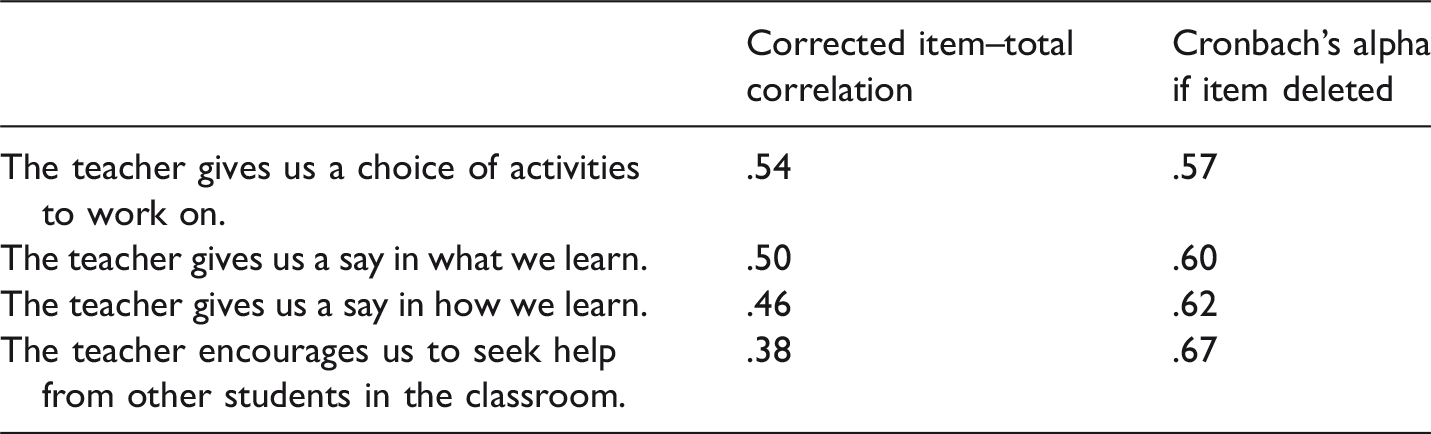
Autonomy
Scale reliability for autonomy.
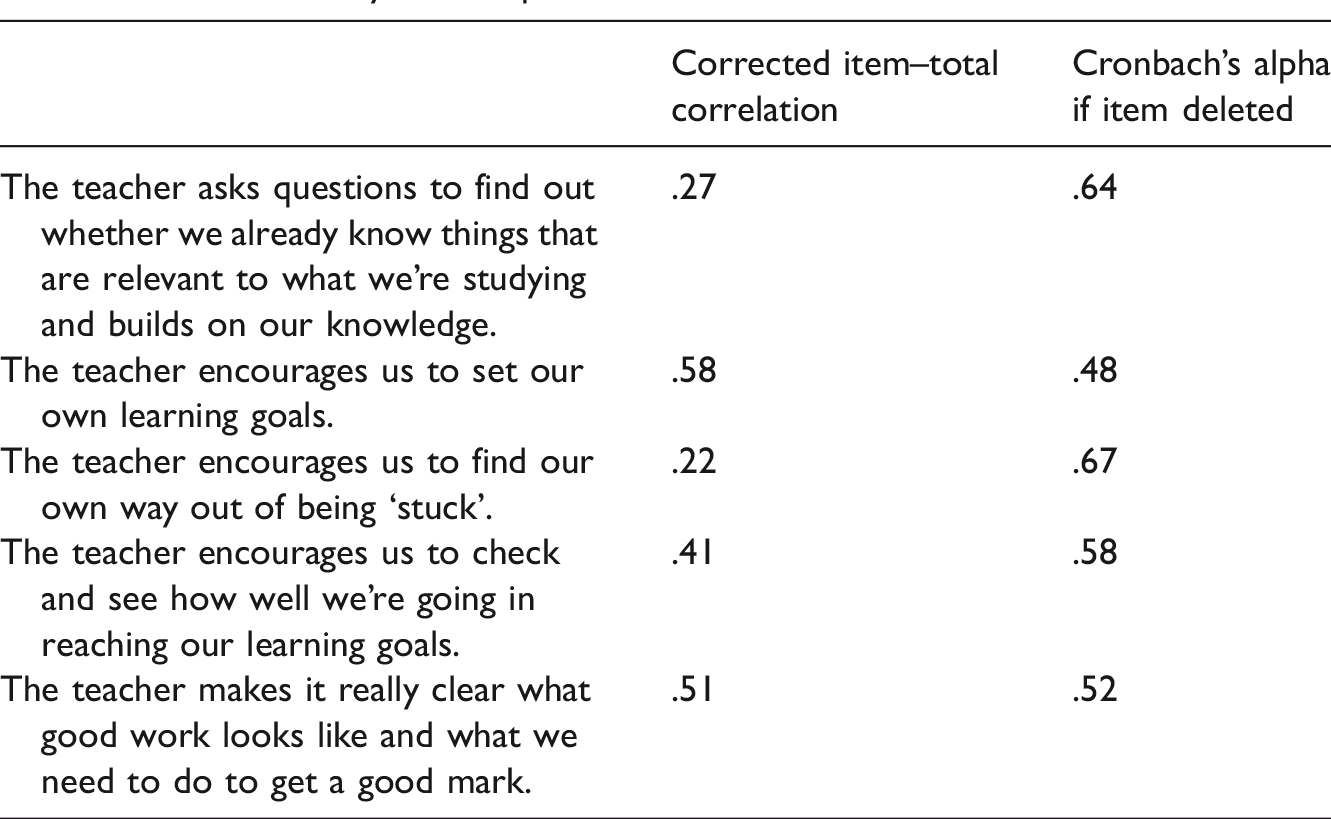
Competence
Scale reliability for competence.
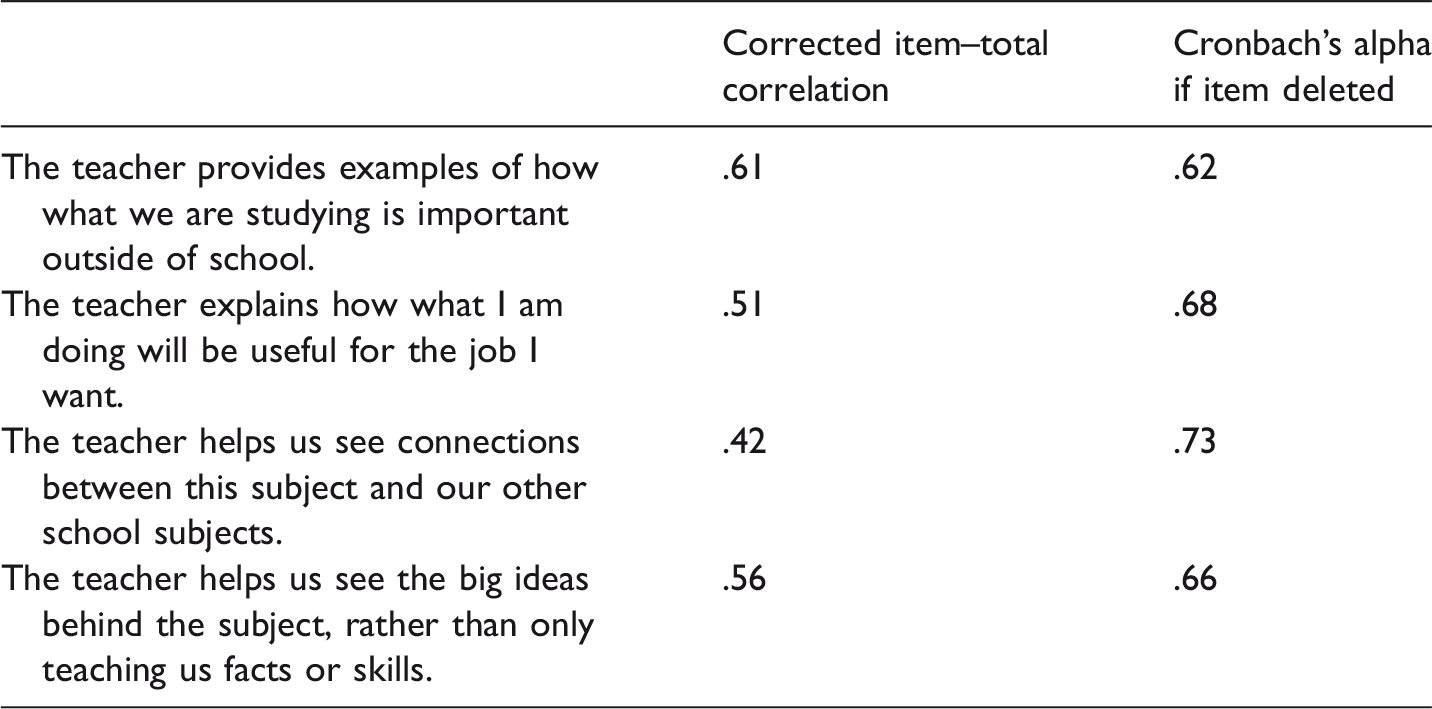
Relevance
Scale reliability for relevance.
Relatedness
Scale reliability for relatedness.
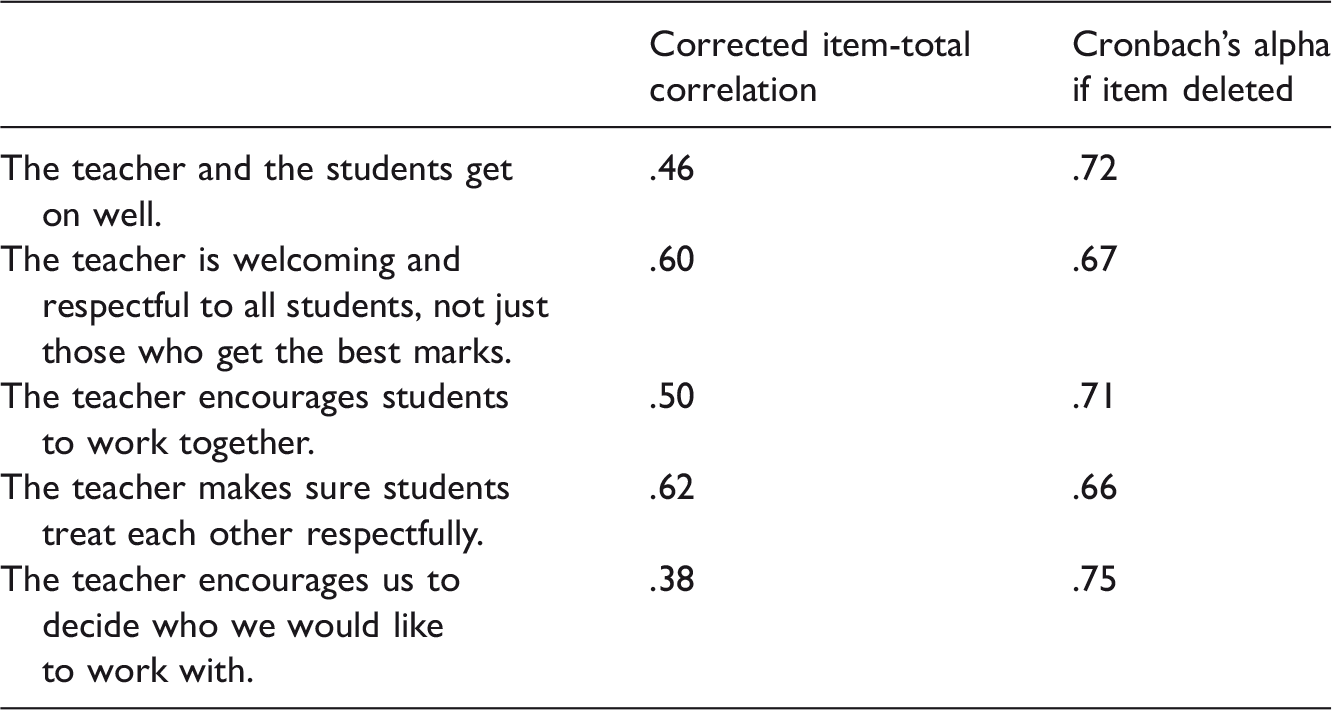
In summary, results suggest that, with the removal of the following items:
‘The teacher encourages us to decide who we would like to work with’ from the relatedness scale, ‘The teacher helps us see connections between this subject and our other school subjects’ from the relevance scale, and ‘The teacher encourages us to find our own way out of being “stuck”’ from the competence scale.
The scales will allow the reliable measurement of the concepts of autonomy, competence, relatedness and relevance in further, large-scale studies aimed at examining the importance of these four constructs for students and links to student engagement and school completion.
Discussion
A review of the research on the initiatives to address school dropout highlighted the policy and practice focus on ‘add-ons’ to standard school offerings through innovations such as structural changes to schools, additional vocational subjects or intensive tutoring, and welfare-based supports for students at-risk of dropping out. A number of these ‘add-ons’ have been found to be successful (Lamb & Rice, 2008). However, many of these activities do not appear to touch the core teaching practice that forms the bulk of students’ experiences in schools.
It is in mainstream discipline-based classrooms that students are spending most of their school time (Rutter, Rutter, Maugham, Mortimer, & Ouston, 1979). Given what we know about the cumulative development of an intention to drop-out (Audas & Willms, 2001), it is necessary to investigate what is actually happening in those classrooms over the accumulation of many years that might encourage students to continue on in formal schooling.
Teachers’ actions in the classroom can have a positive effect on student engagement when they are a part of a wider pedagogical discourse of student choice (Zimmerman, 1986); when they involve interesting, challenging and important work (Frydenberg, Ainley, & Russelll, 2005); and when they have a focus on mastery (Meece, Anderman, & Anderman, 2006). Ryan and Deci’s (1985) identification of how these psychological needs can aid motivation and engagement has provided researchers with a possible framework to investigate what may be happening in classrooms and whether students find what may (or may not) be taking place in the classroom important.
With the adjustments outlined in the findings, the survey we designed should provide a reliable research instrument for measuring the four constructs under consideration and permit the exploration of relationships between these practices and levels of student engagement using large-scale data. If this can be collected longitudinally then relationships between pedagogical practices, engagement and decisions to continue with or leave school may be elucidated.
Such research would allow an in-depth exploration of student voice in relation to teaching and learning practice in mainstream classrooms and how these relate to student engagement. There is a profound need for research that explores the value students place on various aspects of pedagogical practice, and whether students’ needs are currently being met by the practices they experience in secondary schools. In doing so, such research would potentially provide essential pointers to classroom-based change that could reduce the levels of student disengagement and support greater school completion rates.
For example, according to Clarke, Savage, and St Leger (2011) there is a greater need for links between classroom content and post-school options. Previous research has highlighted the failure of current Australian systems to provide coherent and effective pathways and links between school curriculum and post-school jobs (Clarke, 2012). If research using the instruments developed through this study identified that students placed a high value on relevance but did not see their teachers linking the curriculum to their future lives, this could point to the need for professional learning and curriculum materials that support the establishment of such links as actions for policymakers and school leaders.
Conclusion
This study, designed as a pilot study to test a framework and methodology, was small in its size and scope. Results showed the usefulness of a framework centred around the key concepts of autonomy, competence, relatedness and relevance for further exploration of the links between these concepts and student engagement, non-completion and pedagogy. Moreover, the results showed that it was possible to develop reliable measures of the key concepts that can be used with larger samples of students.
The problem of drop-out and school retention is complex and without an easy solution. Leaving school early is likely to have negative consequences for individuals and societies, including psychological, financial and sociological issues. At the policy level, the focus so far has been on reducing drop-out by focusing on initiatives that are not integral to the curriculum or pedagogy of teachers. The measures developed in this study will allow the examination of classroom teaching in mainstream subject areas and the identification of ways in which such teaching can impact on the students’ motivation to continue in educational settings.
Footnotes
Declaration of conflicting interests
The author(s) declared no potential conflicts of interest with respect to the research, authorship, and/or publication of this article.
Funding
The author(s) disclosed receipt of the following financial support for the research, authorship, and/or publication of this article: This research was supported by a seed funding grant from the Melbourne Graduate School of Education.