




Abstract
Teacher attrition is a current issue in Australia and other economically developed countries, with up to 50 per cent of teachers resigning from teaching within the first five years. Teacher attrition is widely considered to impact negatively on student achievement and the school. The present study of 160 Australian primary and secondary teachers who have been in the profession for up to 10 years investigates whether teachers’ generalised resilience is associated with their intention to leave the teaching profession. As hypothesised, results indicate that lower levels of resilience are significantly related to a higher intention to leave the teaching profession, after controlling for job satisfaction and demographic variables. Implications for teaching conditions related to job satisfaction and the resilience of early career teachers are discussed.
Keywords
The large proportion of educators leaving the teaching profession is an ongoing issue faced by Australia and other economically developed countries. High levels of teacher attrition impact negatively on student achievement and the school (Ingersoll, 2001). When a teacher leaves a school, institutional memory is lost and the school must spend additional resources hiring and training a new staff member (Ingersoll, 2001; Ramsay, 2000). Teacher attrition may also disrupt the formation and maintenance of trusting relationships between colleagues and between teacher and student, and can lead to poorer student outcomes (Bryk & Schneider, 2002; Ronfeldt, Loeb, & Wyckoff, 2013). At the same time, to maintain a high level of teaching quality, schools need to attract bright, new teachers while retaining and challenging effective existing teachers (Guarino, Santibanez, & Daley, 2006).
The present study investigated how resilience, job satisfaction and demographic factors relate to teachers’ intention to leave the teaching profession. Although a teacher’s intention to leave may not translate into actual behaviour, intention to leave a profession is regarded as an immediate antecedent to actual career change or job turnover (Griffeth, Hom, & Gaertner, 2000; Rhodes & Doering, 1993). Resilience and job satisfaction are considered particularly important to investigate as possible predictors of the decision to leave the teaching occupation which can be influenced by school leaders and policy makers (You & Conley, 2014).
Intention to leave teaching
In Australia, it is difficult to estimate the extent of teacher attrition as state governments have not disclosed such data (Buchanan et al., 2013). Riley’s research examining the attrition of early career teachers in Australia suggested that 40 to 50 per cent of teachers left the profession within the first five years (as cited in Haesler, 2012). A review of the available data in 2005 indicated that 25 to 40 per cent of educators in Western countries resigned within their first five years of teaching (Ewing & Manuel, 2005). In the United States, turnover was estimated to be approximately 13 to 15 per cent of the teaching staff each year, whereby teachers, either left the profession or changed teaching institutions (Ingersoll, 2001).
Retention has consistently been found to be lower for early career teachers than for more experienced teachers (Guarino et al., 2006). For example, Goddard and Goddard (2006) found that 21 per cent of respondents in a survey of 112 1st and 2nd year graduate teachers in Queensland schools reported a serious intention to leave their current teaching position, with 12 per cent indicating a serious intention to leave the profession altogether. This may be because beginning teachers face a number of teaching-related stressors such as high workload, lack of support from school staff and difficulties with student behaviour management (Kyriacou, 2001). Moreover, teaching is one of a few professions where beginners have as much responsibility as experienced workers (Tait, 2008).
Ewing and Smith (2003) suggest that quality induction and mentoring programmes may help retain quality early career teachers in the profession. In a survey of 196 beginning teachers, the majority of respondents reported poorly planned induction in their beginning year, with 70 per cent of beginning teachers having to find their own informal support (Ewing & Smith, 2003). In contrast, the implementation of formal support in terms of a mentoring programme was found to reduce teacher attrition in a small sample of first year teachers from Western Australia (Paris, 2013).
Job satisfaction
One way to reduce teacher attrition is through an understanding and improvement of teachers’ job satisfaction (Ingersoll, 2001; Stockard & Lehman, 2004; Tillman & Tillman, 2008). Ingersoll (2001) reported teacher attrition is largely explained by job dissatisfaction, and not by retirement as was previously hypothesised. Job satisfaction can be thought of as a type of cognitive appraisal, whereby an individual weighs up how a job meets one’s needs, values and expectations (Dawis & Lofquist, 1984). More recently, job satisfaction has been defined as “the attitude of an employee toward a job, sometimes expressed as a hedonic response of liking or disliking the work itself, the rewards pay, promotions, recognition), or the context (working conditions, benefits)” (Corsini, 1999, p. 516). It is likely that dissatisfied teachers look for alternative, more attractive job opportunities (Dolton & van der Klaauw, 1999).
Previous research shows a number of factors contribute to teachers’ job satisfaction. Cockburn and Haydn (2004) report teachers gain job satisfaction through working with children, having supportive colleagues, observing student improvement and working within a positive school climate. Similarly, Kim and Loadman (1994) found teachers gain job satisfaction intrinsically through professional autonomy and challenges, and meaningful interactions with students and colleagues. Extrinsic variables such as good working conditions and salary were also found to influence job satisfaction (Kim & Loadman, 1994). Ingersoll (2001) found teachers who left the profession attributed poor job satisfaction to low salary, lack of support from the school administration, poor student motivation and high incidence of student discipline problems. Psychological variables such as self-efficacy (Aldridge & Fraser, 2016; Caprara, Barbaranelli, Steca, & Malone, 2006) have also been identified as factors influencing job satisfaction. Furthermore, external stressors, such as pupil misbehaviour and time/resource difficulties, have also been found to be related to lower job satisfaction (Borg, Riding, & Falzon, 1991). More recently, the extent to which principles are approachable and supportive has been found to influence job satisfaction (Aldridge & Fraser, 2016). Worldwide data from the Teaching and Learning International Survey (TALIS) in 2013 suggests that the majority of teachers are satisfied with their jobs, but teaching classrooms with a high proportion of challenging students is associated with lower levels of job satisfaction (Organisation for Economic Co-operation and Development (OECD), 2014). Results from this study also indicated that a supportive and collaborative environment and positive school relationships are associated with increased job satisfaction (OECD, 2014).
Resilience
Given similar teaching contexts, why is it that some teachers thrive and some teachers report poor job satisfaction and consider leaving? As suggested by a number of researchers (see, for example, Beltman, Mansfield, & Price, 2011; Hong, 2012; Tait, 2008), one’s level of resilience may also contribute to teacher attrition. Resilience has been defined as ‘‘the process of, capacity for, or outcome of successful adaptation despite challenging or threatening circumstances’’ (Masten, Best, & Garmezy, 1990, p. 425). Resilience is not an innate characteristic and seems to be a by-product of personal attributes of an individual and the external environment (Gu & Day, 2007; Mansfield, Beltman, Price, & McConney, 2012). Risk and protective factors have been shown to influence levels of resilience. For example, the level of family support typically increases resilience (Benard, 2004). Similarly, Johnson et al. (2010) suggest a supportive school culture, including mentoring, may increase the resilience of early career teachers.
Teachers who are resilient adjust to negative or stressful events by utilising personal and/or environmental resources to bounce back from adversity (Bobek, 2002). Kyriacou (2001) reported that questionnaire studies on the topic indicate that approximately one-quarter of teachers perceive the teaching profession to be “very stressful”, seemingly due to: teaching unmotivated students; maintaining classroom discipline; workload; coping with changes; being evaluated by others (e.g. parents, colleagues, students); relationships with colleagues; self-esteem and status; administration and management; role conflict and ambiguity; and poor working conditions. Having a high level of resilience helps teachers to cope with stress and ward off emotional exhaustion or burnout (Chang, 2009; Tait, 2008). Brunetti (2006) found that higher levels of resilience are especially important for continued productive teaching when working in a more challenging school setting, such as an inner-city American high school.
Resilience may be the key to understanding why teachers leave the profession, given identical and often (dis)satisfying and stressful workplace conditions (Beltman et al., 2011). Hence, efforts aimed at increasing resilience may assist teachers, especially those early in their career, cope with the less satisfying aspects of their work-life and result in them becoming more committed to teaching over the long term (Beltman et al., 2011; Hong, 2012; Mansfield et al., 2012; Tait, 2008).
However, research that has examined factors related to teacher resilience is limited and such studies often suffer from methodological shortcomings. Beltman, Mansfield, and Price (2011) summarised the literature concerning teachers and resilience and found that the majority of the studies which explicitly investigated resilience had small samples sizes of fewer than 30 participants and used qualitative measures, such as interviews or observations, to gather responses. Furthermore, only 16 of the 50 reviewed studies used previously validated instruments to collect data on resilience.
The present study
As previous research has focused on the influence of job satisfaction on teacher attrition and few studies have quantitatively examined the impact of resilience, the present study aimed to investigate whether resilience and job satisfaction are associated with teachers’ intention to leave the teaching profession. It was hypothesised that lower job satisfaction and lower levels of resilience would be related to a higher intention to leave the teaching profession.
Method
Participants and procedure
Participants were recruited for the study by way of snowball technique and online advertising through teacher online communities in Australia. Potential respondents were invited to participate in a study of early career (i.e. less than 10 years’ experience) teacher job satisfaction, resilience and intention to leave teaching by following a link to the explanatory statement and online questionnaire. Participation was voluntary and responses were gathered anonymously. Recruitment of participants was conducted over a two-month period from June to August of 2014, close to the middle of the Australian school year.
Participants provided demographic information, answered items regarding their intention to leave teaching and completed the Teacher Job Satisfaction Questionnaire (TJSQ) and the Resilience Scale for Adults (RSA). The order of the TJSQ and RSA was randomised to minimise any fatigue effects and to minimise the effect of participant early exit from the survey website. The participants took approximately 15 minutes to complete the online survey.
A number of participants did not complete all sections of the online questionnaire and data was restricted to include only pairwise responses. Thirteen participants omitted one item each from the RSA and these missing responses were replaced using mean substitution which is an acceptable procedure in cases of less than five percent missing data (Tabachnick & Fidell, 2013). Two outliers were found and removed from the analysis. Examination of residual plots indicated that the data met the assumption for normality, linearity and homoscedasticity of residuals. After data cleaning, 160 participants remained and were included in subsequent analysis. The final sample consisted of more than 80 percent female (n = 135, 84.3%) and 15 per cent male (n = 25, 15.6%) teachers between the ages of 22 and 52 years (M = 31.11, SD = 6.90). When surveyed, the participants were teaching in an Australian school and had been teaching for a period of 10 years or less (M = 3.69 years, SD = 2.67). The majority of the teachers were teaching in a Government school (73.1%), compared to a Catholic (16.9%) or Independent school (10%). Participants mainly worked in a secondary setting (66.9%) rather than in a primary school (32.5%), with one teacher working in an early childhood setting. The present sample aligns reasonably well with known proportions of Australian teachers in terms of gender the Australian Bureau of Statistics (ABS, 2011) reports female teachers (70%) outnumber male teachers, with the majority of teachers (64%) working in a Government school. However, the sample consisted of a larger proportion of secondary teachers relative to primary school teachers (67%/33%) compared with the actual proportions in Australian schools (49%/51%; ABS, 2016, Table 4221). Thus, it must be emphasised that this study involved a convenience sample drawn from snowball technique and advertising through online communities which limits the generalizability of results and should therefore be considered as indicative only.
Measures
Intention to leave teaching and future years teaching
Participant’s intention to leave teaching was measured using the sum of three items from an Intention to Leave scale, based on scales developed by Hackett, Lapierre, and Hausdorf (2001), and further refined by Klassen and Chiu (2011) for the teaching profession. Scale items were answered on a five-point Likert-scale. The three items of the scale were “I think about quitting the teaching profession”, “I intend to quit the teaching profession” and “I intend to move into another profession/occupation”. Reliability analysis indicated a high reliability of the Intention to Leave Scale (Cronbach’s α = .91) scale.
Responses of the three items were summed to give a total intention to leave score, out of 15. A score above nine on this scale indicated a high intention to leave teaching, whereas a score of nine or below indicated feeling neutral or unlikely to leave. Therefore, a cut off of nine was chosen as these participants reported an above average indication of thinking of quitting the teaching profession, intending to quit the profession and moving professions.
In addition, participants were asked “How long do you intend to remain in the teaching profession?” and chose one of seven options ranging from “Less than one year” to “I plan to remain in teaching until retirement.”
Job satisfaction
A description of job satisfaction variables from the TJSQ (Lester, 1987).
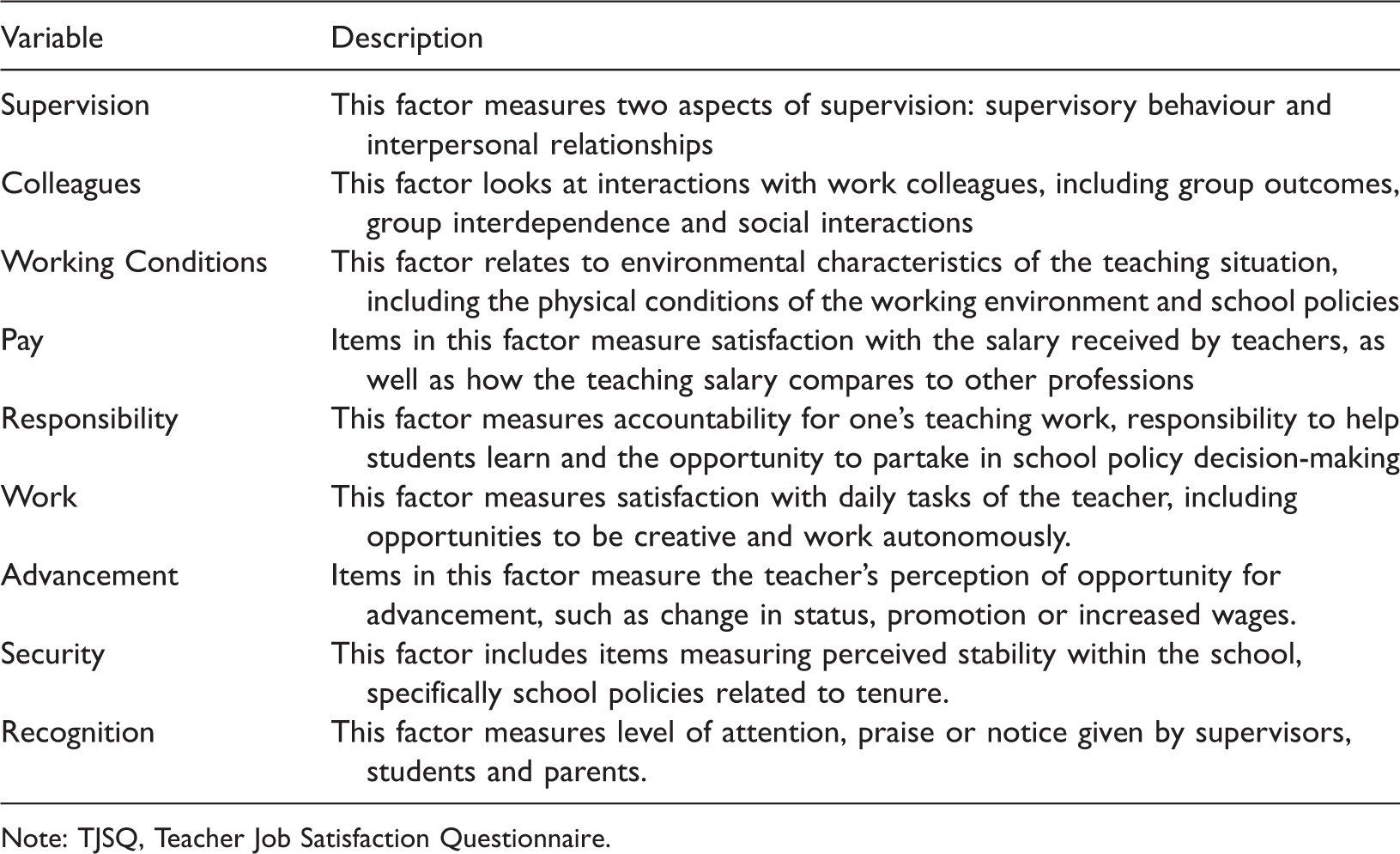
Note: TJSQ, Teacher Job Satisfaction Questionnaire.
In the current study, the reliability of the scales contributing to the TJSQ varied but were generally highly reliable: Supervision (Cronbach’s α = .93), Colleagues (.84), Work conditions (.82), Pay (.84), Responsibility (.66), Work (.75), Advancement (.91), Recognition (.79) and Security (.75). In addition, the reliability of the overall Job Satisfaction scale was also high (Cronbach’s α = .95).
Items were answered on a five-point Likert scale, ranging from Strongly Disagree (1) to Strongly Agree (5). Items were summed together to create a total job satisfaction score, ranging from 66 to 330. The measure was designed such that higher scores indicated higher job satisfaction. Items of this scale have been used in a number of studies on teacher job satisfaction (De Nobile & McCormick, 2008; Lester & Bishop, 1997; McCormick & Solman, 1992a, 1992b).
Resilience
Resilience of the participants was measured by the RSA (Friborg, Barlaug, Martinussen, Rosenvinge, & Hjemdal, 2005). In a review of 15 resilience measures, Windle, Bennett, and Noyes (2011) rated the RSA as having the equal best psychometric properties of a number of reviewed resilience measures with good discriminant and convergent validity in relation to personality and intelligence (Friborg et al., 2005). As there appears to a current lack of readily available measure of teacher-specific resilience, this general resilience measure which is freely available was chosen. The questionnaire comprises 33 self-report items that measure five factors of general resilience and an overall resilience score, ranging from 33 to 165, with higher scores indicating greater resilience. The five factors are: (1) Personal Strength: measures individual’s confidence in their own abilities and judgements, self-efficacy and realistic expectations, as well as their ability to plan ahead, have a positive outlook, and be goal oriented; (2) Social competence: measures individual’s levels of social warmth and flexibility, ability to establish friendships, and the positive use of humour; (3) Structured style: measures the preference of having and following routines, being organized, and the preference of clear goals and plans before undertaking activities; (4) Family cohesion: measures whether values are shared in the individual’s family and whether family members enjoy spending time with each other, have an optimistic view of the future, have loyalty toward each other, and have the feeling of mutual appreciation and support; and (5) Social resources: measure availability of social support and whether the individual has support external to their family.
In the current study, reliability of the subscales of the RSA ranged from Cronbach’s α of 0.67 for the Structured Style scale to Cronbach’s α of 0.88 for the Personal Strength scale, with the other scales also showing high reliability (Social Competence Cronbach’s α = 0.83, Family Cohesion Cronbach’s α = 0.87, Social Resources Cronbach’s α = .84). The reliability of the overall resilience scale was also high (Cronbach’s α = .90).
Results
Intention to leave teaching
Responses to the Intention to Leave Scale showed that about one-third of teachers in the sample (31.9%) intended to leave the teaching profession. In response to the question “How many more years do you plan to remain in teaching?” 53 per cent of participants expressed an intention to remain in teaching for a further 10 years while 23 percent of respondents indicated that they planned to stay in teaching until retirement (see Figure 1).
Frequency of self-report on years of future teaching (N = 160).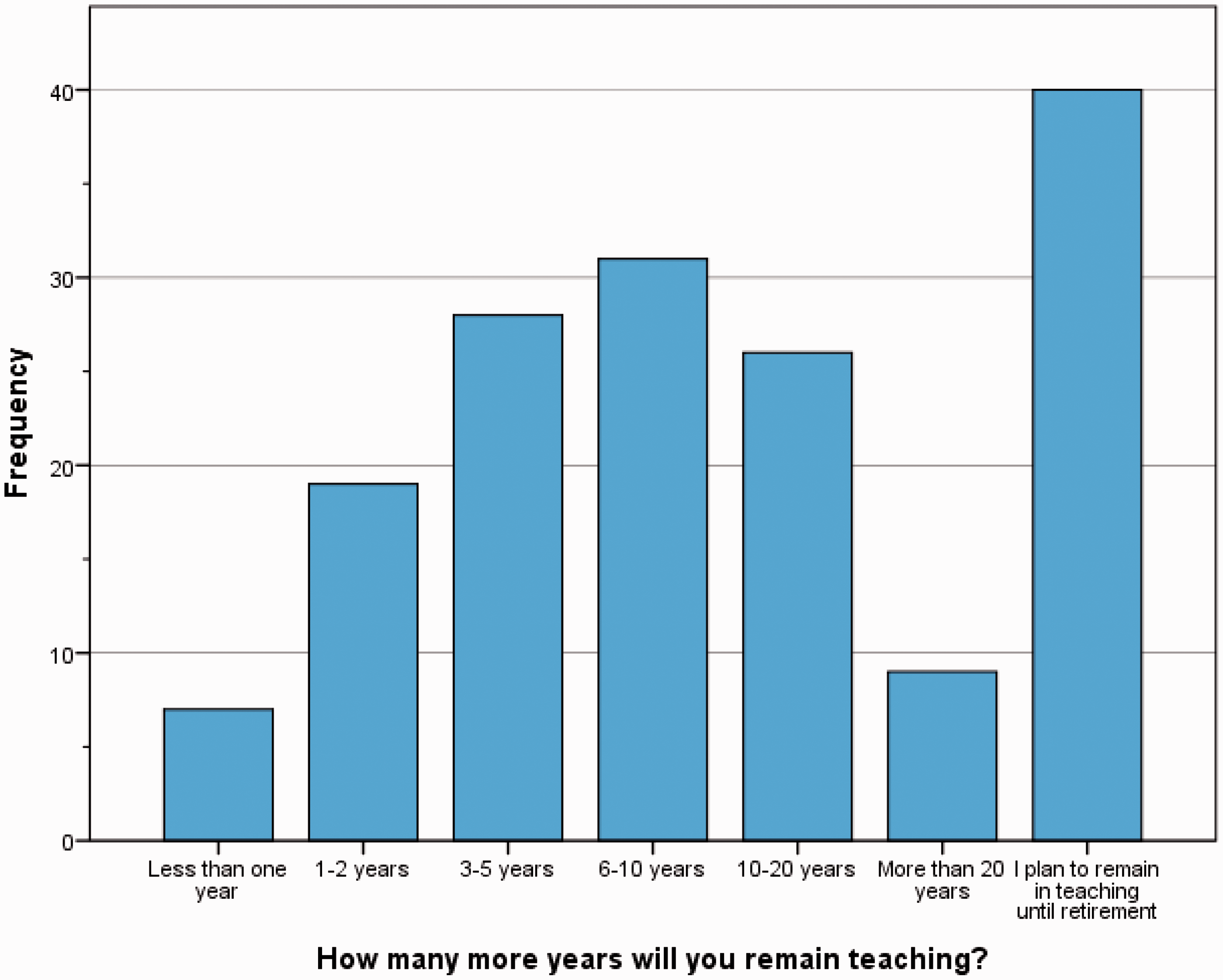
Predicting intention to leave teaching
A hierarchical multiple regression analysis was conducted with intention to leave teaching as the dependent variable. Independent variables were entered in the following steps: (1) Demographics (gender, age, primary or secondary cohort of students, number of years spent teaching); (2) Job Satisfaction, as measured by the TJSQ and (3) Resilience, as measured by the RSA.
Summary of hierarchical regression analysis predicting intention to leave teaching (N = 160).
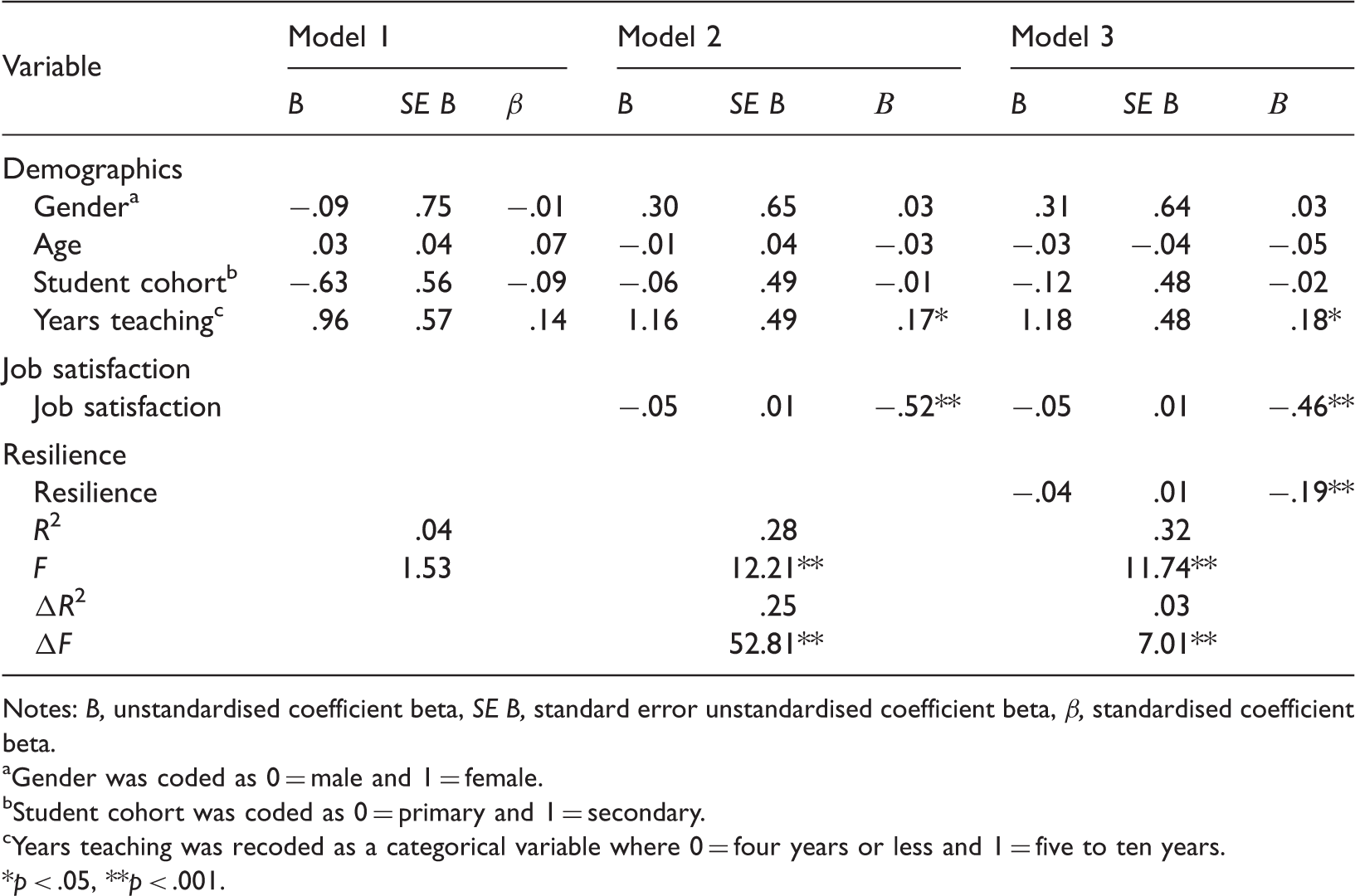
Notes: B, unstandardised coefficient beta, SE B, standard error unstandardised coefficient beta, β, standardised coefficient beta.
Gender was coded as 0 = male and 1 = female.
Student cohort was coded as 0 = primary and 1 = secondary.
Years teaching was recoded as a categorical variable where 0 = four years or less and 1 = five to ten years.
p < .05, **p < .001.
A comparison of mean job satisfaction and resilience components between teachers reporting high or low intention to leave the profession.
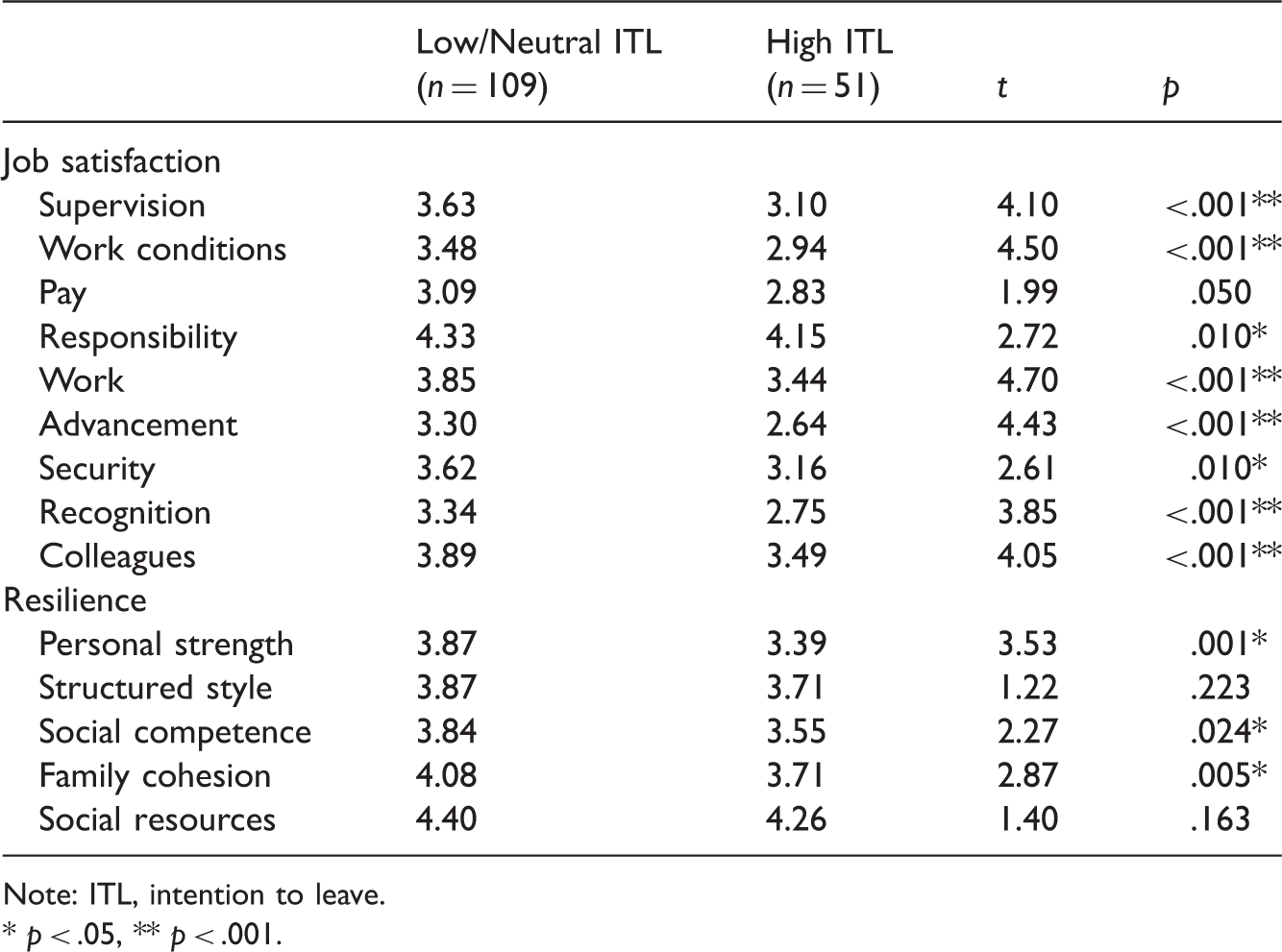
Note: ITL, intention to leave.
p < .05, ** p < .001.
High versus low intention to leave
Additional analyses investigated differences between those teachers who reported a high intention to leave the teaching profession compared to those who reported having a low or neutral intention of leaving (Table 3). Teachers with a high intention to leave rated all job satisfaction components significantly lower than teacher with a low/neutral intention to leave the profession, with the exception of Salary. Low intention to leave and high intention to leave differed significantly on three of the five resilience components, namely Personal Strength, Social Competence and Family Cohesion.
Discussion
The aim of the present study was to investigate how resilience, job satisfaction and demographic variables were related to intention to leave the teaching profession in a sample of Australian teachers with up to 10 years of teaching experience. As hypothesised, lower Resilience and poor Job Satisfaction were found to significantly predict intention to leave the teaching profession.
Intention to leave teaching
The results of the present study are consistent with previous research estimating the proportion of teachers who report an intention to leave the teaching profession. Almost one-third (32%) of participants indicated currently having a high intention to leave teaching. Researchers have found similar proportion in previous studies, such as 21 per cent of first and second year teachers in Queensland (Goddard & Goddard, 2006), 25 per cent of practicing North American teachers (Klassen & Chui, 2011) and 32 per cent of early and mid-career American teachers (You & Conley, 2014).
The majority of the current sample (53%) reported that they would remain in teaching for 10 years or less, and this value is also consistent with previous research on Australian teachers. The Australian Education Union Victorian Branch (2007), for example, reported 52% of teachers in their first five years predict staying in teaching for a maximum of 10 years. Comparably high proportions (44%) were also found in a sample of New South Wales where early career teachers reported they would remain in teaching for 10 years or less (Ewing & Smith, 2003).
The results of the current study indicate a large number of teachers are considering leaving the profession. Although intention to leave may not materialise into career change, it is regarded as a significant predictor of actual quitting behaviour (Rhodes & Doering, 1993).
Job satisfaction and intention to leave teaching
Job (dis)satisfaction was found to significantly predict intention to leave teaching. The results of the hierarchical regression showed that teachers with lower job satisfaction reported a stronger intention to leave the teaching profession, as expected. This result supports previous evidence that job satisfaction is negatively related to turnover (Hellman, 1997) and teacher attrition (e.g., Ingersoll, 2001; Stockard & Lehman, 2004; You & Conley, 2014). Job satisfaction may also predict actual quitting behaviour (Kristensen & Westergård-Nielsen, 2004; Rhodes & Doering, 1993) as people who are dissatisfied with their job are likely to consider leaving the profession and look for more attractive work opportunities (Tillman & Tillman, 2008). The current findings highlight the need to increase the job satisfaction of teachers to help decrease the intention to leave the profession and to ultimately discourage actual quitting behaviour.
Additional comparisons between teachers who reported low intention to leave and high intention to leave the profession showed that the two groups differed in their satisfaction of the variables Supervision, Colleagues, Working Conditions, Responsibility, Work, Advancement, Security and Recognition. Only one factor – satisfaction with Salary – did not significantly differ between groups. Salary has often been cited as a reason for leaving the teaching profession (Arnett & Polkinghorne, 2010; Ingersoll, 2001; Perie & Baker, 1997), however the present study did not support this finding. Furthermore, Borman and Dowling (2008) examined 14 studies investigating the relationship between salary and teacher attrition. They found that low salary significantly predicted attrition for less experienced teachers (less than five years) and those later in their careers. It is possible that the recent increases in teacher salary in Victoria, Australia (Topsfield, 2013) may help explain this result as the early career teachers in the present study may be satisfied with their current salaries given recent increases. Furthermore, beginning teachers in New South Wales enjoy one of the highest commencing salaries of any graduate profession (NSW Government – Education, 2016).
Resilience and intention to leave teaching
Resilience is a psychological factor thought to influence an educator’s decision to leave the profession (Beltman et al., 2011). In the present study, resilience was found to be significantly related to intention to leave teaching, with less resilient teachers reporting a stronger intention to leave teaching.
Resilience also explained additional variance in the model than job satisfaction alone. Independent measure t tests revealed a significant difference in Personal Strength, Social Competence and Family Cohesion between teachers with low and high intention to leave the teaching profession. Previous research involving resilience and intention to leave has used mainly case studies or interviews (e.g. Hong, 2012; Tait, 2008). Hence the results of the present study strengthen these findings by providing further quantitative evidence of the relationship between resilience and intention to leave teaching. Importantly, resilience was found to explain additional variation in intention to leave teaching over and above job satisfaction and teacher demographics.
Teaching is generally regarded as a stressful occupation, often attributed to a high workload and feelings of incompetence (Kyriacou, 2001), and stress has been found to influence teachers’ commitment and intention to leave the profession (Klassen & Chui, 2011). Teachers who report higher levels of emotional exhaustion report higher intention to leave teaching (Tsouloupas, Carson, Matthews, Grawitch, & Barber, 2010) and Tait (2008) suggests resilience can help teachers ward off emotional exhaustion due to stress. The results of the present study may indicate that teachers who are highly resilient may be able to cope better with the stressors and poor working conditions intrinsic to teaching and consequently have less desire to leave the teaching profession (Chang, 2009; Tait, 2008). Importantly, the results of the study highlight the importance of resilience in keeping teachers in the profession.
It should also be noted that overall job satisfaction differentiated those with an intention to leave more so than did general resilience. This suggests that job satisfaction may be a more productive target to change for school administrators as job satisfaction of staff can be argued to be more easily influenced by school administrators, compared with resilience which is a more individual factor.
Limitations and directions for further study
Although the current findings add to our understanding of the relationship between resilience, job satisfaction and intention to leave the teaching the profession, interpretation may be limited by a number of factors. Firstly, the fact that participants were recruited via convenience sampling and may have self-selected as they might have been thinking of leaving teaching means that the sample is unlikely to be representative of all Australian teachers. Demographic analysis, however, indicated the proportions of the sample corresponded well to the percentages of males and females in teaching, and the proportion of teachers in government vs. non-government schools (ABS, 2011). Future studies would benefit from using a larger, probability-based sample of Australian teachers to increase the confidence in the findings.
Secondly, the present study investigated a relatively simplistic model of teacher occupation intention and a number of other variables may influence the relationships studied. For example, it would be worthwhile to investigate whether and how variables such as stress and self-efficacy add to the explanatory power of the hierarchical model. As discussed, previous research indicates that stress may also impact resilience, job satisfaction and teacher attrition (Gu & Day, 2007, Klassen & Chui, 2010, 2011). Self-efficacy, the belief of one’s competency, has also been found to be related to teachers’ occupational commitment, intention to leave and job satisfaction (Caprara et al., 2006; Klassen & Chui, 2011).
Furthermore, the present study did not include any measures of teacher effectiveness or performance. Such information would enable a comparison of the intention to leave of teachers who are performing well versus those who are underperforming.
The present study also neglected to incorporate individual aspects related to teacher attrition such as leaving to start a family, returning to University to study a related higher education degree, or the possibility of moving to occupations still in the education field. Finally, intention to leave teaching may be associated with the availability, quality and attractiveness of alternative teaching positions.
Implications for practice
Notwithstanding these limitations, the present study provides further insight into the proportion of teachers who intend to leave the teacher profession, and the role of resilience and job satisfaction in this decision. To keep teachers working in the profession, the present study highlights the need for increased resilience and job satisfaction of teachers. Researchers have known for years that teachers are often dissatisfied with aspects of their job but little appears to have changed, often due to lack of time and financial resources. Instead, schools may be able to help teachers increase their resilience through increased school support and stress/resilience programmes.
Early career teachers often report a lack of support from the school administration and colleagues (Buchanan, 2012) and Stockard and Lehman (2004) suggest the satisfaction of first year teachers is influenced by the environments in which they work, including collegial support and the mentoring they receive. Haynes (2014) recently called for comprehensive induction programmes for new teachers, including ongoing support from a high-quality mentor and common lesson planning times. Long et al. (2012) suggest that multiple factors influence teacher attrition and the effect of induction (including mentoring) programmes can be difficult to isolate. Moreover, they conclude that schools that are supportive and highly collaborative are most successful in retaining beginning teachers.
Furthermore, as a person’s level of resilience is not fixed, resilience programmes could be implemented in schools to help increase the resilience and coping skills of teachers. Lantieri, Nagler Kyse, Harnett, and Malkmus (2011) showed a resiliency intervention on a small group of primary teachers across New York significantly reduced stress levels and strengthened relationships with colleagues compared to a control group. The importance of developing resilience through learning communities is also currently being investigated in teacher training courses (Le Cornu, 2009). Measuring resilience may also be relevant at the point of entry into pre-service teaching programmes (Bowles, Hattie, Dinham, Scull, & Clinton, 2014). Developing higher levels of resilience will allow teachers to bounce back quickly from set-backs, have more confidence in their ability, reduce impact of stress and hopefully work to improve teachers’ job satisfaction.
Conclusion
While the generalizability of the study reported here could be improved by using a larger, probability-based sample, findings of the present study add to a strong and growing body of literature on teacher attrition. Results showed that resilience explained variance in intention to leave teaching in addition to the variance accounted for by job satisfaction and teacher demographics. Thus, any initiatives to increase the resilience of teachers whilst improving working conditions and collegial support for early career teachers by educational leaders would appear highly desirable to decrease the large number of teachers thinking about and subsequently actually leaving the teaching profession.
Footnotes
Declaration of conflicting interests
The author(s) declared no potential conflicts of interest with respect to the research, authorship, and/or publication of this article.
Funding
The author(s) received no financial support for the research, authorship, and/or publication of this article.