




Abstract
Peer mentoring is often considered the single most effective strategy for increasing student retention and student satisfaction. As a consequence, mentoring programs have been implemented at most universities and are an essential feature of best practice transition programs. Yet, the literature is inconsistent regarding what the term entails and how it is applied, leading to diverse opinions about what constitutes a mentoring program. It could be argued that agreement on a definition of mentoring is secondary to the benefits of its practice and that an emphasis on terminology is just playing semantics. However, this article argues that terminology does matter and that elucidating what mentoring entails is crucial to the comparative evaluation and improvement of mentoring practice as well as the identification of best practice. The article goes on to suggest how mentoring boundaries might be set by drawing on experiences from an Australian University.
Background
One way that higher education institutions can maximise the chances of student success is by enabling a successful transition to university. Research findings indicate that when students first arrive at university, they often feel anonymous, insecure and isolated, especially in large classes (Hockings, 2005, 2011; Mann, 2001). Evidence indicates that about a third of students drop out of university because they made few social connections in their first year and had little personal contact with academic staff (Crosling, Thomas, & Heagney, 2009; Krause, Hartley, James, & McInnis, 2005). As an additional risk, mature-age students and those from lower socioeconomic status backgrounds are more likely to live off-campus, study part time and/or have work and family responsibilities (McInnes, 2001). In fact, this is a pattern for all students, given decreasing access to study support – such as Austudy – and increased fees (Manthei & Gilmore, 2005; Ford, Bosworth & Wilson, 1995). Evidence indicates that over 70% of students do some form of paid work and an increasing percentage (up to 30%) are working full time (Zimitat, 2003). These conditions make it more difficult for students to participate in co-curricular and extracurricular activities that allow the building of robust social networks, making it easier for them to feel disengaged (Crosling et al., 2009).
Findings also indicate that a lack of engagement can reduce the sense of belonging, which, in turn, reduces the likelihood of such students seeking help if faced with difficulties or impediments to study. While the notion of engagement is a more complex issue than previously thought (Krause & Coates, 2008), it is generally believed that students who can engage with university life by understanding the culture, making friends or developing a sense of belonging are more likely to persevere and to report a positive experience (Nelson, Quinn, Marrington, & Clarke, 2011). To foster this sense of engagement, universities have started to implement comprehensive orientation/transition programs that provide opportunities for commencing students to get to know the university and to create social and academic networks (Kift, 2004). One of the most common mechanisms used to facilitate this process is some form of mentoring program.
Much has been written about the effectiveness of mentoring and its crucial role in any comprehensive transition program. Peer mentoring in particular – the use of a more experienced fellow student to act as a mentor – has become a standard feature of a best practice model for transition (Adams, Banks, Davis, & Dickson, 2010; Gale & Parker, 2011) and for improving what is standardly referred to in the literature as the First Year Experience. In Wilson’s example of a best practice model for first-year orientation and engagement, one of the primary tasks of the First Year Advisor is to facilitate social networks by ‘[i]nitiat[ing], conduct[ing] and actively manag[ing] a Peer Mentoring Program for at least the first half of the first semester’ (Wilson, 2008, p. 3). Western Australia’ Curtin University has had a whole-of-university mentoring program since 2002. Its 2012 Annual Report indicated an increase in students’ decisions to persevere with their studies that was proportionate to their use of the mentor program (Smith & Elliott, 2012, p. 5). According to others, peer mentoring programs have assisted first-year students to transition successfully to university and be retained, to gain a sense of belonging and to develop communication and organisational skills (Beltman & Shaeben, 2012; Glaser, Hall, & Halperin, 2006). While not exactly a ‘silver bullet,’ peer mentoring appears to be the single most effective way to prevent attrition and low satisfaction rates. It also has the potential for the early identification of students who may be at risk of disengaging or failing.
In recognition of the reported benefits of mentoring, Flinders University, Adelaide began to implement a peer mentoring strategy in 2012 as a key feature of its whole-of-University approach to transition and retention. Each school within the university was directed to establish its own peer mentoring program unless they already had implemented one. Training, resource development, overall evaluation, reporting and oversight of the initiative were to be coordinated centrally by the Transition Office. Not surprisingly, this approach resulted in a diverse range of peer support programs, each of which were called ‘peer mentoring’ and which employed ‘peer mentors.’
In this context, a literature review was undertaken to ascertain whether or not the diversity of the mentoring programs mattered, given that each program might still achieve the same or similar beneficial outcomes for commencing students. The review was driven by the following questions, namely (1) was there a preferred standard model of peer mentoring or an example of best practice; (2) was there an agreed set of mentor functions and/or mentee outcomes and (3) did it matter if there was diversity in mentoring programs?
Literature review
In order to address these questions, various literature reviews of the mentoring literature were examined, namely the works of Jacobi (1991), Ehrich, Hansford, and Tennent (2004), Terrion and Leonard (2007), Crisp and Cruz (2009), Haggard, Dougherty, Turban, and Wilbanks (2011) and Gershenfeld (2014). These reviews cover around 40 years of mentoring literature, drawing predominantly from business and higher education. Within universities and colleges, the literature is predominantly from within psychology and education. It should be noted that the reviews predominantly cover practices in the U.S – in fact Jacobi’s review focussed exclusively on U.S. studies. This is probably a consequence of the long-standing practice of mentoring in the world of business, which has been transferred to higher education via the American college system. Over the last 10 years, mentoring programs have been implemented within most higher education institutions throughout the English-speaking world, with subsequent research being conducted and published. As a result, both Crisp and Cruz’ and Gershenfeld’s more recent reviews are broader in scope and include articles from outside the U.S. as well. Nelson, Clarke, Kift & Creagh (2012) extensive review of First Year in Higher Education literature from 2000 to 2010, referred to below, includes a wide range of Australian research on mentoring.
Benefits of mentoring
Levels of evidence-based intervention effectiveness.
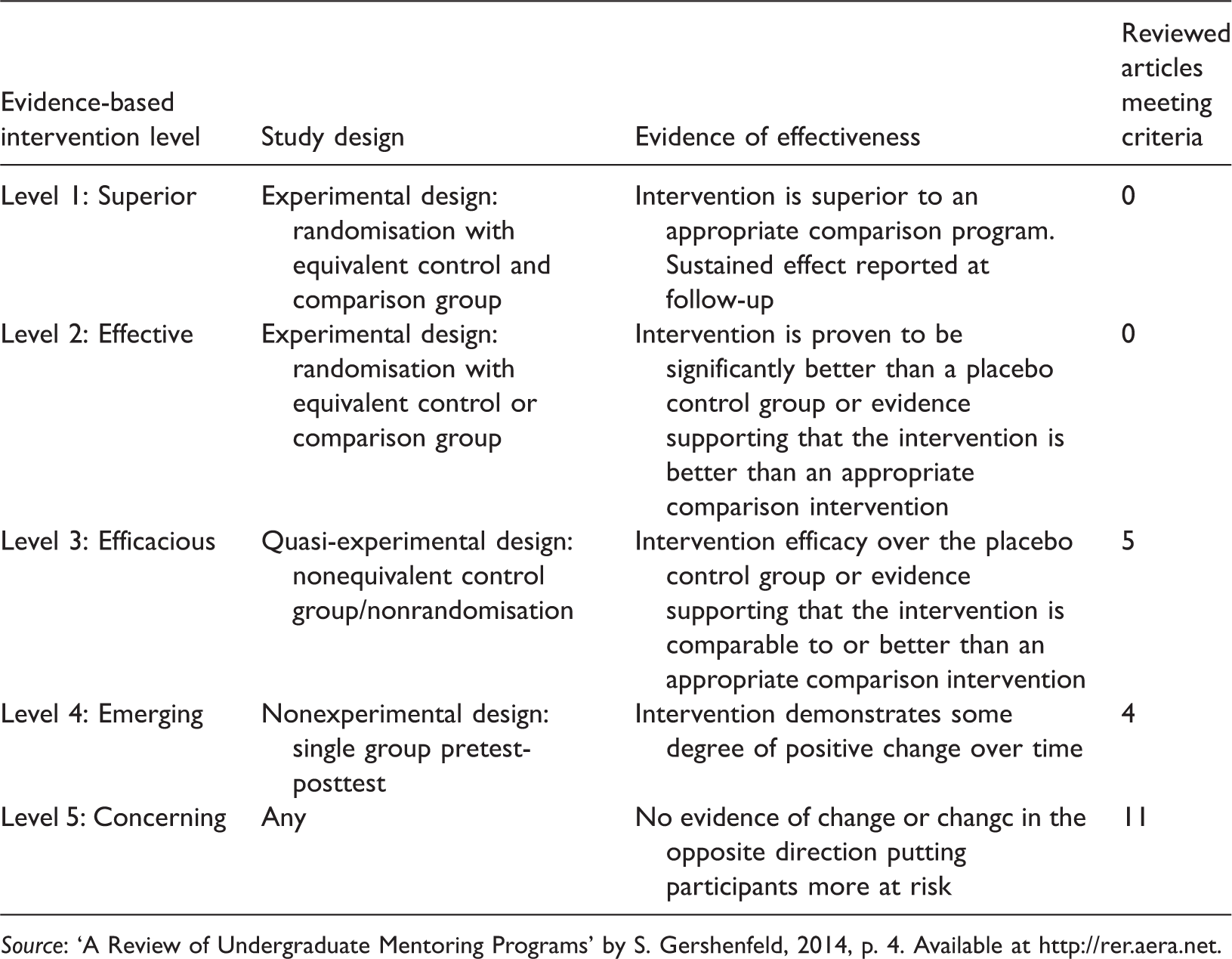
Source: ‘A Review of Undergraduate Mentoring Programs’ by S. Gershenfeld, 2014, p. 4. Available at http://rer.aera.net.
The prevalence of peer mentoring, peer support or peer-assisted learning programs all point to the widely held belief in their efficacy to fill gaps in academic or institutional support, as well as their overall usefulness in providing new students with access to social networks.
Mentor functions and best practice models of peer mentoring
However, while the value of mentoring is widely accepted and reported, there is what Ehrich et al. (2004) term the ‘dark side’ to the mentoring literature, first identified by Jacobi (1991). Her early review of mentoring identified several issues for concern in the literature, the most significant of which was the lack of a ‘widely accepted operational definition of mentoring’. She pointed to the various settings in which the mentoring concept appeared – such as in the business world and higher educational settings like psychology and education – and demonstrated that different concepts of mentoring were used in each sphere. In fact, she argued that no definitions of what the term entailed were provided in the literature under review, which made it difficult to identify or explicate the practices that were incorporated under the term ‘mentoring’. The role of the mentor was equally vague, with very few researchers specifying the functions of the mentoring role and, where they did, there was little evidence of consensus in the field. She identified a minimum of 15 different functions that fell loosely under three broad categories of the mentor–mentee relationship – (1) emotional and psychological support; (2) direct assistance with career and professional development and (3) role modelling (p. 510). A consequence of this vagueness was its impact on the relevance and rigour of the subsequent research findings. Even though there may be, in fact, a positive benefit to having a mentor or from participating in a mentoring program, it is difficult to see how this can be measured and then compared to other initiatives unless one is clear about what practice is under examination. As Jacobi stated (1991, p. 17), ‘methodological rigour is clearly necessary to fully understand the impact of formal mentoring programs’, but this is further complicated by the fact that mentoring programs are ‘so diverse they actually have little in common’. This deficit meant that research findings illustrating the benefits of mentoring were unlikely to be repeatable and the findings could not be (and should not be) generalised across the mentoring field.
The subsequent reviews by Crisp and Cruz (2009) and Gershenfeld (2014) took into account Jacobi’s concerns. They both concluded that, while some progress had been made in terms of methodological rigour, little if any progress had been made on clarifying its boundaries, specifying mentor functions or achieving any disciplinary consensus on what constitutes a mentoring program. Crisp and Cruz demonstrated that Jacobi’s analysis of the literature still holds, despite improvement in the methodological integrity of some research articles. They concluded that mentoring research had ‘made little progress in identifying and implementing a consistent definition and conceptualization of mentoring, is largely a-theoretical and is lacking in terms of rigorous research designs that allow for testing external validity of findings’ (p. 525). They identified over 50 diverse definitions of mentoring, including inconsistent use of the term, preventing replication of results and comparisons. Further issues were establishing external validity of variables, narrowness of the student sample and specificity of the cohort. The majority of their studies were considered to be flawed as they failed to describe the methods used to collect and analyse the data (p. 531). Additionally, variables other than mentoring that may have had an effect on the perceived benefits were not factored in or even discussed. To highlight the consequences of this vagueness and ambiguity in relation to our own research, many of the studies were from one type of American educational institution (the four-year college), they did not involve peer mentoring and were focussed primarily on the impact on career pathways. Most often the mentoring model, if specified, was a dyadic relationship with a Faculty member, possibly matched to ethnic grouping. Within the Australian literature, there were similar difficulties as the term ‘mentor’ or ‘peer mentor’ is used loosely to connote any formalised student–student interaction. At one New Zealand university with three peer support programs, the term mentor is reserved for the subject-specific academic advisor, while at another Australian university with at least 10 different ‘mentoring’ programs, the term also referred to paid library staff working with students in a drop-in centre.
Consequently, programs as diverse as peer-assisted study sessions (PASS) or RMIT University's psychology peer-assisted tutorial support (PPATS), both designed to foster improved grades, Curtin’s university-wide social integration peer mentoring program and Flinders Inspire program for high school students all fall under the general rubric of mentoring. Even if participating students claim to have benefitted from each one of these programs, it would be difficult to ascertain exactly what the contributing factors were or to isolate what aspects of the programs constituted mentoring as opposed to some other function. This makes it problematic to compare, improve and to learn from other practices.
Gershenfeld’s more recent review (2014) remains highly critical of the state of research on mentoring, arguing that the lack of rigour in mentoring research makes it unclear if mentoring programs are achieving their goals. She does acknowledge that some progress has been made in attempts to provide a theoretical framework for mentoring, the most common of which was Tinto’s social integration theory (p. 17). Despite this, she noted some important limitations. Research methodologies remained problematic as did the research methods. Very few studies had a control group or some other mechanism to compare mentored students to others, and little effort appeared to be made to isolate the effect of mentoring from other possible confounding factors. Again, she highlighted the specificity of the cohort (i.e. ethnic Latinos, a single discipline), the small sample size and the uniqueness of each program as limitations, particularly to generalisability and relevance to other researchers. Her findings are summarised below (p. 4). Her conclusion is that the proliferation of mentoring programs has ‘not been guided by empirical evidence’ (p. 21).
Does diversity matter?
We argue that it does. Several key messages emerge from the literature. First, despite the lack of rigour in some of the research, it is clear that mentoring is still considered to be a beneficial intervention and that mentoring programs have broad institutional support. Second, it is equally clear that there is no apparent single mentoring model and there is no widely accepted definition of mentoring. Mentoring programs do not even cluster around a broad, but common, axis. There is no model that constitutes best practice. Third, this lack of clarity has made rigorous evaluation of even single mentoring programs problematic, thereby reducing the generalisability of any possible benefits that result from mentoring. There are currently too many unknown variables. This means that empirically based, cross-institutional comparisons of the impact of mentoring programs are highly unlikely to be useful. At a minimum, one would need to know what the objectives of the mentoring programs are and what the functional role of the mentor is. Even intra-institutional comparisons would only be possible if there were enough commonalities between the types of programs in place, their objectives and their implementation. As Jacobi pointed out, the reported benefit of mentoring could be just as much a function of the mentee’s characteristics as it is the result of the mentor (1991, p. 516). This possibility is suggested by Haggard et al.’s findings (2011, p. 296), which indicate that the personality characteristics of both mentors and mentees ‘influence the extent of positive and negative mentoring experiences’. Of the large cohorts who have access to a mentoring program, only small numbers report significant effects; i.e. of 7000 mentees at Curtin, only 166 claimed their mentor made a difference to their decision to persevere with study (Smith & Elliott, 2012). While this might mean that the vast majority of students did not need or use a mentor or contemplate withdrawal, and the seemingly small effects may be significant enough to justify the cost of the program (increased retention), more rigorous work would need to be done to isolate the role of mentoring or a mentor in contributing to that effect. Where other programs report stronger findings, it is often unknown what the variables are between programs to draw valid comparisons, as these are rarely stated under research methods. As an example, the research question ‘did you have a mentor?’ (Haggard, Dougherty, Turban, & Wilbanks, 2011) revealed a multiplicity of definitions and contexts in which supposed mentoring occurred. Given the connotations of the term, recipients drew on past relationships where there had been a positive influence from someone. This presupposes the benefits one is attempting to elicit, leading to a far from objective set of data.
At our own institution, there is concern that the diversity of programs will make systematic evaluation of the impact of mentoring on mentees difficult, given there are very few commonalities. We conducted individual interviews with 14 mentor coordinators (one from each School) to elicit the details of their mentoring programs as background for an institutional progress report on the mentoring initiative at Flinders. We found that some of the programs have mentors embedded in tutorials on a regular basis; others have mentors aligned to an introductory topic; still others have a drop-in service or have their mentors arrange their own contact times. One program has a semi-structured arrangement where mentors meet with their group on a regular basis according to a timetable of events; another’s is left to the desires of the mentees themselves. Potentially, it would be a useful exercise to evaluate and compare each program to see whether or not one method was more effective than another in reaching the target outcomes. This would answer one of Jacobi’s questions about which program characteristics produce the best results (1991, p. 528). However, the aims and objectives of each program seem to vary enough to also make this problematic. Some have an academic focus; some have a topic information focus; others are more focussed on social engagement or support networks.
The role of the mentor themself is often seen as having multiple functions – academic advisor, confidante, friend, study buddy, career advisor, support, role model. This was actually commented on in the literature as well, with Crisp and Cruz suggesting there are up to 50 identifiable functions associated with the mentoring role, depending on cohort (2009, p. 527). Variations in the size of the mentoring group (which can range from 1:1 to 1:30); in the frequency and type of contact and in the understanding of the role by mentors and mentees, may all be confounding variables. Variations in recruiting, training and resources were also noted as potential factors that could influence outcomes. Terrion and Leonard (2007, p. 162) concluded that mentor characteristics influenced mentee experiences enough that the selection and training of mentors should be specific to the desired outcomes of the program (i.e. whether career-focussed or psychosocial).
While it seems impractical to rigidly specify what a mentoring program should entail, given the diversity of Schools, cohorts and even institutions, there does need to be a clearer conception of what one means by mentoring program or mentor. When a term is so broad that anything can fall under its aegis, it starts to become meaningless. It should be possible to define what is meant by a mentor and, hence, a mentor program. A little consistency would enable more effective evaluation of the impact of mentoring on things like student satisfaction, GPA or retention. This is particularly critical in an environment of cost cutting and competition for financial resources. It is also part of the process of trying to build on past practice to turn it into best practice. At this point in time, there appears to be no best practice model of mentoring.
As stated earlier, this could all seem like unnecessary fussing or just a matter of semantics. One could argue that what really matters is; does it work, does it produce benefits for the student? We would agree that it is, ultimately, the outcomes that matter. If an intervention produces the right outcomes then, on one level, it should not really matter if it is called a mentoring program or something else; nor should it matter what falls under the title of ‘mentoring program’. Unfortunately, it does seem to matter if one wants to engage in any empirical study that measures the impact of a particular program in achieving a particular set of outcomes, and it matters even more so if you want to both compare and draw generalisations from those findings to other practices. How else does one justify the costs of setting up a mentoring program? The outcomes themselves are dependent on what one is trying to achieve, and this is tied to the function of the program. A mentoring program in School X that has a 1:1 ratio, is embedded within the curriculum and is designed to improve academic understanding of an experimental procedure is not easily comparable to a mentoring program in School Y that has a 1:30 ratio, is outside a curriculum structure and is designed to foster an ongoing social support network. It is even harder to measure outcomes relevant to an intervention program like mentoring as a whole if each manifestation of the program is unique such that you have not/cannot control for other potential contributing or causal factors. If you cannot do that, you cannot repeat it and build on the perceived benefits. They may turn out to be an anomaly or they may have little to do with the intervention strategy being evaluated. The impact could be coincidental. Similar concerns operate when looking at cross-institutional comparisons of research findings. If mentoring itself is not defined and the type of program is not explicated, it is not clear what we would be comparing and contrasting. It is not clear what would count as a benchmark program or what would constitute best practice.
Setting the boundary conditions
Because of the issues around experimental rigour, we believe there is some merit in expounding what Bozeman and Feeney (2007) call the ‘boundary conditions’ of mentoring – what does and does not fall within that concept. Not every peer intervention strategy will constitute mentoring, just as not all friends and colleagues count as mentors, even if they could. The same applies to the design of the mentoring program. Just as not any peer is a mentor, not any intervention program using peers is a mentoring program. It is important to explicate the differences, while acknowledging that many different strategies can achieve the same or similar ends.
We would argue that mentoring, or specifically peer mentoring, is a distinctive type of student–student interaction. It is supposed to play a particular role in a transition program. In our own explication of a whole-of-institution approach to orientation, transition and retention, we identified four key strategies – orientation programs, mentoring programs, identification of ‘at risk’ students through the Student Success Program (see e.g. Nelson et al., 2012; Wilson & Lizzio, 2008) and a ‘just-in-time’ intervention program (Kutieleh & Egege, 2012). Within that framework, mentoring programs had a specified function, as did the mentor – to encourage student engagement and their sense of belonging to the university. It is against that function that our mentoring programs should be evaluated.
Developing a strong sense of identification with and sense of belonging to university appears to encourage retention and foster a sense of satisfaction with the university experience (McInnis, 2001; Nelson et al., 2012; Wilson, 2009). Tinto’s social integration theory appears to be an appropriate theoretical basis for transition strategies like mentoring. His proposition that retention or attrition is an outcome of commitment and integration has been validated in a range of studies (Gershenfeld, 2014; Jacobi, 1991). According to Jacobi, empirical studies evaluating the impact of mentoring would use integration as an intervening variable and retention as the outcome. One way of differentiating mentoring programs, and thereby allowing meaningful comparisons, might be to stipulate upfront whether or not a program has a core academic focus or a core integration focus. Programs like PASS, PALs and RMIT’s PPATs have a primary focus on understanding subject content leading to academic success. As stated in RMIT’s 2009 LTIF report, the role of the peer tutors is to assist students with the ‘transition, engagement and acquisition of foundational academic skills’ (Xenos, Chester, & Ryan, 2009, p. 4). 1 A common operational difference between academic-focussed mentoring programs and others is the embedding of the tutor/mentor into the subject topic tutorials where they work with a group of students on set subject matter. A distinction that Bozeman and Feeney (2007) draw that is relevant here is that between training and mentoring. In a formal or structured relationship, such as when providing training or instruction, the transmission of knowledge is topic specific and dictated by institutional or course-related requirements, in line with an organisational goal. This is generally not a voluntary relationship (although it can be), is mediated by some authority (i.e. course coordinator/tutor/lecturer), and takes place in a formal setting that requires a high level of accountability from the instructor (that knowledge was imparted or that goals were achieved). Training, instructing or tutoring all have an expectation that a required level of competency in a designated skill or area is desirable or essential, it is achievable and its transmission is the purpose of the training. In a similar vein, tutorial-embedded academic advising often entails a more structured arrangement, with fixed or regular meetings, semi-compulsory attendance and designated topics of discussion or activities. These kinds of programs tend to be highly structured and less flexible in the student needs addressed. Traditional peer-assisted student support (i.e. PASS) programs seem to fall under this aegis. It may be that such programs, while beneficial, would not strictly be considered mentoring.
Although critical of the research on mentoring, Jacobi did manage to isolate a few commonalities amongst the various aims and objectives of the mentoring programs, in terms of the functions of the mentor. In particular, she isolated three distinct roles that mentors were often accredited with playing – providing psychosocial support; being a role model and providing career or professional advice (1991, p. 510). Crisp and Cruz and Gershenfeld acknowledge the conceptual work done by Nora and Crisp (2007) who identified four ‘latent variables’ or constructs within the mentoring concept. Three of these were similar to Jacobi’s, with academic knowledge and support as an additional variable. These are useful delineations of the mentoring role. The last variable from Nora and Crisp seems most suited to the PASS model identified above or to the American College models that utilise Faculty members as mentors.
In an attempt to set boundaries to mentoring, Bozeman and Feeney (2007, p. 722) put forward the following limitations. Mentoring is a process for the informal transmission of knowledge, social capital, and the psychosocial support perceived by the recipient as relevant to work, career, or professional development; mentoring entails informal communication, usually face-to-face and during a sustained period of time, between a person who is perceived to have greater relevant knowledge, wisdom, or experience (the mentor) and a person who is perceived to have less (the protégé) [our italics].
Beltman and Shaeben (2012, p. 34) claim mentoring requires ‘a reciprocal relationship, involving mutuality of social exchange’, a point supported by Jacobi. Benefits accrue both ways. This adds to the idea that mentoring is about building a relationship with one’s student mentees. Relationships take time and they need to be explicit. One cannot claim to be in a relationship if one of the parties is unaware of that relationship. Mentees need to know they have a mentor. Likewise, a one-off meeting may provide useful advice, but it is a stretch to call it mentoring. Drop-in centres would not seem to be the right format for developing an ongoing mentoring relationship.
Another way of setting boundaries could be by delimiting the scope of the mentor’s role. Drawing from university websites, it is possible to conclude that peer mentors, as opposed to business/career or Faculty mentors, are generally not seen as or utilised as academic tutors or academic advisors and were actively discouraged from taking on this role should a mentee ask (see e.g. University of Ontario, Bangor, La Trobe, Melbourne, Curtin). The University of Sheffield website states that ‘[m]entors are NOT counsellors, social workers, financial advisers or academic tutors’ (accessed 2014). This is in sharp contrast with the PASS/PPATS models whose focus is primarily academic support. Within the former model, the mentor passes on their knowledge according to the needs or dictates of the mentees, not the dictates of the topic.
The functional role of the (peer) mentor raises two facets that are often neglected in the mentoring research – the relevance of the characteristics of the mentor on the effectiveness of the mentoring program in achieving its goals and the importance of mentor training. It is likely that these two features were considered largely irrelevant in the typical business model of an informal dyadic mentoring relationship. Mentors chose mentees or were approached to act as a mentor based on their personal characteristics or knowledge. 2 No training was given or expected. A similar scenario seems to operate with the Faculty staff/student mentoring model common in the U.S. However, it is not irrelevant in a formal school-based or broad cross-institutional peer mentoring program of one to many. While the peer mentor is frequently given, the credit for positive outcomes in the literature, their individual traits are an unaccounted variable in the data analysis. In reality, potential mentors are carefully selected, most frequently for altruistic traits, and training is provided. Feedback we received from mentors about their own motivation listed the desire ‘to inspire others’, ‘to assist other students’, ‘to offer support’, or ‘to give back to the Uni’. Typical ways they characterised themselves were as empathetic, a good listener, friendly, compassionate and caring. It is, thus, worth noting that the benefits of mentoring programs rise proportionally to the rapport mentors build with their mentees and that their success may be a function of the individual characteristics of the mentors. The vast majority of peer mentors are unpaid volunteers and this in itself may influence the type of person who becomes a peer mentor. Peer mentor training is another variable that is seldom addressed, yet it provides the necessary tools and techniques a mentor needs to engage with their mentees, such as communication techniques or icebreakers and information about services and supports. Access to training is likely to improve the quality of the mentor and their effectiveness in dealing with students potentially at risk. Mentor comments from our own training programs support this. Participating students claimed to appreciate the cultural diversity awareness components and the information on what and where to seek support, which they may not have been aware of.
If we return to the function of a peer mentor within the context of a transition initiative, then peer mentoring is about helping the commencing student settle in to university life by reducing their anxiety and familiarising them with their new environment. At this stage, it is not about getting students to pass their topics or improve their grades, although this may be a beneficial side effect. However, helping someone transition into university life may require a separate focus to helping someone transition into a specific discipline or profession such as Law or Medicine. This would not be a delimiting factor on its own, unless coupled with a predominantly academic focus as core business.
Conclusion
This article sought to ascertain whether or not the diversity of what constitutes a mentoring program mattered, or whether, in fact, a model of best practice could be identified. It became clear from the review of the literature that there was no standard practice for mentoring and that the diversity did matter. Not only was the diversity symptomatic of the field, but the terms ‘mentoring’ and ‘mentor’ lacked consensual definitions. As a consequence, evaluation of the effectiveness of mentoring programs was difficult as was the cross-institutional comparison of programs that would be needed to ascertain a benchmark practice.
This state-of-affairs could be improved if studies on mentoring provided a theoretical framework and more rigorous methodology such as explicit details of the adopted model of mentoring and its objective, how it was implemented, monitored and evaluated. Details could include making explicit how mentors are recruited, their access to and type of training, frequency and duration of contact with mentees and expectations of what mentors should address with mentees. Such information would enable more meaningful comparisons and the categorisation of programs according to the adopted model of mentoring.
Identification of mentor characteristics and delineation of what constitutes a mentoring program may lead to the exclusion of some of those, albeit useful, peer support programs with a largely academic focus and which are compulsory for both student and peer supporter. Likewise, drop-in centres or other casual peer support interactions may fall outside the domain of mentoring. This does not mean such programs should not be implemented. However, in order to evaluate the effectiveness of mentoring programs as a retention strategy, some boundaries need to be set to ascertain how one initiative differs from others. The onus would be on mentor program coordinators to demonstrate that their program is (a) about mentoring and (b) achieving the desired results in the most cost-effective way. This would be assisted by mentoring research becoming sufficiently rigorous to provide evidence of best practice in mentoring programs. Such knowledge, in turn, would enable universities to make informed decisions about which programs to fund, not only in order to retain students but also to provide them with the best possible student experience.
Footnotes
Declaration of conflicting interests
The author(s) declared no potential conflicts of interest with respect to the research, authorship, and/or publication of this article.
Funding
The author(s) received no financial support for the research, authorship, and/or publication of this article.