




Abstract
Young children interact with touch screen tablets at home and this may impact upon emergent literacy. The present study examined home access and use of touch screen tablets, as reported by parents, in Australian pre-schoolers (N = 109) aged 3–5 years and whether this was associated with emergent literacy skills (letter name and sound, numeral identification, print concepts and name writing). Children with greater access to tablets were found to have higher letter sound and name writing skills. No relationships were found between time on tablets and emergent literacy skills. The quality of experiences rather than time spent on tablets may be important especially when viewed within a socio-cultural framework. Most parents (69%) reported that tablets were easy for their child to operate and believed tablets support early literacy development (70%). 53% believed children should have access to tablets at pre-school. Tablets have the potential to foster emergent literacy although this may depend upon the quality of digital interactions.
Introduction
Emergent literacy skills such as letter name and sound knowledge, early writing and print concepts are important predictors of future reading ability (e.g. Adams, 1990; Snow, Burns, & Griffin, 1998; Whitehurst & Lonigan, 1998). These skills develop gradually from birth through a range of daily print experiences that may be in non-digital form (e.g. paper-printed story books) or digital form (e.g. electronic books or e-books) (Cohen & Cowen, 2011; McPake, Plowman, & Stephen, 2013). For example, as young children explore their way through digital windows on computers they are exposed to numerous interfaces that contain printed letters, words, symbols, numerals and icons from which they make meaning, and these experiences have the potential to foster emergent literacy skills (Levy, 2009; Thurlow, 2009). Hisrich and Blanchard (2009) describe how early exposure to digital media presents a potential learning opportunity for emergent literacy development and how digital tools can help pre-schoolers learn communication skills. Young children find digital forms of print interesting (Downes, 2002; Tahnk, 2011) and actively engage with digital devices to creatively express themselves, draw, read and incorporate digital activities into their dramatic play (Edwards, 2013; Marsh, 2010).
Viewed within a socio-cultural framework (Vygotsky, 1978), young children learn through interactions with others and with cultural tools such as digital devices (Plowman, McPake, & Stephen, 2010; Stephen, Stevenson, & Adey, 2013). Parents play a key role in their child’s early literacy development and shape children’s experiences with technology at home (e.g. Plowman, Stevenson, McPake, Stephen, & Adey, 2011; Plowman, Stevenson, Stephen, & McPake, 2012). Previous studies on young children and digital technology in the home have shown that parents hold a range of views about children’s use of these devices (Downes, 2002; Green, Orwitz, & Lim, 2009; Healy & Schilmoeller, 1985; O’Mara & Laidlaw, 2011; Plowman & Stephen, 2003; Plowman et al., 2012; Smith, 2001). For example, some families value more traditional activities (e.g. outdoor play, library visits, appreciation of books, board games and imaginative play with toys) rather than digital activities (Downes, 2002; Hillman & Marshall, 2009; Plowman et al., 2011). Other parents provide and embrace computers at home and seek to maintain a balance between digital and non-digital activities (Plowman et al., 2012; Smith, 2001). Exploring parent views about touch screen tablets and the relationship between emergent literacy skills and tablet use can provide further insights into the role touch screen tablets may play in fostering emergent literacy.
Due to the recent release and popularity of touch screen tablets (Orrin & Olcese, 2011), young children are gaining increasing exposure and access to these digital devices at home and pre-school (McManis & Gunnewig, 2012; Rideout, 2011). For example, O’Mara and Laidlaw (2011) describe Australian children aged 3 and 5 years interacting with a virtual tea party game on their tablet while playing with their physical tea set. Touch screen tablets are light weight and portable, consisting of a flat, glass screen (17 cm × 25 cm) interface that detects and accurately responds to stimulation by a finger within the visual display area. The tactile nature of tablets allows toddlers in Piaget’s sensorimotor stage (Berk, 2012) with limited fine motor development to competently operate these devices directly with their fingers (Michael Cohen Group & U.S. Department of Education, 2011; Tahnk, 2011). This is unlike the traditional desktop computer with a mouse that requires more complex hand–eye coordination and keyboard skills (Cooper, 2005; Plowman & Stephen, 2003). The tablet’s multimedia interface engages young children by stimulating their tactile, visual, auditory and kinaesthetic senses, providing them with immediate feedback (Cooper, 2005; Tahnk, 2011). This is evidenced through an observational study (Michael Cohen Group & U.S. Department of Education, 2011) that examined children’s interactions with touch screen tablets. Sixty children aged 2–8 years were grouped into experienced and novice touch screen users. From 2-year-old, children accessed, played with and learned with touch screen devices. Children who had no previous experience using touch screen tablets were fascinated and engaged by its immediate response to their touch. The simple user interface made children curious and keen to explore it further and they quickly learnt the function of the home icon and moved with ease from one application (app) to another.
An app is a software program designed to run on mobile devices such as touch screen tablets and downloaded from the internet. Three main types of apps designed for children are gaming apps (interactive, entertaining and compelling to master), creating apps (tools and activities for constructing) and interactive e-books that have an in-built narrator (Michael Cohen Group & U.S. Department of Education, 2011). Tahnk (2011) reports how 2- and 3-year-olds use touch screen tablet apps at home for story time, memory and matching games, sorting shapes and learning about numbers, letters and vowel sounds. Therefore, the multisensory nature, child-friendly operating and navigational features, and range of apps available afford a promising way for learning in the early years. However, further examination of the types of apps children are using at home will help inform the optimal utilisation of tablets for early learning (McManis & Gunnewig, 2012).
Several studies have shown that traditional non-touch-screen desktop computers with literacy software have positive effects on children’s emergent literacy skills (e.g. deJong & Bus, 2003; Levy, 2009; Shamir, 2009; Smith, 2001; Wollman-Bonilla & Carpenter, 2003). Reading digital print on traditional desktop computers requires screen navigation skills and understandings about the organisation of space, which may help support the development of print concepts (McMunn Dooley, Seely Flint, Holbrook, May, & Albers, 2011). Other research has shown that e-books can enhance emergent writing (Korat, Shamir, & Arbiv, 2011; Shamir & Korat, 2007) and word recognition (Korat, 2009; Shamir & Korat, 2007), as e-book design features can draw children’s attention to words (Roskos, Brueck, & Widman, 2009). Also, a computer desktop drawing (KidPix) and word processor program in a kindergarten classroom was found to foster children’s emergent writing and print concepts (Yost, 2003).
However, due to the recency of the release of touch screen tablets, little is known about the impact of these digital devices and their apps on emergent literacy development. It is evident that the tactile-based interface allows infants, toddlers and pre-schoolers to begin their interaction with the digital world much earlier in their development (McPake et al., 2013; Plowman et al., 2012; Tahnk, 2011). For example, data from a recent online parent survey in the United States (N = 1384) showed that over half of children aged birth to 8 years had access to touch screen devices (tablet, iPod and smart phone) at home and used them, on average, for 43 minutes per day (Rideout, 2011). In addition, a significant proportion of young children (10% of children aged from birth to 1 year, 39% of children aged 2–4 years and 52% of children aged 5–8 years) used apps at home (Rideout, 2011). Increasing access to and use of tablets in the home environment highlights the need to examine how these early experiences are associated with early literacy development.
The present study aimed to extend Rideout’s (2011) American study to examine the extent to which Australian pre-schoolers are accessing and using touch screen tablets at home and whether this is related to emergent literacy skills such as letter name and sound knowledge, name writing and print concepts. Numeral identification was also examined as it is associated with emergent literacy skills and is a predictor of conventional reading skills (Scanlon & Vellutino, 1996). As previous studies have shown that traditional desktop computers and literacy software have positive effects on emergent literacy (e.g. deJong & Bus, 2003; Korat, 2009; Korat et al., 2011; Shamir, 2009; Shamir & Korat, 2007), it was hypothesised that relationships between emergent literacy, tablet access and tablet use would be found. This might be especially so for letter knowledge and early writing due to the tactile nature of the touch screen whereby young children use their fingers to trace and point to letters on the interface.
Parents also play an important role in providing children with opportunities to access and use digital tools at home, which in turn influences their learning (e.g. Plowman et al., 2011; Stephen et al., 2013). For example, Michael Cohen Group & U.S. Department of Education (2011) reported that caregivers who owned touch screen devices readily introduced their children to technology and viewed tablets as learning tools. However, novice caregivers with little touch screen experience expressed anxiety about their child using tablets. It was therefore important to examine in Australian families, parent views on children’s use of tablets at home and pre-school for learning and the types of apps children used. The research questions addressed in the present study were as follows:
What relationships exist among child home tablet access, use and emergent literacy skills (letter knowledge, numeral identification, print concepts and name writing)? What types of tablet apps are children using at home? What are parents’ views on children’s ease of tablet use, on tablets as a tool for early literacy learning and on access to touch screen tablets at home and at pre-school?
Method
Participants
One-hundred and nine children aged 3–5 years (M = 50.6 months; SD = 6.2 months; range = 38.2–68.1 months) from 11 pre-schools across south-east Queensland, Australia participated in the study. The children (57 boys and 52 girls) used English as their main language spoken at home and were pre-readers as determined by Clay’s (2005) word reading test. The majority of parents were Australian (70%) and married (75%), with 11.1% divorced or separated and 13.9% single or never married, and two-thirds of parents had completed specialised training (e.g. TAFE) or a university degree. The modal occupation of mothers was associate professional and of fathers was tradesman or related worker. Each family’s socio-economic status (SES) (M = 41.4; SD = 12.5; range 14–58) was calculated using Hollingshead’s (1975) 4-factor index based on parent occupation and education level, and the mean SES fell within the middle-class range of SES scores (8–66).
Measures
Letter name and sound knowledge and numeral identification
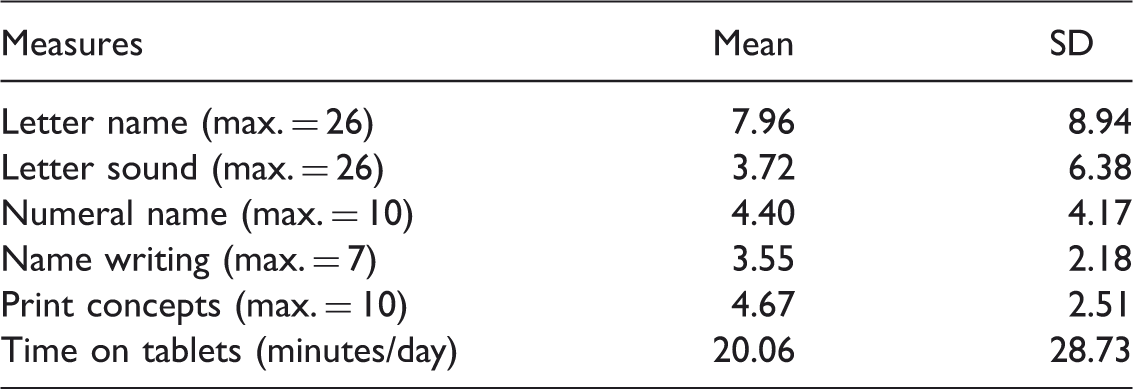
Children were presented with 26 uppercase letters printed on cards in randomised order and asked to provide the name and sound. Children’s numeral identification was tested in a similar way by presenting numerals 0–9 printed on cards in random order and asking children the name of each numeral (maximum = 10). Cronbach’s (1951) alpha for letter name, sound knowledge and numeral identification scores were .97, .96, and .95, respectively.
Name writing
Each child wrote his/her name on a blank sheet of A4 paper with a pencil. This was scored on a 7-point scale adapted from Bloodgood (1999): 0 = no production, 1 = random scribbling, 2 = controlled scribbling, 3 = pseudo-letters, 4 = strings of non-phonetic conventional letters or the first letter of their name, 5 = some correct letters of child’s name, 6 = name writing generally correct and 7 = name written and spelled correctly. The author initially scored name writing for all participants. To determine inter-rater reliability, 15 participants were randomly selected and name writing was scored independently by the author and a trained research assistant. Inter-rater correlations were extremely high (r = .98), so it was deemed sufficient that the first author’s scores be used throughout.
Print concepts
This test was administered using Clay’s (2008) story book Stones. Ten questions (e.g. left-to-right directionality and concepts of a word and letter) were selected from Clay’s (2005) Concepts About Print Test suitable for pre-reading children. The test has a maximum score of 10 (Cronbach’s α = .76).
Word reading test
Ten words from Clay’s (2005) Ready to Read Test were presented to children (for, look, and, come, will, he, up, here, to and me) and they were asked to read each word. Children were considered pre-readers as the majority (92%) could not read any words, and 6% and 2% could read 1 and 2 words, respectively.
Home questionnaire
The home questionnaire asked parents about the child’s age and gender, and the parents’ marital status, education, occupation and cultural backgrounds. Questions about touch screen tablets asked how many touch screen tablets families had at home (access to tablets) and how much time their child uses tablets per day (time on tablets). Parents rated how easy it was for their child to operate a touch screen tablet on a 5-point Likert scale (1 = very difficult, 2 = difficult, 3 = neither difficult nor easy, 4 = easy and 5 = very easy). Parent views on whether touch screen tablets would help young children’s literacy development and whether children should have access to them at home and pre-school were rated on a 5-point Likert scale (1 = strongly disagree, 2 = disagree, 3 = neither agree nor disagree, 4 = agree and 5 = strongly agree). Parents were asked to list the tablet apps their child uses at home.
Procedure
The managing directors of 11 pre-schools across south-east Queensland provided consent for the research to be conducted at their centres and the study was advertised to parents. Families choosing to participate completed a consent form and home questionnaire that consisted of questions about family demographics and touch screen tablets. Children were assessed by the first author or a trained research assistant on early literacy measures (letter name and sound knowledge, numeral identification, name writing, print concepts and word reading) in a quiet room at the child’s pre-school. The assessment session lasted approximately 20 minutes and children were provided with breaks if required.
Results
Descriptive statistics for emergent literacy measures and time on tablets (N = 109).
Correlations among emergent literacy measures, home access to tablets and time on tablets, controlling for child age (N = 109).
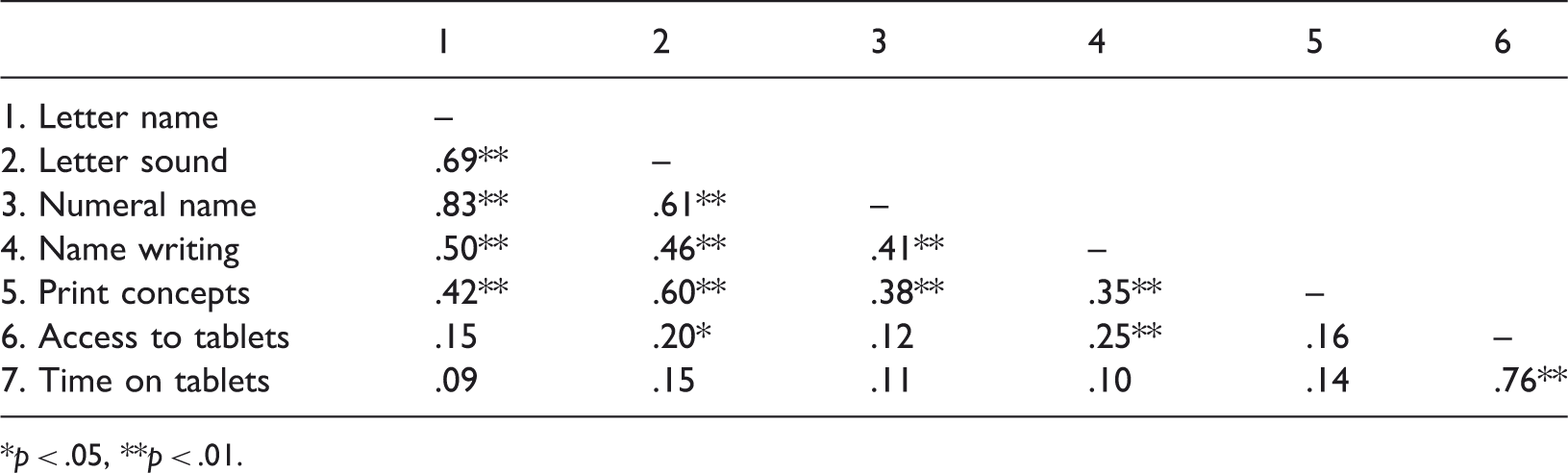
p < .05, **p < .01.
Parent views on tablets
The majority of parents believed it is very easy (43%) or easy (26%) for their child to operate a touch screen tablet, 25% were undecided and a small proportion thought they were difficult (2%) or very difficult for children to use (5%). Most parents agreed (46%) or strongly agreed (24%) that touch screen tablets would help their child’s early literacy development. Nearly a third (27%) were undecided and only 4% disagreed.
Close to half of parents were undecided (48%) about whether children should have access to touch screen tablets at home and 17% did not believe children needed touch screen tablets at home. However, 25% expressed that homes should have a touch screen tablet and 10% were strongly in favour of this. In comparison, 53% of parents believed children should have access to tablets at pre-school (38% agreed and 15% strongly agreed). About a third of parents were undecided about having tablets at pre-school (38%).
Types of tablet apps children use at home
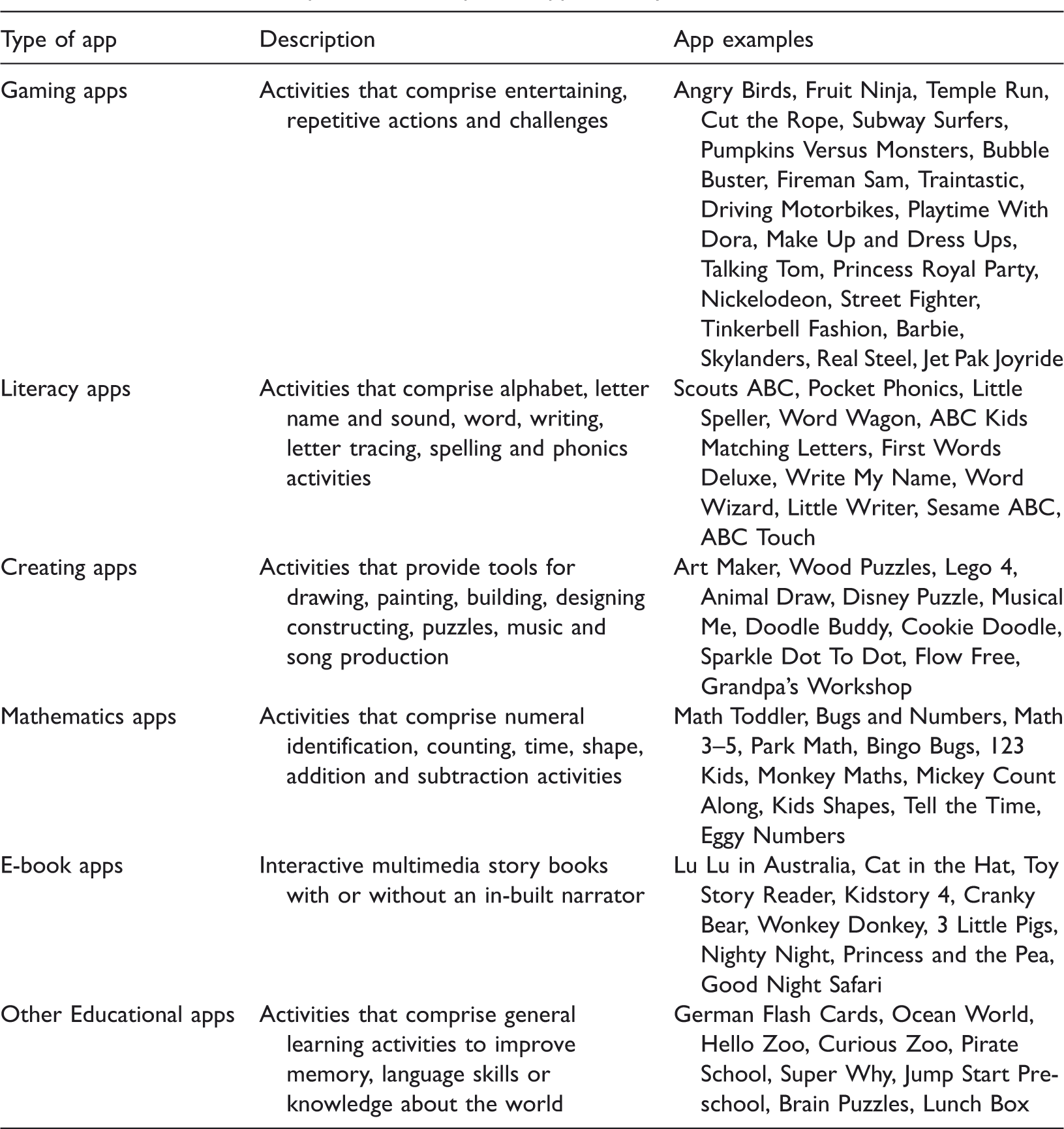
Classification, description and examples of apps used by children at home.
Discussion
This study explored an area about which little was previously known. Children’s access to tablets at home was positively associated with letter sound knowledge and name writing skills. Time spent on tablets at home was not related to any emergent literacy skills. Children mainly used gaming apps and literacy apps on their tablets at home. The majority of parents were in favour of their child using tablets to support early literacy learning as they believed tablets were easy for children to operate, and half of parents indicated that tablets should be available at pre-school.
Tablets, apps and emergent literacy
Home access to digital tools such as desktop computers is known to influence early literacy development (e.g. Bittman, Rutherford, Brown, & Unsworth, 2011; Plowman et al., 2012). The present study explored this further by examining how touch screen tablets are associated with emergent literacy skills. Only children’s level of letter sound knowledge and name writing was related to home access to tablets. This suggests that tablets may be a potential resource for aspects of emergent literacy, but raises questions regarding the factors or features of the tablet that may be contributing to this. The tactile nature of the tablet allows young children to engage in activities such as tracing letter shapes with a finger while listening to letter sounds, which may foster their learning. Previous research that has examined the use of tactile activities to enhance early literacy skills supports such a concept. For example, studies with pre-school aged children have shown that multisensory activities involving visual, auditory and tactile activities such as tracing large letter shapes with a finger while simultaneously listening to or saying its sound facilitated letter writing and letter–sound skills (Bara, Gentaz, Cole, & Sprenger-Charolles, 2004; Neumann, Hyde, Neumann, Hood, & Ford, 2012; Zafrana, Nikoltsou, & Daniilidou, 2000).
However, the associations of tablet access with letter sound and name writing skills do not imply causation. Therefore, further empirically designed research is needed to provide a more rigorous evaluation of this link. No associations were found between time on tablets and emergent literacy skills. It is possible that the quality of time spent on tablets rather than quantity of time affects learning. For example, Bittman et al. (2011) examined the association between young children’s (aged 0–8) use of digital media in the home and children’s learning, and showed that using desktop computers but not computer games was associated with literacy skills. This suggests that the type and quality of digital activities in which children engage during computer use may influence literacy learning.
The present study found that young children had access to, on average, five tablet apps in their home, and six different types of tablet apps were identified (gaming apps, creating apps, e-book apps, literacy apps, math apps and other educational apps). The most commonly used apps were gaming apps such as Angry Birds and Fruit Ninja, which, due to their entertaining and less educational features, may not be as profitable for literacy learning compared with the other five types of learning apps that focus on fostering literacy, maths, creativity, learning skills and memory skills. Although speculative, greater time spent on gaming apps rather than literacy apps could explain the lack of association found between time on tablets and emergent literacy skills. The effect of tablet time on emergent literacy learning requires further examination by comparing children’s learning outcomes following the use of different types of apps. In addition, there is a need to provide parents with information that recommends quality learning apps that are an alternative to gaming apps and evidence-based suggestions on how best to use tablets at home to support learning (Goodwin, 2012).
In the current study, greater access to tablets was found to be associated with more time pre-school children spent on tablets. However, the Longitudinal Study of Australian Children (Australian Institute of Family Studies, 2008) showed that older children (aged 8–11) spent more time on computers than 3- and 4-year-olds. Family factors such as having to compete with older siblings for use of tablets could impact upon the time young children are able to interact and play with digital devices (e.g. Plowman et al., 2011). Plowman et al. (2010) also reported that children who did have high access to digital devices and resources at home did not necessarily use them despite invitations by parents, suggesting that increased access may not equate with increased use. Therefore, family factors are important to consider when examining child use of tablets and early literacy learning in the home setting (McPake et al., 2013).
Parent views on tablets
Parents in the present study held a range of views about tablets. A small proportion of parents believed touch screen tablets would not help literacy learning and a third were undecided; however, the majority agreed that they are beneficial and easy for children to use. This reflects a generally positive parent attitude towards tablet use and aligns with previous research showing that parents viewed the home computer as a helpful tool for learning (Plowman et al., 2010; Plowman & Stephen, 2003; Stephen et al., 2013) and important for job success and academic achievement (Green et al., 2009), with both mothers and fathers having similar attitudes (Healy & Schilmoeller, 1985). Other research has found that 68% of Australian parents of children aged 3 and 4 years were happy with their child’s level of involvement in media activities (Australian Institute of Family Studies, 2008).
Interestingly, the present study found that only 35% of parents believed children needed access to touch screen tablets at home; however, a greater proportion (53%) believed tablets should be provided to children at pre-school. These views may have been shaped by various factors such as the affordability of new technology for home use (Plowman et al., 2011), the perception that children should be engaging more in traditional activities at home such as outdoor play (Downes, 2002) or a belief that pre-schools should be resourced with tablets to prepare children for their digital world (Green et al., 2009). Furthermore, children who have access to digital devices at home may be more likely to gain support from parents who are more digitally enabled (Plowman et al., 2010). For example, parents who modelled how to use digital devices for online shopping or leisure activities to their child helped them learn to use the technology and communicate digitally (Plowman et al., 2011). Parent beliefs are also important because they set the context for digital experiences at home (Plowman et al., 2010), which influences children’s digital experiences at school. McPake et al. (2013) describe how the digital competencies children gain from home experiences will support children’s development of communication and creativity skills at school. Furthermore, children who have had positive and frequent experiences with computers in the home may have an advantage in the classroom setting (Downes, 2002; Green et al., 2009; Healy & Schilmoeller, 1985; Levy, 2009; Plowman et al., 2011).
Practical implications for early childhood education
Early childhood educators would be well placed to work with families to adopt a pedagogical approach that builds on children’s home digital experiences to support emergent literacy learning (McPake et al., 2013). Framed by socio-cultural theory (Vygotsky, 1978), the present findings suggest that the quality of child–tablet interactions rather than time spent on tablets is important to consider when using tablets to support emergent literacy skills. Bittman et al. (2011) highlight the important role that instructional scaffolding (Wood, Bruner, & Ross, 1976) plays in the process of fostering early literacy during children’s use of digital devices. This view has been voiced by other researchers who have discussed the importance of adult scaffolding in enhancing the quality of young children’s digital experiences (Korat et al., 2011; McPake et al., 2013; Plowman & Stephen, 2003; Smith, 2001; Wohlwend, 2010). Children are self-motivated to interact with these devices independently; however, parents and teachers play a key role in scaffolding children’s use of and interaction with these tools, helping them decipher the print on the screen (Downes, 2002; O’Mara & Laidlaw, 2011; Stephen et al., 2013).
More specifically, recent research on touch screen tablet use by young children has discussed three types of scaffolding that may have positive effects on early learning (McManis & Gunnewig, 2012). Cognitive scaffolding involves the parent/adult sitting with the child during a tablet activity (e.g. interacting with a literacy app such as Write My Name app or First Words app) using questioning and modelling strategies and encouraging critical thinking. During affective scaffolding, the parent/adult provides positive feedback to the child (e.g. ‘well done’). Finally, technical scaffolding is the type of support that the tablet and app itself provide during the activity, such as varying the child’s level of play if they have mastered certain letters or words. The degree of scaffolding various apps provide is an important design consideration that may influence the extent of a child’s engagement and acquisition of literacy skills (Murray & Olcese, 2011).
Recent research has also discussed how touch screen tablets can transform literacy instruction and reported how young children viewed iPads as exciting and not as school work, claiming that these tools foster creative thinking (Saine, 2012). Tablets and apps are thought to be beneficial for young children because they provide children with opportunities for digital play with peers which supports cultural meaning making and fosters creativity, critical thinking, communication, language, literacy and mathematical skills (Marsh, 2010). For example, the Peppa Pig logo appears on tablet learning apps and icons and as plastic figurines and young children play, learn and make meaning through such digital and non-digital tools (Edwards, 2013). Edwards (2013) emphasises the need to view digital play and learning with tablets and apps in a similar way to traditional play activities in order to better support children’s early learning. Early childhood educators should be encouraged to adopt a pedagogical approach that embraces the integration of tablets and apps into early childhood curricula using quality scaffolded learning strategies to support emergent literacy development. Children’s home digital experiences and parent views on tablets and apps should also be considered during curriculum planning.
Limitations and future research
The lack of association found between time spent on tablets and emergent literacy suggest that the quality of tablet experiences involving type of app and scaffolding may be factors influencing early learning. In order to disentangle such factors it is important to further study child use of tablets via other measures as parent home questionnaires can be influenced by social desirability bias. For example, further examination may be achieved by requesting parents to record a 24-hour diary of their child’s use of tablets and time spent using different types of apps (e.g. gaming apps vs. literacy apps) over several weeks. Observing children in their homes using tablets may provide a more ecologically valid measure of these behaviours as previous research has shown how the home environment is more complex than revealed by parent surveys (McPake et al., 2013). Observational work is also needed to explore how parents naturally scaffold and guide their children’s learning during touch screen tablet use. This research could help in the design of effective strategies that could be adopted by early childhood teachers to enhance children’s literacy learning through tablets.
Furthermore, in order to determine the benefits of tablets and different types of apps for literacy learning, methodologically rigorous interventions are needed that include randomised control design with pre- and post-testing on a wider range of emergent literacy skills. As the home literacy environment consists of both traditional and digital literacy tools, it would be useful to compare the effects of using touch screen tablet literacy apps such as e-books with the effects of traditional literacy activities (e.g. shared reading of paper-printed books) to more rigorously examine the influence of apps on emergent literacy. Finally, further research is needed with a larger participant sample to gain a deeper understanding of parent views about touch screen tablets, especially within families from diverse backgrounds.
Conclusion
Touch screen tablets are fast becoming prevalent in technology-based societies, with many families having access to them at home. Due to the positive association detected between children’s access to tablets, name writing and letter sound knowledge, this study indicates that the tactile nature of tablets may play a role in the acquisition of these skills. The lack of relationship between time spent on tablets and emergent literacy suggests that the quality of these tablet experiences should be explored. Current early childhood education policies, for example, the Early Years Learning Framework (Australian Government Department of Education, Employment, & Workplace Relations for the Council of Australian Governments, 2009) and Te Whàriki Early Childhood Curriculum (New Zealand Ministry of Education, 1996) embrace the use of digital technology in pre-schools. However, investing in the integration of tablets and apps as effective literacy learning tools into the curriculum requires careful planning and will rely upon evidence-based research framed by strong pedagogical models. Although parents in the present study viewed tablets positively, further consideration of a wider spectrum of parent views on digital technology will assist policy makers and early childhood educators as they begin to integrate these devices into early childhood policy so that home experiences link positively with pre-school experiences.