




Abstract
The intent of this paper is to suggest the dimensions of intentional learning and identify the key cognitive benefits of systems modeling with regard to intentional learning through a review of related studies. The authors propose that intentional learning occurs when learners realize the need for refining their conceptual understanding, relate learning to their everyday experiences, possibly through everyday problem solving, and activates or develops metacognitive processes in the course of learning. When engaged in intentional learning, learners’ epistemological beliefs are also challenged. The authors also discuss how systems modeling could potentially foster domain knowledge, systemic thinking, and conceptual change. The second section of this paper describes a technology-enhanced learning environment that fosters intentional learning.
Introduction
In psychology research, intentional learning mainly refers to having clear mental attitudes such as goals, intentions, and beliefs that motivate and guide the learning so as to accomplish the desired learning outcome (Subagdja, Sonenberg, & Rahwan, 2009). Similarly, cognitive science suggests that intentional learning is guided by reasoning processes for the achievement of specific learning goals (Ram & Leake, 1995). From the learning perspective, intentional learning implies active construction of knowledge (Bereiter & Scadamalia, 1989) and monitoring and regulating of learning (Sinatra & Pintrich, 2003). Bereiter and Scadamalia (1989) used the term intentional learning to refer to cognitive processes that have learning as a goal rather than as an incidental outcome. It is an “achievement, not an automatic consequence of human intelligence” (p. 366). When intentional learning occurs, the learner also possesses an awareness of what has been learned (Schnotz & Kurschner, 2007). This process also sees the activation of the learner’s beliefs regarding knowledge and skills acquisition (Taasoobshirazi & Sinatra, 2011). Simply put, intentional learning occurs when a learner wants to learn, sees the need to learn, believes in the need to learn, knows what to learn, knows what is needed to learn, and knows how to learn. As such, it is an important active process by the learner, not an incidental outcome of teaching. Regardless of the definitions provided by various researchers, none explicitly discuss the dimensions of intentional learning. Effortful learning is not sufficient to warrant meaningful knowledge construction. Learners could be actively involved in classroom activities but not engaged in intentional learning. Given that learning has become increasingly complex as a result of the ever-changing demands and expectations for knowledge workers, there is a need to reconsider what it takes to be an “intentional learner” from a more systemic perspective. This paper discusses the various dimensions of intentional learning and argues that systems modeling as an instruction best explicate intentional learning. The goals are to suggest the dimensions of intentional learning and identify the key cognitive benefits of systems modeling with regard to intentional learning. The second section of this paper describes a technology-enhanced learning environment that fosters intentional learning.
Intentional learning
Intentional learning brings about meaningful learning and possibly conceptual change. Based on our literature review, we propose that intentional learning occurs when learners realize the need for refining their conceptual understanding, relates learning to their everyday experiences, possibly through everyday problem solving, and activates or develops metacognitive processes in the course of learning. When engaged in intentional learning, learners’ epistemological beliefs are also challenged.
Everyday problem solving for intentional learning
For intentional learning to occur, learners must realize the need to learn and the value in learning. Furthermore, intentional learning involves using phenomena that each individual has already some form of general awareness and common understanding (Biemans & Simons, 1999). When investigating individual difference in mental representations of physics in a problem-solving context, Gerrit, Van der Veer, Kok, and Bajo (1999) reported that if a problem is presented in an “everyday life” context, novices would put more effort and creativity into solving them compared to when the problem is presented in a physics context. Similarly, Hallden (1999) noticed that students tended to perceive problem-solving tasks in the context of everyday life, and applied the kind of problem-solving strategies that they had used in everyday life rather than using probability theory, because they found it more meaningful to do so. The realness and the relatedness of the problem to the children’s everyday experiences created a learning intention (Ferrari & Elick, 2003; Pintrich, 2000). Lee (2010) argued that problem solving, as one of the most important activities in our daily life, may foster deep learning. Specifically, problem solving as a learning strategy can increase students’ awareness of the inconsistencies between their naive theories and those that are scientifically accepted, and create intentional learning opportunities that arguably avoid the development of confused synthetic models (Vosniadou, 2007a, 2007b).
Cognitively challenging learning situations
Intentional learning necessarily invokes deep learning, which means learning that requires students to be cognitively challenged, creating cognitive conflicts in order to achieve well developed conceptual understanding. Computer modeling offers such a platform for cognitive conflict. The process of resolving such conflict is a rich example of a conceptual change process, and systems modeling provides a platform for creating cognitive conflict in learners (Jonassen, Strobel, & Gottdenker, 2005). When students create and test their models in simulations, which they compare with real-world data or other competing models, cognitive conflict (Lehrer & Schauble, 2000) may occur as the expected values do not result from the model they built. When students discover the inconsistencies in their conceptual structures while modeling, they are more likely to revise and refine their conceptual framework to resolve the cognitive conflict. Immersing students in challenging learning environments may produce internal inconsistencies in students’ conceptual models that have to be reconciled (Vosniadou, 2003). Lee (2010) reported that it is possible for children to engage in deep learning, provided they are immersed in learning environments such as an inquiry-oriented problem-solving environment that creates opportunities for them to actively challenge their initial understanding. These findings are significant because they challenge the views of many science educators that science learning is conceptually difficult because young learners have limited experiences which they do not even know how to interpret (Vosniadou, 2003).
Epistemological beliefs in intentional learning
Epistemological beliefs are beliefs that people hold about knowledge and knowing (Hofer, 2002). Researchers have shown that students’ epistemological beliefs influence or impede the way they learn and comprehend knowledge. In a recent study conducted by Lee (2010) on using systems dynamic modeling tools for building problem representation, it was reported that students who have more sophisticated epistemological beliefs tend to engage in deep learning. Given the importance of epistemological beliefs in learning, we suggest that intentional learning must foster the development of epistemological beliefs. Many researchers have argued for the importance of epistemological beliefs with regards to learning, and have reported that students’ epistemological beliefs could be changed as a result of interventions. For instance, Conley, Pintrich, Vekiri, and Harrison (2004) found that elementary students became more sophisticated in their beliefs about the source of knowledge and the certainty of knowledge over the course of science instruction where students were given a hands-on program. Similarly, Gill, Ashton, and Algina (2004) also reported that preservice teachers’ epistemological beliefs about teaching and learning in mathematics could be shifted through intervention. When learners’ naïve understanding is grounded on their epistemological beliefs, intentional learning must seek to provide the opportunity for learners to recognize the inconsistencies between their beliefs and scientifically held understanding.
Learning that encourages regulation and monitoring of learning
Regulation of knowledge has been studied extensively, and numerous studies suggest its importance in learning. For instance, Everson and Tobia (1998) stated that accurate monitoring of new learning enables students with effective metacognitive strategies to concentrate on new content and adjust their learning goals. Echoing the importance of regulation of cognition, Batha and Carroll (2007) found a stronger relationship between regulation of cognition and decision-making than knowledge of cognition and decision-making when they conducted a study on university students’ decision-making ability. In general, regulation of learning can be referred to as the executive control processes of the mind, which include planning (planning the use of strategies, and organizing the materials to be used), monitoring (constantly checking the use of various strategies), and evaluation (Brown, 1980). Despite the importance of regulation of learning, studies have reported that many students do not plan efficiently or thoroughly. Most importantly, they do not plan in a systematic manner and they do not plan ahead (Manlove & Lazonder, 2004). Similarly, students also find difficulties in monitoring their own learning progress (de Jong & Van Joolingen, 1998). With a low ability of regulating their own knowledge, students have a very limited scope in terms of identifying their own learning deficits and their needs for further learning. This is especially true when students are confronted with open-ended learning environments (de Jong, 2006; Manlove, Lazonder, & de Jong, 2006) and ill-structured problems (Lee, Jonassen, & Teo, 2011). Intentional learners not only cognitively engage in the learning process, but also actively regulate their learning (Lee, 2013). Lee (2013) suggests that from the pedagogical perspective, to develop learners who have the intentionality to learn, educators need to embed metacognitive tasks and activities to help learners acquire skills to understand their own strengths and weaknesses and their own learning processes.
Model building and systems modeling
There are many types of models, ranging from physical models which represent the phenomena of the world and mental models which could be abstract mathematical models or theoretical models. According to Lesh and Doerr (2003), models are “conceptual systems” consisting of elements, relations, operations, and rules governing interactions that are expressed using external notation systems. Models are also incomplete as they do not replicate every detail of a phenomenon, but rather represent what the model builder considers as the essential or key components (Lennard, 2010). Modeling is an iterative process whereby students engage in a sequence of testing and revising cycles to develop models (Lesh & Harel, 2003; Penner, Giles, Lehrer, & Schauble, 1997) that best represent their understanding of the phenomenon. Modeling occurs in practically all aspects of our daily activities because human beings construct mental models in order to comprehend the world around them (Johnson-Laird, 1983).
Model using and model building have different implications for the impact of learning. Building models is considered to be more beneficial in fostering intentional learning as learners own the models and assume epistemic agency when creating them, thus creating stronger motivation to produce a more logical model. When engaging in technology-based modeling activities, learners externalize their thinking, making it visible for scrutiny (Lee et al. 2012). Because modeling supports varied deep-level cognitive processes such as hypothesis testing, inferring, predicting, evaluating, analysis and most importantly causal reasoning, it is one important learning activity that could potentially invoke intentional learning.
Modeling is a highly engaging and effortful activity that allows learners to create or revise their conceptual understanding. VanLehn (2013) compiled a list of common difficulties students face, which include their inability to exercise appropriate and effective strategies in constructing and debugging models. It was also reported in several studies that students’ lack of fluency in modeling language limits the modeling process (Cronin, Gonzalez, & Sterman, 2009; Hopper & Stave, 2008; Löhner, Van Joolingen, & Savelsbergh, 2003). For instance, in systems dynamic modeling, the English phrases used are usually difficult to understand, such as when naming a variable to suggest the number of students entering university per year. In modeling language, it would most likely be named “students entering rate” which has little meaning to learners who are not familiar with systems modeling. Although it has been reported in various studies that students have difficulties modeling dynamic systems (Cronin & Gonzalez, 2007; Fretz et al., 2002; Hmelo, Holton, & Kolodner, 2000), as systems dynamic modeling usually implies a steep learning curve, it has been proven in many research settings that it is one of the most powerful instructional activities for improving learning (Jonassen, 2008). Research has also reported that students who engage in modeling activities involving modeling tools acquire more sophisticated modeling skills than those who use a traditional approach towards modeling (Papaevripidou, Constantinou, & Zacharia, 2007). In her recent research, Lee (2010) found that those who were deeply engaged in systems modeling would use a variety of strategies such as the self-questioning technique to refine their conceptual understanding, and they were the ones who achieved conceptual change.
Dynamic systems modeling for intentional learning
Various modeling tools support different types of modeling activities. The most engaging type of model building activity is systems modeling as it helps learners to understand complex dynamic systems (van Borkulo, van Joolingen, Savelsburgh, & de Jong, 2012). Systems modeling tools allow learners to build dynamic simulation models in the form of causal loops, and such models predict the behavior of a system over time. Using a set of building block icons such as stocks, flows, converters, and connectors, learners build an initial model that represents their understanding of the system. They build the model and determine the relationships of these factors by inputting mathematical equations. Next, they could test their dynamic models, observe the changes in the output of the models, and engage in an iterative process of refining and modifying their models.
The premise for arguing that system modeling provides a platform for explicating intentional learning is that first, real world systems are dynamic and the relations between variables are nonlinear. This assertion is in disagreement with some of the information and concepts presented by school textbooks which sometimes oversimplify the complexity of systems. Nonlinear models mean the rise of a more subtle and, consequently, a more realistic vision of the world (Goerner, 1995), and they provide the platform for learners to exercise various levels of cognitive processes. Second, by creating dynamic models, learners actively engage in metacognitive processes and thus learners may be able to better understand the interrelationships between concepts in a larger context. System modeling is a highly engaging activity which requires students to be committed to the modeling process as they will necessarily need to incorporate several strategies such as analyzing, synthesizing, evaluating, reasoning, and applying domain-specific knowledge to create a model that supports their conceptual understanding. This process of learning requires the regulation of knowledge and challenges learners’ beliefs. Therefore, model creation inherently promotes cognitive restructuring. Learners are not only able to create a model, but are also able to test and run it using various initial settings. Through this process of constantly revising and refining the model, the students are engaged in reflective thinking, and obtain feedback in relation to their a priori held beliefs not only about the system being modeled but also their knowledge about the system. This iterative and simultaneously reciprocal process of model building in pursuit of sound justifications can eventually lead them to higher levels of cognition and understanding.
Cognitive benefits
Domain knowledge
Systems modeling for intentional learning may involve several cognitive benefits. Through building dynamic models of systems, learners develop more sophisticated domain knowledge. Domain knowledge can be referred to as the knowledge about a particular domain or discipline. Traditionally, domain knowledge presented in school textbooks is mostly arranged and organized in a linear fashion. Such presentation impedes learning as learners are not made aware of the complex nature of the knowledge and the underlying semantic networks of their knowledge systems. Building systems models helps learners to visualize their knowledge structures for better comprehension. When learning is made visible, learners can identify their naïve understanding or misconceptions more effectively, realizing the learning gaps and thereby noticing contradictions. However, being aware that there are conflicts in learning is not always adequate for deep learning to happen. Learners who have low interest or domain knowledge may not perceive a real need for change. However, when engaging in intensive modeling activity, the chances of learners developing the need to change are higher as there is ownership of the learning (Lee, in press). When modeling domain knowledge, learners explicate and analyze what they already know, make adjustments to their current conceptual framework to provide better understanding of the current knowledge, or make refinements to it in order to incorporate new knowledge in a reciprocal fashion. Schwarz and White (2005) found that students who received a modeling task as part of the instruction gained improvement on an inquiry post-test and on far transfer problems. Similarly, Papaevripidou et al. (2007) also reported that compared to students who used a more traditional worksheet, students who used a modeling approach with a modeling tool were able to model the domain in an increasingly sophisticated way. van Borkulo et al. (2012) concluded that, for complex tasks, the modeling group outperformed the expository group on declarative knowledge, and this was probably as a result of the overview that the model provided which allowed for better integration of the various facts and relations that are present in the domain.
Systemic thinking
One of the main reasons why developing systemic thinking in students is critical is that causal reasoning is one cognitive process that underlies all thinking (Carey, 1995; Keil, 1989). The causal relationships between ideas and concepts or domains are usually complex, and an oversimplification of these relationships will lead to surface level understanding. This is especially true when abstract ideas are intricately interrelated and cannot be presented in a traditional fashion in which information is compartmentalized. The oversimplification of systems encourages misconceptions and linearity in the understanding of concepts and ideas. Engaging learners in systems modeling enables them to develop systemic perspectives on phenomena, be it social phenomena or cognitive systems. When modeling a complex system, learners will come across situations where they experience cognitive conflicts. To resolve these perturbations, the learner engages in a series of experimentation, questioning, discussion, or other types of high engagement in order to compare rival naïve theories (Lee, in press), leading to possible deep learning. As suggested by many researchers, learners’ naïve understandings or misconceptions are most often entrenched beliefs (Vosniadou, 2008) and thus are difficult to revise or correct because these beliefs are part of the larger theoretical framework that explains the daily phenomena they observe. Systems modeling provides an avenue for learners to understand the characteristics and behaviors of complex and dynamic systems. It also challenges learners’ belief systems and creates ownership of learning. In a recent study, Wu (2010) investigated the use of a technology-enhanced learning environment (air pollution modeling environment (APoME)) for tenth graders, and found APoME not only helped the students by demonstrating expert-like modeling practices such as identifying major related variables and describing the interactions among the variables, but also allowed the students to engage in complex reasoning. They were able to examine nonlinear relationships and consider the interactive effects among the variables within the system.
When engaging in systems-modeling activities, learners identify critical variables and manipulate the parameters to understand the dynamicity of the system that they are modeling. Further, building systems models allows learners to externalize their thinking, making abstract understanding explicit so that they may reflect upon their knowledge, effectively identify their own learning gaps, and resolve perturbations created while engaging in the modeling activities.
Conceptual change
Despite the variations in defining conceptual change, in this paper, we will refer to it as the process through which students’ initial understanding or beliefs are modified or refined so that they are more aligned with dominant scientific understandings. This view is generally agreed upon by most researchers in the field. Conceptual change has been a key focus in education in recent decade. The important issues central to conceptual change such as the implications of the conceptual change approach for the design of instruction and curricula (Duit, Treagust, & Widodo, 2008; Jonassen, 2008; Leach & Scott, 2008; Lee, 2010; Linn, 2008; Scott, Asoko, & Leach, 2007; Sinatra, Brem, & Evans, 2008; White & Gunstone, 2008) have been discussed extensively. Research has documented the large volume of “misconceptions” or “naïve understanding” of students across a number of subject areas and, in many instances, such naïve conceptual models are relatively stable and resistant to change (Vosniadou, 1999; Ali, 1990; Brown, 1992; Gunstone, 1998; Schnotz & Preuß, 1999) as they are deeply rooted in daily life experiences and are continuously supported by such experiences as a coherent explanatory structure (Duit, 1999; Vosniadou, 1999). In most traditional classrooms, learning approaches used to engage students are generally bottom-up additive approaches (Vosniadou, 2007a, 2007b). Such approaches assume that new information is added to the existing explanatory framework through participation in socio-cultural activities, and may result in “synthetic models” (Vosniadou, 2007a, 2007b). Given the “robustness” of entrenched naïve understanding, instructional activities designed for conceptual change must seek to increase students’ awareness of the inconsistencies between their naïve theories and those that create intentional learning opportunities that arguably avoid the development of confused synthetic models.
In this paper, we argue that, given that systems modeling activities require a high level of active cognitive and metacognitive engagement, it provides a platform for such intentional learning. In a recent study conducted by van Borkulo et al. (2012) on computer modeling, it was reported that students in the modeling condition performed significantly better on the overall complex items as compared to those in the expository condition, and the researchers explained that the models provided an overview of the model structure and allowed for a better integration of knowledge. Similarly, in a study conducted by Lee et al. (2011) on using a systems modeling tool for the building of problem representation, fifth grade students who built models were able to replace their simpler conceptual models with more sophisticated models. This study showed that it is possible for children to engage in deep learning, provided they are immersed in learning environments that create opportunities for them to actively challenge their initial understanding.
Designing a technology-enhanced platform for intentional learning
Intentional learning, as described in this paper, can inform the design of technology-enhanced learning environments. The following section presents an overview of an initial learning environment (Lee & Ling, 2011) created for fostering intentional learning. We argue that PRES-on (the name of the web-based system), which can be readily integrated into any authentic and complex task such as problem solving, motivates learners to engage in highly engaging model-building activity, develops their metacognitive awareness of their own learning, and perturbs and challenges their conceptual and belief systems. Studies examining how experts solve problems have identified a number of factors which contribute to their problem-solving ability. These include, but are not limited to, the ability to develop sophisticated mental models of the problem being examined (Schunk, 2012) PRES-on is a web-based scaffolded dynamic simulation tool for learners to amplify their thinking by building systems models using a set of building block icons (stocks, flows, converters, and connecters, Lee et al., 2011) (see Figure 1). It promotes the discovery and manipulation of underlying beliefs by promoting cognitive disequilibrium (Graesser, McNamara, & VanLehn, 2005) whilst simultaneously scaffolding their learning through progressively different levels of question prompts to support their reasoning (Graesser, Baggett, & Williams, 1996). Although scaffolding in learning is usually associated with the role of the teacher and the instructional procedures they may use (Palincsar & Brown, 1984), research has progressively shown that scaffolds do not have to involve explicit human-like guidance, may be tools, such as procedural prompts or techniques and that scaffolds have been found to support students to activate schemata, organize and retrieve knowledge, monitor and evaluate, and reflect on their learning (see Xun & Land, 2004). We have earlier argued that systems dynamic modeling offers a platform to explicate intentional learning. However, if students are not provided with the necessary scaffoldings when dealing with complex situations, meaningful and desired knowledge are not likely to occur (Spector, 2000).
A deep level prompt generated by the system (Diponegoro, 2012).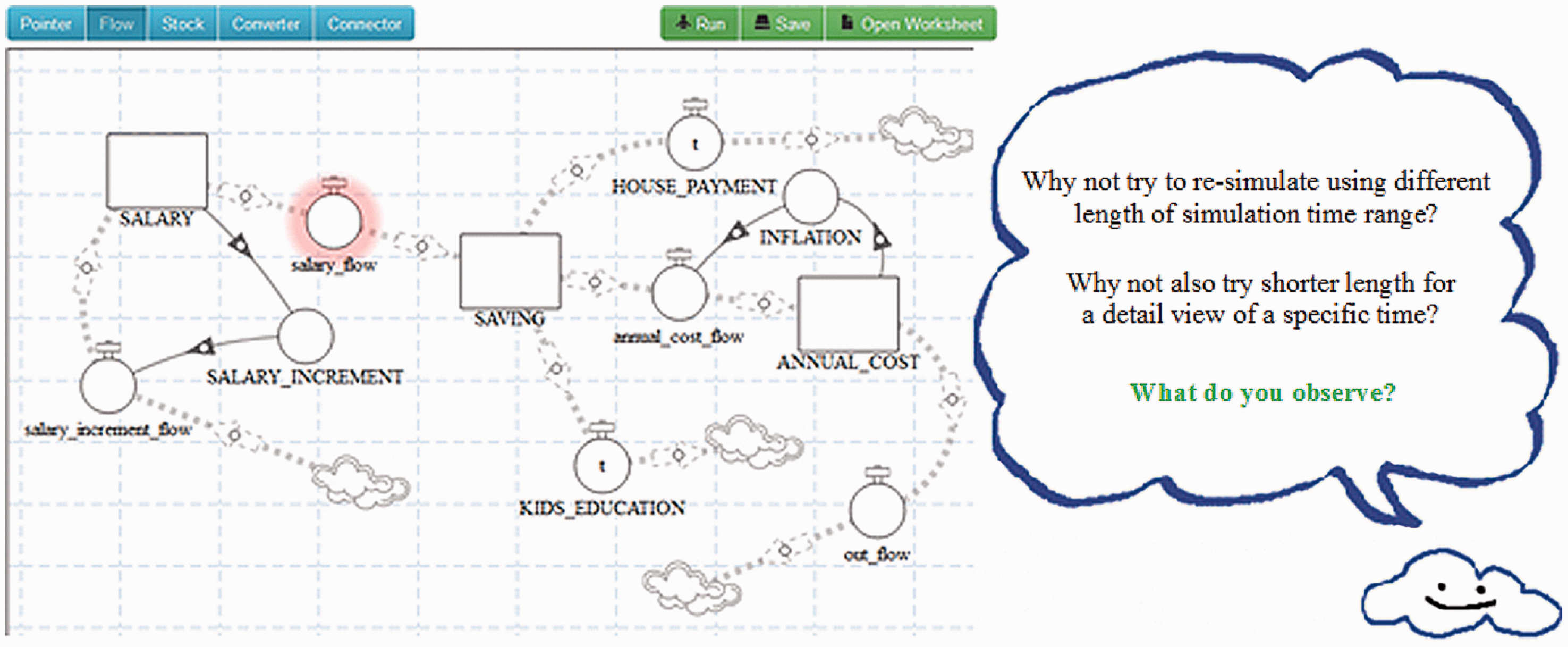
Adaptive scaffoldings
The scaffolding component is one distinctive feature of PRES-on. With scaffolding, learners can achieve learning goals or engage in challenging activities (Davis & Miyake, 2004). In a recent study conducted by Lee (2010) on using system modeling for conceptual change, she provided evidence that employing a “self-questioning” strategy plays a pivotal role in learners’ deep learning. Hence, instruction may need to equip learners with the ability to ask and answer questions effectively, a task which is central to learning (Korkmaz, 2009). The adaptive scaffoldings in PRES-on mimic self-questioning. These scaffolding prompts take the visual form of a cloud-face (see Figure 1) displaying a variety of possible messages that are triggered by learners’ performance based on conditions set by the system. Currently, there are three levels of prompts within the system. Adaptive scaffoldings analyze learners’ behaviors and performance to provide an appropriate scaffold (Molenaar & Roda, 2008; Puntambekar & Hubscher, 2005) to support learners’ reasoning. The type of scaffolding provided will be different levels of question prompts as questions are at the heart of virtually any complex task.
Procedural scaffolding (Chen & Ge, 2006) prompts are meant to direct learners’ attention to the procedures of building their problem representation. This level of scaffolding also reminds learners to set their goal and determine the variables first. Examples of procedural prompts are: “Have you checked the output of your problem representation?” and “Do you have the appropriate function in ____variable?”
Reflective scaffolding (Chen & Ge, 2006) prompts focus on helping learners reflect upon their process of building problem representation, enabling learners to engage in a deeper level of thinking. This level of scaffolding is meant to make learners rethink and reflect on their half-completed model, and encourages them to refine their initial assumptions if needed. Examples of this type of scaffolding include: “Have you thought of other related variables that would affect your problem representation?” and “Have you considered changing the relationships between variable ____ and variable ____?”
Deep reasoning scaffolding (Graesser et al., 1996; Graesser et al., 2005) prompts enable the learners to engage in explaining the causal mechanism of the system. The learner is also prompted to create reasons and arguments to explain various phenomena or behavior occurring within the system. Examples of deep reasoning prompts include: “Why do you think the output of your problem representation behaves in this manner?” and “What if you increase/decrease the rate of variable ____?”
Collaborative model building
To support the model building process, PRES-on not only considers the cognitive support (levels of scaffoldings) but also the socio-cultural supports. To achieve successful collaboration, there must be shared understanding of the goal of the activity or what is referred to as intersubjectivity (Rogoff, 1990; Wertsch, 1985). Intersubjectivity is attained when learners collaboratively redefine the modeling task so that there is combined ownership of the model that they are building. As a web-based platform, PRES-on will eventually allow learners to synchronously and collaboratively build a model. The motivation behind the design of the collaborative feature is to encourage open-mindedness so that learners may develop the ability to take multiple perspectives into consideration and examine different points of view. Although some tools such as Colab are designed for synchronous collaborative work, they are designed more for the learning of science (Bravo, van Joolingen, & de Jong, 2009), whereas PRES-on is designed as a generic engine for multidisciplinary learning. To support collaboration during model building, PRES-on introduces the use of a chat tool (see Figure 2). The use of such a tool has been shown to be as effective as face-to-face communication during collaborative tasks (Barile & Durso, 2002; Basque & Pudelko, 2004) as it not only provides an avenue for group members to discuss their model, but also serves as a platform for meaningful negotiation (Sins, Savelsbergh, Wouter, van Joolingen, & van Hou-Wolters, 2011). Specifically, it affords a space for learners to build a common goal, to agree on shared understanding and to resolve possible conflicting viewpoints, and to collectively share the responsibility for the product’s effectiveness.
Chat tool in PRES-on (Koh, 2012).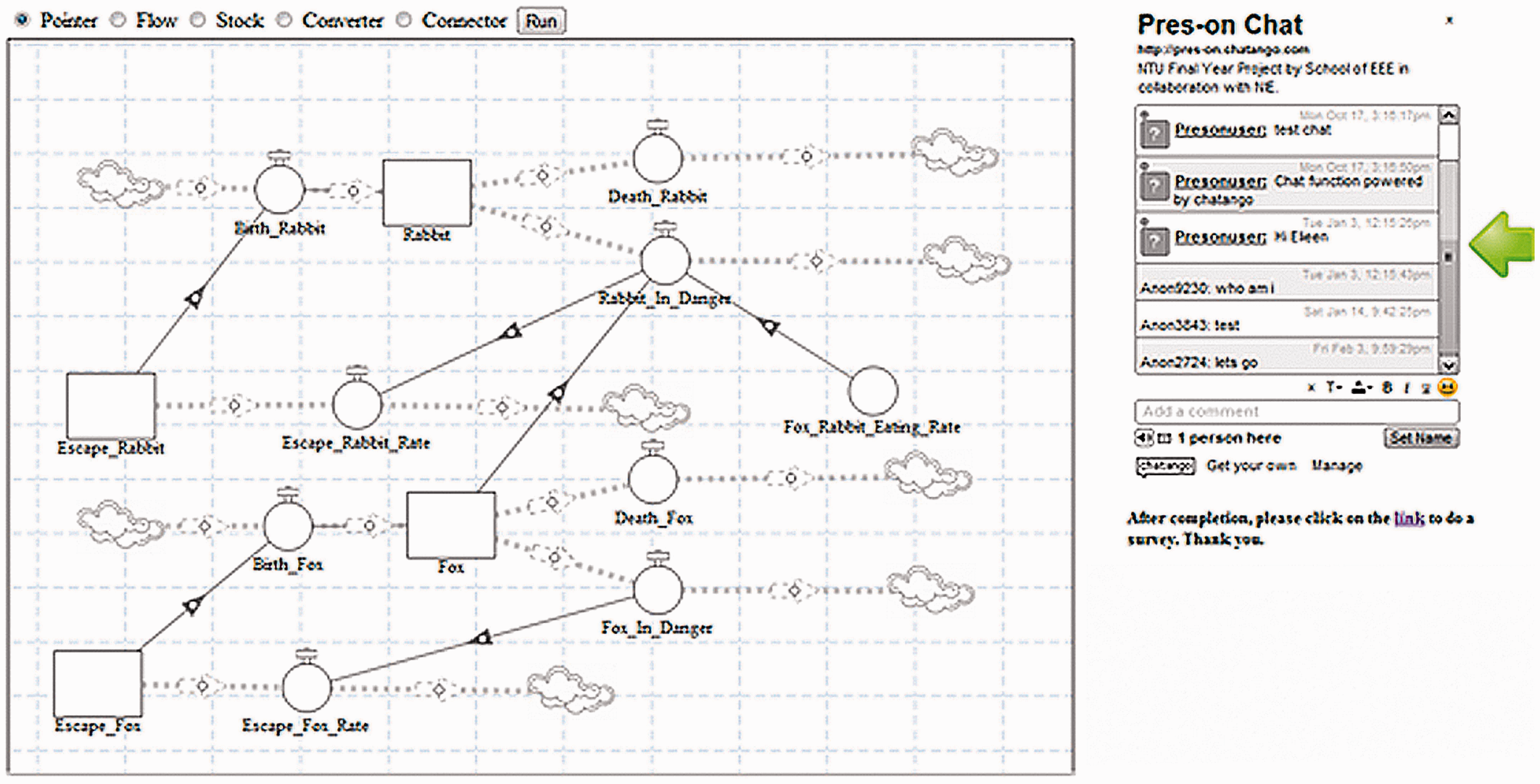
Conclusion
Traditionally, intentional learning has mainly referred to having explicit mental attitudes such as goals, intentions, and beliefs that motivate and guide the learning and strategies to achieve the desired learning outcome, or learning that is guided by reasoning processes for the achievement of a specific learning goal. Drawing from Bereiter and Scadamalia’s (1989) discussion on intentional learning which is based on the premise of knowledge building, we argue that intentional learning refers to the process whereby learners are cognitively challenged, and awareness of the need to engage in various cognitive processes for high cognitive engagement is triggered, thereby enabling them to identify their deficiencies in learning, perturbing them to restructure and reconsider their own belief system and conceptual understanding, and engaging them in the monitoring and regulation of their learning during this process. Based on the literature review of related studies, this paper discussed the dimensions of intentional learning and highlights its specific characteristics, proposed systems dynamic modeling for fostering intentional learning, and discussed a technology-enhanced scaffolded systems dynamic learning environment designed for intentional learning.