




Abstract
Teachers make pedagogical decisions in their planning and use of interactive whiteboard (IWB) technologies. Intentional teaching incorporating IWB and interactive planning software requires deliberate selection and sequencing of digital resources. The research reported in this paper explored and documented teacher and student use of IWB technology in two Western Australian primary science classrooms. Our case study research applied a social constructivist perspective and drew from principles of pedagogical interactivity and multimodal representation. Ethnographic microanalyses resulted in the generation of principles of practice with IWB technology, which were illustrated by classroom examples of technical and conceptual interactivity in intentional primary science teaching.
Keywords
Introduction
The ever increasing use of digital technologies such as personal computers, interactive whiteboards (IWB) and iPads in education has generated interactive classroom environments that challenge teachers and students to interpret and generate a wide range of multimodal representations when constructing understanding of scientific phenomena (Jewitt, 2006; Murcia, 2010). The installation of IWB into an increasing number of Australian and international schools has generated debate about the affordances of the technology and its potential for supporting productive teaching and learning. Technical competency is integral to successful integration of technology into a learning experience, but clearly it is the teachers’ pedagogy that surrounds the use of the technology that determines effectiveness (Murcia, 2012; Tanner, Jones, Kennewell, & Beauchamp, 2005). Teachers make pedagogical decisions in their planning and use of technologies in the classroom. Intentional teaching that incorporates IWB and interactive planning software or ‘notebooks’ requires deliberate selection and sequencing of digital resources. As a consequence, it is important to understand the ways in which technologies such as the IWB work as a mediating or convergence tool and the impact of this on teaching practices and the opportunities it creates for active multimodal learning.
Research has suggested that when the affordances of IWB technology are used by teachers and students, it can aid intentional teaching, enhance authentic learning, encourage cognitive grappling and give students more control of the direction of learning and having a voice in whole class interactions (Hedberg, 2006; Kearney & Schuck, 2008; Murcia & Sheffield, 2010). The touch-sensitive IWB and the associated interactive software have gained popularity with many teachers as it enables the convergence of a diverse range of ICTs. The IWB interactive software working space or ‘notebook’ has been reported to evolve and grow through the students’ learning journey as brainstorming ideas are incorporated, annotations are made to images and text and the results of searches and links to online sources are included (Murcia, 2012). The provisional nature of the IWB notebooks has been reported to encourage the saving and recording of multimodal interactions and flexible reviewing of learning activities (Betcher & Lee, 2009; Moreno & Mayer, 2007; Murcia, 2012). It provides an opportunity for students and teachers to move flexibly through the notebook and select from the converged range of information sources.
However, reports of teachers’ use of IWB technologies have been variable, and it has been suggested that ‘teachers tended to use the IWB predominantly for explicit instruction and presentation’ (Kearney & Schuck, 2008, p. 9). Findings such as this support the assertion underlying the research initiative reported in this paper that educators must continue to explore how the affordances of IWB technology can be fully exploited in the classroom and what interactive multimodal pedagogies are required to enhance intentional science teaching and learning.
Theoretical perspectives and background literature
Our research was framed by a social constructivist perspective of science learning and teaching which emphasises that students actively construct understandings through social interactions within the classroom. Social constructivists have argued that learners construct meaning through discussion and negotiation with both peers and teachers (Driver, Asoko, Leach, Mortimer, & Scott, 1994; Vygotsky, 1978). It is asserted that the process of shared meaning making is guided by the teacher and evoked through engagement with multimodal resources and substantive discourse (Murcia & Sheffield, 2010). Models for social constructivist learning and teaching emphasise that engaging students with a target phenomenon and eliciting their prior knowledge enables exploratory experiences to be generated which are appropriate for shared construction of new understanding (Bybee, 1997; Hackling, Peers, & Prain, 2007; Murcia, 2007). From this perspective, intentional teaching strategies and thoughtfully crafted learning journeys would provide opportunities for students to meaningfully engage and construct deep understanding.
Link making in science and intentional teaching
Classroom-based research has found cases where teachers strategically brought multiple representations into the IWB social learning space to promote interactive student engagement and higher order thinking (Higgins, Beauchamp, & Miller, 2007; Murcia, 2012). Teachers were deliberate in their choice of resource and mode of representation as they support students’ knowledge building and continuity in learning. Pedagogical links are made by teachers and students as they connect ideas in the on-going meaning-making interactions of the classroom (Scott, Mortimer, & Ametller, 2011). The term intentional teaching has been used in the literature to capture pedagogical practices which are deliberate, purposeful and thoughtful. Intentional teaching describes the nature of the interaction between students and teachers which purposefully builds concepts, skills and values (Fleer & Hoban, 2012; Hunter, 2012). In the social constructivist science classroom, the sequence and nature of activity and representational forms would be intentionally matched to the stage of scientific inquiry (Hackling, Smith, & Murcia, 2010). It is proposed that the social constructivist teacher purposefully orchestrates an inquiry learning experience by drawing from a range of multimodal resources that are necessary for socialising students into the science discipline and for constructing understanding.
Intentional teaching in contemporary classrooms arguably involves pedagogy that incorporates technology. Kent and Holdway (2009, p. 21) stated that to enhance the professional practises of teachers, digital technologies should be used in ‘presenting a concept, exploring the implications, placing the concept in various contexts, creating links with existing knowledge, and leading discussions that probe student understanding’. It is evident in this statement that the significance of technologies such as IWB in the classroom does not lie with the device itself but rather how it is used to enable interaction between users and resources in meaning making and knowledge construction (Edwards-Groves, 2012). Consequently, understanding the complexity of interactions and pedagogical link making in a learning environment incorporating IWB technologies requires a holistic view of the classroom. The interactive and multimodal nature of the learning environment needs to be better understood, so the affordances of the technology can be used to enhance pedagogy.
Pedagogical interactivity
Teachers using interactive technology exercise professional judgment to identify when and how the tool can support students’ learning and achievement of curriculum outcomes (Betcher & Lee, 2009). Moving beyond technical competence requires teachers to understand and use principles of pedagogical interactivity to facilitate students’ inquiry and development of scientific understandings (Hennessy, Deaney, Ruthven, & Winterbottom, 2007; Murcia, 2010). An aim in an ICT-rich learning environment would be to achieve pedagogical interactivity, which includes the practises that mediate communications between the teacher, students and the technology (Beauchamp & Kennewell, 2008; Hennessy et al., 2007). Moreno and Mayer (2007, p. 312) stated that ‘interactivity is a feature that can be used to promote deep cognitive processing in the learner’. They argued that learners are supported in building mental representations as they ‘select, organize and integrate new information with existing knowledge’. It is suggested that teaching activities in an interactive learning environment are dependent on the actions of the learner and are potentially flexible and responsive. For example, Tanner et al. (2005) conceptualised interactivity as a blend of both the degree of control a student has over the learning and the degree to which classroom discourse is dialogic in nature.
Interactive learning is facilitated by the integration and intersection of activity at the board, at students’ desks and in the minds of the students (Higgins et al., 2007). Research has indicated that activity within an IWB classroom is diverse and includes technical interactivity with a focus on using the tools of the board and physical interactivity focussing on student manipulation of objects at the board’s surface. At a higher more complex level, conceptual interactivity occurs when use of the IWB tools supports exploring, unpacking and co-construct understanding of concepts through multiple modes (Deaney, Chapman, & Hennessy, 2009). At the highest level, teachers have moved beyond using the technology simply as a display screen for the transmission of content and are using it as a tool for mediating pedagogical relationships in meaning making.
Multimodal representation
Interactive practises in digital learning environments include accessing a range of multimodal representations and creating opportunities for students to experience knowledge and demonstrate what they know in an increasing range of modes (Murcia, 2010; Twiner, Coffin, Littleton, & Whitelock, 2010). Multimodal was defined by Prain and Waldrip (2006, p. 1844) as using ‘different modes to represent scientific reasoning and findings’. In this context, the term mode is referring to the form of the content and includes descriptive (verbal, graphic, tabular, written), experimental (demonstration, fair test investigation), mathematical, figurative (pictorial, analogous, symbolic and metaphoric), and kinaesthetic or embodied gestural representations of the same concept or process.
Multimodal representations can serve learning in a range of ways and be used strategically in teaching (Tytler & Prain, 2010). For example, a teacher can present a representation to review previous learning, consolidate previously addressed concepts or elicit student prior knowledge. At other points in an inquiry-based learning experience, a representation may be used to focus students’ attention and thinking on a particular conceptual feature or idea. Multimodal representations can be used to assist students in constructing understanding of a concept that underlies or sits across examples of phenomena (Ainsworth, 1999). In this way, multimodal representations are used to scaffold the construction of understanding, scientific explanations and reasoning (Tytler, Prain, Hubber, & Haslam, 2013).The interactive and multimodal nature of an IWB learning environment enhances learning opportunities as arguably images do not supply a similar version of a concept to what is exchanged verbally but rather they provide a different representation of it (Jewitt, Moss, & Cardini, 2007). Building conceptual interactivity into an IWB supported learning journey means students will talk about a concept, investigate with their hands and minds, draw it and even animate it, while accessing and tapping into different aspects of a concept.
Research question
The research question driving our study was: how do teachers intentionally use IWB technology in creating a social constructivist primary science classroom?
Methods
Our exploratory case study research used video capture and microanalysis techniques. It was conducted in collaboration with two teachers from an independent boy’s school in the Perth metropolitan area of Western Australia. Both teachers were working with classes of approximately 25 year six (11 year old) students. This school was in the highest band of the Index of Community Socio-Educational Advantage (ICSEA) and was invited to participate due to the installation of permanently mounted IWBs in classrooms with ICT support services.
The classroom teachers, Anthony and Lynette (pseudonyms) developed and implemented interactive notebooks and pedagogies. They were supported in the research process to critically reflect on their practice and the impact it had on their students’ engagement with learning.
Anthony
Anthony described himself as a confident user of technology with approximately two years experience with an IWB. The furniture in his classroom was movable and he created different desk arrangements to suit the learning tasks. A ‘horse shoe’ arrangement was, however, most typical with the students facing a central dry erase traditional board. The IWB was mounted on the side wall and had a small desk in front of it. Students were observed turning backwards to observe action on the IWB. Students commented that the IWB was great for watching videos and they used it most in science. The lessons that were video captured and analysed in this research were part of a science programme on Forces in Flight.
Lynette
It was Lynette’s first year at the school and she was introduced to IWB technology at the start of the research project. She had previously seen the technology demonstrated and was keen to use the IWB in her new classroom. The furniture in Lynette’s classroom was movable but typically the students’ desks were arranged in groups of 4 and angled towards the centrally mounted IWB. She maintained an open space in front of the IWB, which allowed students to work in groups and interact at the board. The lessons that were video captured and analysed were part of a science programme on Sustainable Energy.
Approach and data collection
The research was conducted in conjunction with normal classroom science activities. A reflective cycle of action was used to support the teachers’ development of interactive multimodal design skills and to capture their implementation of these principles in the classroom (Murcia, 2005). Regular meetings, at two- to three-week intervals, were held with the teachers over a six-month period. These meetings were collegial in nature and assisted in establishing common understanding and research protocols. Data gathered for the case studies included semi-structured interviews, video-captured lessons, classroom observation field notes, student work samples and interactive notebooks produced by the teachers.
Observations and video recordings were made in four of Anthony’s and six of Lynette’s science lessons conducted within one school term. These lessons were negotiated with each teacher and chosen due to timing and whole school programmes. Video data were obtained by using a single camera with a wide angle lens placed at the back of the classroom out of the students’ line of sight. Field notes from lesson observations were produced concurrently with video capturing and each teacher’s IWB science notebook was collected in order to assist in the analysis.
The teachers also participated in a debriefing interview after each video-captured lesson and a semi-structured interview pre and post their project involvement. Collated video segments showing the nature of IWB use was given to each teacher to view at the end of the data-collection period. Their reviewing of the video segments assisted in focusing the post-project semi-structured interview and reflection on practise.
Analysis
The video-captured lessons were analysed using a form of ethnographic microanalysis. The videoed lessons were watched repeatedly, major events were identified, multimodal transcriptions were generated and reviewed (Hackling, Murcia, & Ibrahim-Didi, 2012), and comparisons were made across the video data set to identify themes and patterns (Erickson, 1992). Analysis progressed from analysing the series of four or six lessons to focussing down into classroom action illustrative of IWB pedagogical interactivity, which ranged from technical to conceptual interactivity (Deaney et al., 2009). The themes identified in the data set were verified by the case study teachers in post-project interviews and validated by emersion back into the data to identify confirming video extracts and evidence in interview transcripts.
Findings
Classroom observations and the video data showed a range in the nature and level of teachers’ multimodal interactive pedagogy. Both teachers used the IWB for different purposes during the science inquiry process. At times, students were passive in the IWB learning experience as they watched videos or listened to teacher talk. At other times, there was much greater control of the interaction by students, with students asking questions, engaging in whole-class exploratory talk and representing their understanding through original representations such as a short multimedia recordings or diagrams created and annotated on the IWB.
Type and nature of case study teachers’ interactive pedagogy.
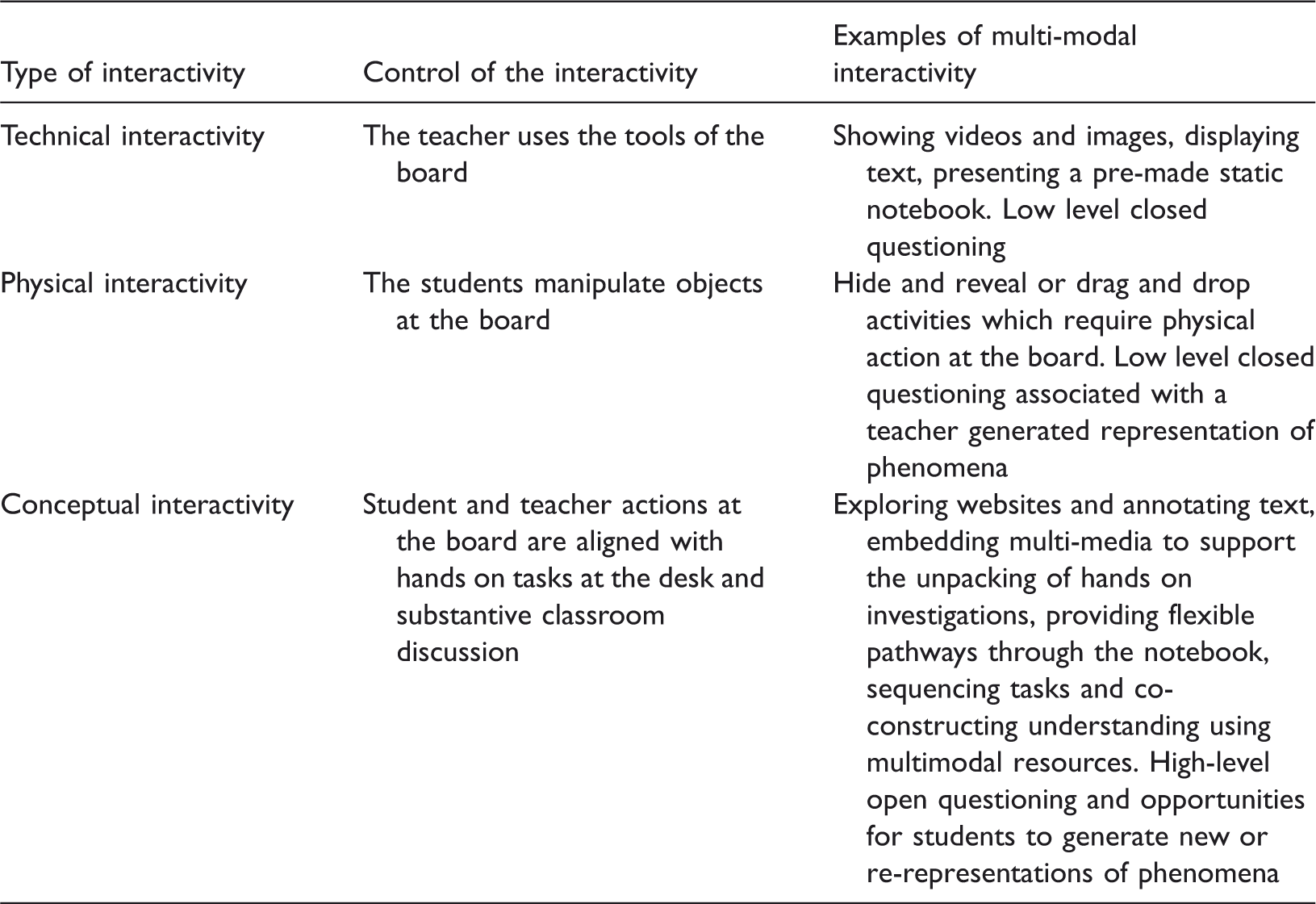
The following examples or episodes of classroom action were selected from the data set as they demonstrate the nature of representation and higher levels of interactivity, as described in Table 1. An episode is a snapshot of classroom action and represents a part of a more extensive learning sequence. They are used to illustrate five major themes in the observed interactive multimodal pedagogy associated with intentional teaching practises facilitated with IWB technology.
Engaging through multimodal activity
Lynette used an interactive notebook for planning, delivering and recording the students learning journey. The episode described here is the first lesson in the learning sequence on Sustainable Energy. Her intent was to engage the students, elicit their prior knowledge of energy and open up the scientific problem of sustainable energy.
To begin the inquiry learning sequence, Lynette created a sense of intrigue amongst the students by using the software spotlight function to only reveal the child’s hair in the image incorporated into the display (Figure 1). She asked the students to ‘share their thoughts’ about the image. Students were curious as they could not see the whole photo and this got them talking about static electricity. Lynette explained ‘I had a link to YouTube and the television commercial State Electricity House. It’s very funny, suggesting that static electricity could be used to power houses. I asked the students to vote on the question, could you power a house with static electricity?’
Engaging students with the energy concept.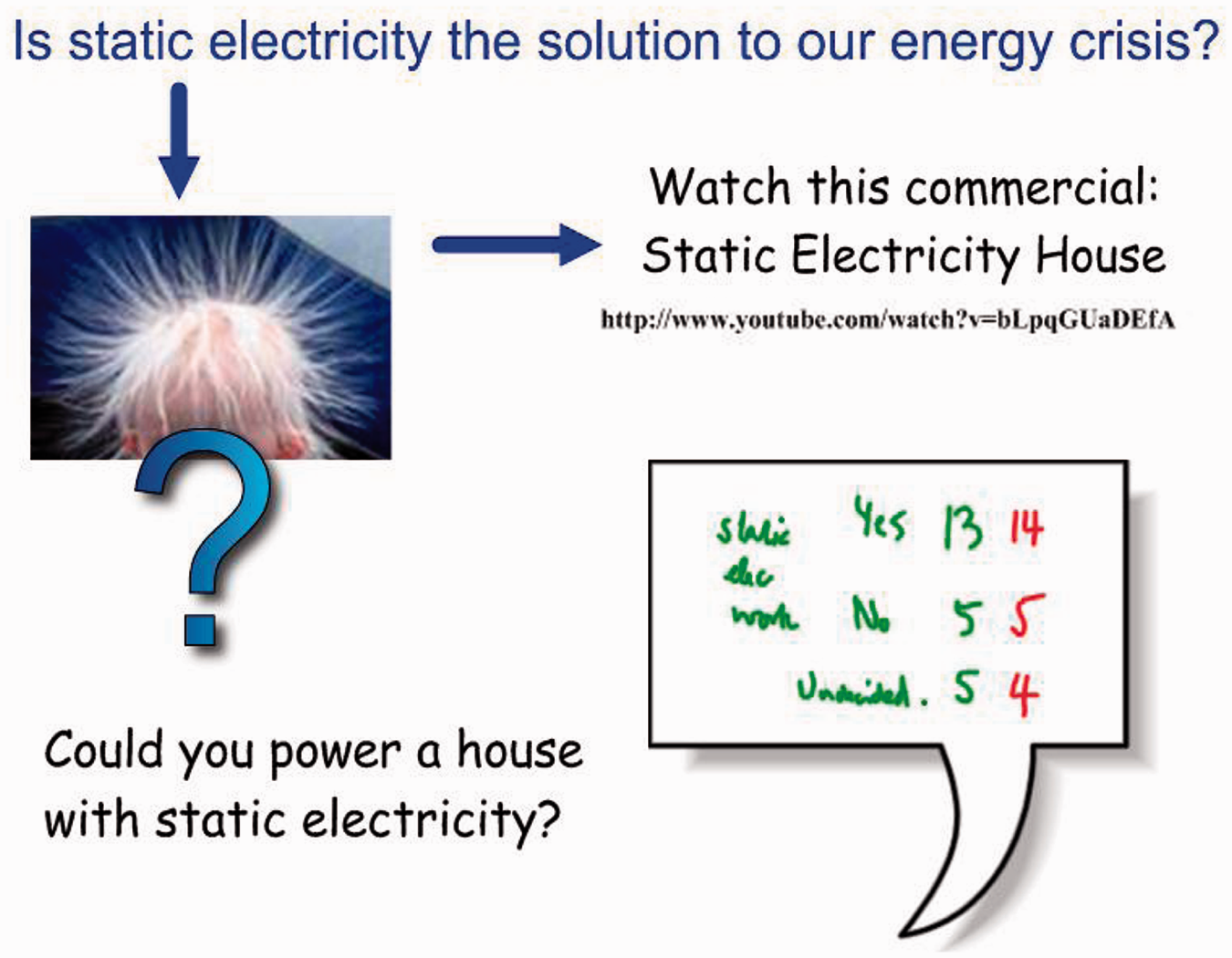
Lynette had used the interactive tools of the IWB and brought together the digital photo, video clip and text into the learning space. She commented that ‘the students’ comments around the voting were enlightening; they were talking to each other, debating perspectives, and giving reasons to justifying their vote’. This interaction provided insight into the students’ understanding of energy, power and static electricity. Eliciting and responding to students’ prior knowledge was a key phase in this social constructivist learning journey.
In this episode, the teacher was the critical agent in mediating effective use of the IWB tools and substantive whole class discussion of the science phenomena. She used the spotlight function to focus students’ looking at the photo and thinking about static electricity. The teacher’s selection of resources and sequencing of these in the lesson were appropriate to the engage stage of inquiry, as she aimed to motivate the students and elicit their prior knowledge and experiences of energy. She captured her students’ interest by linking to a popular television commercial. Lynette later reflected, ‘If you have good graphics and you’ve got good questions you’ll have the students there with you following along and contributing to the discussion’. Lynette’s choice and sequencing of multimodal representations of energy were intentional, matched to an engage stage of inquiry and demonstrated conceptual interactivity.
Promoting exploratory discourse and action
Anthony also used the interactive notebook software for his planning and delivery of his science topic. His pedagogy with the IWB tended to be focussed on physical interactivity. He often used drag and drop actions on the IWB to involve students in presentations and included closed questioning for focussing students attention on the salient feature of the representation. Like Lynette, his inclusion of representations and interactive practices was thoughtful and strategically sequenced. He introduced scientific language and the scientific concepts associated with the forces of flight as a foundation to students’ exploration and investigations of Frisbees, boomerangs and paper planes.
To promote students exploration, Anthony used the IWB to show video of real jet planes in flight. He then transitioned to a stylised diagram of an aeroplane and then a rocket with hidden labels for the forces of flight. He used a hide and reveal interactive strategy to get students thinking about the forces of flight in a jet plane and how they applied to a rocket. Students were encouraged to think about lift, thrust and gravity and make prediction about the place of the forces on the rocket diagram. A student was then invited up to the IWB to slide away the label cover to check their answer.
Anthony’s questioning and gesturing in relation to the image aimed to focus students’ attention on the concept of forces and assist students in translating between the two examples, an aeroplane and a rocket. The image and actions on the IWB were supported and framed by the teachers focussing questions, explicit talk and gesturing. The following transcription extract illustrates the interaction in this episode. Andrew: “Let’s change things around a little. Now we’re looking at a rocket, so that changes where our forces of flight apply. In the rocket what do you think (points to IWB image) that is going to be. Think (pause). It’s a bit different to the plane. What force is going to be there? (pause, students put up their hand). Ok, let’s see if you’re right; come up (points to a student). It doesn’t matter if he’s right or wrong. Okay slide it (student touching and dragging label cover). You’ve got lift here. Why in the rocket is there going to be lift instead of thrust? What’s different about the rocket from the plane?” Student responds: “The rocket is facing up” (points to the IWB image and gestures an upward direction). Andrew: “The rocket is facing up, it’s like a plane that has been tilted on its side and it’s going upwards. Instead of going forwards like that (gesturing direction with hand), it’s going up like that (gesturing direction and pointing at IWB image)
Creating representations and re-representations
Lynette used her IWB planning and activities to guide students and encourage them to work with scientific views. She aimed to hand over responsibility to students to apply and use their conceptual understandings in a new investigation of energy which was the construction and testing of a solar oven.
As an outcome from the investigation, Lynette wanted students to realise through graphing their solar cooker’s temperature over time that there was an implicit link between their model cooker and their data. Her aim was to make explicit the link between different model designs, differences in data collection and the story the graph trends showed. The students had to come up to the IWB in their investigation group and visually plot the data points (Figure 2). Lynette commented in the post-project interview, ‘this was actually one of the richest lessons because of the talk and negotiation that went on around where to put those “dots” and how they should line up’.
What was the most efficient solar cooker design?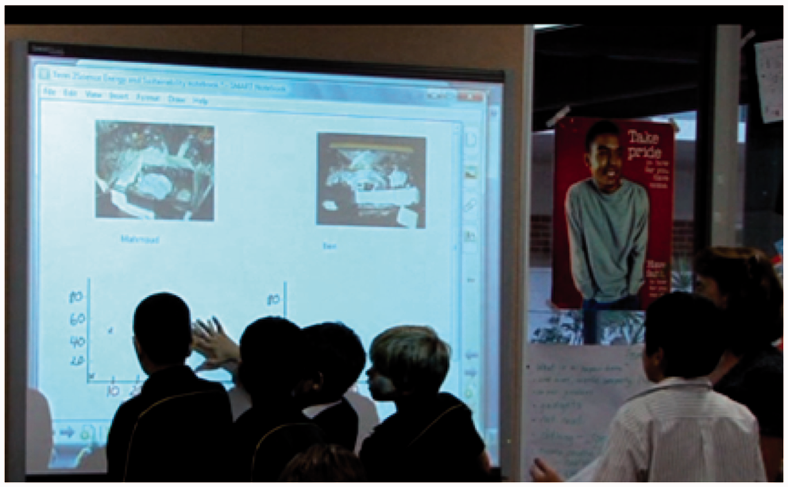
This task prepared students for making comparisons between each group’s data and cooker design. The teacher and student communication mediated with the IWB in this episode, included student gestures (pointing) as an orchestration strategy, which assisted in organising the collaborative talk, connecting data to the digital photos displayed on the board and negotiation of ideas from the students in each group. Explicitly talking about and physically pointing to the focus science concept in an image helped students clarify their ideas, make connections between representations and build joint understanding through exploratory dialogue.
This episode illustrates conceptual interactivity in Lynette’s intentional teaching sequence. She purposefully created the opportunity for students to generate a new graphical representation of their investigation data. The re-representation process, occurring in the flexible (easily erasable) and large collaborative space at the IWB, encouraged student-centred discussion about the common features across representational types and modes.
Orchestrating explanations
Both Lynette and Anthony facilitated explanation activities at the IWB, so students could share their exploration experiences and understandings. Importantly, the explanation of the phenomena came after the students’ exploration and highlighted the accepted scientific explanation of the target concept. In the following illustrative episode, Anthony has created a learning space at the IWB in which he co-constructed with students, a scientific explanation of flight and introduced Bernoulli’s Law.
Anthony displayed a stylised image of an aeroplane wing or airfoil on the IWB to assist students in ‘seeing’ the scientific concept in their investigations of flight. He again used focussing questions to encourage students to think about airflow direction and speed around an aeroplane wing (Figure 3). He said in reflection, ‘I wanted to focus the students’ thinking on the important ideas in Bernoulli’s Law. I tried to get them relating the wings of their paper planes to the diagram and think about ideas they had been learning to explain flight’.
Bernoulli’s law.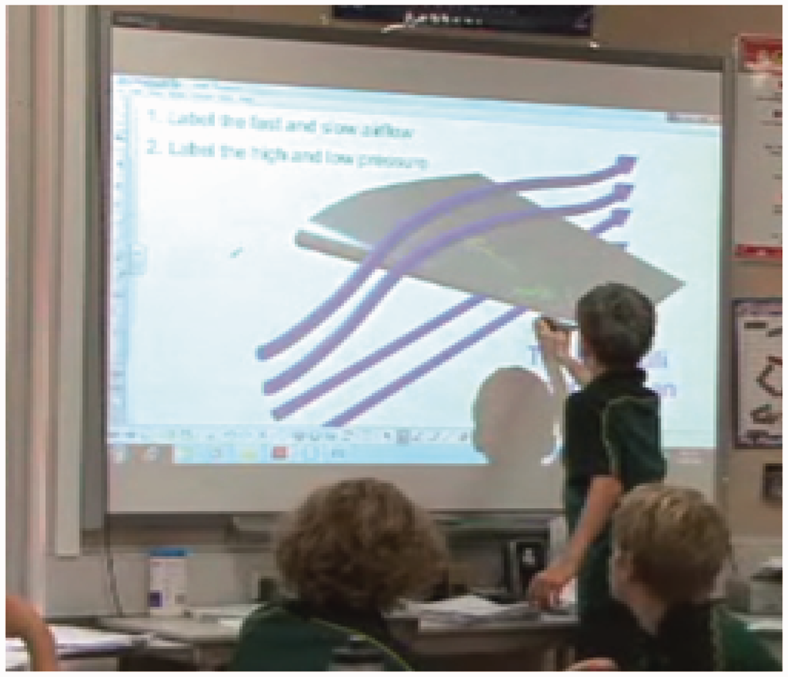
Interactive scaffolding and physical interactivity were largely evident in this episode as students annotated the image with words and arrows. Students were observed using minor gesturing and pointing to support their talk as they annotated the diagram of the airfoil with key words describing air flow speed and pressure. Anthony also used gesturing to assist in creating a sense of Bernoulli’s Law as he co-constructed with students an explanation of the phenomena. The direction of air flow was shown with hand movements over an imagined wing of an aircraft. It was evident that the gesturing and pointing helped in negotiating and constructing meaning from the representation of the target concept. Students and the teacher drew on the representation displayed on the IWB to support and even arguably replace verbal explanations. Andrew further elaborated, ‘I believe in doing a lot of viewing activities in science. Viewing requires students to understand what symbols mean, what arrows mean, how they apply and how you take meaning out of a diagram’.
Teacher talk dominated this episode with mainly low level questioning and short student responses. Yet, students were given the opportunity to ‘see’ the scientific principles in the investigations and link these concepts to the re-representation that included scientific conventions for directional areas and movement. When reflecting, Andrew said: ‘making links with the IWB works particularly well in science as you’re talking about the investigation process while you’re teaching concepts. What it helps with is that you can go through the process skills with students while pulling in lots of concepts’. The students annotated the notebook page with their ideas as they shared their learning from the exploration activities. The annotations to the notebook focussed the students’ thinking and gave permanence to the talk and action weaving through the learning activity.
Reviewing learning flexibly
Both Anthony’s and Lynette’s IWB notebooks evolved and built in richness throughout the science learning journey. Their notebooks were both a part of the process and a product of the students’ learning. Lynette reflected in the post-project interview and said, ‘When we needed to look back at the results, I could easily flip back to that page on the IWB, even though we had moved onto another investigation. It meant I could actually go back and recover the material very quickly and add in the extra results without it being too difficult or tricky’. The teachers were using interactive and multimodal pedagogies to facilitate students’ reflection on their learning journey. Teachers were also able to formally and informally assess students’ understandings through their engagement with the range of representations.
In addition, to evaluate student learning at the end of the science inquiry sequence of lessons, Lynette required students to be creative and represent their understanding of sustainable energy in the design of an energy efficient futuristic classroom. This evaluation experience facilitated students’ reflection on their learning, enabled the resolution of the posed scientific problem and continued the development of the scientific concept.
In this episode (Figure 4), a student stood up at the IWB and was able to explain his diagram and ideas about energy to his classmates. He pointed out various features and explained his reasons for the design of his energy-efficient classroom. Using the IWB for this purpose meant the student could annotate over his design, relate directly to the displayed assessment rubric and receive feedback from his peers. The meta-cognitive practise illustrated in this episode is again evident of conceptual interactivity in the intentional teaching of science through inquiry.
Reviewing and evaluating learning.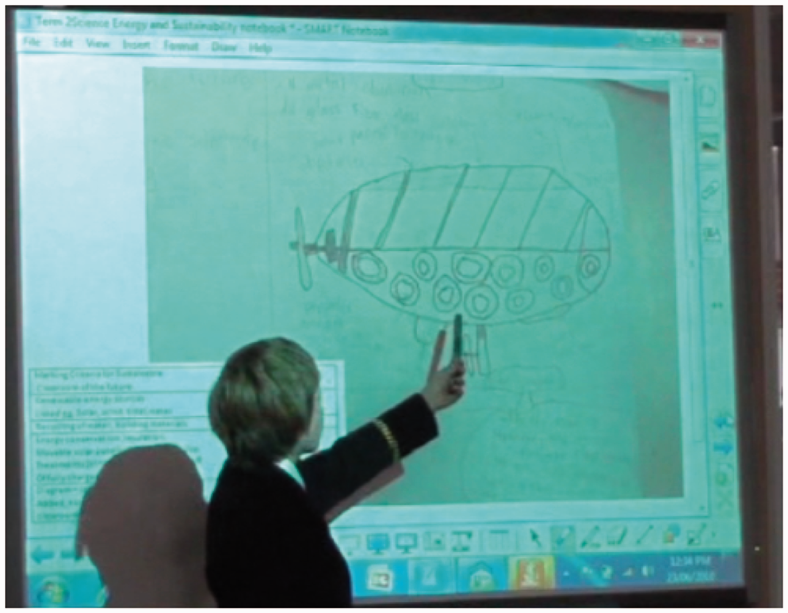
Principles of practice for integrating IWB into the intentional teaching of primary science
Designing the interactive learning experiences required the teachers to re-think their traditional approaches as the IWB technology introduced new tools for coordinating representations of science concepts and facilitating students’ learning. The scientific story unfolded through the inquiry process with students and the teacher co-constructing explanations and collectively reasoning. At times, the pedagogical interactivity moved beyond being solely technical to including conceptual interaction in which students were engaged in substantive science talk and actively represented and re-represented concepts in multiple modes.
The design of the IWB notebooks was an artefact of the pedagogical decisions made by the teachers. It represented the unfolding scientific story and included focus questions and activities that signposted the inquiry learning. In a large UK study of multimodal literacies in the science classroom, Kress, Jewitt, Ogborn, and Tsatsarelis (2001) noted that making a representation required a clear understanding of design and purpose. They stated, Making a representation now goes well beyond simple encoding. It has become a matter of active, deliberate design, and meaning-making becomes a matter of the individual’s active shaping and reshaping of the resources that he or she has available, in the wish to make representations match intentions as closely as possible (p. 2).
The following principles of practice emerged from the case study research and were considered central to the intentional social constructivist design of IWB supported science learning and teaching experiences.
Engage and elicit students’ prior knowledge through visually and conceptually appealing multimodal interactive displays. Generate exploration and explanation opportunities that are rich in dialogic discourse about multimodal representations and re-representations of concepts. Provide opportunities through higher-order questioning for students to transfer their learning to new or different contexts. Create opportunities for students to generate their own representations and re-representations of concepts. Review learning by moving flexibly through an interactive learning sequence
These principles were generated from the specific cases and as such should not be over generalised. However, they are practical in nature and could assist teachers across the curriculum to reflect on the nature of their interactive and multimodal pedagogy. These principles were generated in an IWB context, yet they could also inform inquiry into the pedagogy associated with a wider range of interactive learning technologies.
In summary, evidence from this case study research suggests that intentional teaching supported by technology can promote higher level thinking and conceptual engagement. Teachers were found to be deliberate in their representational choices, sequencing and link-making interactions. When the teachers used the IWB technology concurrently with pedagogy that demonstrated conceptual interactivity, students were observed actively moving between representations on the board, at their desks and through collaborative investigations. The classroom episodes shared in this paper demonstrated the dynamic, flexible and multimodal nature of interactive pedagogy. In these IWB environments, the teachers’ pedagogy not only focussed on the interactive technology, but also on promoting interactive students who actively explored science concepts in multimodal formats.