




Abstract
Digital technologies serve as an important educational resource for tertiary students. A key feature of many current digital technologies available to students is that they can function as proxies in the learning process; that is, technology can be used to carry out some academic-related tasks on behalf of the user. For tertiary educators, the widespread availability of technological proxies raises a number of important pedagogical issues. In this article, we discuss technological proxy in the context of intentional learning. Drawing from the literature on learner motivation, we identify three key variables – learners’ achievement goal orientations, self-efficacy beliefs, and proxy efficacy beliefs – and advance a set of propositions about how relationships between these variables may shape students’ use of technology as intentional learners. A key goal of this article is to expand current thinking around the ways in which tertiary learners’ efficacy beliefs relate to working with digital technology and, ultimately, their learning and performance outcomes.
Keywords
Introduction
Human beings often intentionally seek out and engage others to carry out tasks on their behalf to achieve specific goals (Shields & Brawley, 2006). As an everyday classroom example, students who are unable to attend school may have fellow students take notes or homework assignments on their behalf to ensure that they keep up-to-date with their schoolwork. From the perspective of Social Cognitive Theory (SCT: Bandura, 1997, 2001, 2006) these arrangements can be described as ‘proxy relationships’.
Although discussions of proxy relationships have predominately focused on human interactions (Bray & Cowan, 2002; Elias & McDonald, 2007), we argue that proxy relationships can extend to interactions between learners and technology. In the context of higher education, student use of digital technologies represents a good example of the role of technology as a ‘proxy’ in the learning process. Currently, university students have access to a range of digital technologies that carry out learning tasks on their behalf – we refer to such technologies as technological proxies (TPs). Examples of TPs include text-based referencing software (e.g., Endnote, RefWorks) that automatically inputs citations into reference lists for the student, plagiarism software (e.g., Turnitin) that assess for the student the ‘originality’ of their essays and reports, search engines (e.g., Google Scholar, Pro Quest) that locate information on the student’s behalf and visual presentation tools (e.g., Prezi), which organise and manage ideas for the students in ways suitable for a public presentation.
Conceptualising certain digital technologies as ‘proxies’ in the learning process is pertinent to understanding how intentional learning influences student use of digital technologies as educational resources. Intentional learning is goal directed, deliberate, and under the conscious control of the learner (Sinatra, 2000). The central goal for students with this mindframe is ‘learning’ (Bereiter & Scardamalia, 1989). TPs emerge as important to a discussion on intentional learning as digital technologies can potentially be used by students in ways that enhance their opportunities to fulfil the goal of learning and in ways that do not. To illustrate this, intentional learners may use text-based referencing software such as Endnote to perform the task with the purpose of deepening their own learning about referencing styles, in-text citations, and reference list protocols. Non-intentional learners may simply use the application to perform the task, without any intention of extending their learning. The intentional usage of technology as a proxy is thereby marked by the user’s awareness of the features and functionality of the proxy action of application itself. In other words, intentional learners are likely motivated to explore what the technology is capable of doing on their behalf and learn from the processes the applications uses to complete the task, despite the fact that they are off-loading the cognitive task of actually performing the process themselves. Continuing with the Endnote example, intentional learners are necessarily aware that different referencing styles require different formatting and understand this function is the proxy service that Endnote provides, whereas unintentional learners may perform the task of generating reference lists without these additional considerations.
Positioning technology as a proxy, explicitly frames these resources as potentially contributing to students’ opportunity and ability to achieve specific ‘learning’ goals. We propose that intentional learners will strategically use TPs to enhance and exercise control over their learning and will be consciously aware of how technology can help them achieve specific goals. Non-intentional learners may ‘intentionally’ use technology, but the intention may not be related directly to learning, but rather performance outcomes such as saving time on task or scoring high marks on an assessment.
As there are likely to be a multitude of factors that influence how students approach and use TPs, we concentrate on motivation-related variables. Our goal is to provide researchers and educators with direction concerning the types of motivation-related variables that will predict whether or not students engage with TPs as intentional learners. As a step toward achieving this goal we draw on arguably the two dominant theories of learner motivation, achievement goal theory (Elliot, 1999; Harackiewicz, Barron, Tauer, & Elliot, 2002; Senko, Hulleman, & Harackiewicz, 2011) and SCT (Bandura, 1997, 2001, 2006).
A key construct within achievement goal theory, mastery-approach goal orientation, has been identified as a variable that may facilitate intentional learning (Linnenbrink & Pintrich, 2003). Learners with a mastery-approach goal orientation focus on task mastery and utilise metacognitive and self-regulatory strategies in order to attain mastery (Dweck, 1999). We propose that this goal orientation is necessary for students to engage with TPs as intentional learners.
In addition to a mastery goal orientation, we argue that learners’ efficacy beliefs will be critical to students’ use of TPs as intentional learners. Two forms of efficacy beliefs that should be particularly important are technological self-efficacy (TSE) and technological proxy efficacy (TPE). TSE is a learner’s beliefs about their personal capabilities for successfully using technology for a specific purpose. TPE refers to learners' beliefs about how successfully a technology may carry out tasks on their behalf. The importance of efficacy beliefs regarding intentional learning with TPs can be illustrated using the example of Turnitin. Although recognised primarily as a software program that assists in the detection of plagiarism, this program has been promoted as a tool, which has the functionality to improve students’ academic literacy skills. One would expect intentional learners to use this program not simply to alert them about potential plagiarism but to deepen their knowledge about academic literacy. To use Turnitin to improve academic literacy skills requires that learners perceive that they have the capabilities (self-efficacy) to take advantage of all the features of Turnitin. In addition, learners need to perceive that the program itself possesses the capabilities (proxy efficacy) to help them improve their academic literacy skills. If students do not believe that they are capable of using Turnitin or that Turnitin cannot help them advance their learning – a key goal of intentional learning – it is unlikely that they are going to use this program as intentional learners.
Given that technology is firmly entrenched in the everyday learning experiences of tertiary students, it can be expected that technology-related self-efficacy and proxy-efficacy beliefs will be related to learners’ self-beliefs for carrying out specific learning tasks (academic self-efficacy), such as academic writing, research, and oral presentations. Academic self-efficacy is a central element of learners’ motivational processes (effort, persistence, choice of activities) and academic achievement (Bong, Cho, Ahn, & Kim, 2012; Pajares, 1996; Zimmerman & Kitsantas, 2005).
Contexts for engaging a TP
Tertiary learners may engage proxies when working on academic learning activities for both scholarly and functional reasons. In some circumstances, learners are faced with academic tasks beyond their unassisted capabilities. These learners might employ TPs to address the gap in their knowledge. For example, some higher degree research students need to carry out large-scale correlational studies. Analysing the data of such studies often involves employing sophisticated statistical procedures such as multiple regression analysis. The mathematical calculations required to perform such analyses are likely to be beyond students’ capabilities unless they use software programs such as SPSS. These programs carry out the complex mathematical procedures on behalf of the user. In fact, for very advanced multivariate analytic techniques, it is unlikely that most people, even some with backgrounds in statistics, could perform the necessary calculations without the assistance of a computer and appropriate software.
While some learners may still turn to a proxy even when they have the requisite knowledge to perform a task on their own, they may engage proxies for other functional reasons such as time pressures or the need for efficiency (Alavi & McCormick, 2011). Some students may use a text-summarisation tool (e.g., Text Compactor), to condense the key ideas in a website, document, or report. The ability to summarize (i.e., find key points) in an essay or text is an important process and skill; however, the use of technology as a proxy in this way can be strategically used by intentional learners to perform the task more quickly, thereby summarising/researching more documents than otherwise would be possible in the available time.
Further, some students may turn to a TP when they do not wish to burden themselves with the responsibilities and stress that personal control may entail. Tertiary students are often required to use different referencing styles (e.g., APA, Chicago, Harvard, MLA) when writing essays or reports depending on the academic domain in which they are studying. Some students may perceive learning the intricacies of the different referencing styles stressful and, ultimately, of little practical use. To alleviate these stresses, they may elect to use text-based referencing applications such as Endnote or RefWorks. Tertiary students’ integration of various TPs as necessary tools aiding in the completion of their academic learning tasks is increasing exponentially. However, not all use is the same and we argue that the nuanced differences in students’ intentionality when using TPs, and related task outcomes, can be explained by key motivational factors, as below.
Motivational factors
Achievement goals
Achievement goals are a significant contributing factor to student engagement in achievement-related tasks (Pintrich & Schunk, 2002). Initial work on achievement goals (Atkinson, 1957) centred on the notion that human beings are fundamentally motivated to approach tasks that are likely to result in positive outcomes (approach goals), and avoid those tasks that are perceived to lead to negative consequences (avoidance goals).
Since the late 1990s, the approach-avoidance distinction has been integrated into theorising about mastery and performance goal orientations (Elliot, 1999; Elliot & Church, 1997; Elliot & McGregor, 2001; Van Ypren, 2006; Van Ypren, Elliot, & Anseel, 2009). Mastery approach goals focus on task mastery, such as improving on one’s own past performance, whereas with mastery avoidance goals, the emphasis is on avoiding performing more poorly than one has before. Mastery approach orientation has been linked to a range of positive outcomes including achievement, deep learning, effort, resilience, and enhanced task enjoyment (Ames, 1992; Dweck & Leggett, 1988; Elliot & Dweck, 1988). Mastery-avoidance orientation has received much less attention and the findings are less clear.
Similarly, the distinction between approach/avoidance has been applied to performance goal orientations. In a performance-approach orientation, goals focus on demonstrating ability and outperforming others, whereas in a performance-avoidance orientation, the goal generally is to hide one’s perceived inability when compared with others and avoid looking incompetent. While a performance-avoidance orientation has been unequivocally linked to higher levels of anxiety and lower levels of interest and achievement (Bernacki, Byrnes, & Cromley, 2012; Elliot & Church, 1997; Elliot & McGregor, 2001), the findings regarding performance-approach orientations are less clear. In their review of the empirical work on performance-approach, Linnenbrink-Garcia, Tyson, and Patall (2008) found positively-coded relationships between academic achievement and this goal orientation in 40% of the studies and negatively-coded relationships in 5% of these. Indeed, while these positive links are present, a performance-approach orientation is viewed as vulnerable to negative motivational concerns around the self (Elliot & Moller, 2003) and likely to be accompanied by performance-avoidance goals when impacted by low perceived competence (Law, Elliot, & Murayama, 2012).
In the literature on intentional learning, it has been theorised that mastery-approach students engage in learning activities as intentional learners (Linnenbrink & Pintrich, 2003). This is due to the fact that mastery-approach students typically employ metacognitive and self-regulatory strategies, which is consistent with the types of learning strategies employed by intentional learners. Linnenbrink and Pintrich (2003) argued that the relationship between performance goals and intentions is unclear. Since the key focus in this special issue is intentional learning, the scope of our remaining discussion on achievement goals will be restricted to mastery approach goals.
Another important aspect of our discussion on mastery-approach goals concerns the distinction between trait and state manifestations of these goals. Traditionally, achievement goals including mastery goals have been conceptualised as trait-like dispositions (Dweck & Leggett, 1988; Elliot & Dweck, 1988). However, more recently, some researchers have suggested that goal orientations can also manifest as state-like orientations (Breland & Donovan, 2005; VandeWalle, Cron, & Slocum, 2001). The difference between trait and state-like orientations is that the former are stable, enduring dispositions, whereas the latter may be temporary and shaped by external factors such as classroom environments. For example, a student may generally have a trait-like mastery goal orientation but may have a state-like performance orientation in a highly competitive classroom environment.
We focus specifically on state-like goal orientations given that they are malleable to teacher intervention. Indeed, Linnenbrink and Pintrich (2003), in their discussion of the potential relationships between learner goal orientations and intentional learning, conceptualised achievement goals as state-like orientations. According to them, “achievement goals are situated, can be altered by context, and are not based solely on individual differences” (p. 351).
Self-efficacy
Although learners’ goal orientations may be integral to whether or not they engage as intentional learners, we argue that their beliefs about their capabilities for achieving specific goals (self-efficacy) are also a key factor for intentional learning to occur. In the context of technology use, some learners may have a mastery-approach goal orientation; however, it also important that they perceive themselves as capable of using technology in their academic learning. The important issue is ‘learner control’ which, as noted previously, is fundamental for students to engage as intentional learners. Strong self-efficacy beliefs in a particular learning domain are linked to the belief that one has direct control over one’s learning in that domain (Bandura, 1997). Logically, if learners perceive that they are incapable of achieving specific goals it is unlikely that they will engage in related intentional action.
Research informs us that self-efficacious learners tend to think and act in self-enhancing ways, persist in the face of difficulties, and exert considerable effort to achieve their goals (Bandura, 2012; Pajares, 1996; Pintrich & Schunk, 2002). Conversely, less self-efficacious learners tend to think and act in self-debilitating ways, such as disengaging from an activity when confronting difficulties and exerting minimal effort when tasks are perceived to be beyond the learners’ capabilities (Bandura, 1997). Across all levels of formal education, self-efficacy has been found to predict learner motivation and achievement outcomes across many subject areas (Hanham & McCormick, 2009; Pajares, 1996; Schunk & Meece, 2006; Zimmerman & Kitsantas, 2005). An important aspect of self-efficacy is that these self-beliefs are not specifically concerned with individuals’ actual skills, but rather what they believe they can accomplish with those skills.
Over the last few decades researchers have examined the role of self-efficacy beliefs in regards to how individuals use technology (see Moos & Azevedo, 2009 for review). The term computer self-efficacy (CSE), first proposed by Compeau and Higgins (1995), referred to individuals’ perceived capabilities for using a computer. Further research and theorization of CSE led to a conceptual and empirical demarcation between general CSE and application-specific CSE (AS-CSE) (Marakas, Yi, & Johnson, 1998). The former refers to individuals’ perceptions of capability across all computing domains, and the latter, reflects individuals’ assessment of their abilities for using a specific computer application (Downey & McMurtrey, 2007). Self-efficacy is considered to have more explanatory power and is a more accurate predictor of behaviour when it is measured at the task-specific level (Pajares, 1996). Notably, AS-CSE has been found to be an important variable with regard to learner motivation and performance when technologies are used as educational resources (Johnson, 2005; Yi & Hwang, 2003). In this article, we have used the term AS-TSE, because there is now a vast range of computer/device applications in which tertiary students currently engage as part of their learning.
Given the emerging evidence regarding the importance of self-efficacy beliefs for how learners approach and use technology, there has been a growing interest in identifying the sources of this particular form of self-efficacy (Marakas, Yi, & Johnson, 1998; Moos & Azevedo, 2009). Based on SCT (Bandura, 1997, 2012 see also Joët, Bressoux, & Usher, 2012; Usher & Pajares, 2008), individuals are likely to derive their self-efficacy beliefs from interpreting four sources of information: mastery experiences, vicarious experiences, social persuasion, and physiological and affective states.
Mastery experiences, successful learning experiences and/or positive performance outcomes, are considered to be the most authentic and powerful sources of one’s self-efficacy (Bandura, 1997; Usher & Pajares, 2008). In the context of technology use, successful engagement with a specific software application such as Linear Structural Relations (LISREL), a program for testing structural equation models, may be expected to boost self-efficacy for using that specific application. On the other hand, learners who have been unable to operate LISREL successfully, thereby lacking previous successful experiences, may be expected to have relatively weak self-efficacy for using this application. It should be emphasised that these beliefs represent an individual’s interpretations of his or her successes or failures, rather than objective evidence of successes or failures, which best predicts self-efficacy beliefs (Pajares, 1996). For example, individuals’ self-efficacy beliefs may not be significantly altered when they have been unsuccessful in using a specific application if they attribute their failure to external factors, such as a perceived faulty version of the program, rather than lack of knowledge and skills.
Although not as powerful as mastery experiences, individuals can develop self-efficacy expectations through observing and interpreting the performances of others, known as vicarious learning (Bandura, 1997; Klassen, 2004). Observing a classmate successfully use a specific technological application may increase one’s self-efficacy for that application. Likewise, seeing a classmate struggling while using the technological application may weaken one’s self-efficacy. Assessing the performance of a peer with similar ability is considered to provide the most powerful source of comparative information. However, individuals can also develop self-efficacy from dissimilar individuals such as experts (Usher & Pajares, 2008). It has been suggested that vicarious experiences may be particularly useful for individuals who have doubts about their abilities and/or for those who have had limited mastery experiences (Joët et al., 2011).
Social persuasion represents another source of self-efficacy beliefs (Bandura, 1997; Joët et al., 2011). The credibility of the person/s providing encouragement or feedback is an important factor in the influence of social persuasion on individuals’ self-efficacy beliefs (Pintrich & Schunk, 2002). For example, an individual with limited experience using SPSS, is unlikely to have credibility when providing learners with advice about their capabilities for using this particular software program. In general, positive feedback from a reliable source (e.g., an experienced teacher) can strengthen self-efficacy (Hattie & Timperley, 2007), while negative information from a credible source can weaken self-efficacy (Pajares, 1996).
Learners’ interpretations of their physiological and affective states, including anxiety, stress, and mood, can also affect self-efficacy (Bandura, 1997). For example, individuals who are anxious when using technological devices may interpret physiological indicators such as an increased heart-rate and sweating when using technology as further evidence that they lack the capability to use technology. Indeed, technophobia generally is negatively related to self-efficacy for using technology (Mcilroy, Sadler, & Boojawon, 2007).
Proxy efficacy
As technology is fully integrated into the everyday learning experiences of most tertiary students (Norton, 2013), it is important that students are not only self-efficacious for using technology, but also that they have proxy efficacy beliefs that the technology can carry out specific tasks on their behalf. One of the consequences of the growing range of TPs that can assist learners is that students may have to make choices about which TPs are most suitable for them in particular learning contexts. While a TP may be used to by learners to achieve functional goals (e.g., fulfilling a university requirement of submitting assignments through a plagiarism detection program) or its use has taken on a quotidian, habitual feel (e.g., using internet search engines such as Google to conduct information searches online), we expect intentional learners to focus primarily on how their use of a TPs will allow them to exercise control and extend their learning. We propose that intentional learning is likely to be compromised if a particular TPs limits opportunities for students to obtain essential mastery experiences and/or students perceive that the TPs does not allow them to exercise control over the task or extend their learning.
Given that proxy-efficacy, and in this case application-specific TP-efficacy (AS-TPE), focuses on learners’ beliefs that technology can carry out specific tasks on their behalf to help them achieve their goals, we argue that this is a more appropriate construct to theorise about intentional learning than potentially related constructs such as perceived usefulness of technology (Davis, 1989; Yeh & Teng, 2012). In Davis’ (1989) original conceptualisation of perceived usefulness, this construct referred to “the degree to which a person believes that using a particular digital technology would enhance his or her job performance” (p. 320). This concept reflects more general perceptions of how technology can assist an individual, whereas proxy efficacy refers to more task-specific outcomes. While individuals may generally perceive that an application may be useful when completing a task, it may not follow that they perceive that the technology can carry out some very specific tasks on their behalf to help them achieve very specific goals. To illustrate this, students may perceive that Endnote is a useful program that can help them prepare and manage reference lists for their essays. However, they still may not have actually used this program, and as result, they are unlikely to have developed accurate estimations about the efficacy of Endnote to carry out tasks on their behalf. Research (see Bong & Skaalvik, 2003; Ferla, Valcke, & Cai, 2009) suggests that efficacy beliefs are more accurate predictors of achievement related outcomes than general measures of learner perceptions. It follows that intentional learners are likely to set more accurate goal expectations through estimations of TP efficacy than through perceptions of perceived usefulness of technology.
AS-TPE is a novel construct; therefore, we can only hypothesize about the potential sources of this form of efficacy. As AS-TPE has its roots in SCT (Bandura, 1997), it seems logical to use this theory as a guide for discussing the potential sources of AS-TPE. We suggest that the sources of AS-TPE are likely to be similar to those that influence self-efficacy. However, we posit there to be different origins and directions of information. Consistent with past studies on efficacy beliefs in both educational (Joët et al., 2011; Usher & Pajares, 2008) and technology related settings (Compeau & Higgins, 1995; Moos & Azevedo, 2009) learners may develop proxy efficacy for a particular TPs based on their direct experiences with using that TPs. For example, if a learner perceives that a particular application such as an online database has previously been successful in helping them locate information and that the use of that database was integral to that learner achieving her or his goal, then we would expect the learner to have high AS-TPE for that application. Based on what we know about the impact of vicarious learning on efficacy beliefs (Phan, 2012, Smith, 2001) learners may also vicariously develop efficacy beliefs for their TPs by comparing the performances of different TPs for carrying out specific tasks. For example, learners may compare technology-based presentation applications (e.g., PowerPoint, Prezi), to identify which application is most suitable for the presentation of their content. A peer, colleague or expert’s (persuasive) appraisals of the capabilities of a TP may influence a learner’s proxy efficacy beliefs for that TPs. For instance, if lecturers repeatedly advocate PowerPoint as the TP of choice for slideshow presentations, as opposed to others, students may acquire higher proxy efficacy for PowerPoint as an inherently preferable TPs for that task. Learners own social and emotional states when using technology (Orlando, 2013a; Wilfong, 2006) may also influence their proxy efficacy beliefs. Technological applications perceived to be non-user friendly might invoke stress and anxiety amongst users. Learners who directly experience stress and anxiety when engaging a non-user friendly TPs or who observe others experience stress and anxiety may be expected to have low proxy efficacy for that TPs.
Theoretical model
The theoretical model (see Figure 1) developed here is based on the literature on intentional learning, empirical research findings concerning achievement goals and self-efficacy beliefs, and our own theorising about proxy efficacy. To illustrate how this model could be operationalised, we will provide a running example using the software program Turnitin, used by the large majority of Australian universities to assist students in identifying and correcting plagiarism in their academic writing. Students use this ‘cloud-based’ software by submitting their piece of writing for assessment through the Turnitin system. Turnitin works as a proxy to assess the assignment against an enormous online database in order to identify areas of similarity on behalf of the user.
Theoretical model of intentional learning with technological proxy agents.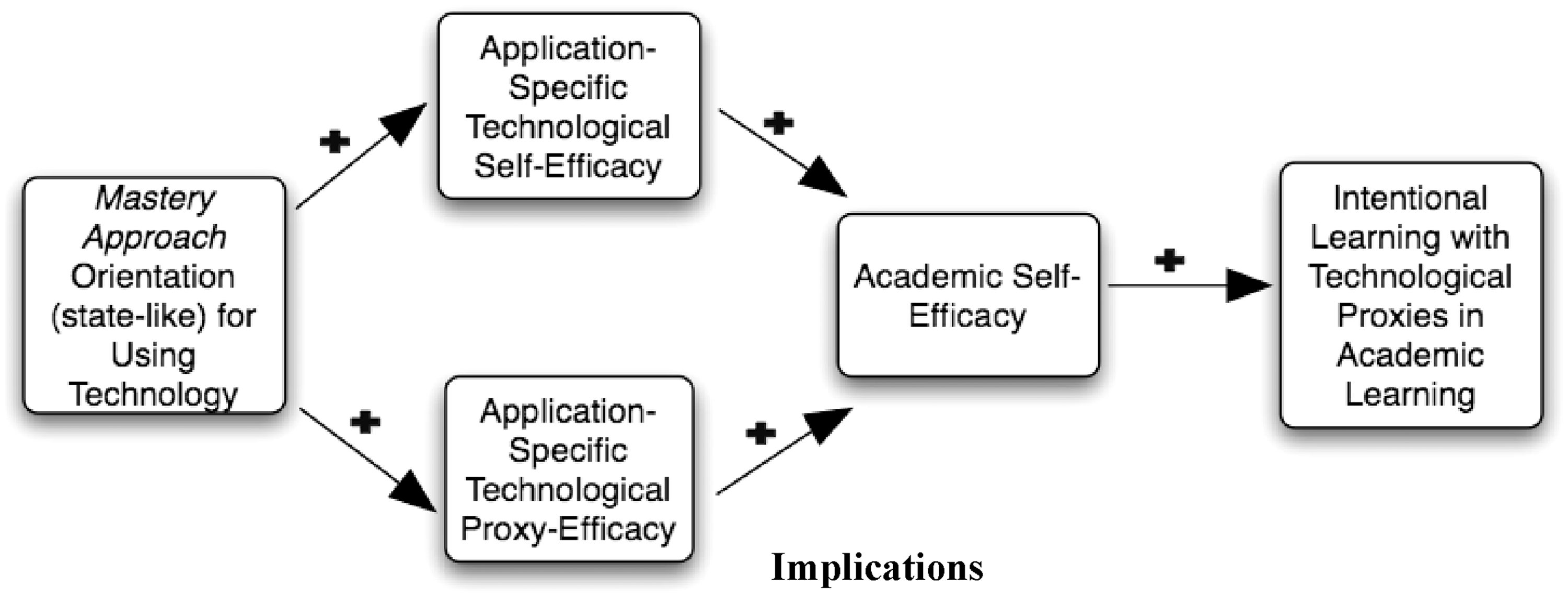
Moving from left to right, our model proposes that state-like mastery-approach goals will predict both AS-TSE and AS-TPE. The relationship between mastery goal and application-specific technological applications has been established in the literature (Yi & Hwang, 2003), and we expect that mastery-oriented students will also have strong proxy efficacy for technology that carries out tasks on their behalf. A key source of efficacy beliefs is mastery experiences. Since students with a state-like mastery approach to working with technology are likely to have had extensive mastery experiences with technologies that serve to advance their learning and understanding, we expect them to have strong proxy efficacy for the TPs that have successfully carried out tasks on their behalf.
Students who have had mastery experiences using technology to assist with academic writing tasks are likely to have both strong self- and proxy efficacy beliefs for using Turnitin. Importantly for university educators, we view both the framing of technology within (a) the students’ immediate classroom environment, including teacher influence and obvious teacher engagement with the TPs offered for use (Orlando, 2013b; Yen & Abdous, 2011), as well as framing and incorporation of technology use within (b) the broader tertiary environment as priming state-like manifestations of students’ achievement goals (Loraas & Diaz, 2009) when working with specific TPs. Continuing with our example, learners with state-like mastery-approach orientations for using technology to enable academic writing tasks are likely to have higher levels of AS-TSE and AS-TPE than students with avoidance goals (either mastery-avoidance or performance-avoidance). Students with high AS-TSE using Turnitin will express higher levels of confidence that they are able to effectively employ this TP to accomplish elements of the academic writing task on their behalf (sample measure: “I am able to use Turnitin to identify overused sources in my assignment”). Further, these students with high AS-TPE will express higher levels of confidence that the program itself has the functionality to be able to effectively accomplish associated tasks on their behalf (sample measure: “I am confident that Turnitin can provide me with feedback to improve my essay writing capabilities”).
The next variable in our model is academic self-efficacy, which refers to learners’ perceived competence when engaging with specific learning tasks in academic contexts at designated levels (Bong & Skaalvik, 2003). Technology, in general, is an integral aspect of modern tertiary learning, therefore it seems reasonable to expect that students’ self-efficacy beliefs for engaging in learning activities in tertiary settings will be impacted by their TSE and proxy-efficacy beliefs. For academic writing tasks that require students to submit an assignment to Turnitin, we anticipate that learners with both strong self-efficacy beliefs for using Turnitin and proxy-efficacy beliefs in Turnitin’s capability to accomplish a related academic writing task on their behalf, will also have strong academic self-efficacy for academic writing itself.
Intentional learning processes and related performance outcomes represent the final component in our model. Self-efficacy has been linked to a range of positive learning processes and outcomes including effort, persistence, choice of activities, and academic performance (Bandura, 1997; Elias & Loomis, 2002; Pajares, 1996; Schunk & Meece, 2006; Zimmerman & Kitsantas, 2005). As such we expect strong academic self-efficacy to be positively related to these learning processes and outcomes. We predict that intentional learning with TPs would manifest in observable ways, which could be assessed and evaluated by tertiary educators to maximise student learning outcomes. For example, students engaged with Turnitin as intentional learners are likely to submit their assessment multiple times, achieving their planned outcome of generating a smaller similarity index each occasion. These learners are likely to use the hyperlinks provided within their Turnitin feedback to investigate the online source content listed and subsequently cite these sources properly or edit their assignment by paraphrasing to increase original content and provide evidence of their own writer’s ‘voice.’ In contrast, students working with Turnitin in a non-intentional way may submit a final assignment draft through the software as requested without revisiting their feedback, editing their work or engaging further with the online site.
In terms of model outcomes, persistence and self-regulation are of key interest here given the nature of TP use, whereby the learner relinquishes an element of control to the application to accomplish a task on their behalf. It has been suggested that students with mastery goals are more adaptive when faced with task challenges or failure (Kozlowski et al., 2001; Linnenbrink & Pintrich, 2003); this has useful implications for application-specific technology use, where students may need to ‘troubleshoot’ or may encounter unexpected or unfamiliar outcomes. We expect intentional learners to retain a crucial element of autonomy and perceived control when working with TPs, which would enhance their persistence in the face of technological challenges.
The propositions discussed in the article are represented schematically in Figure 1.
Implications
Although previous literature has focused on the role of achievement goal orientation and self-efficacy beliefs in terms of how learners approach and use technology, it appears that scholars have yet to frame their studies in the context of intentional learning. The introduction of the construct AS-TPE gives researchers a broader scope by which to examine the role of learners’ efficacy beliefs in technology-assisted learning environments. While learners’ self-efficacy beliefs for using technology have been shown to affect how they engage with technology, further acknowledging the influence of TP efficacy is likely to lead a whole new set of research questions around efficacy beliefs. One interesting question concerns the differences between predictive capabilities of TP efficacy beliefs and the predictive capabilities of perceived usefulness of technology (Davis, 1989; Venkatesh, Morris, Davis, & Davis, 2003; Yeh & Teng, 2012). Researchers may include both variables in future studies to establish which variable is more strongly related to learner’s self-efficacy beliefs for using technology and/or various learning and performance outcomes with technology.
Another aspect of the model that is worth noting is the distinction between technology-related efficacy beliefs (self & proxy) and academic self-efficacy. One criticism of research on self-efficacy in technology settings is that researchers rarely distinguish technology-related self-efficacy beliefs from task-related self-efficacy beliefs (Ortiz de Guinea & Webster, 2011). Theorising about how technology-related self and proxy-efficacy beliefs may be related to students’ academic self-efficacy beliefs represents a relatively new direction in research on efficacy beliefs in tertiary learning contexts.
The implications for educators from the propositions put forward in this article will depend primarily on empirical data gathered in future studies that explicitly test these propositions. Nevertheless, it is worth noting that the constructs in the model are malleable. Thus, if future studies confirm that the constructs are important with regards to how students engage with technology, this will have direct significance for educators who are in a position to strategically manipulate these variables. With respect to learners’ goal-orientations, the state-like manifestations of these orientations can be induced (Loraas & Dias, 2009). Thus, students who are identified as performance-avoidant with technology may be able to be influenced to adopt a mastery-approach goal orientation with technology. In terms of learners’ technology self-efficacy and proxy-efficacy beliefs, educators may strategically target the different sources of these efficacy beliefs. For example, learners with relatively weak TSE for a specific software application may be asked by teachers to observe their peers using that particular application. Ideally, the peers in question would already be proficient at using the application and viewed as having similar ability to the observers. Teachers also may actively enhance learners’ proxy efficacy beliefs for specific technological application by persuading them that the application can carry out specific tasks on their behalf, which will allow them to achieve their goals. We are confident that our novel approach opens a portal to what potentially is fruitful and valuable research that will improve learning processes and outcomes in educational contexts.
Footnotes
Declaration of conflicting interests
None declared.
Funding
This research received no specific grant from any funding agency in the public, commercial, or not-for-profit sectors.