




Abstract
While the national testing of Australian school students is now well-entrenched, the educational outcomes of students with additional needs in this country are unknown. Students with a disability may be exempted from national testing and, in the absence of consistent standards for test accommodations and alternative tests, Australian educational authorities continue to be unaccountable for these students. Using secondary data from the Longitudinal Study of Australian Children, it is estimated that 12.3% of study children had additional educational needs (predominantly learning disabilities, emotional and behavioural disabilities and autism) that required specialist services. More than a third of students with additional needs did not participate in national testing. Those students with additional needs who did participate performed at a significantly lower level in comparison to students without additional needs. Further, students with additional needs in public schools were much more likely to have poorer academic outcomes than their counterparts in the Catholic and Independent education sectors.
Keywords
Introduction
Over the last decade in Australia, there has been a renewed focus within education on developing national policies, goals, and strategies to promote improvement in educational outcomes for all children. Australian policy, in the form of the Melbourne Declaration on Educational Goals for Young Australians, has been established (Ministerial Council for Education, Early Childhood Development and Youth Affairs [MCEECDYA], 2008). These goals include the rights of all students to access world-class curriculum and assessment. To achieve these goals, a number of initiatives have been put in place, and one of the most important of these involved the development of the National Assessment Program – Literacy and Numeracy (NAPLAN) and, more recently, a national curriculum (Australian Curriculum, Assessment and Reporting Authority, 2011a). While these goals for equity are laudable, there has been on-going concern that such initiatives have failed students with additional needs.
As early as 2002, Dempsey identified a “lack of consistent methods of data collection and reporting for students with disabilities at the state and national level” and the difficulty in obtaining “an accurate picture of type and level of disability, where students are placed, what curriculum they access, and the educational outcomes of these students” (p. 27).
Nearly a decade ago, Dempsey and Conway (2004) argued that educational reform relied on accurate reporting through “inclusive processes in the measurement of educational outcomes and accountability systems” (p. 12). They raised concerns that students with disabilities were most likely to be excluded from large-scale assessment and reporting – critical components of the Australian educational accountability system. Since this early work, a raft of Australian education policy and related initiatives has evolved. These recent goals and initiatives are described and discussed in relation to students with additional educational needs.
National Australian Educational Policy
Since 1999, national goals for schooling have driven broad directions for Australian schools and education authorities. The achievement of socially just and comparable educational outcomes for all students including students with additional needs (MCEECDYA, 2010) was embedded into a common and agreed commitment to developing curriculum and related systems of assessment, accreditation and credentialing. The MCEECDYA Four Year Plan 2009–2012 (2009a) outlines key strategies to support the achievement of educational goals for all Australians, and strategies in two specific areas are of relevance to this paper.
Key strategies for the promotion of world-class curriculum and assessment include a National Curriculum, and plans to improve the capacity of schools to assess student performance, to link assessment to the national curriculum, and to manage the National Assessment Program. Key strategies for the strengthening of educational accountability and transparency include providing students, teachers, and schools with good quality data on student performance to improve student outcomes, informing parents and families about the performance of their son or daughter at school, of the school their child attended, and of the larger education system. The National Assessment Program is central to these two key strategy areas and will be outlined in more detail following information about Australian legislation that protects students with a disability in line with National Educational policy.
The Disability Discrimination Act 1992 (DDA) aimed to address discrimination against people with a disability (Australasian Legal Information Institute, 2009).Under this act, it is unlawful for an educational authority to discriminate against a student on the grounds of disability by denying or limiting the student’s access to any services or curriculum provided by the authority that will either exclude the student from participation or subject the person to any other detriment. The DDA has been extended by the development of specific Education Standards.
Disability Standards for Education (Australian Government Attorney-General’s Department, 2005) addresses participation and curriculum, among other issues (Australian Attorney-General’s Department, 2012) in educational settings. The education standard for curriculum development, accreditation, and delivery directs the education provider to take reasonable steps to ensure that the student is able to participate in the learning experiences (including assessment) of the courses or programs provided by the educational institution on the same basis as a student without a disability. Assessment requirements of a course or program need to be appropriate to the needs of the student and accessible to him or her; the assessment procedures and methodologies for the course or program are to be adapted to enable the student to demonstrate the knowledge, skills, or competencies being assessed. The provider must also consult the student about whether a “reasonable” adjustment is necessary to ensure that the student is able to participate in the courses or programs provided by the educational institution on the same basis as a student without a disability (Australian Attorney-General’s Department, 2012).
In coming to terms with these education standards, schools are required to embrace the DDA definition of disability (this definition of disability is wider than the definition used by some education authorities in Australian states and territories), and are now legally obliged to provide a minimum level of educational support to students with a disability (Nelson, 2003), including access to assessment. Australian educational authorities involved in national achievement testing have yet to fully embrace inclusive assessment, despite the recognition that the public reporting of assessment results for students with disabilities, along with those who participate in different or modified assessments, is “key to ensuring fair and equitable comparisons among schools, districts, and states” (McDonnell, McLaughlin, & Morison, 1997, p. 7).
The National Assessment Program for Literacy and Numeracy
Commencing in 2008, all Australian students in Years 3, 5, 7, and 9 were assessed using common national tests in Reading, Writing, Language Conventions (Spelling, Grammar, and Punctuation), and Numeracy. Involvement in the program by the states and territories was essentially mandatory since Commonwealth legislation required testing of all students in identified grades in every Australian school each year, and federal school funding was contingent upon involvement in the program.
Comparative data are publicly available on the performance of students from each grade across each State and Territory with each State and Territory compared to national results for each learning domain (see MCEECDYA, 2008, 2009b). Schools receive information about how their year level compares against national minimum standards, and percentages of children reaching national minimum standards. These data are published on the My School website (ACARA, 2011b). Schools also receive statements of performance of individual students and year levels as a whole. Results for individual students can be compared against the national minimum standards and for many students achieving below the national minimum standard, anecdotal evidence suggests that educational intervention is likely (Elliott, Davies, & Kettler, 2012). Schools provide individual students (and their parents/carers) with statements of performance in relation to the national minimum standards. With students from 2008 (except for those in Year 9) having completed their second NAPLAN in 2010 (and 2009 students having completed their second NAPLAN in 2011), measures of growth in achievement over years can be determined.
Access to NAPLAN
While it is mandated that all students are assessed under the NAPLAN program, substantial numbers of students (including students with additional needs) do not participate in this assessment (ACARA, 2011c). This gap between legislation, policy goals, and educational practices related to students with a disability has only recently received attention in the literature (Cumming, 2012). Davies and Dempsey (2011) raised concerns about the gap and argued for a change in practice so that all students with additional needs or disability were included in either the standard national assessment and reporting regime or a viable alternative regime suited to students with substantial impairment. Additionally, Davies (2012) provided available data on exemptions and withdrawals and identified initiatives that would improve accessibility to NAPLAN for all students, based on lessons learnt from the United States. These initiatives involved ensuring that all students have the opportunity to learn assessed material; that they are afforded testing accommodations that do not place them at risk in any comparison with those without disability; and for NAPLAN to allow testing modifications so that alternative forms of assessments are available. Understanding the educational achievement of all students, including those with additional needs (including disabilities), is critical if educational goals in line with the espoused policy initiatives are to be met. McDonnell et al. (1997) considered the inclusion of students with disabilities in state-wide assessment systems to be essential, and declared that when achievement data on students with disabilities are missing, then “judgments about the effectiveness of policies and programs at local and state and national levels” (p. 6) are neither valid nor fair.
Access to NAPLAN for students with additional needs
NAPLAN provides reports on the achievement of some groups of Australian students, such as Aboriginal and Torres Strait Islanders and students who have English as a Second Language. However, no achievement data are collected or reported for students with a disability or additional needs. Crucial to reporting educational outcomes for students with a disability is the use of a common definition of disability across Australian education jurisdictions. Despite the longstanding need for a common definition (Dempsey & Conway, 2004), there has been no progress in this area. This need has more recently been highlighted by the Review of Funding for Schooling – Final Report (Department of Education, Employment and Workplace Relations, 2011), better known as the Gonski report, that endorsed fund loadings for students with a disability as an entitlement, but then recognised that “there are a number of significant data and definitional issues that hamper the development and rapid implementation of this funding stream for students with disability and which must be addressed urgently before new arrangements can be finalised” (p. 183). The report called for the Australian Government and state and territory governments to work towards collaborative action and the full implementation of the collection and reporting of nationally consistent data on students with disability from January 2013 on the basis of the recently developed and trialled model.
Data on the number of students with a disability in Australian schools and the nature of enrolment of those students are limited (Davies & Dempsey, 2011). Similarly, the profile on the types of disability is also limited (Dempsey, 2002). In 2004, the Australian Government Productivity Commission (2004) noted that over 3.5% of Australian school students have a disability. More recently, the Gonski report (Department of Education, Employment and Workplace Relations, 2011) indicated that “in 2010, there were around 172,300 students who met state and territory eligibility criteria for receiving disability funding, representing 4.9% of total student enrolments” (p. 119). Across each state and territory, there are differing percentages of funded students with disability (between 3% and 8%), largely due to differing definitions of disability (Steering Committee for the Review of Government Service Provision, 2011). The 2009 census data from the Australian Bureau of Statistics (ABS) showed that 8.8% of people in Australia aged 5 to 14 years had a disability. There has recently been an increase in the proportion of the total student population placed in segregated settings. More importantly, an increasing number of students with a disability are attending regular schools (Australian Government Productivity Commission, 2004; Dempsey, 2004, 2007). More recent data confirm that most funded students with disability attend mainstream schools. Of students with a disability and aged 5 to 14 years, around 9% attend special schools (Australian Institute of Health and Welfare, 2006), and nationally there are 416 special schools, 332 of which are Government schools (ABS, 2011).
Davies (2012) noted that while Australian legislation and policies (e.g., Education Standards) require equity of opportunity for students in all school activities, it is apparent that many students with a disability are not provided with the opportunity to properly access NAPLAN. Davies reported that many students are either exempted or withdrawn from national testing and the reasons for their non-involvement are not centrally documented or reported. This lack of accountability has consequences for students, parents, teachers, school profiles, and the resourcing and the efficacy of teaching programs. Indeed, the lack of NAPLAN data on the achievement of students with disabilities could easily give the impression that these students do not exist in the education system given that some countries do report these data (US Department of Education, 2008).
While national achievement testing such as NAPLAN provides one means for assessing student outcomes and measuring school improvement, potential negative consequences of such testing for stakeholders have been reported. In the United States, “the participation of students with disabilities in these assessments has been controversial” (Katsiyannis, Zhang, Ryan, & Jones, 2007, p. 160). In Australia, concerns have also been raised about testing, in that “despite good intentions, the movement for increased educational accountability has been accompanied by a number of unintended consequences” (Dempsey & Conway, 2005, p. 153). More recent reviews of testing and increased emphasis of accountability indicate many positive outcomes (Davies, 2012; Katsiyannis et al., 2007), especially with carefully designed alternate assessment systems that have the potential to provide meaningful information about the progress of all students, including those with significant cognitive disabilities, and to guide decision-making at the classroom and district level (Hager & Slocum, 2011). Using alternate assessments, Hager and Slocum reported an increase in the participation of US students with additional needs, and Katsiyannis et al. (2007) noted impressive gains in academic performance and other related outcomes by students with disabilities. In terms of educational practices, Thurlow, Lazarus, Thompson, and Morse (2005) indicated that inclusion was essential to improving educational opportunities for students with a disability and in gathering meaningful and valuable student performance information for schools and others.
National achievement testing in Australia has been operating since 2008 with minimal support for students with additional needs or disability in the form of special considerations. What support approaches are available will now be outlined.
NAPLAN special provisions and considerations
To comply with the legislative requirements of the Disability Standards for Education, in NAPLAN testing, special provisions are to be made available when deemed necessary for some students, so they can complete the tests. In general, special provisions utilise a range of support and differentiated resources for students with additional needs comparable to the type of support the student regularly accessed in the classroom. Consistent with the lack of reported information about students with disabilities, NAPLAN reports do not provide the number and percentage of students who are afforded special consideration, or the types of accommodations provided for them (Davies, 2012). Since some testing authorities have gathered data on students who were given special consideration, Davies (2012) concluded that while NAPLAN special provisions and accommodations are increasingly being provided, their use is still limited and variable such that the validity of these practices has been questioned (Cumming, 2009).
Students who are exempt or withdrawn from NAPLAN
Since NAPLAN began, there has been a consistent policy that students with a language background other than English, who arrived from overseas less than a year before the tests, and students with significant intellectual disabilities or co-existing conditions may be exempted from testing. Students can also be withdrawn from the testing program by their parents/carers, in consultation with the school. Students who are withdrawn are not counted as part of the school population for the NAPLAN test. This allows education authorities and schools to minimise the percentage of their students reported as failing to achieve national minimum standards by permitting parents to withdraw these students, rather than considering special provisions or the use of an alternative testing process better suited for students with cognitive delay. The characteristics of students who are exempt or withdrawn from NAPLAN are not reported, however between 2008 and 2010, 5% to 7% of Australian students were either exempt or absent/withdrawn from testing (Davies, 2012). The reasons for exemptions or absences and withdrawals are not centrally recorded at the National, State, or systemic level (Davies, 2012). The number of students exempted on the grounds of special educational needs, including identified disabilities, learning disabilities, or language difficulties, is therefore unknown. Similarly, the reasons for students being withdrawn, or absent or suspended, and the basis of parental philosophical objections for withdrawal are unknown. Finally, the number of students with learning or other disabilities who were absent or withdrawn is also unknown.
Given the lack of officially reported outcomes for students with additional needs in reports of Australian NAPLAN, the research reported in this paper had a number of aims:
to provide a profile of the range and prevalence of additional educational needs in young Australian children; to determine the participation rate of students with additional educational needs, including disabilities, in NAPLAN; to determine the results for those students with additional needs, including disabilities, who participated in NAPLAN; and to explore what variables may be associated with the educational performance of these students in national tests.
Methodology
Sample and participants
The participants in this study were sourced from the Longitudinal Study of Australian Children (LSAC) which seeks to examine the impact of a variety of social and environmental influences on childhood development (Australian Institute of Family Studies, 2011a). Information on study children’s (SC) physical and mental health, their education and social, cognitive, and emotional development is being collected from parents, carers, and teachers and from the children themselves. In these respects, the analyses reported in this paper are secondary data analyses. After obtaining rights to access de-identified data from the LSAC, the authors completed a range of analyses with the selected data.
Begun in 2002 and commissioned by the then Commonwealth Department of Community Services, LSAC recruited and surveyed in 2004 over 10,000 children and their families and teachers in a stratified random sample (based on postcodes) from the Medicare database. Information on overall response rates and response rates from subpopulations are available in several LSAC technical papers (Australian Institute of Family Studies, 2011b). LSAC has collected data from participants every two years up to and including 2010 and later data collection waves are planned. The first wave of data collection involved roughly equal numbers of children in two cohorts of 0–1 (birth cohort) and 4–5 years (kindergarten cohort).
The data reported in this paper relate to the Wave 4 data collection period in mid-2010. For the first time, this data set included 2008 and 2009 NAPLAN test results for the kindergarten cohort and these results are the focus of this study. Further, this paper reports selected results from the teacher and parent survey that relate to this cohort. In 2010, 4169 children remained in the kindergarten group.
Study instruments and variables
The primary parent or carer of the SC (typically the SC’s mother) completed a survey and an interview in Wave 4, which accessed a wide range of family and SC information. For the current study, the following parent survey data were used:
The gender of the SC. State or territory of residence. Whether the SC had a disability or on-going condition for at least six months.
A self-completion teacher survey was distributed to the teachers of the study children, where parents consented for this to occur (Australian Institute of Family Studies, 2011c). The questionnaire sought to establish the characteristics of the educational program that the child was attending as well as determining the characteristics of the teacher and the child. For the research reported here, the following survey items were included in analyses:
Whether the SC required specialised services or assistance with their school program because of a diagnosed disability or special need. The main reason the SC required specialised assistance. The school type (i.e. public, Catholic or Independent school).
Where permission was obtained from parents, the Wave 4 data set sourced SC’s NAPLAN test results from the relevant state and territory authorities. Because of the age range of the SC and because NAPLAN data were provided for 2008 and for 2009, 23% of the SC had completed Year 5 NAPLAN tests. This group was not included in further analysis because the relatively small number of children receiving specialised services who also completed Year 5 NAPLAN tests (N=72) did not permit a range of statistical analyses to be conducted. Consequently, the analyses reported in this paper relate to the SC with Year 3 NAPLAN results. Between 2493 and 2499, SC had Year 3 NAPLAN results, depending of the type of test (i.e., reading, writing, spelling, grammar and punctuation, or numeracy). Up to 258 (9.6%) of these children required specialised school services for a disability or special need.
NAPLAN results in each assessment area and at each grade are scaled to permit comparisons within and across years (ACARA, 2011c). In addition, the scales for each assessment are organised into 10 bands to cover the full range of student achievement across Years 3 to 9. The first six bands are used in Year 3. For the SC in 2008, Year 3 test scores ranged from 4.8 to 684.7.
Data analysis
A variety of non-parametric and parametric tests of significance were employed to examine differences across relevant groups. In addition, when statistically significant differences were found, effect sizes were reported to assist the reader to determine the practical importance of those differences (Hojat & Xu, 2004).
Results
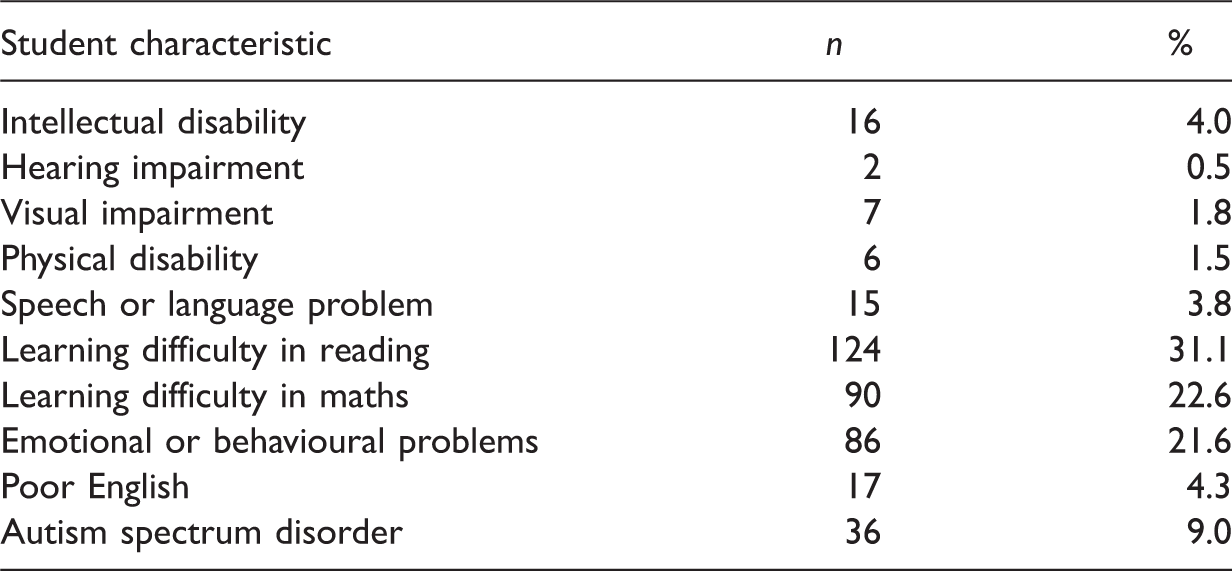
Characteristics of students receiving specialised school services from the kindergarten cohort of the Wave 4 LSAC database in 2010 (n = 399).
Year 3 NAPLAN 2008 and 2009 test means, standard deviations, and effect sizes for LSAC students receiving and not receiving specialised school services.
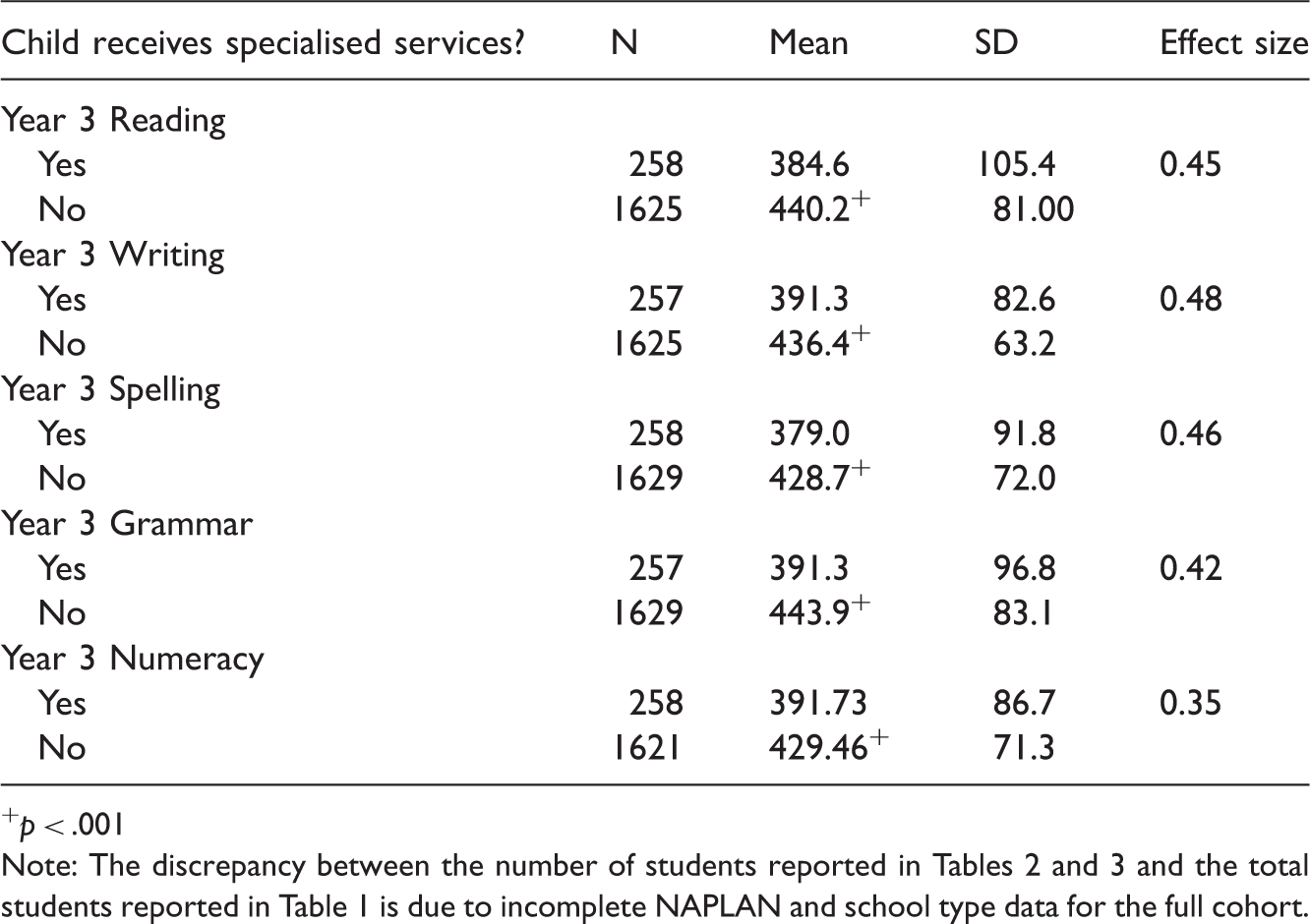
p < .001
Although included in the LSAC data as receiving specialised school services, gifted students are excluded in the analyses related to students with additional needs reported in this paper because such students are typically not regarded as having special education needs in this context. Gifted students are included in the “not receiving specialised services” group in Table 2.
For the students not receiving specialised services, the mean NAPLAN test scores of females were significantly higher than males in every test except numeracy, but the effect size of these differences ranged from d = 0.15 to d = 0.31 and were deemed to be of small practical importance. For students receiving specialised services, females (M = 411.16, SD = 66.32) had significantly higher writing test scores than males (M = 378.66, SD = 89.32); (t(255) = 3.13, p = .002). The effect size (d = 0.39) was moderate. There were no significant differences in the proportion of students receiving additional support by state or territory of residence.
Year 3 NAPLAN 2008 and 2009 test means, standard deviations and effect sizes for LSAC students receiving specialised school services by school type.
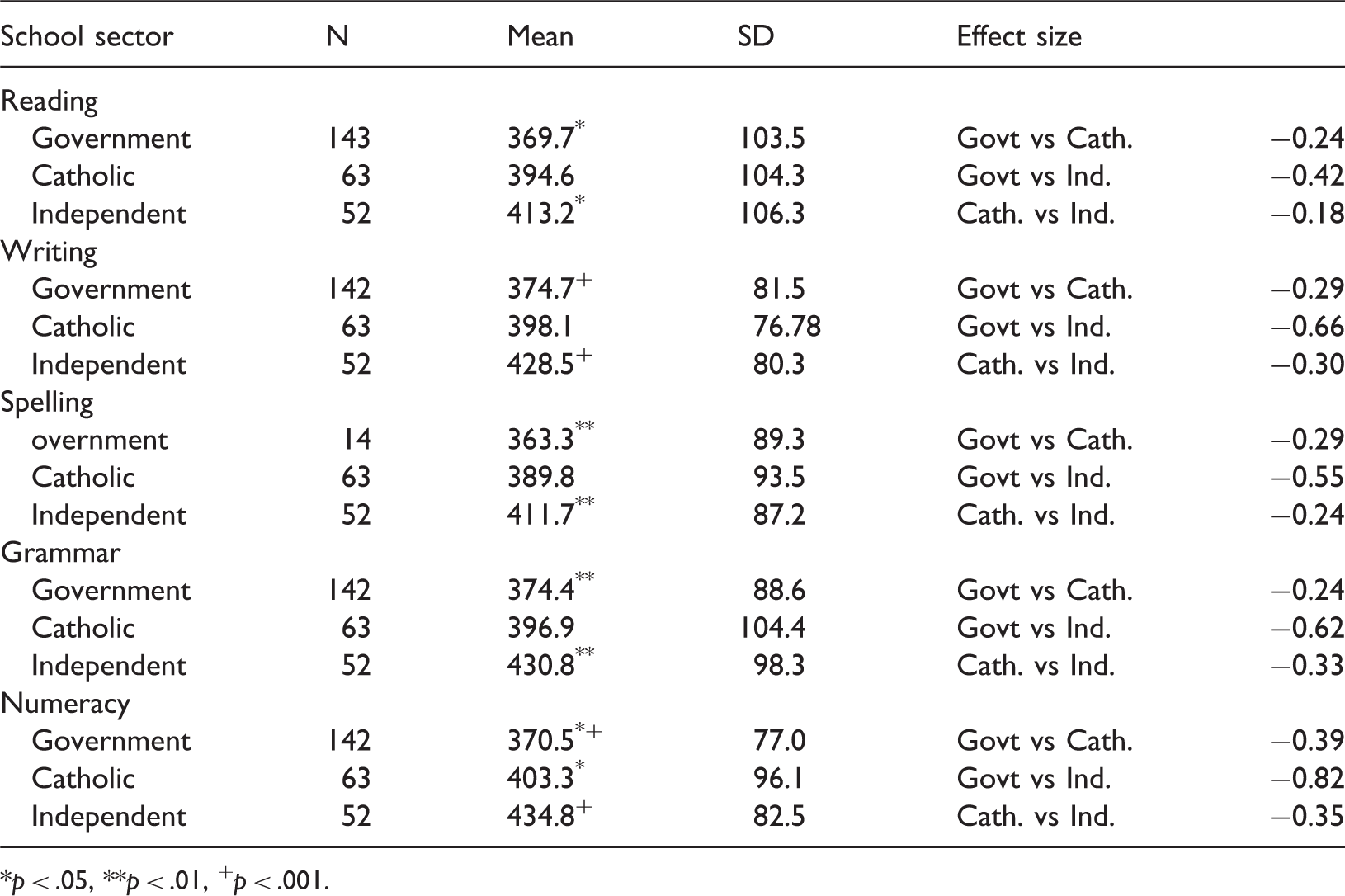
*p < .05, **p < .01, +p < .001.
Discussion
Analysis of the data provides a profile of the type of disabilities represented in those students who require specialised services. Over 12% of students required specialised services, which is above the level of 8.8% identified by the ABS (2011). Of the types of need represented in students requiring specialised services, not surprisingly the most prevalent were learning difficulties (53.7%), emotional or behavioural problems (21.6%), and autism spectrum disorder (9.0%).
For the first time, this report provides detail on the NAPLAN test performance of young students with special needs in Australian schools. Such information is important given that ACARA does not release this detail in national reports. In this regard, Australian educational reporting mechanisms for students with special needs are deficient (Davies, 2012; Davies & Dempsey, 2011; Elliott, Beddow, Kurz, & Kettler, 2011; Elliott et al., 2012).
One limitation of the research reported here is that although the LSAC database is a representative sample of the relevant population, some minority groups in this sample may not be accurately represented. Readers can be reasonably confident that LSAC students with learning difficulties and students with behavioural and emotional problems are representative due to the large proportion of these students in the sampled group with additional needs. However, the extent to which smaller additional needs groups in the sample are representative is uncertain.
While the available data at the time of writing were limited to a sample of Year 3 students, the sampling procedure used by LSAC is likely to mean that the data were representative of the national group of Year 3 students at the time. Over one-third of the sample of students with additional educational needs did not have a NAPLAN test result. The lack of clear guidance to educational authorities on the level of cognitive disability that may permit students to be exempted from sitting these tests may have contributed to this. It may be in the interests of a variety of stakeholders to exercise discretion over who should and who should not sit national tests based on their knowledge of the relevant student. However, it is undesirable that a substantial proportion of Australian students with special needs are denied access to a form of assessment that permits educational authorities to be accountable for their educational outcomes. While this issue of concern has repeatedly been raised (Davies, 2012; Davies & Dempsey, 2011; Dempsey, 2002; Elliott et al., 2012), no resolution is evident.
The other important finding from this study is a confirmation of anecdotal evidence and limited research evidence (Dempsey, 2011) that Government schools are supporting students with a higher level of needs. Across all five Year 3 NAPLAN tests, students with special needs in Government schools were performing at substantially lower levels than their counterparts in Catholic and Independent schools. This finding is likely to add weight to on-going criticism about the manner in which Australian governments apportion funds among the three education sectors (Bonnor & Caro, 2007).
In conclusion, many Australian students with special needs and their carers are being disadvantaged by the lack of scrutiny of their educational outcomes. There are urgent needs in the Australian setting for the inclusion of students with additional needs in the national education reporting process, for improved consistency in the employment and documentation of test accommodations and exemptions from national testing and for the development of an alternative assessment of education outcomes for students with substantial impairment.
Footnotes
Funding
This research received no specific grant from any funding agency in the public, commercial, or not-for-profit sectors.
Declaration of conflicting interests
None declared.