



Abstract

To the Editor
Early in the COVID-19 pandemic, the Australian media reported increased use of antidepressant medicines based on general practitioner surveys (Australian Broadcasting Corporation, 2020). We examined whether antidepressant use changed over the course of the COVID-19 pandemic in Australia using data on sales and dispensed prescriptions.
We acquired data of monthly sales to pharmacies of all antidepressants on the Pharmaceutical Benefits Schedule (PBS, ATC group N06A) at the Local Government Area (LGA) level for 2016–2020 from IQVIA; and monthly national dispensing supply to consumers for PBS items (Section 85 PBS) for the same period. We calculated use in defined daily doses (DDD) per day per 1000 population and evaluated the trend slopes for 2016–2019 versus 2020 using linear regression. We modelled a forecast for 2020–2021 based on an autoregressive integrated moving average (ARIMA) modelling procedure (Schaffer et al., 2021).
Antidepressant sales to pharmacies increased substantially in March 2020 when Australia entered its only national lockdown, then decreased sharply in April and May and resumed the previous trend. Antidepressant dispensing followed a similar trend, but the changes were minor compared to sales. Sales increased by 68% in March, whereas dispensing increased by 15%. Anticipation of supply shortages in the wake of a global pandemic may have triggered increased purchases by pharmacies, resulting in a pulse in sales. We propose dispensing is likely a better indicator of population medicine use than sales to pharmacies, as trends in sales can be substantially impacted by fluxes in market dynamics.
Melbourne experienced additional hard lockdowns in July and September 2020, following the national lockdown in March. The trend in Melbourne antidepressant sales was no different to the rest of Australia (Figure 1(a) and (b)). This suggests the additional lockdowns did not result in increased antidepressant use, despite the media reporting. The trend slope of dispensing without the COVID-19 pulse impacts (Figure 1(c) and (d)) suggests the slope of antidepressant sales and dispensing would have remained stable.
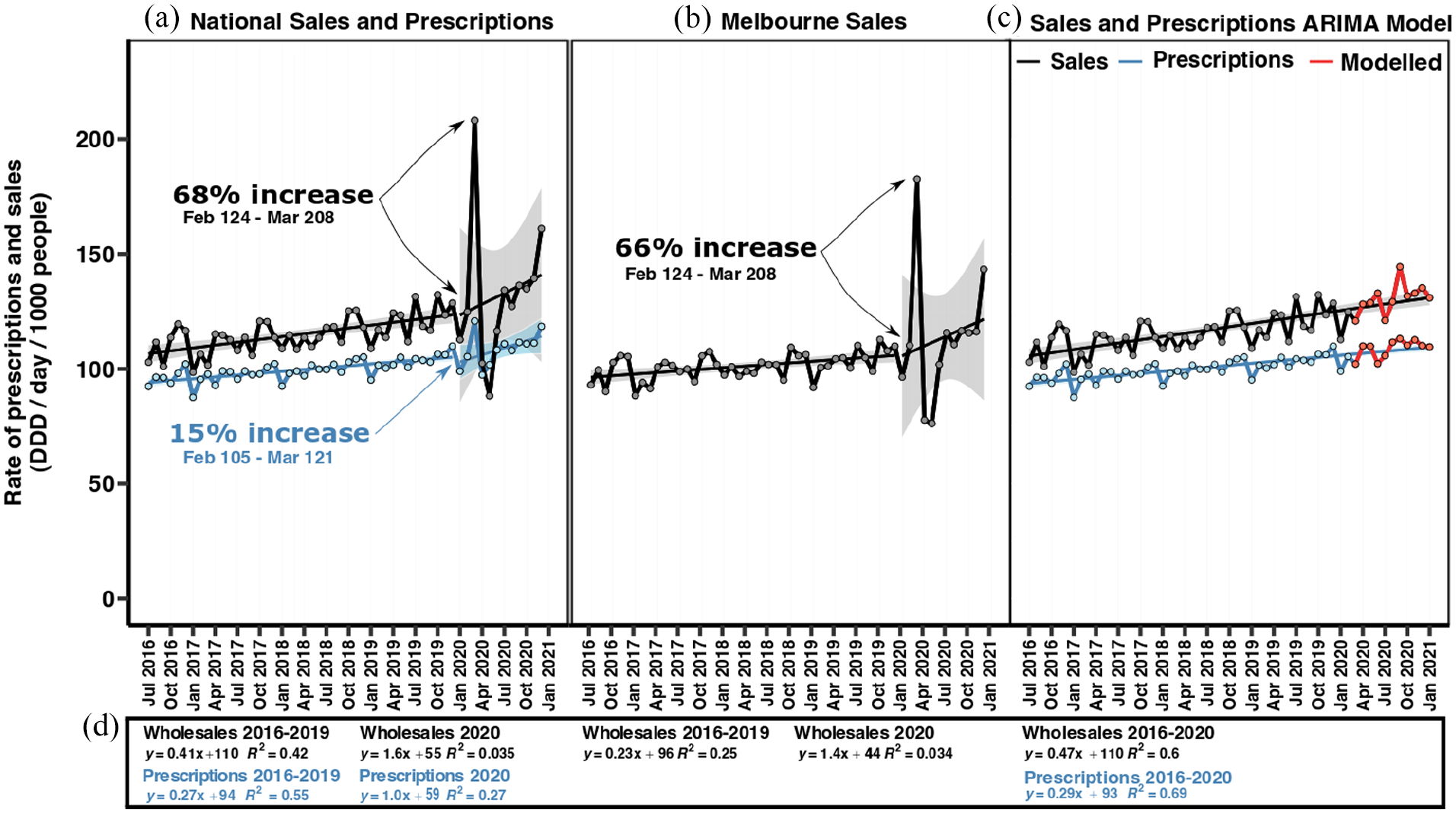
(a) Monthly wholesales to pharmacies and prescriptions nationally, (b) wholesales to pharmacies in Melbourne 2016–2020, (c) modelled wholesales and prescription data and (d) the linear equations of the linear regressions. Trends and 95% confidence intervals are also shown as lines and shaded regions, respectively.
Antidepressant use during year one of the pandemic increased at a greater rate than past decades; the compounding effect of a second year may show further increases. The trend of increasing antidepressant use is concerning as it is driven by long-term users, who continue treatment beyond the duration recommended in guidelines and are at risk of harm (Morley, 2017). Australia is among the top users of antidepressants worldwide so it is timely to review if better access to mental health services can provide patients with the appropriate long-term support.
Footnotes
Declaration of Conflicting Interests
The author(s) declared no potential conflicts of interest with respect to the research, authorship and/or publication of this article.
Funding
The author(s) disclosed receipt of the following financial support for the research, authorship and/or publication of this article: This work was supported by the University of Queensland, Faculty of Health and Behavioural Sciences Research Collaboration Seed Grant.
