




Abstract

The vulnerability paradox
Psychiatric epidemiology has, until quite recently, been limited to a small number of industrialised affluent countries. However, there is now increasing prevalence data on major mental disorders in so-called ‘low and middle income countries’ (LMICs). Much of these data are derived from the WHO World Mental Health (WMH) Survey Initiative (Kessler and Üstün, 2008). A recent summary of this cross-national lifetime prevalence data contained within the survey reported that in 17 of 18 mental disorders (Adult Separation Anxiety Disorder being the exception), the prevalence in LMICs was lower than that in high-income countries (Scott et al., 2018). As the authors note, this finding seems counter-intuitive given that the trend is in the opposite direction to what might be predicted based on individual-level inverse associations between socio-economic status and mental disorder prevalence within most countries. This has been described by some as the ‘vulnerability paradox’, with high vulnerability (such as low income) associated with increased mental disorder at an individual level, but showing the converse association at a country level (Dückers et al., 2019).
Unsurprisingly, these findings have sometimes been viewed with some scepticism. Challenges have included methodological limitations, stigmatising attitudes and cultural stoicism associated with low willingness to disclose psychiatric symptoms (which might be higher in LMIC), coupled with the fact that well-informed populations complain more about health problems. The finding of low prevalence of disorders in low-income countries has led to researchers putting forward cultural factors as potentially playing a substantial role. For example, there may be factors that promote mental health or buffer the effects of vulnerability in LMICs. These could include greater support from extended families, and more opportunities for community engagement. Less emphasis on individual achievement may be associated with less expectation and therefore less stigma or distress around a mismatch between expectations and achievements. There is also evidence that Eastern and Western cultures think differently about negative emotions. Eastern cultures’ holistic versus Western cultures’ analytic model suggest they approach negative emotion from a perspective of acceptance and curiosity rather than avoidance or fear. This may mean that negative emotions are less likely to develop into affective and anxiety disorders (De Vaus et al., 2018).
Subjective well-being
Subjective well-being (SWB) is not clearly defined, but usually includes a cognitive component evaluating satisfaction with life and an affective component involving positive affect. In studies which have looked at it, SWB is related to mental ill health. People who experience mental disorders score lower on measures of SWB. Depression and anxiety are correlated with negative affect. However, the large literature on SWB, pursued more within the disciplines of psychology, economics and political science, is not consistent with the psychiatric epidemiology findings. Notably, the SWB of nations increases with income per capita, the opposite of what has been reported in psychiatric epidemiology.
A review by Jorm and Ryan (2014) reports that increases in per capita income improve the SWB of a nation, although the returns appear to diminish at higher levels. These findings are consistent even when adjusting for a wide range of other predictors. When the association is plotted, there is a stronger association among poorer countries and a levelling off of gain at higher levels of national income (see Figure 1). The findings reported in psychiatric epidemiology seem the opposite of findings on SWB. Why might this occur, and what are the implications of a focus on economic growth for mental health? From the SWB literature, it appears that the findings underscore the importance of further economic development for poorer nations. But the psychiatric epidemiology literature does not provide us with sufficient confidence that economic development will result in a decrease in rates of mental disorders.
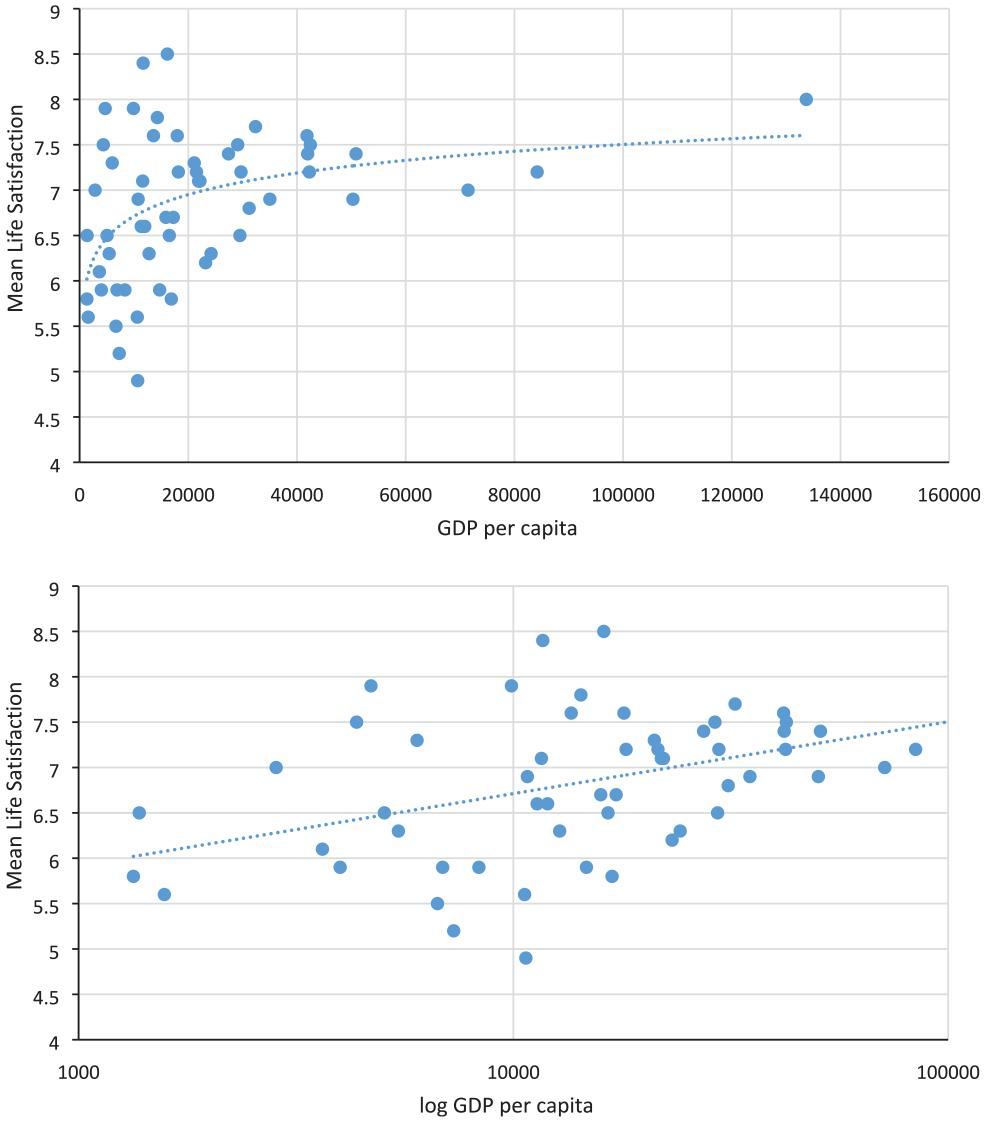
Scatterplot of mean life satisfaction rating against Gross Domestic Product (GDP) per capita. Top panel shows raw values and a logarithmic trend line. Bottom panel shows GPD per capita logarithmically transformed (base 10) and a linear trend line.
Despite the fact that the construct of SWB only partially overlaps with the construct of mental ill health, it seems hard to accept that LMICs could simultaneously have a much lower prevalence of mental disorders and lower measures of SWB. A good example that illustrates this is that of suicide rates. A recent study containing data from the WHO 2014 suicide report and country vulnerability data from the World Risk Report reported a negative association between country vulnerability and suicide prevalence in both men and women (Dückers et al., 2019). Yet suicide scores have consistently been reported to be lower in those who have high SWB scores (Jorm and Ryan, 2014). How can individuals in LMICs feel worse in terms of SWB yet have lower suicide rates?
These apparently contradictory findings even have implications on the type of values mental health professionals may advocate. The psychiatric epidemiology findings suggest that collectivistic societies (which most LMICs are) may be more able to buffer the consequences of becoming mentally ill or may even have fewer mental disorders. In contrast, national SWB is associated with a package not only involving higher income but also more individualism (Jorm and Ryan, 2014).
Future directions
Clearly, more research is needed to help determine what these apparently contradictory findings mean. The methodology used in each field of research is different. SWB measures are brief but they have been assessed in many countries alongside information on a wide range of national and cultural characteristics. This has enabled multi-level analyses to parse out which economic, social or cultural factors may be contributing to cross-national variation in SWB. Psychiatric epidemiology on the other hand uses a complex diagnostic interview that creates challenges for achieving cross-national equivalence. The symptoms also have to impair functioning to meet the criteria. If people ‘soldier on’ with symptoms, this may lead to paradoxical associations. The WMH surveys are also not optimised for the kind of country-level analysis undertaken in the SWB studies; it is possible that the positive association between prevalence and country-level income is due to country-level differences in other factors that correlate with economic development.
Resolving these apparently contradictory findings may require cross-national studies with rich country-level data that incorporate both SWB items and diagnostic assessment of at least one common mental disorder (e.g. depression). Researchers would need to look for differences in individual symptoms as well as algorithmically based diagnosis; include simple SWB measures as well as mental health ones; examine functioning separately and see whether it has differential associations with symptoms; investigate attitudes towards reporting symptoms; and include measures of hypothesised mediators such as stoicism, stigma, collectivism and tolerance of negative emotions.
Conclusion
The economic development of LMICs is generally seen as an important global goal, which is supported by the greater national SWB that it produces. However, the evidence from psychiatric epidemiology cautions that there might possibly be elements of the package of national attributes that accompany economic development which are detrimental for psychological distress and mental disorders. If we are to achieve a world with both greater SWB and a lower prevalence of mental disorders, we need to investigate the source of this paradox as a matter of priority.
Footnotes
Declaration of Conflicting Interests
The author(s) declared no potential conflicts of interest with respect to the research, authorship and/or publication of this article.
Funding
The author(s) received no financial support for the research, authorship and/or publication of this article.
