




Abstract
Background:
In December 2014, after a 16-hour siege of the Lindt café in Sydney, Iranian-born gunman Man Haron Monis shot dead a hostage precipitating the police action which broke the siege.
Objective:
This paper reviews the demographic and other factual details of Monis as documented by the NSW Coroner’s Inquest and critically analyses the published findings of the Coroner particularly in relation to the role of the psychiatrist who advised senior police and negotiators during the siege.
Results:
At the time of the siege, there was no formal protocol that delineated the role of a psychiatrist in hostage negotiations. Despite the psychiatrist’s credentials including his extensive experience with siege-hostage incidents and his counter-terrorist training, the Coroner was unfairly critical of the psychiatrist.
Conclusion:
The Coroner’s censure of the psychiatrist was clearly prejudiced by hindsight bias. During the siege, the psychiatrist properly considered and evaluated all the available intelligence and other information known about the gunman. As the psychiatrist advised, Monis was a narcissist and the siege was not an Islamic State-inspired terrorist attack. Given that he announced he was armed with a bomb, Monis represented a ‘credible threat’ to the hostages. The psychiatrist’s endorsement of the police strategy to ‘contain and negotiate’ was prudent in the circumstances. The Coroner’s disparagement of the senior psychiatrist may have the unintended consequence that psychiatrists may be reluctant to assist in hostage-sieges or other critical incidents.
On 15 December 2014, nearly 20 years after he arrived in Australia, Man Haron Monis took 10 customers and 8 staff hostage in the Lindt Café in Martin Place in the central business district of Sydney. After 16 hours, Monis shot dead one of the hostages and was killed during the subsequent armed intervention. Another hostage was fatally wounded after she was struck by fragments of bullets fired from the high-powered M4A1 carbines used by the Tactical Operations Unit of NSW Police.
On 27 May 2017, after 123 witnesses testified over 109 days, the findings of the Inquest were published. After emphasising that Monis did not have a mental illness, the Coroner concluded that by the time of the siege, Monis had become ‘radicalised’ and committed a ‘terrorist act’.
Islamist radicalisation and terrorism
Radicalisation is the process by which beliefs and motivations change to an extremist position in which an individual or group is willing to engage in violence in pursuit of their goals (McGilloway et al., 2015; Vergani et al., 2018). Post (2007) has proposed a succinct definition of terrorism:
Terrorism … is violence or the threat of violence against non-combatants or property in order to gain apolitical, ideological, or religious goal through fear and intimidation.
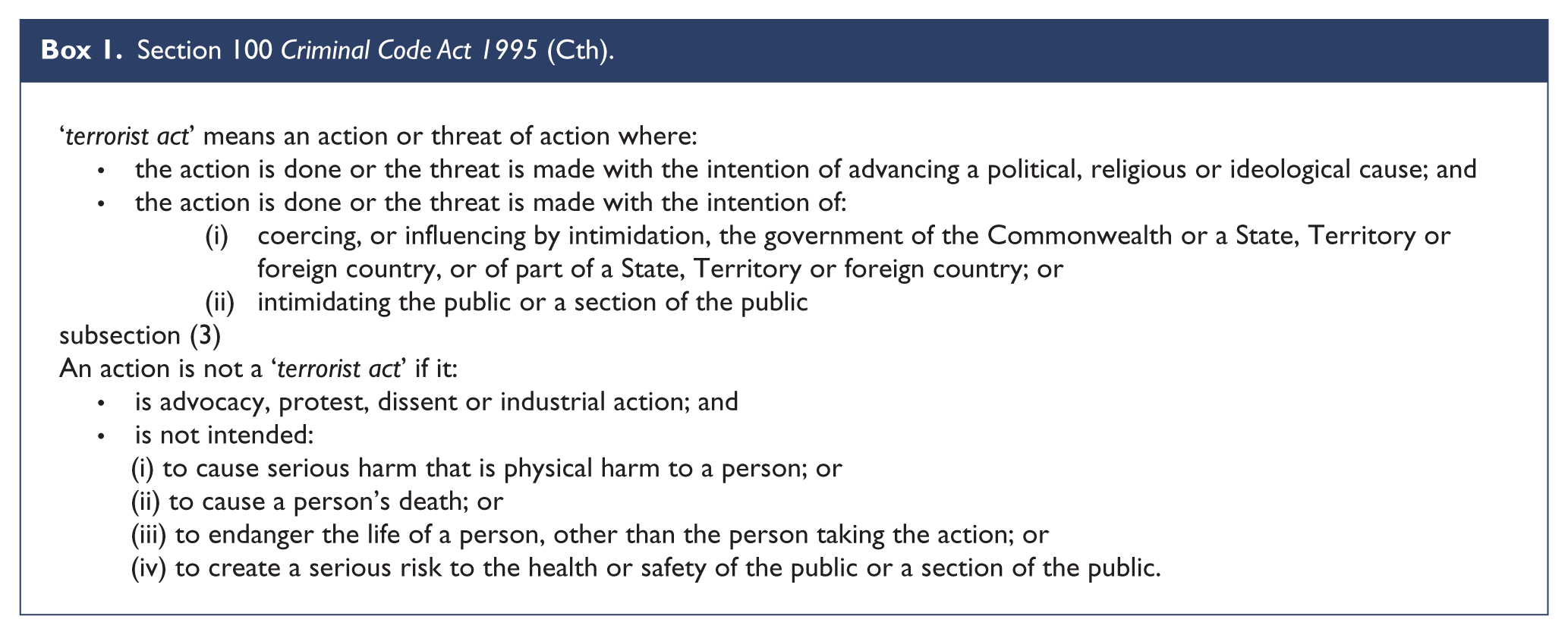
Terrorism can also be defined as violence which is political in its aims and motives and designed to have far-reaching psychological repercussions beyond the immediate targets or victims (Hoffman, 2017). In the Criminal Code (Cth), motive and intention are key elements of the statutory definition of a ‘terrorist act’ (Box 1). Deliberate violence against nondescript victims which has no political, ideological or religious motive is better described as grievance-fuelled violence.
Section 100 Criminal Code Act 1995 (Cth).
There is no accepted profile for the radicalised domestic Islamist terrorist (Lentini, 2008). A situational model has been proposed in which circumstances converge to create a ‘radicalisation window’ in which an individual may identify with the ummah (an imagined global Muslim community) in the context of a discourse of injustice against Muslims which is further fermented by extremist propaganda (Peddell et al., 2016; Zekulin, 2018). Further research has elaborated other factors (Desmarias et al., 2017) including ‘enabling environments’ (Mullins, 2011) and indoctrination in close peer groups (Harris-Hogan and Barrelle, 2018), over the Internet or via social media (Ammar and Xu, 2018).
A study of 12 Australian convicted terrorists identified features including attitudes that legitimised violence against westerners (Porter and Kebbell, 2011). An obligation to engage in jihad (holy war) to defend their faith ‘against infidels’ or ‘martyrdom’ – dying for jihad which brought great reward, including the forgiving of all sin and entry into paradise – was identified, as was the theme of ‘retaliation’ against the military policies of the West in Afghanistan and Iraq (Rahimullah et al., 2013). However, some individuals may simply be looking for acceptance or justification for their criminal lifestyle (Valasik and Phillips, 2017) including attitudes that support violence (Jensen et al., 2018; Schuurman and Taylor, 2018) or beliefs of superiority over kuffar (‘non-believers’) (Lakhani, 2018).
Political scientist Olivier Roy (2017) has asserted that there was little evidence to show a causal link between the radicalisation of Islam and terrorist violence. Roy has argued that Islamic radicalism is a movement of a ‘lost generation’ and that young unemployed and disenfranchised Muslims are attracted to Islamic State’s violence rather than any utopian caliphate.
The majority of convicted Australian jihadists have been aged between 18 and 35 at the time of their arrest (Harris-Hogan, 2017). Monis was aged 50 at the time of the Lindt café siege.
Man Haron Monis – not a liberal Shi’a cleric refugee
All demographic and factual details regarding Monis are obtained from the published findings of the Inquest (Coroner’s Court of New South Wales, 2017).
The Inquest heard evidence that Monis was born on 19 May 1964. In 1984, he married the daughter of the general secretary of Imam Sadegh University in Tehran. In April 1996, when he was aged 32, Monis became the manager of a travel company and was living an affluent lifestyle with his wife and two young children in a large apartment near Imam Sadegh University.
In July 1996, when Monis first applied for a business visa to come to Australia, he falsely described himself as a ‘legal consultant’ to an engineering company. In October 1996, without telling his wife or employer, Monis flew out of Tehran. The Inquest heard evidence that by the time he left Iran, Monis had defrauded clients of the travel company of a sum equivalent to AUD550,000. Soon after arriving in Australia, Monis applied for political asylum. Implausibly, he claimed that he was a victimised liberal Shi’a cleric and, because he had knowledge of state-sponsored terrorism, he would be summarily executed if he was extradited back to Iran. The refugee coordinator of Amnesty International Australia supported Monis’ application and in August 2000, he was granted a Protection Visa. The Coroner later found that few checks were made to confirm the legitimacy of Monis’ visa application.
In November 2000, despite saying originally that he feared being ‘assassinated’ if the government of Iran discovered he was in Australia, Monis chained himself to the outside of Parliament House in Perth and staged a hunger strike purporting to protest against the Iranian government not allowing him to see his children. In January 2001, Monis staged a similar protest outside the NSW Parliament House. In April 2001, INTERPOL Canberra alerted the Australian Immigration Department that Monis was wanted in Iran for ‘fraud-related’ offences. Since no extradition agreement existed between the two countries, it was not possible to arrest Monis with a view to extradition.
Man Haron Monis – multiple sex offences
In July 2001, Monis registered a business listed as ‘Spiritual Healing’ and claimed to be an expert in clairvoyance, astrology and ‘black magic’, activities which were irreconcilable with his self-professed Muslim faith. Monis’ early media releases were posted on his website to attract attention to his ‘Spiritual Healing’ business. It was alleged that between 2002 and 2010, Monis preyed on vulnerable women and took photos and videos of some of his ‘healing’ sessions which later enabled police to charge him with multiple counts of aggravated indecent and sexual assault.
The day after 11 September 2001, when airliners hijacked by operatives of the Sunni extremist organisation Al-Qaeda crashed into the World Trade Centre buildings in New York and the Pentagon in Virginia, Monis called the Australian Security and Intelligence Organisation (ASIO) and volunteered information that Iran, whose government is a Shi’a theocracy, funded the attacks on the United States. During one interview, Monis asked whether he might receive a reward for his assistance.
Man Haron Monis – Australian citizenship
In 2002, a 20-year-old woman who was an Australian citizen began a relationship with 39-year-old Monis. Even though he was still married to his wife in Iran, in August 2003, Monis married the young woman and moved in with her in her parents’ home in a Sydney suburb. The Inquest heard evidence that Monis lied about his age and told his new wife that his mother was Egyptian and his father was Greek and that he was a ‘non-practicing Muslim’. Monis never supported his Australian wife or their two sons and refused to have his name on their birth certificates. During a subsequent domestic violence hearing, Monis’ Australian wife described Monis’ controlling behaviour, his insistence that she not leave their flat and his secretiveness. In October 2004, Monis was granted Australian citizenship.
In July 2005, after Islamist extremists detonated bombs aboard underground trains and a bus in London, Monis called ASIO and the UK High Commission claiming to have intelligence information relating to the attacks. Later, in February 2007, Monis contacted ASIO and offered to become an intelligence source for Australian security agencies.
Man Haron Monis – personal grievances against Channel 7
In June 2007, a burning vehicle loaded with propane canisters was driven into the Glasgow Airport terminal (Crichton, 2014). The occupants of the vehicle were later identified as a British-born Muslim doctor of Iraqi descent and an Indian-born engineering student. On 4 July 2007, as he was preparing to leave Australia, Indian-born Muslim Dr Muhamed Haneef, who was a second cousin of two terror suspects, was arrested at Brisbane Airport, on suspicion of terror-related activities (Pickering and McCulloch, 2010). On 5 July 2007, Monis wrote his first letter of complaint about comments made by an academic on the Channel 7 Sunrise programme related to the arrest of Dr Haneef and seven ‘Muslim doctors’ implicated in bomb plots in the United Kingdom.
Monis’ confected indignation towards Channel 7 appeared on his website: Until 4th July 2007 I was in a deep sleep. Sunrise woke me up! God can awaken a person by many different means even by a terrorist broadcast from the program Sunrise on Channel Seven from the Australian TV! I thank God and I won’t give up until the Australian government condemns that broadcast which was instructing terrorism. (Coroner’s Court of New South Wales, 2017: 66, para 134)
Subsequently, Monis repeatedly referred to the Sunrise programme and regularly protested in Martin Place outside the studio of Channel 7.
In August 2007, Monis registered the name ‘ sheikh.haron.com ’ on the Internet and began posting inflammatory statements. Monis took out front page advertisements in the Australian Muslim newspaper Crescent Times, directing readers to his website. The Coroner noted that from late 2007, Monis began sending letters and media releases to the Prime Minister, the Federal Attorney General and the Australian Federal Police (AFP). In January and March 2008, Monis wrote letters to the Queen of England and the Pope.
Between November 2007 and May 2008, Monis sent letters to the families of Australian soldiers killed in action in Afghanistan. In June and July 2008, Monis held further protests outside the studio of Channel 7 in Martin Place. Channel 7 began a 6 month investigation which found that Monis had no association with any mosque or Islamic organisation and was held in contempt by the Muslim community. In August 2009, after an exposé was aired on the Channel 7 Today Tonight programme describing him as a ‘fake sheikh’, Monis again complained that Channel 7 had ‘insulted’ Muslims and endangered his life. In October 2009, Monis was charged with seven counts of Commonwealth offences related to the use of a postal service to menace, harass or cause offence.
Man Haron Monis – loses custody of his children, ex-wife murdered
In June 2011, Monis’ wife separated from him. Within a week of the separation, Monis reported that his eldest son had been indecently assaulted by his ex-wife’s father. The Inquest heard that police who investigated determined that Monis’ allegations were false and had been made by Monis to secure custody of his children. In July 2011, Monis’ ex-wife reported to police that in the context of disputes over access to his children, Monis had threatened her. Monis was subsequently charged with intimidation intending to cause fear and was made subject to a domestic violence order. In August 2012, Monis’ ex-wife was granted full custody of their children. In April 2013, when she arrived to collect her children after an access visit, Monis’ ex-wife was stabbed to death and set on fire outside Monis’ unit. At the same time that his wife was being murdered, Monis staged a minor motor vehicle accident near the Penrith police station and insisted that he be taken to hospital.
Man Haron Monis – challenges to debate the Australian Prime Minister
In September 2013, Monis challenged the Prime Minister to a live debate in which Monis said he would prove that ‘Australians will be attacked’ because of Australia’s involvement in the war in Afghanistan. However, much earlier, in October 2008, Australia had begun withdrawing its troops from Afghanistan and by August 2009, combat operations had ended. On 28 October 2013, Prime Minister Abbott announced the withdrawal of all Australian troops from Afghanistan (Brissenden, 2013). On 1 November 2013, a week after Mr Abbott’s announcement, Monis again challenged the Prime Minister to a debate.
Man Haron Monis – charged with murder-related offences
On 15 November 2013, two weeks after his second challenge to debate the Prime Minister, Monis and his partner Amirah Droudis were charged with offences related to the murder of his ex-wife. On 12 December 2013, when he appeared before a magistrate, Monis claimed that ASIO were trying to ‘frame’ him. After he was granted bail and released, Monis staged a protest outside the courthouse complaining that he had been ‘tortured’ in prison because of his letter-writing campaign.
Man Haron Monis – bailed on multiple historical sex offences
In April 2014, Monis was charged with three sex offences and granted bail. On 10 October 2014, Monis was charged with a further 37 sex offences in relation to six victims and his bail was continued.
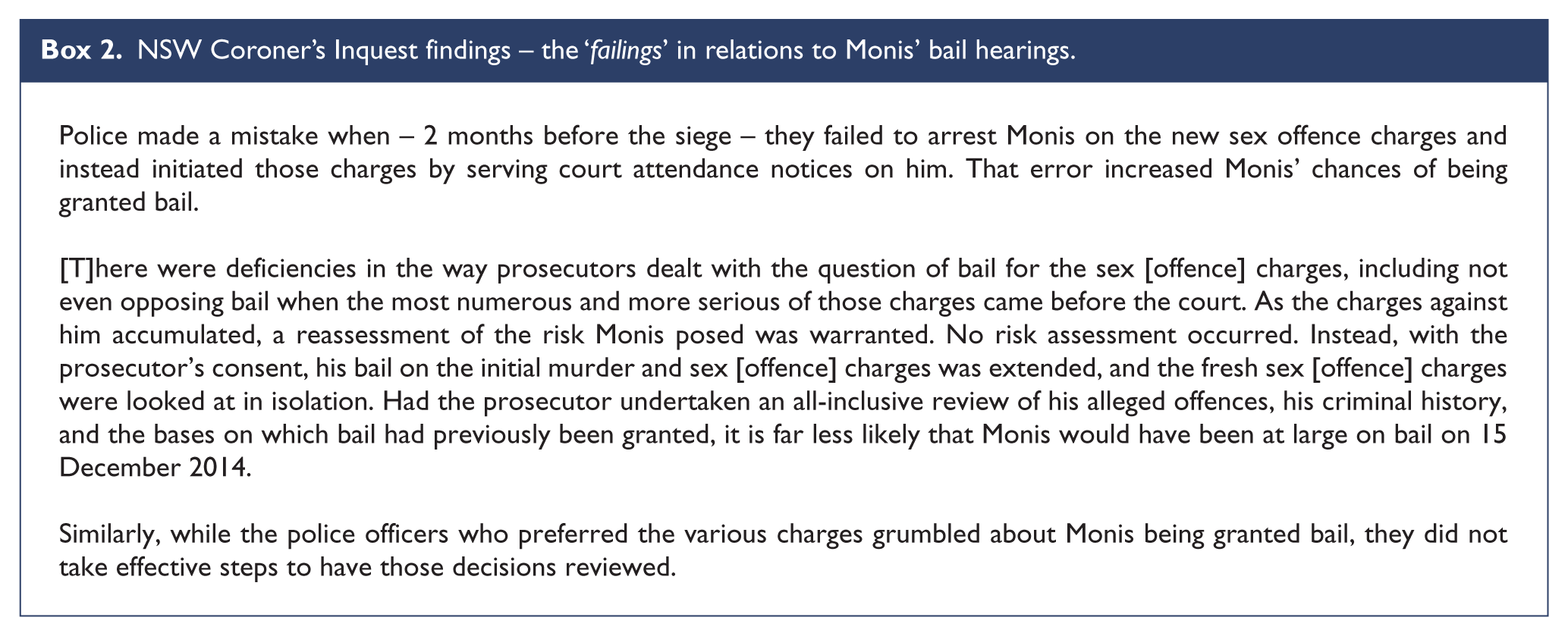
Although the NSW Director of Public Prosecutions was granted leave to appear before the Inquest and applied to prevent the Inquest examining Monis’ bail hearings, the Coroner held that the circumstances of Monis’ repeated grant of bail should be scrutinised by the Inquest. The Coroner was subsequently highly critical of the ‘mistakes and missed opportunities’ (Box 2).
NSW Coroner’s Inquest findings – the ‘failings’ in relations to Monis’ bail hearings.
Man Haron Monis – no terrorist intent
In late October 2014, the Family Court granted full custody of Monis’ two children to their maternal grandparents. In the first week of December 2014, Monis posted on his website a photograph of dead children captioned ‘… evidence for terrorism in America and its allies including Australia, the result of their airstrikes’. Monis also made an obscure post on his website: ‘I used to be a Rafidi, but not anymore’. The Coroner heard evidence that the Arabic word ‘Rafidi’ can be translated as ‘rejectionist’ or ‘heretic’ and is sometimes used by Sunnis as a derogatory term for Shi’a Muslims.
Between 9 and 12 December 2014, the National Security Hotline received a number of phone calls and emails raising concerns about Monis’ Facebook page. All of the notifications were referred to ASIO and the AFP. The Coroner found that while Monis’ Facebook page contained confronting and provocative content, they did not indicate an intent to undertake an act of ‘politically motivated violence’.
Right up to the time of the siege, Australian law enforcement and security agencies had no information to indicate Monis had formed the intent to commit a terrorist act. The Coroner concluded that between August 2008 and November 2014, threat assessments conducted by ASIO were ‘adequate and appropriate’.
Lone-actor terrorists
There is a burgeoning literature on lone-actor terrorists (McCauley and Moskalaenko, 2014). Compared to the traditional terrorist cell, the anomic lone actor negotiates a different radicalisation (Lindekilde et al., 2017) within their own attainable means, including violent online sermons (Aly, 2017) and an idiosyncratic reverence for some identified terrorist movement or leader (Alakoc, 2017).
Lone-actor terrorists may have a range of personal grievances (Meloy and Genzman, 2016) and may seek validation or legitimisation by identifying with a recognised terrorist organisation even though the individual may have no communication or any real affinity with the terrorist organisation (Van Zuijdewijn and Edwin, 2016). Theoretically, the lone-actor terrorist adopts methods without any direct outside command or direction (Schuurman, 2018). However, while they may appear to act alone, most so-called ‘lone actors’ demonstrate some degree of contact with operational extremists (Sageman, 2014). Lone actors may be troubled individuals who seek solace in extremist ideology (Bhui et al., 2016) – an ideology that for the most part remains self-taught but which is usually reinforced through online contact with extremists (Sardarnia and Safizadeh, 2017). Some experts have emphasised that attackers hastily labelled as ‘lone wolves’ often turn out to have interpersonal, political or operational ties to larger networks (Gill et al., 2018; Hofmann, 2018; Schuurman et al., 2018b).
The Internet has dramatically transformed the dynamic of Islamist terrorism (Gill et al., 2017). A study of 112 Islamic State-related terrorists found that more than 80% accessed Islamic State propaganda including speeches by terrorist leaders and execution videos (Cottee and Cunliffe, 2018). Extremist dogma and even technical information including online manuals for bomb-making are easily accessible on the Internet (Sageman, 2008).
The term ‘leakage’ refers to behaviours by which a ‘would-be’ lone actor intentionally or unintentionally divulges their motivation or resolve to commit a terrorist attack (Meloy and O’Toole, 2011). A study of 69 ‘post-9/11’ lone-actor terrorists found that in 70% of instances, the terrorist broadcast his intent before initiating the attack (Hamm and Spaaij, 2017). Other studies have found that terrorist incidents are frequently preceded by activities which come to the attention of authorities and that even skilled terrorists leave clues to their violent intent, either to deliberately attract notoriety (Hamm, 2007) or through poor ‘tradecraft’ (Kenney, 2010).
Operational security refers to the behaviours by which a lone-actor terrorist minimises the likelihood of detection while preparing an attack (Bennet, 2018). A recent study of the attack planning of 55 lone-actor terrorists found that lone actors often paid little attention to operational security (Schuurman et al., 2018a). The study found that more than 80% of lone actors communicated their radical or extremist convictions to others including strangers online and nearly half came in contact with the authorities during the planning and preparation phase.
Man Haron Monis – not a radicalised domestic terrorist
While noting that Monis’ radicalisation was ‘atypical’, in that radicalisation was most commonly a social process and that it was rare for a person to become radicalised alone, the Coroner was satisfied that by the time of the siege, Monis had become ‘radicalised’.
However, all of assumptions made by the Coroner that can be questioned (Scott and Shanahan, 2018). Monis was a prolific user of the Internet and social media and his many announcements linked to high-profile events were clearly calculated to attract attention. Having also staged sham protests, Monis could portray himself first as a ‘refugee liberal cleric’ and later an ‘anti-war protestor’ who was being harassed by the authorities. Monis’ posturing can be characterised as pretence, designed to attract attention which he could later manipulate in his favour.
Monis’ appearance in clerical garb at rallies and protests and his inane pronouncements could not mitigate the reality that he had no standing in the Muslim community. During the Inquest, no witness testified to having observed Monis in solemn prayer or attending any mosque. The Inquest heard expert opinion evidence on fundamentalist Muslim extremism and more particularly the most extreme form of radical Salafi Islam of Islamic State which is marked by its rectitude. Given his ostentation and history of predatory behaviour, it is difficult to accept as genuine Monis’ protestations about ‘oppression’ of Muslims. It is similarly difficult to reconcile Monis’ narcissistic traits with any sincere commitment to an Islamist ideology which required religious devotion and subordination to the caliph (leader of the Muslim community).
The Inquest heard that Monis’ website never demonstrated a sophisticated understanding of Islamic theology and often mixed up Shi’a, Sunni, Sufist and other Muslim terminology. At one stage, Monis’ website even featured an image of Al-Qaeda leader Osama bin Laden who was an adherent of Wahhabism, the strict doctrinaire form of Sunni Islam (Alvi, 2014). Bin Laden had proclaimed Shi’a Muslims (of which, at the time, Monis professed to be a cleric) as ‘heretics’ who, along with America and Israel, were the principle ‘enemies of Islam’ (McAuley, 2005).
Arguably, Monis’ greatest fears were that he would be extradited to Iran to stand trial for the fraud offences or that he would be charged with sex offences. Later, he would also have been pre-occupied with the prospect of having his bail revoked after he was charged with aiding and abetting the murder of his ex-wife. In this context, Monis’ attention-seeking can be seen as disingenuous attempts to create the persona of a victimised activist.
Man Haron Monis – no standing with Hizb ut-Tahrir
Hizb ut-Tahrir (Arabic for ‘Party of Liberation’) is an international, non-violent pan-Islamic political organisation founded by Sunni Muslim scholars in Palestine 1953 (Karagiannis and McCauley, 2006). In July 2011 and June 2014, Monis was photographed attending public meetings organised by Hizb ut-Tahrir. On neither occasion did Monis address the meeting. In September 2014, Monis was photographed apparently in conversation with a Hizb ut-Tahrir spokesperson during a protest outside the Egyptian consulate in Sydney. Although it is proscribed in many Arab countries, Hizb ut-Tahrir is permitted to operate in the United Arab Emirates, Lebanon and Yemen and also in many Western countries including the United States, United Kingdom and the Netherlands (Orofino, 2015).
As the Coroner noted, Hizb ut-Tahrir was not proscribed in Australia and actually denies the legitimacy of Islamic State. Hizb ut-Tahrir has never been shown to have radicalised anyone in Australia nor has it been implicated in any terrorist plot in Australia.
No account of the nature of any conversations Monis may have had with anybody associated with Hizb ut-Tahrir has ever been reported. Although Monis, a self-professed Shi’a cleric, attended meetings and demonstrations organised by Sunni Hizb ut-Tahrir, the Inquest heard no evidence that Monis had any standing with Hizb ut-Tahrir or indeed any Islamist organisation.
Man Haron Monis – no major mental illness
Given the many women, particularly Muslim women, he had victimised and the many others he had offended by his letter-writing and protests, Monis may have had reality-based concerns that he was intermittently under surveillance by different agencies. However, there is no evidence that Monis ever developed a major mental illness even when he experienced the stressors of being arrested, detained in watch houses and remanded to prison awaiting court hearings.
The Coroner noted that Monis attended a number of doctors, psychologists and psychiatrists, presented at public hospitals on two occasions, attended a community mental health service and was assessed in custody by Justice Health and Forensic Mental Health Services. The Coroner also noted that Monis consulted different health care providers without disclosing his history of earlier presentations and gave differing accounts of complaints and symptoms. The Inquest heard no evidence that any of the medications prescribed by various doctors were ever dispensed to Monis. After hearing the evidence of all the health providers who actually had contact with Monis, the Coroner observed that Monis may have been ‘doctor shopping’ to substantiate his claim that he had suffered harm from being victimised by government agencies.
Man Haron Monis – a malignant narcissist
In August 2013, a clinical psychologist with the NSW Police Forensic Services Group Behavioural Science Team accessed police records and Monis’ affidavits and correspondence to complete a psychological assessment. Although she qualified her opinion by emphasising that she had not actually interviewed Monis, the psychologist opined that Monis was grandiose and lacked empathy and was preoccupied with his own self-importance, features consistent with narcissistic personality disorder.
In his evidence to the Inquest, NSW Chief Psychiatrist Dr Murray Wright testified that he reviewed the Justice Health and NSW Health records and formed the impression that Monis was a ‘manipulative, narcissistic criminal’. During the Inquest, senior psychiatrist Dr Jonathan Phillips also gave expert evidence that Monis demonstrated anti-social, narcissistic and paranoid personality traits.
During her murder trial in 2016, Monis’ partner’s defence counsel did not contest the prosecution case that Monis organised the murder of his ex-wife (R v Droudis [2016] NSWSC 1550). By the time of the siege, Monis was also charged with multiple sexual offences against six victims. The Coroner noted that since a number of women, who did not know one another and were from different ethnic backgrounds, all described assaults which were remarkably similar, it was probable that Monis would have been convicted of multiple offences had he stood trial.
On 12 December 2014, 3 days before the Lindt café siege, the High Court dismissed Monis’ appeal from his conviction for the postal offences (Monis v The Queen [2014] HCA Transcript 280). Having exhausted his appeal options, Monis was likely to have feared that his bail may be revoked at any time and that he would be remanded into custody.
Man Haron Monis – conversion to Sunni Muslim?
Less than 2 weeks before the Sydney siege, Monis self-identified as a Shi’a Muslim, the arch enemy of Sunni Islamic State. The obscure reference Monis made in December 2014 to not being ‘Rafidi anymore’ can be characterised as the self-serving ploy of a fantasist who parlayed the jargon of extremist rhetoric into his disparate denouement. Pointedly, the Coroner did not conclude that Monis had actually converted. The Coroner referred to the expert evidence of an academic in Islamic studies who was dubious about Monis’ purported conversion particularly given that Sunni Islamic State was well documented as pursuing sectarian slaughter of Shi’a Muslims in Syria and northern Iraq.
The importance of sectarianism in the strategic doctrine of Islamic State cannot be overstated. Describing Shi’a Islam as ‘a sect of treachery and betrayal’ (Warrick, 2015), Jordanian jihadist Abu Musab al-Zarqawi believed that Islamic State attacks on the Shi’a populations in Iraq would not only undermine the new Iraqi government and local support for the coalition forces but the indiscriminate killings would precipitate a Shi’a–Sunni civil war. Even after al-Zarqawi’s death in June 2006, Islamic State’s sectarian violence continued unabated, targeting both Shi’a religious and political leaders as well as Shi’a civilian populations with pitiless bombings, shootings and beheadings (McCants, 2016). In May 2012, Islamic State spokesperson Abu Muhammad al-Adnani proclaimed: ‘(Y)our first enemy are the [Shi’ites], and after them the Jews and the Crusaders’. A year later, in 2013, Abu Bakr al-Baghdadi, cited in Hamming (2017), the self-proclaimed caliph, announced: So rise, O lions of the Islamic State in Iraq and the Levant, and cure the frustration of the believers and attack the hateful Rafidah [Shi’ites], the criminal Nusayris [the Alawi sect of Shi’a Muslims in Syria], the Party of Satan [Shi’a Hezbollah] and those who come from Qum, Najaf and Tehran [in Shi’a Iran].
Man Haron Monis – no leakage, no terrorist message
Nothing has ever been shown to substantiate that Monis was even inspired by Islamic State. Contemporary Islamic State-inspired terrorists in Australia demonstrate a number of salient features (Box 3). However, the Inquest heard that no record could be found of Monis ever having downloaded any videos or speeches from radical Salafist clerics or any of the vast material produced by Islamic State or other extremists organisations.
Features of Islamic State-inspired lone-actor terrorists.
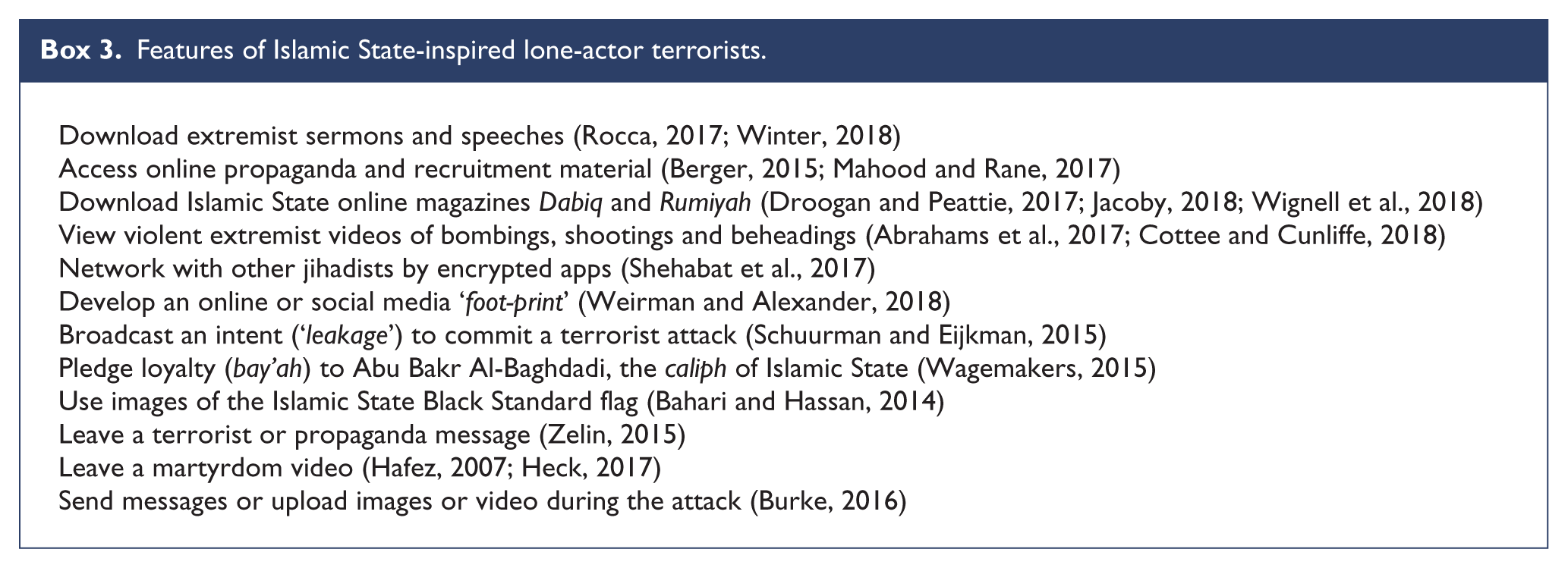
While jihadists commonly use encrypted apps such as Telegram, WhatsApp or Zellow for their clandestine communications, Monis posted all his messages on his publicly accessible website presumably to attract the widest audience.
A regular feature of Islamic State attacks is a pledge or oath of bay’ah (loyalty) to the caliph. The pledge is made to the ‘leader’, not to any organisation. On 17 November 2014, Monis posted a brief statement in Arabic on his website: I pledge my allegiance to God, his Messenger, and the Caliphate of the Muslims. Peace be upon the Commander of the faithful and the Caliph of the Muslims, the Iman/preacher of our time. (Coroner’s Court of New South Wales, 2017: 69, para 154)
The wording of the statement reveals more about Monis’ narcissism than any professed loyalty to the caliph. Monis pledged allegiance only to ‘God’, ‘his messenger’ (the Prophet Muhammad) and ‘the Caliphate of the Muslims’. Monis did not even refer to al-Baghdadi by name when he offered the generic salutation: ‘Peace be upon the Commander of the faithful and the Caliph of the Muslims …’.
The Inquest heard expert evidence that an examination of Monis’ YouTube accounts, the websites he visited and his use of social media found no extremist online or social media ‘foot-print’ or that Monis ever had any contact with any extremist or terrorist organisation.
Although Monis had become adept at creating videos to upload onto YouTube or his website, he created no martyrdom message or video. Even during the siege, Monis did not deliver any religious or ideological message which could have been used as propaganda by Islamic State and over the 16-hour siege he never pressed any terrorist demands.
Why did Monis choose the Lindt café?
Monis’ preparation for the siege was rudimentary. In the backpack he purchased the previous day, he carried a speaker box with protruding wires. As Monis envisaged, the media highlighted hostages holding up a black flag with Arabic writing. But the generic shahada (‘There is no God but God. Muhammad is the messenger of God’) is a central tenet of Islam and is not synonymous with extremists or jihadists.
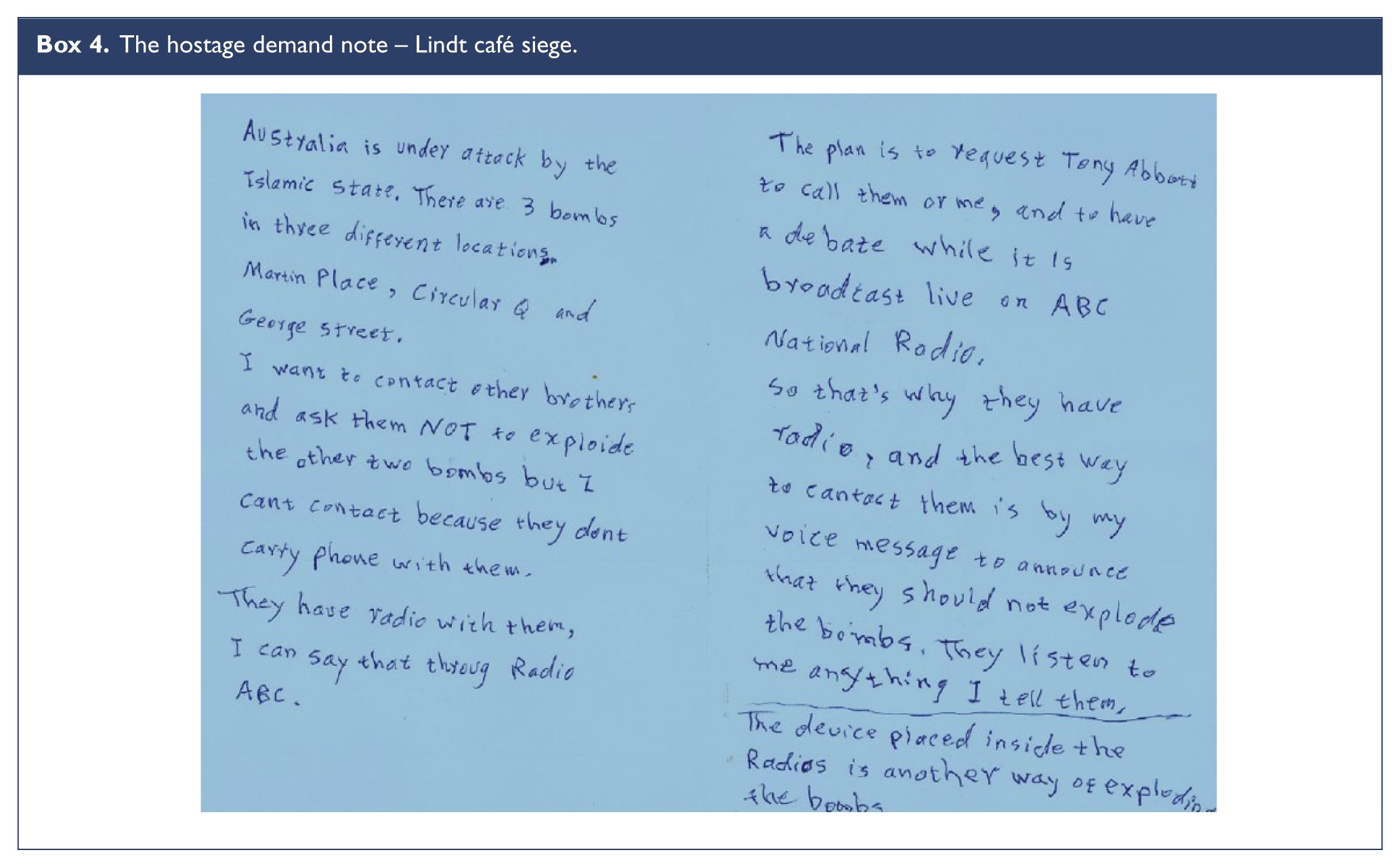
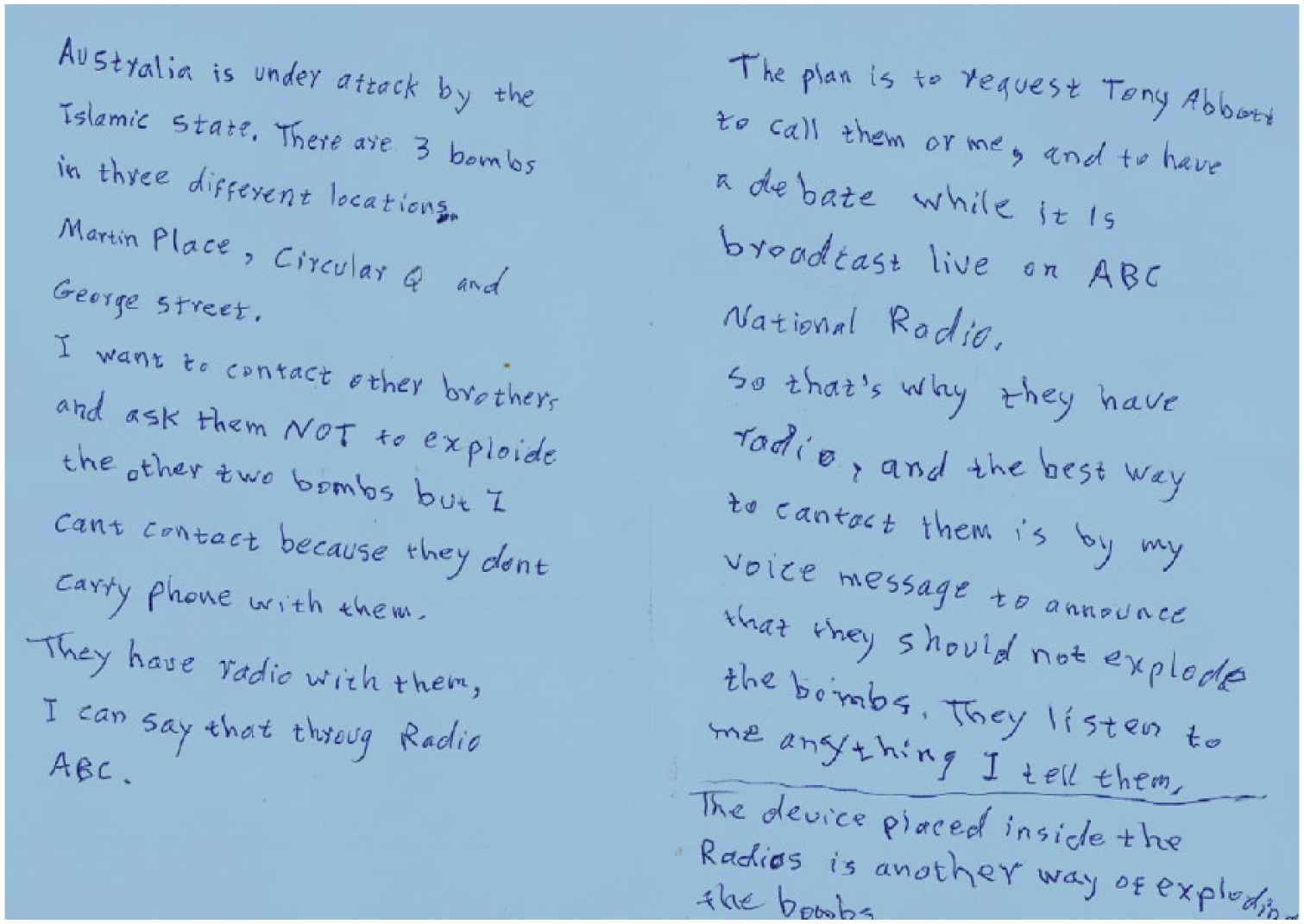
From the outset of the siege, Monis’ aim was clearly to draw attention to himself rather than any cause. Only in the first sentence of the scribbled note he ordered café manager Tori Johnson to read did Monis announce that Australia was ‘under attack by Islamic State attack’ (Box 4). Monis made no reference to any terrorist objective. During the siege, Monis never used any of the vernacular characteristic of Islamist jihadists (kuffār – infidels, murtāddin – apostates, tawāghīt or ‘crusaders’ – the West or Christians) and neither did he cite any verses from the Qur’an or Hadith to justify mujahideen (jihad ‘struggle’).
The hostage demand note – Lindt café siege.
Unlike the offices of the French satirical newspaper Charlie Hebdo, a kosher supermarket in Paris or the Canadian Houses of Parliament, the Lindt café had no social, political or religious significance. It was significant because it was located directly opposite the studio of Channel 7, an organisation that Monis believed had disrespected him. Monis’ choice of target came from a deep personal grievance, rather than an intent to advance any terrorist agenda.
The Lindt café siege – not characteristic of an Islamic State attack
During the siege, Monis positioned hostages in front of windows around the café with their hands against the glass and their eyes closed. Although he spoke sharply and intermittently threatened them, Monis did not tie up or otherwise brutalise his hostages. From 11.15 a.m., hostages relayed Monis’ second demand that the Islamic State flag be delivered to the café. From mid-afternoon, hostages began to escape. While he was armed with over 20 shotgun cartridges, before police stormed the café, Monis fired his shotgun only three times. By 4.58 p.m., even after five hostages had escaped, Monis did nothing and made no further demands.
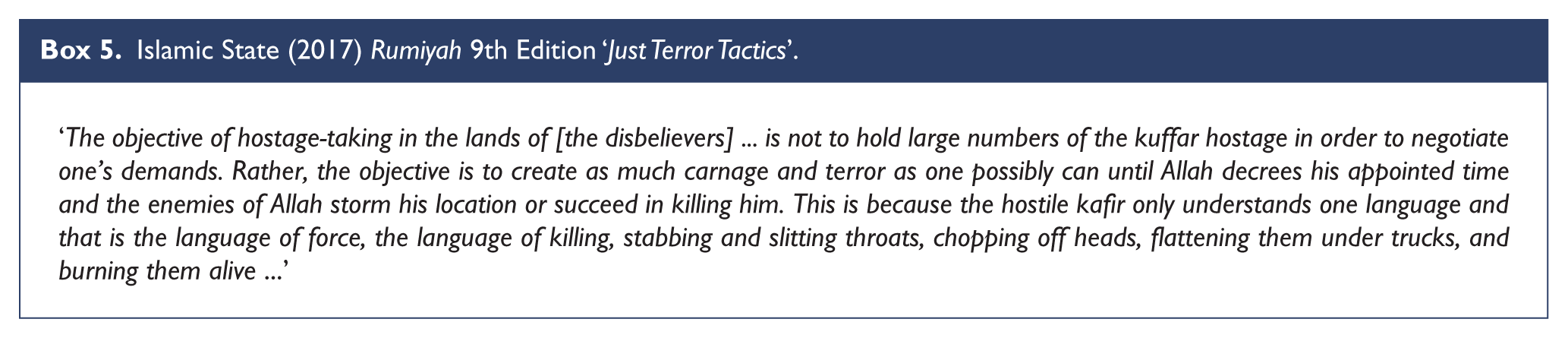
Adhering to what has been termed ‘radical apocalypticism’ (Flannery, 2015), Islamic State-inspired terrorists follow a very basic model: ‘kill, proclaim and fight out’ by which they kill indiscriminately and die in the process thereby being martyred (Westphal, 2018). The quite explicit aim of any Islamic State terrorist act is to cause fear and terror by killing as many ‘unbelievers’ as possible before being killed or dying by suicide. At one stage, the Islamic State online magazine Rumiyah provided a justification for the bombing of two churches which killed 45 Christian worshippers in Egypt and also featured an article titled ‘Just Terror Tactics’ which highlighted the aims of an Islamic State-inspired terrorist attack (Box 5). Since the Lindt café siege was drawn out over more than 16 hours, Monis’ original aim was clearly not to terrorise the community by killing hostages.
Islamic State (2017) Rumiyah 9th Edition ‘Just Terror Tactics’.
The consultant psychiatrist
At 1.15 p.m. on the first day of the siege, the psychiatrist arrived at the Police Forward Command Post which had been established in a cramped second floor office in the nearby NSW Leagues Club. The psychiatrist remained in the Police Forward Command Post with the negotiation team until well after the siege ended the following day.
The psychiatrist had a long association with both the NSW Police Force and the AFP – NSW Police Force joint counter-terrorist unit in both threat assessments and developing counter-terrorist procedures. Since 1991, when the NSW State Protection Group and the specialist Negotiation Unit were established, the psychiatrist had been involved in many police negotiations. Since 1991, the psychiatrist had also attended bi-annual National Training of Police Negotiators courses in counter-terrorist negotiations and was involved in developing police policies and procedures for the management of critical incidents. In terms of experience and expertise in advising police during hostage-sieges, the psychiatrist was arguably the most qualified expert forensic mental health clinician in Australia.
Man Haron Monis – identified as the Lindt café siege gunman
By mid-afternoon of the first day of the siege, Monis’ identity had been confirmed and the negotiators and the psychiatrist had details of Monis’ criminal history and outstanding charges and had accessed Monis’ website and Facebook. The negotiators and the psychiatrist also had the 2013 report of the NSW Police clinical psychologist. The psychiatrist was briefed by the NSW Chief Psychiatrist Dr Wright who was also experienced in advising NSW Police negotiators during domestic hostage-sieges. Dr Wright had reviewed the Justice Health and NSW Health records and made his own assessment and concluded that Monis was a ‘narcissistic criminal’. During the Inquest, Dr Wright testified that when he briefed the psychiatrist who was assisting the negotiators, Dr Wright found that the psychiatrist’s assessment of Monis was the same.
The negotiators and the psychiatrist also obtained intelligence about Monis from debriefing those hostages who had escaped and from the conversations inside the café captured by a covert surveillance device.
From 11.30 p.m., after detaining Monis’ partner Amirah Droudis, NSW Police began searching their flat in the Sydney suburb of Wiley Park. The police search of the flat found no bomb-making materials or extremist literature or any manifesto or suicide note. Unfortunately, this advice was not communicated to the negotiators until after the siege had been broken. The Coroner was critical of both the delay in conducting the search of Monis’ flat and the failure of the report of the preliminary findings from the search to be passed from the Police Operations Centre to the Police Forward Command Post.
The Lindt café siege – hostage demands not consistent with Islamic State-inspired terror attacks
Just as the psychiatrist advised the police negotiators, Monis did not act like an Islamist extremist and his methodology was not consistent with any previous Islamic State-inspired terror attack. In his evidence to the Inquest, the psychiatrist emphasised how fatuous Monis’ original demands were. Monis purported to be the leader of an Islamic State cell with other terrorists ‘brothers … who don’t carry phone (sic)’ listening to ABC radio, poised ready to detonate bombs around Sydney but who would desist once the Prime Minister called ‘them or me … to have a debate … broadcast live on ABC national radio’. In the hostage note, as an apparent afterthought, Monis added ‘The device placed inside the radios (sic) is another way of exploding the bombs’.
The Lindt café siege – why did Monis take a list of Muslim prisoners?
After the siege, a note was found in Monis’ pocket which listed the contact details of his lawyers as well as the in-mate numbers of Muslim prisoners in Long Bay Correctional Centre whom Monis met while he was held on remand in 2014. As the Coroner noted, the finding of the list clearly indicated that Monis anticipated surviving the siege and becoming a notorious prisoner. The discovery of the list of prisoners’ names further supports the psychiatrist’s advice to negotiators that Monis’ objective was to conduct a dramatic siege which would enhance his standing after he was imprisoned. Rather than being disparaged as a prolific sex offender against Muslim women, the siege would enable Monis to cast himself as a ‘lone wolf’ jihadist who would be admired and respected, at least by some of his fellow Muslim inmates.
The police strategy – contain and negotiate
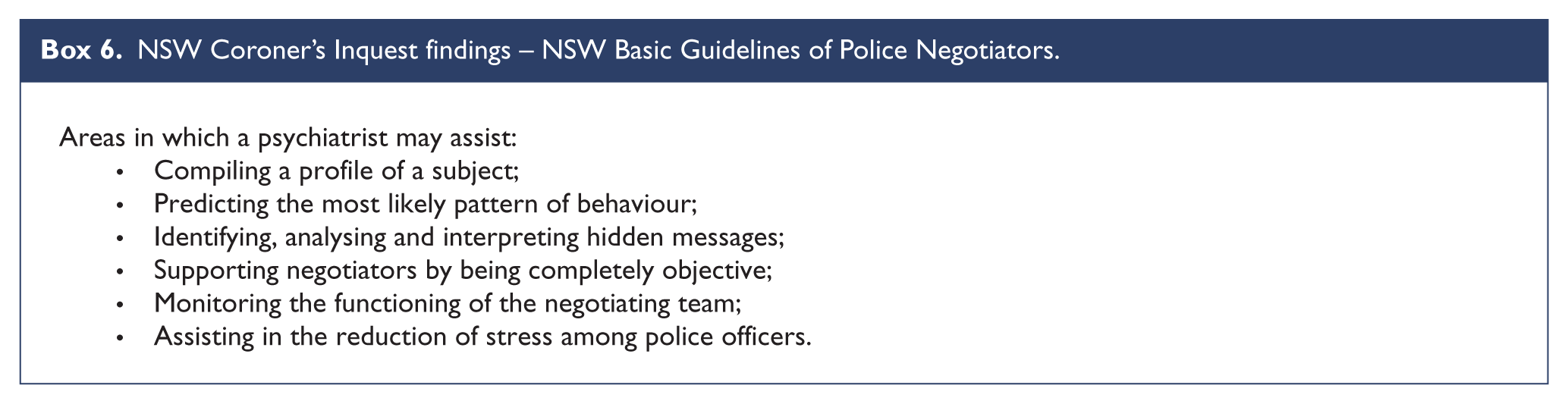
The Coroner highlighted that in 2014 there were no detailed protocols or procedures that delineated the role of a psychiatrist in police hostage negotiation (Box 6).
NSW Coroner’s Inquest findings – NSW Basic Guidelines of Police Negotiators.
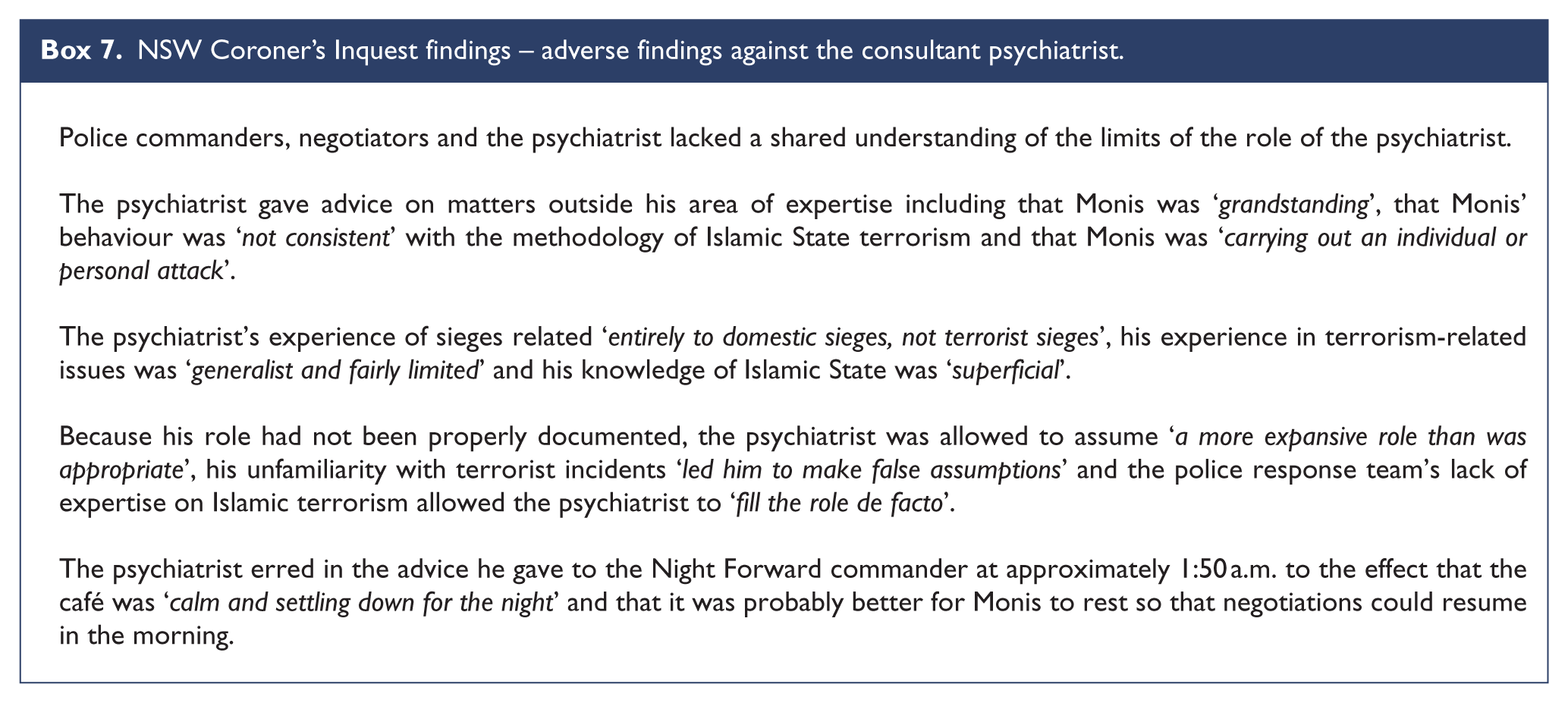
Despite the lack of formal guidelines, the Coroner was critical of the advice the psychiatrist provided to negotiators during the siege (Box 7). But as the psychiatrist advised, the Lindt café siege was not a ‘terrorist attack’ and Monis demonstrated all the features of narcistic personality disorder. Attempts at negotiation were greatly hampered by Monis only communicated indirectly through his increasingly distressed hostages. Given that he announced he was armed with a bomb, Monis represented a ‘credible threat’ to the hostages as well as to any police who may attempt to break the siege. The psychiatrist’s endorsement of the police strategy to ‘contain and negotiate’ was entirely prudent in the circumstances.
NSW Coroner’s Inquest findings – adverse findings against the consultant psychiatrist.
Man Haron Monis – demand to have the Martin Place lights turned off
From 8.38 p.m., hostages repeatedly relayed Monis’ demand that the ‘Christmas lights’ in Martin Place be turned off. The Coroner was critical of the failure to turn the lights off – an intervention which would have conferred advantages to the Tactical Operations Unit officers and police snipers who surrounded the café. While the Coroner highlighted that responding to Monis’ repeated demand that the lights be extinguished was a ‘simple practical matter’ which was ‘mismanaged’ by senior police and negotiators, the psychiatrist provided no advice on this issue.
NSW Police Commissioner – media conference
At 9.00 p.m., Monis listened to a live radio broadcast of a media conference in which the NSW Police Commissioner said ‘contact’ had been made with gunman inside the Lindt café and that negotiations were proceeding to resolve the siege ‘peacefully’. At 9.05 p.m., a covert surveillance device captured Monis’ saying to the hostages: That news shows that police … are emphasising at this point that they are confident they can finish it peacefully. (Coroner’s Court of New South Wales, 2017: 184, para 608)
At 11:13 p.m., the surveillance device captured Monis’ further comment: … hopefully by morning, everyone home … After Tony Abbott calls, everyone happy, go home … (Coroner’s Court of New South Wales, 2017: 185, para 616)
The police negotiators regarded that last comment by Monis as a positive development. At 11.30 p.m., the NSW Police Commissioner and the Deputy Commissioner both left the Police Operations Centre for the night while the psychiatrist remained with the negotiators in the Police Forward Command Post.
At 1:50 a.m., early on the second day of the siege, the psychiatrist made observations to the effect that the café appeared to be ‘calm and settling down for the night’ and that it was probably better to allow Monis to rest so that negotiations could resume in the morning. The psychiatrist and the negotiators knew that during most sieges, patience was rewarded when the exhausted hostage-taker finally decides that he has made his protest and agrees to surrender (Noesner, 2018).
The failure of communications between the hostages and the negotiators
The Coroner found that the attempted negotiations were plagued by recurrent logistical and communication problems. At 1.40 a.m., a hostage had telephoned a radio station to relay Monis’ offer that if the media announced that the hostage had ‘not escaped’, a hostage would be released. At 1.43 a.m., the café manager Mr Johnson sent his partner a text message that Monis wanted to release a hostage ‘out of good faith’. Although Mr Johnson’s partner immediately contacted the police, that advice and the contents of the earlier phone call to the radio station were never relayed to the negotiators. The Coroner found that the failure to relay this information and the many calls hostages attempted to make to the negotiators which went unanswered represented ‘a significant failure in a basic component of siege management – the maintenance of open communication between hostage/s and negotiators’.
The Lindt café siege – not a lone-actor terrorist attack
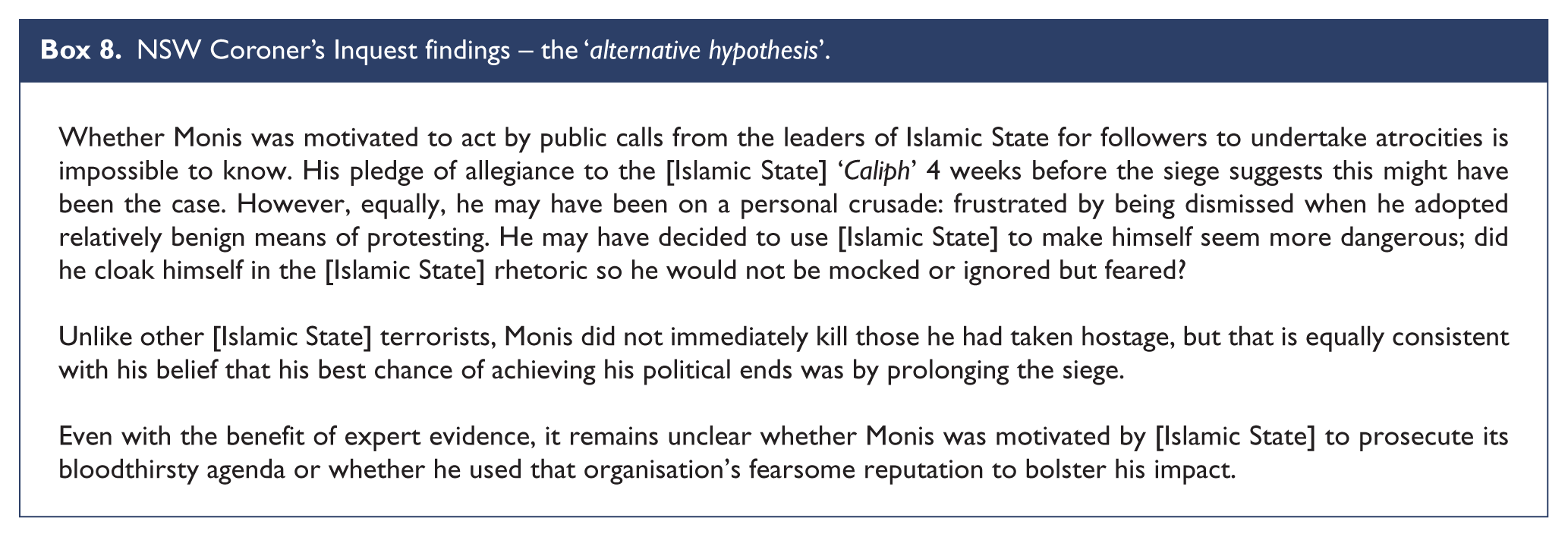
In his findings, the Coroner defaulted to a simplistic orthodoxy that less than 2 weeks before the siege, Monis abruptly converted to the Sunni faith and, in total social isolation, ‘self-radicalised’ before embarking on a ‘lone actor’ terrorist attack. In the chapter titled ‘A Terrorist Incident’, the Coroner only briefly considered an alternative hypothesis without further elaboration (Box 8).
NSW Coroner’s Inquest findings – the ‘alternative hypothesis’.
The Coroner was poorly served by the limited expert advice on Islamic State terrorism. Lone-actor Islamic State-inspired terrorist attacks are almost universally characterised by a sudden ‘spree’ of violence, usually a concentrated shooting or bombing attack or the use of a motor vehicle to kill as many victims as possible in a short space of time (Phillips, 2012). Even after he shot Mr Johnson and waited some minutes for the police to burst into the cafe, Monis did not turn his shotgun on the remaining hostages.
In seeking to restore the caliphate, Islamic State adheres to a rigidly fundamentalist Sunni position (Celso, 2015). For Sunni jihadists, there can never be any accommodation or compromise (Cottee, 2017). Those inspired by Islamic State have no ‘negotiating position’. Their aim is to cause terror by killing as many victims as quickly as they can (Tziarras, 2017). They do not take hostages and conduct prolonged sieges (Dolnik, 2015).
The psychiatrist who advised NSW Police formulated Monis as an embittered unemployed, middle-aged divorcee, who, after allegations of domestic violence, had lost custody of his children and was also charged with multiple historical sex offences. More significantly, Monis was also charged with aiding and abetting the murder of his ex-wife. As the Coroner noted, Monis could envisage conviction and a long prison sentence. In this context, the Lindt café siege is better characterised as lone-actor grievance-fuelled violence.
In failing to systematically consider the chronology before the siege, the Coroner neglected to highlight that while he demonstrated none of the characteristic features of Islamic State-inspired terrorists, Monis demonstrated all the prominent features of a malignant narcissist. As the psychiatrist advised NSW Police, a narcissist may react to the humiliation of a ‘narcissistic injury’ with an intense fury characterised as ‘narcissistic rage’.
The Lindt café siege - the mass hostage escape
At 2.03 a.m. on the second day of the siege, six hostages escaped through the building foyer exit which had been left unlocked since the last two hostages escaped. As he achieved none of his banal demands and clearly lost control of the siege, Monis would have experienced a profound humiliation with the flight of the last group of hostages which left only six of the original 18 hostages. As the psychiatrist testified during the Inquest, after 16 hours, Monis was fatigued and was likely to have been contemplating surrendering. Tragically, the mass hostage escape intervened and precipitated ‘a complete reversal of the psychological process at its most susceptible movement’. It was this ‘cataclysmic shift’ that incited Monis’ rage to kill a hostage and seal his own fate.
NSW Coroner – criticism of the consultant psychiatrist
The Coroner’s selective criticism included that the psychiatrist was unaware that on 22 September 2014, Islamic State spokesperson Abu Muhammad al-Adnani had uploaded onto Twitter a 42-minute-long meandering propaganda speech calling for Muslims across the world to defend the Islamic State against the ‘dozens of nations … gathered against it’. What the Coroner failed to acknowledge was that forensic examination of Monis’ use of the Internet and social media found no evidence that Monis knew of Adnani’s speech when it was made in September 2014 or indeed any other propaganda from Islamic State.
Expertise of the UK ‘experts’
Although the Coroner was critical of the psychiatrist’s ‘limited experience of terrorist sieges’, there was in fact no one in Australia and indeed few people in the world with any experience in advising police or security agencies on terrorist hostage-sieges. By the time of the Lindt café siege, there had never been a terrorist siege-hostage incident in Australia.
The Coroner held that during the siege, negotiators failed to pursue opportunities to attempt to engage with Monis ‘because of a lack of experience in terrorist negotiations’. The Coroner held that the Inquest required ‘independent expert evidence’ in relation to policing during terrorist hostage-sieges and took advice from a panel of UK experts. However, the expertise of the UK experts can be questioned. Four of the five experts were tactical officers. Only one of the five UK experts – Chief Superintendent Kerrin Smith from Durham – was involved in hostage negotiations. More pointedly, while there had been a number of terrorist attacks during ‘The Troubles’ in Northern Ireland, the siege of the Iranian Embassy in London in April 1980 was last terrorist hostage-siege incident in the United Kingdom. In 1980, no mental health clinician assisted the London Metropolitan Police who, over 5 days, adhered to the strategy of ‘contain and negotiate’. Late on the sixth day, when their demands for the release of political prisoners held in Iran and safe passage out of the United Kingdom were not acceded to, the terrorists murdered a hostage which precipitated the Special Air Service tactical assault in which five of the six terrorists were killed and a second hostage was also killed by the terrorists (Moysey, 2004).
Hindsight bias of the NSW Coroner
Hindsight bias refers to the tendency for persons equipped with knowledge of an outcome to exaggerate their ability to predict the inevitability of the outcome and to retrospectively criticise the decision-making during a critical incident particularly when there has been loss of life. It is clear that the tragic outcome of the Lindt café siege prejudiced the findings of the Coroner.
The psychiatrist who advised and supported the police negotiators throughout the siege had evaluated considerable information and intelligence and had developed a sophisticated formulation of Monis. As a civilian, the experienced psychiatrist was always cognizant of the limits of his role in the advice he offered the police. During final submissions to the Inquest, senior counsel representing the NSW Police submitted that the consistent evidence of senior police personnel and negotiators was that the role of the psychiatrist was to provide insights into human behaviour and not to engage in the decision-making about police tactics or strategy.
The Coroner’s criticism of the psychiatrist was misplaced and ill-informed. Despite hearing submissions on the psychiatrist’s credentials, his extensive experience with critical incidents including barricade and hostage-sieges and his long-standing involvement in counter-terrorist training, the Coroner unfairly marginalised the psychiatrist and overstated the psychiatrist’s influence on the negotiation strategy adopted by police.
Conclusion
It is most unfortunate that the Coroner sought to scapegoat the experienced psychiatrist who correctly formulated Monis as a narcissist and offered behavioural analysis advice during the siege. There is good evidence to support the intuitive proposition that crisis teams which are advised by a mental health clinician during critical incident negotiations have better outcomes (Augustin and Fagan, 2011; Feldmann, 2004). The Coroner’s disparagement of the senior psychiatrist who considered all the information known about Monis and offered sound advice to senior police and the negotiators during the Lindt café siege may have the unintended consequence that psychiatrists may be reluctant to assist police and security agencies in hostage-sieges or other critical incidents.
Footnotes
Author’s Note
The author has obtained all factual details about the case from the findings of the NSW Coroner’s Inquest which has been published and appears as open-source material. The author alone is responsible for the content and writing of this paper.
Declaration of Conflicting Interests
The author(s) declared no potential conflicts of interest with respect to the research, authorship and/or publication of this article.
Funding
The author(s) received no financial support for the research, authorship and/or publication of this article.
