




Abstract

Mental health innovation may provide soft diplomatic power for managing a range of global issues. Soft power is the ability to persuade, attract and co-opt with culture, values and policies, as opposed to coercion with economic or military ‘hard power’. Mental health innovation may be a soft power asset because it can improve patient access and outcomes, optimise psychological capital, increase economic productivity and create entrepreneurial ecosystems and jobs. There are also opportunities for international trade and investment in mental health innovation which may further multinational economic and cultural ties. However, the soft power value of mental health innovation is under-recognised due to stigma associated with mental health disorders and the relative novelty of technologies like genomics, sensors, machine learning and smartphones.
Lost productivity and disability due to mental health issues are major. Mind, brain and nervous system conditions are responsible worldwide for 32% of all years of disability and 13% of all disability adjusted life years (Arjadi et al., 2018). Disorders within this group include depression, anxiety disorders, schizophrenia, bipolar disorder, alcohol and drug use disorders, mental disorders of childhood, migraines, dementias and epilepsy. Persons with these disorders face increased rates of morbidity from general medical conditions (e.g. heart disease). Access to care is poor in many parts of the world. Treatment is trial and error with inadequate rates of improvement. A recent World Health Organization–led study estimates that depression and anxiety disorders cost the global economy US$1 trillion each year in lost productivity (CB Insights, 2017). Clearly, innovations are required to reduce the burden of global mental health issues.
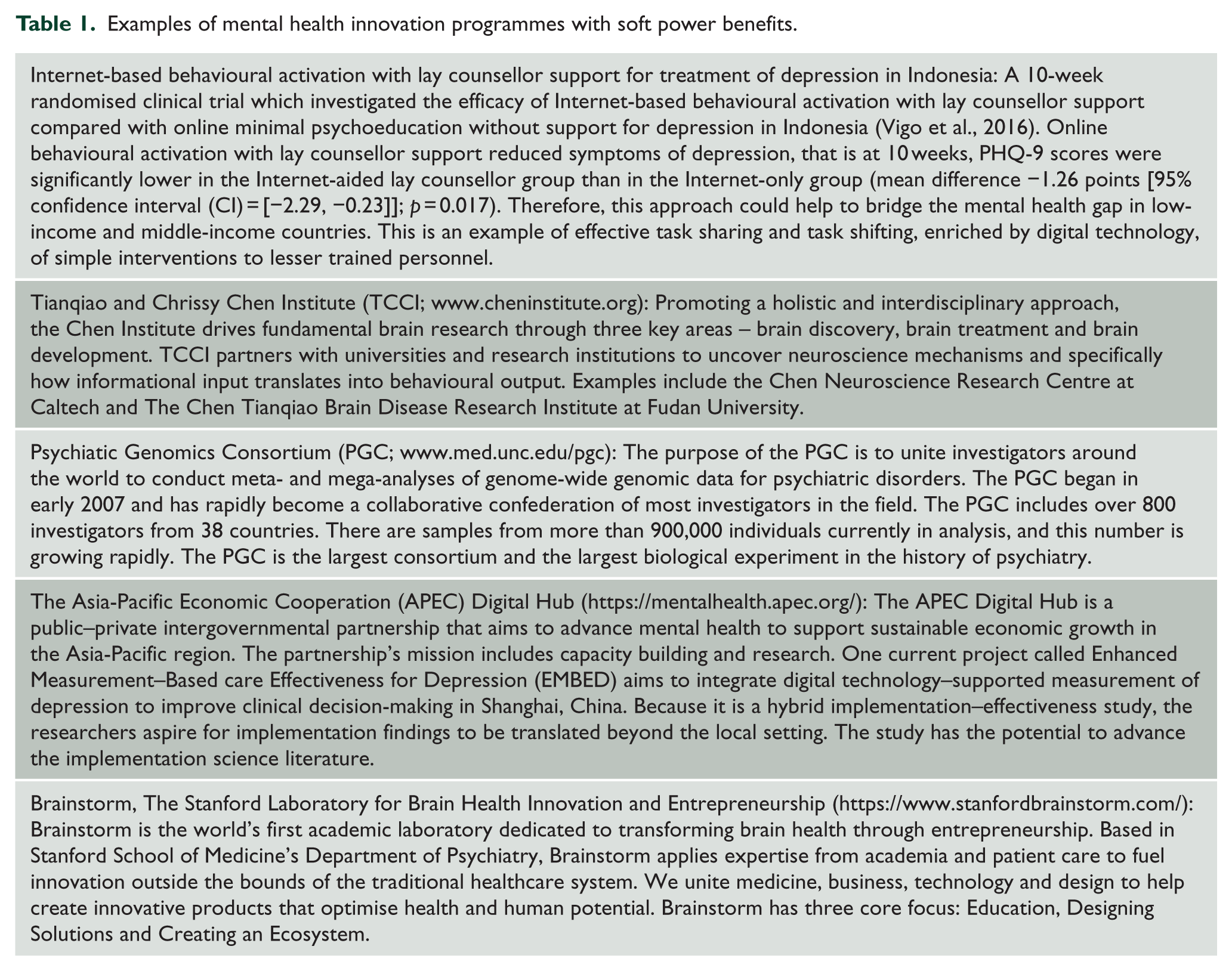
Technology has opened a new frontier in mental healthcare. For example, mobile devices like cell phones, smartphones and tablets provide the public new ways to access help and education. Advances in genetics allow doctors to guide patients’ medications with their genetic information to improve outcomes and reduce side effects. Many of these technological developments can help mitigate the reluctance to seek care of patients facing stigma by enabling more discreet treatment. Free open-access medication education on the Internet allows for improved training of mental health clinicians internationally. The development of the mental health innovation entrepreneurial sector is encouraging and exemplified by start-up numbers and investments. Funding to mental health tech start-ups has risen every year since 2013, nearly hitting US$200 million in 2016 (Chisholm et al., 2016). Tech companies of various sizes are now investing in mental health innovation (Chisholm et al., 2016). These companies are variously leveraging their engineering skills, computing power, machine learning expertise, social media platforms and large capital reserves. There are ongoing ethical debates (surrounding privacy and appropriate consent) about negative mental health effects of social media and simultaneous engagement by social media companies in mental health therapy. Table 1 provides examples of mental health innovation programmes which have soft power benefits.
Examples of mental health innovation programmes with soft power benefits.
Mental Health Innovation Diplomacy as a soft power asset should be recognised. Its value will continue to grow as smartphones, social media, microprocessors and genomic testing become more widely available and as greater investment enters the field by private and governmental institutions. Greater involvement and training of the mental health workforce with a new set of skills are required to ensure they are prepared to engage and use these technologies.
Footnotes
Declaration of Conflicting Interests
The author(s) declared no potential conflicts of interest with respect to the research, authorship and/or publication of this article.
Funding
The author(s) received no financial support for the research, authorship and/or publication of this article.