




Abstract

As we pull up stumps on the 2018 Psychiatry Ashes, it is an opportune time to review the ‘game’ and consider what it has taught us. On the basis of final scores (see Figure 1), it would appear that the Australian and New Zealand Journal of Psychiatry (ANZJP) has won – indeed by a significant margin. But this is only one story, and even though the totals are telling, they don’t tell the total story.
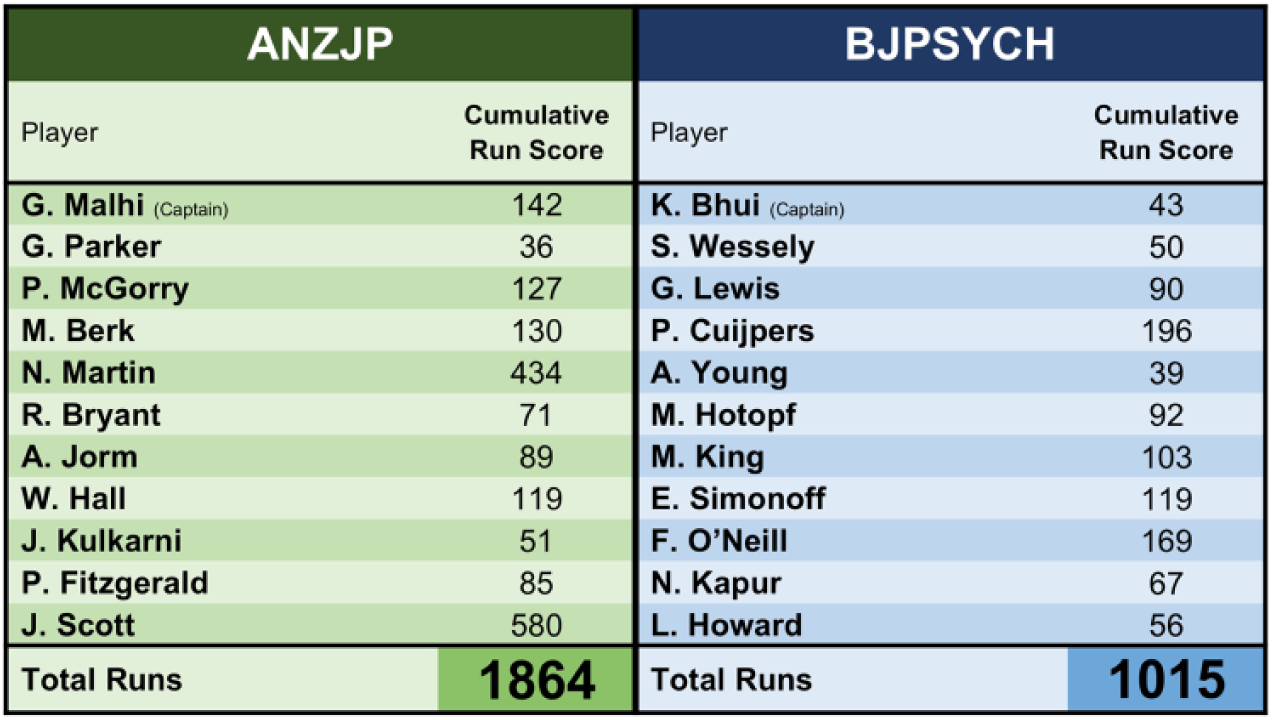
Scoreboard.
For example, if we apply the usual cricketing milestones to compare the performance of the two teams, then a very healthy five players on the ANZJP Team, and four players on the British Journal of Psychiatry (BJPsych) team, managed a century or more. Alongside this, the numbers that achieved half a century (50 runs) are again very satisfying, with five players on the BJPsych team scoring over 50 (but less than 100) and four managing the same on the ANZJP team. This then seems a lot closer and in actuality the game was neck and neck. A look at the scoreboard also shows that all the players scored very well – with no papers having no citations for example – despite this being a common occurrence for papers in the first few years of publication. In fact, attracting any citations over the life of a paper, let alone in the first few years, is an accomplishment. And all the players on both sides excelled in this regard.
Another way of comparing the teams is to compare the score of an individual player with the score of their paired counterpart. Usually in a cricket match, different batting skills are required at various stages of the game – as the conditions of the pitch and ball change. Hence, the order in which cricket players bat is important and can sometimes be critical. Examining scores in this manner between pairs of players according to their ‘batting order’, we can easily determine who scored more at each stage of the game. In other words, who won each pairing. If we do this, we see that pair number 8 (Hall and Simonoff) scored an equal number of runs (119) and that the remaining pairings fall equally in favour of the two teams, with five wins each: ANZJP (A) and BJPsych (B). Hence, the overall pattern of wins and losses was: A, B, A, B, A, B, B, Draw, B, A, A (see Figure 2), and by this reckoning the match is a draw!
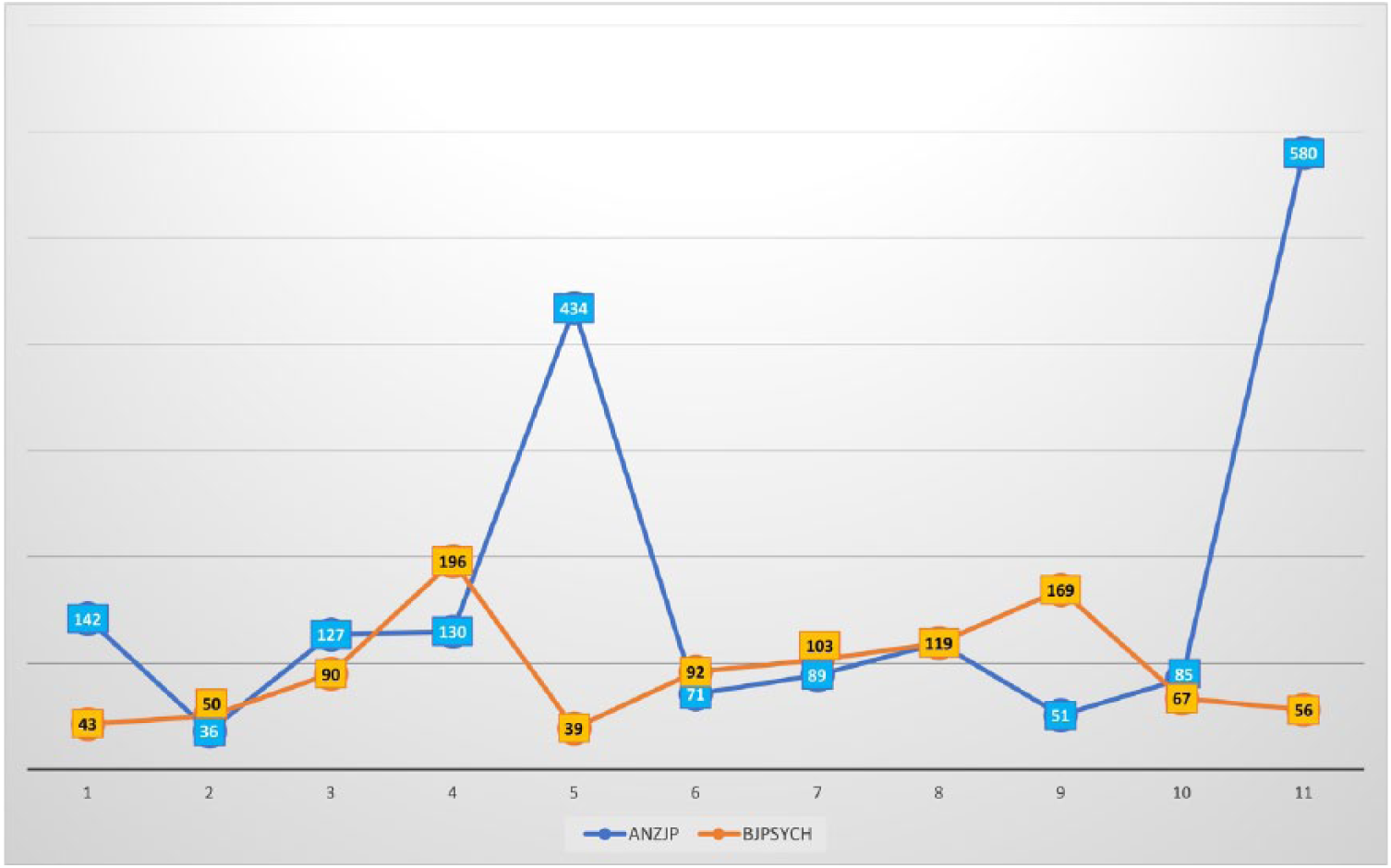
Paired scores.
These different ways of comparing the scores (citations to papers) that clearly produce quite different outcomes have a serious side to them. Currently, university academics worldwide are increasingly being ‘assessed’ using a whole host of metrics. Broadly speaking, there are inputs and outputs. Inputs include the funds academics bring to a university by attracting grants to support research projects. Outputs include many things but perhaps the most visible are publications. The latter are assessed variably according to subject matter (science, arts, medicine, law, etc.), but one aspect that seems to be increasingly popular is that of the number of citations to publications. As a consequence, this has become gradually more sophisticated, with not only the raw number of citations being regarded as important but also the status of the journal in which the paper is published – in particular its impact factor. The scoring in our Psychiatry Ashes, although complicated, was relatively straightforward when considered alongside the metrics now being used to assess academic performance. But you might be saying – surely, this is a good thing? And yes, at a macrolevel, it is necessary in order to quantify effort and achievement. But the means by which academic success is measured is vitally important to the success of the overarching endeavour (to gain knowledge), and in this regard, competing and measuring academic performance can result in similar distortions to those seen in sports.
For example, the increasing pressure to ‘succeed’ as an academic may encourage academics to ask easier questions and address more solvable problems. The problem with this is that their efforts may not advance our understanding as much as if they had addressed more difficult questions. This could potentially create problems of its own, with those academics choosing an easier path seemingly performing better (and therefore being rewarded with promotion, for example) than those that are perhaps trying just as hard or even harder but making less headway because they are tackling greater challenges and hence, inevitably, advancing more slowly. These are important considerations that require more in-depth discussion than this short piece affords us. Hence, we will return to this theme in the future. But for now, let’s focus on the fun aspects of this endeavour.
Although somewhat of a cliché, the reality is that the real winner of this game has been academic psychiatry. The Psychiatry Ashes has shown that the two sister journals and their teams have great spirit and share a camaraderie and common vision. We as Editors of the respective journals (and captains of the two teams) are immensely grateful to our fellow players for their generosity in allowing us to put them on show, publishing their records as part of a game. It is clear that they have all contributed immensely to the ‘field’ of psychiatry, not only through their achievements in the past year but throughout their careers. To this end we salute them.
We also thank the officials (Match Referee and Umpires), the Master of Scores and, finally, the all-important Stats Gurus, without whom much of the game would not have been possible.
With the festive season upon us – we thank you for your support, wish you all well and hope that you have enjoyed ‘watching’. The Psychiatry Ashes 2018 – over and out.
Footnotes
Declaration of Conflicting Interests
The author(s) declared no potential conflicts of interest with respect to the research, authorship and/or publication of this article.
Funding
The authors received no financial support for the research, authorship and/or publication of this article.
