




Abstract

To the Editor
Othello syndrome is named after the character in Shakespeare’s play and refers to a delusion of infidelity. It has been associated with psychiatric and neurological disorders. We present a rare case of delusional jealousy about 2 years after a lacunar infarct with cerebellar-pontine lesions.
A 76-year-old man was brought to our neuropsychiatric outpatient clinic due to jealous delusions for 2 years. About 3 years ago, he had been admitted to our hospital with sudden onset of right hemiparesis. Cranial computed tomographic angiography identified an occlusion of the tortuous left vertebrobasilar artery with acute lacunar infarctions involving the left hemipons and cerebellar hemispheres (Figure 1), and he experienced long-term sequelae of right-sided paresis. His jealous delusions involved accusing his wife of having a sexual relationship with their neighbors and irritability with the use of abusive words. He was then admitted to our hospital and initially treated with risperidone 2 mg per day, with some improvement in the first 2 weeks of treatment. Despite showing remission of agitation and irritability, he was still suspicious of his wife. Risperidone was then increased to 4 mg daily, which was followed by an additional improvement in the delusional symptoms, without complaints of excessive sedation. He was discharged after 1 month of treatment after a great improvement and was followed up at our clinic.
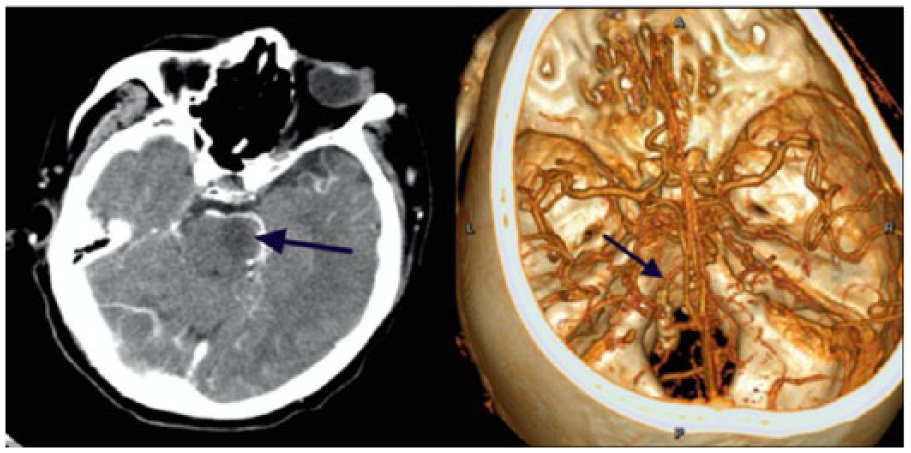
The left image is the brain CT scan, and the black arrow indicates the hypodense lesions in the left hemipons; the right image is the brain CT angiography, and the black arrow indicates occlusion of the tortuous left vertebrobasilar artery and narrowing of the distal basilar artery.
Many different anatomic locations which could be related to secondary delusions have been reported. The majority of these studies reporting secondary delusions after stroke have identified lesions in the right hemisphere, although the etiopathogenesis remains unclear (Kumral and Ozturk, 2004).
In our case, the delusions were probably caused by the cerebellar-pontine infarction rather than common cerebral lesions. Cerebellar-pontine lesions may be responsible for delusions due to their connection with frontal and posterior parietal–subcortical–thalamic circuitry via input to the thalamus (Nagao, 2004). This may be associated with disruption of the rostral brainstem dopaminergic nuclei and projections to the frontal–subcortical circuits (Nishio et al., 2007). We suggest that disruption of ascending dopaminergic projections from nuclei in the brainstem area to the frontal–subcortical neural circuit could lead to cortical reorganization, which may in turn cause delayed-onset Othello syndrome.
We chose risperidone as the antipsychotic medication due to its efficacy in reducing paranoia and delusions in elderly psychotic patients. Another important consideration was safety concerns over orthostasis and sedation when prescribed to a patient with long-term sequelae of stroke.
Footnotes
Declaration of Conflicting Interests
The author(s) declared no potential conflicts of interest with respect to the research, authorship and/or publication of this article.
Funding
The author(s) received no financial support for the research, authorship and/or publication of this article.