




Abstract

Excessive computer gaming is recognised as a problem worldwide, although its diagnostic status remains contentious (Starcevic, 2016). Recently, an epidemiological study of internet addiction in six Asian countries reported prevalence rates in China (2.2%), Hong Kong (3.0%), Japan (3.1%), South Korea (1.2%), Malaysia (2.4%) and Philippines (4.9%) (Mak et al., 2014). The prevalence rate of pathological video gaming (PVG) in Australian secondary schools was noted to be 1.8% (King et al., 2013), more than four times lower than the rates in Singaporean adolescents (i.e. 7.6–9.9%) (Gentile et al., 2011). These statistics highlight the need for schools, treatment clinics and community groups to provide intervention for these adolescents. To better understand this phenomenon, we examined data collected from treatment seekers having behavioural addictions over a 2.5-year period.
Totally, 120 adolescents between the ages of 12 and 19 years sought treatment at the National Addictions Management Service (NAMS) in Singapore for excessive gaming. They were seen by a multi-disciplinary team comprising psychiatrists, family therapists and counsellors. Of these, 50 of them agreed to be part of the treatment outcome monitoring (TOM) programme. Their demographic and clinical profiles were collected. The referral sources for these patients include NAMS Helpline (54%), the child and adolescent psychiatry department (34%), schools (6%) and general practitioners (4%).
The sample was predominantly male (98%) with a mean age of 15.1(±1.6) years. In all, 6% of them had dropped out of school and 10% were retained in the previous grade. Majority were in secondary level or higher (98%), with 32% having conduct problems (e.g. truancy, fighting and verbal abuse towards teachers). In total, 42% had a previous mental health diagnosis, predominantly attention-deficit hyperactivity disorder (ADHD) (24%) and depression (6%; see Table 1). In terms of gaming, 85.7% reported that their excessive gaming had led to significant consequences. Participants’ mean gaming time was 45.05 hours per week, with 91.8% reporting gaming daily and predominantly on strategy-based games.
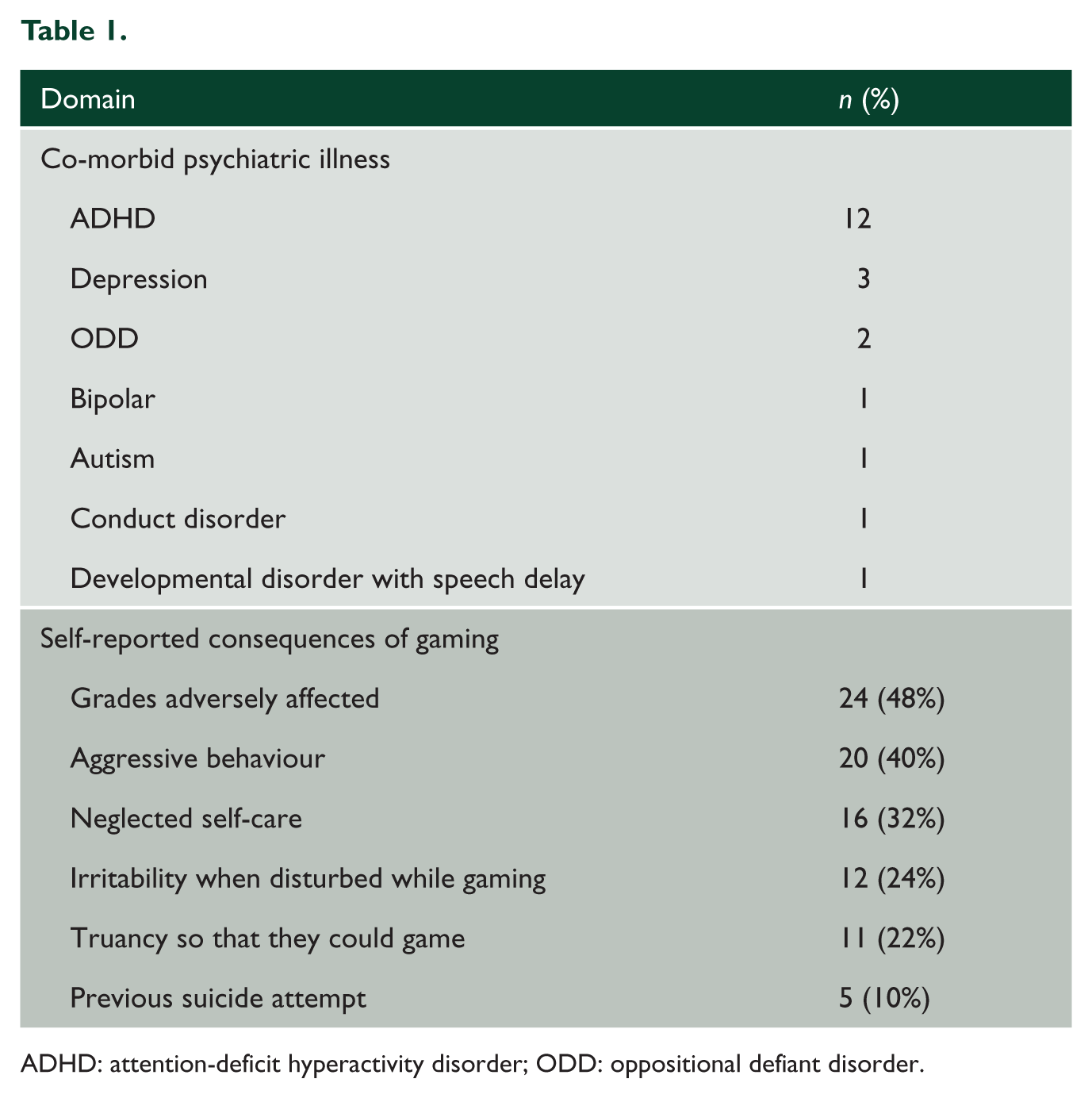
ADHD: attention-deficit hyperactivity disorder; ODD: oppositional defiant disorder.
Our findings add to the existing literature on excessive computer gaming in Asia. In our sample, serious consequences such as declining grades, aggressive behaviour and poor self-care were commonly reported. This problem affects adolescents during their scholastic years, with a loss of important educational, social and emotional milestones.
A majority of treatment seekers were self-referrals (either by theparents or child) via the Helpline. Coupled with the referrals from polyclinics, our findings show that 58% sought help of their own accord. Although local data suggest that a substantial proportion of the school-going population (7%) have excessive gaming issues (Gentile et al., 2011), the predominant referral routes were via helplines (self-referrals) and the child psychiatry unit. As such, there is discordance between where the problem is prevalent and how individuals are typically referred to treatment providers. It is essential to educate schools and the community about the effects of computer gaming, its consequences and, more importantly, the avenues for help and the treatment programmes available.
Of note, a significant proportion of treatment seekers had a previous mental disorder or comorbidity. Given that nearly a quarter of our sample had a diagnosis of ADHD, perhaps school counsellors could screen their students diagnosed with ADHD for excessive gaming issues and vice versa. Closer collaboration, therefore, is imperative between mental health teams and schools. Indeed, ‘Cyberwellness’ programmes such as the Singaporean-based Planet Crush have been developed in schools for ‘at-risk’ students, as an early intervention measure, so as to help prevent and, where necessary, treat this problem. Moving forward, more programmes such as this need to be incorporated into the education curriculum and supported by the Ministry of Education.
The stigma associated with mental illness may be preventing those suffering from this problem to seek help. More effort in engagement with schools, community services and other mental health teams (e.g. Child and Adolescent Psychiatry) may help alleviate stigma associated with this problem.
Despite these findings, we accept that comparing our findings with those of other studies may be difficult, given the lack of a set of definitive criteria (Diagnostic and Statistical Manual of Mental Disorders–Fifth Edition [DSM-5], 2013). Our sample was a pool of treatment-seeking individuals who presented with excessive gaming and were treated for that. To date, there is much debate on the diagnostic criteria for excessive gaming. There is an urgent need, therefore, for a consensus to be reached by experts regarding the diagnostic criteria. Once attained, future studies can then be designed appropriately to understand this condition in its totality, therein paving the way to developing effective treatments for this population.
Footnotes
Declaration of Conflicting Interests
The author(s) declared no potential conflicts of interest with respect to the research, authorship and/or publication of this article.
Funding
The author(s) disclosed receipt of the following financial support for the research, authorship, and/or publication of this article: The data are extracted from the treatment outcome monitoring programme at National Addictions Management Service, which is funded by Ministry of Health Singapore.