



Abstract

To the Editor
A 48-year-old female was admitted after self-enucleating her left eye and partially enucleating her right eye using her fingers during a psychotic relapse. Examination revealed a ruptured right globe with no perception of light (NPL) and an absent left globe. She subsequently underwent washout and closure of her left conjunctiva and primary repair of her right ruptured globe. Figure 1 shows her eyes 2 days postoperatively.
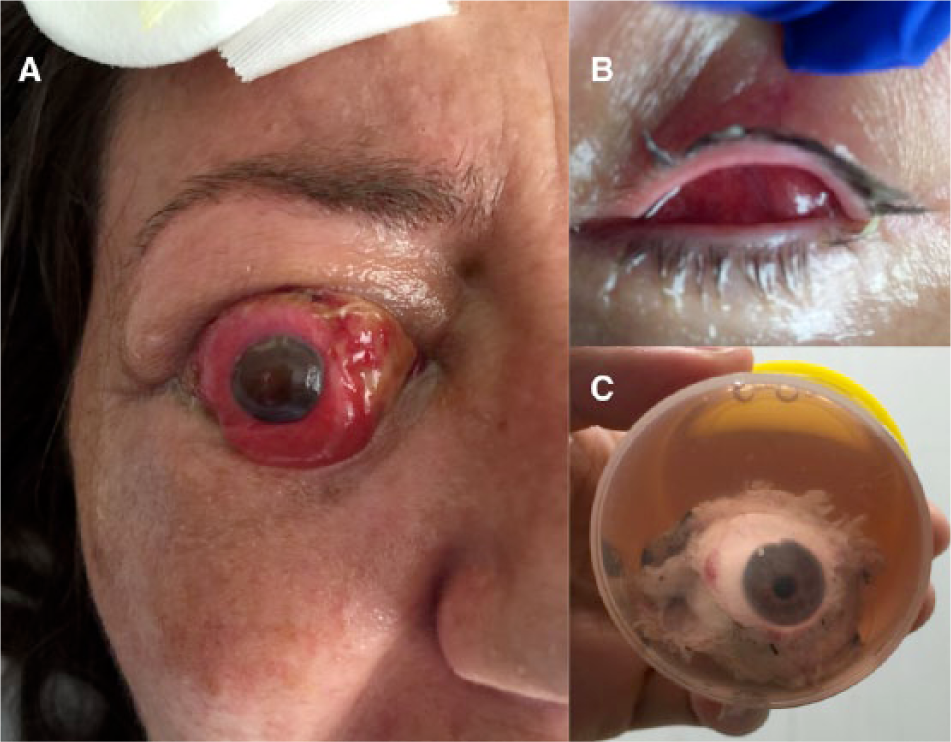
The patient underwent primary repair of her right ruptured orbit and washout and closure of her left conjunctiva. The images were taken on post-operative day 2, showing her partially autoenucleated right globe (A) and her left conjunctiva (B). Her autoenucleated left globe (C) was remarkably well preserved.
Psychiatric history revealed several delusional beliefs involving her eyes. One reason she provided was that her right eye had ‘sinned’ and its removal was ‘punishment for molesting her son’. Another reason was that she felt persecuted by others and had written a will as a result of being persecuted; she believed that she could use her eye to ‘coat’ that piece of paper so as to protect it from her persecutors.
Psychoanalytic theory suggests that autoenucleation is linked to a failure to resolve the Oedipus complex, repressed impulses, self-punishment, focal suicide and aggression turned inwards. Oedipus was a character in a play by Sophocles who removed both eyes upon discovering that he had murdered his father and married his mother. Another theory is a literal interpretation of a verse from Matthew 5:29: ‘And if thy right eye offends thee, pluck it out, and cast it from thee: for it is profitable for thee that one of thy members should perish, and not that thy whole body should be cast into hell’. However, case reports of autoenucleation in patients identifying as Muslims, Jews and Hindus (Large and Nielssen, 2012) suggest that autoenucleation is not culturally restricted and is usually not a literal interpretation of the biblical passage. Most cases of autoenucleation stem from psychosis (Large et al., 2008), namely, the delusion that their eyes pose a threat to themselves or their loved ones (Large and Nielssen, 2012).
Inpatient psychiatric management for this patient included one-to-one supervision, antipsychotic and anxiolytic medications and four-point restraint (while acutely psychotic). She subsequently became cooperative, regained insight into her situation and was compliant with her visual rehabilitation. Despite her visual acuity remaining NPL in the right eye, she remained oddly indifferent to her permanent disability.
Prevention of autoenucleation is key; mental health practitioners should be alert to delusions about eyes (Large and Nielssen, 2012) and regularly assess a patient’s risk of self-harm or self-mutilation. Once autoenucleation has occurred, ongoing psychiatric review and close observation are required to prevent further self-harm.
Footnotes
Declaration of interest
The authors report no conflicts of interest. The authors alone are responsible for the content and writing of the paper.
Funding
This research received no specific grant from any funding agency in the public, commercial or not-for-profit sectors.