




Abstract

To the Editor
Fibroblast growth factor (FGF) 21, an atypical member of the FGF superfamily, has recently been introduced as a regulator of glucose and lipid metabolism (Woo et al., 2013). Schizophrenia (SZ) is a neuropsychiatric disorder with abnormal glucose metabolism (Fernandez-Egea et al., 2009). Considering the aberrant glucose metabolism in SZ and the regulator role, the aim of this study was to investigate serum FGF21 levels and its relationship with the metabolites in glucose metabolism in first-onset patients with SZ.
Thirty-nine first-onset patients with SZ and 39 healthy controls matched for age, gender, and body mass index were recruited. Methods of serum sample collecting were described in our previous study (Yang et al., 2013). Serum FGF21 levels were determined with a commercially available enzyme-linked immunosorbent assay (Quantikine Human FGF-21 ELISA, R & D Systems, Minneapolis, MN, USA) according to the manufacturer’s instructions. The basic characteristics of all subjects were summarized in Figure 1A.
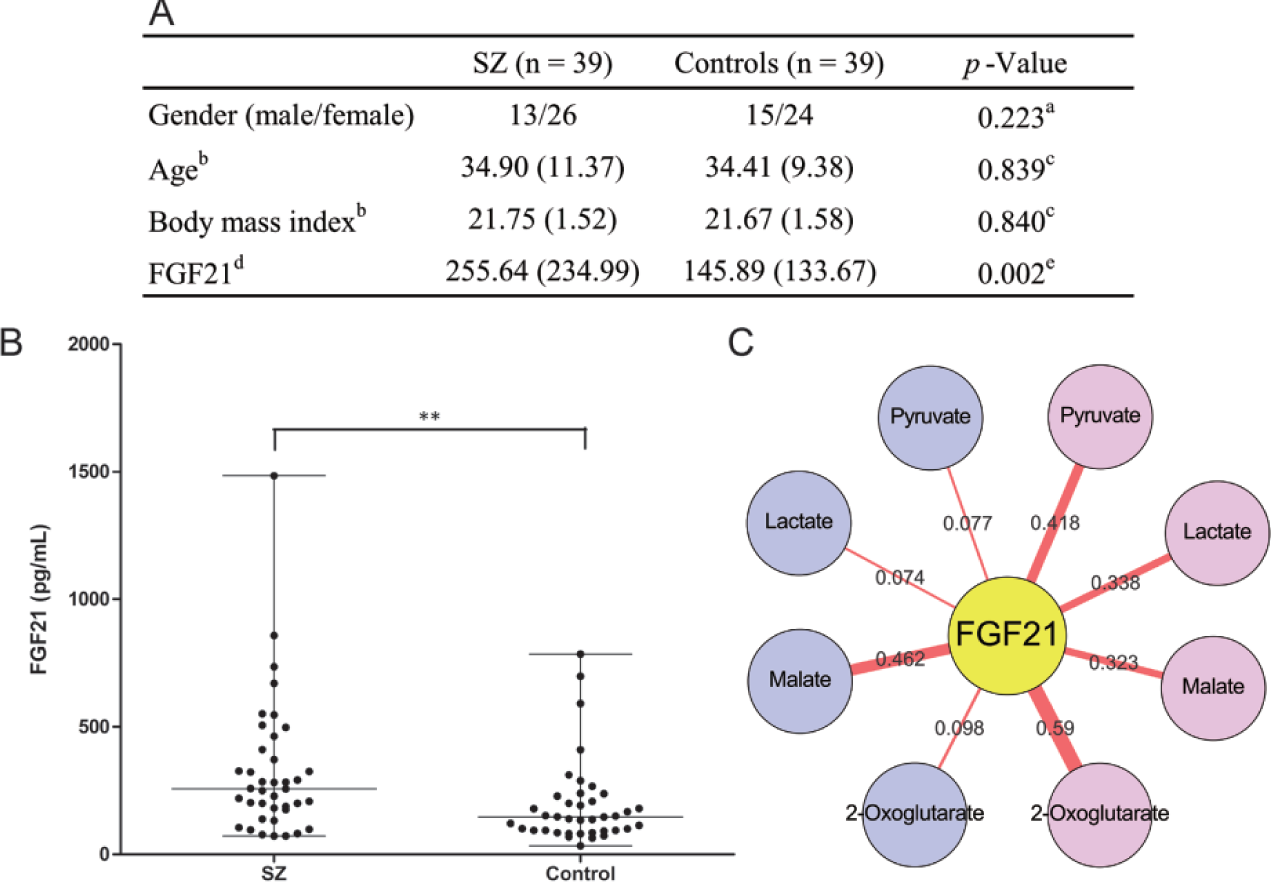
Serum FGF21 levels were significantly increased in the SZ patients and markedly correlated with certain intermediates in glucose metabolism. (A) Basic characteristics of patients with SZ and healthy controls. a: Chi-square; b: Mean (standard deviation); c: T-test; d: Median (interquartile range); e: Mann-Whitney. (B) Serum FGF21 concentrations in SZ patients (n = 39) and healthy controls (n = 39). Median FGF-21 concentrations are shown for each group. ** indicates P <0.01 as assessed by Mann-Whitney U test. (C) Spearman’s correlation analysis was performed to examine the relationship between FGF21 and pyruvate, lactate, 2-oxoglutarate, and malate in the SZ group and the control group. The metabolites in purple circles are from the control group and those in the pink ones are from the SZ group. The thickness of red lines represents the correlation coefficients.
Median serum FGF21 levels were significantly elevated in the SZ group compared to the controls (Figure 1B). In our previous study (Yang et al., 2013), we found 22 differential serum metabolites in the SZ patients which are involved in glucose, lipid, amino acid, and inositol phosphate metabolisms. Interestingly, our present study showed that FGF21 was markedly associated with the differential metabolites involved in glucose metabolism. Specifically, FGF21 had significantly positive correlations with pyruvate, lactate, 2-oxoglutarate, and malate in the SZ group. In the control group, however, the significant correlations in the SZ group mentioned above all disappeared except for malate (Figure 1C). These significantly positive correlations possibly indicate that elevated FGF21 leads to active TCA cycle and disturbs the balance of glucose metabolism in SZ.
To summarize, this study showed the levels of serum FGF21, an endocrine regulator in glucose metabolism, were significantly higher in patients with SZ than in the healthy controls. Furthermore, FGF21 had a robust correlation with the serum metabolites involved in TCA cycle in SZ, which could be a cue for unveiling the malfunction of glucose metabolism in SZ. FGF21 might be a possible biomarker for SZ and more studies on molecular mechanism of FGF21 would be helpful in clarifying the role of FGF21 in SZ.
Footnotes
Acknowledgements
The authors are grateful to Dr. Qingyu Wang and Liya Sun for assistance on data analysis. Thanks to Xin Zhang for figure adjustment.
Declaration of interest
The authors report no conflicts of interest. The authors alone are responsible for the content and writing of the paper.
Funding
This work was supported by the 973 Program (2012CB910102) and the National Nature Science Foundation of China (81271486).