




Abstract

We read with interest the article by Emms et al. reporting two cases of positive analytical interference by the alpha-adrenoceptor agonist midodrine and its metabolite desglymidodrine in plasma metanephrines testing. 1 Specifically, it was the adrenaline metabolite metanephrine which was falsely elevated in the liquid chromatography-tandem mass spectrometry (LC-MS/MS) methods affected, both employing hydrophilic interaction liquid chromatography (HILIC). This is an important finding given that midodrine is one of the treatments of choice for postural hypotension, which itself is an atypical presentation of phaeochromocytoma/paraganglioma. 2 In our own laboratory, we recently encountered a false positive plasma metanephrine test which we have attributed to midodrine interference. However, in contrast to the report of Emms et al., it was the dopamine metabolite 3-methoxytyramine which was falsely elevated (3404 pmol/L, reference range <120), whereas metanephrine (87 pmol/L, reference range 80–510) and normetanephrine (129 pmol/L, reference range 120–1180) were within normal limits. In our laboratory, plasma metanephrines are quantified using a modified Turboflow LC-MS/MS (Thermo TSQ Vantage) method which employs a porous graphitic Hypercarb column for analytical chromatography. 3
To investigate the discrepancies between our experience and the report of Emms et al., we first infused aqueous midodrine extract into our MS/MS. This gave dominant m/z transitions of 237 > 180 and 180 > 133, corresponding to the intact drug and the hypothetical m/z of desglymidodrine (resulting from in source fragmentation). (We did not have access to desglymidodrine reference compound to confirm this.) Like Emms et al., we identified ionic cross-talk of directly infused midodrine extract with metanephrine (m/z 180 > 148) and 3-methoxytyramine (m/z 151 > 91) transitions. However, chromatographic analysis of the extract revealed that midodrine did not co-elute with metanephrine, normetanephrine or 3-methoxytyramine using the Hypercarb column. In contrast, when the patient sample was reanalysed, a midodrine-related compound with m/z transition 180 > 133, inferred to be desglymidodrine, co-eluted with 3-methoxytyramine, resulting in a false positive result (Figure 1).
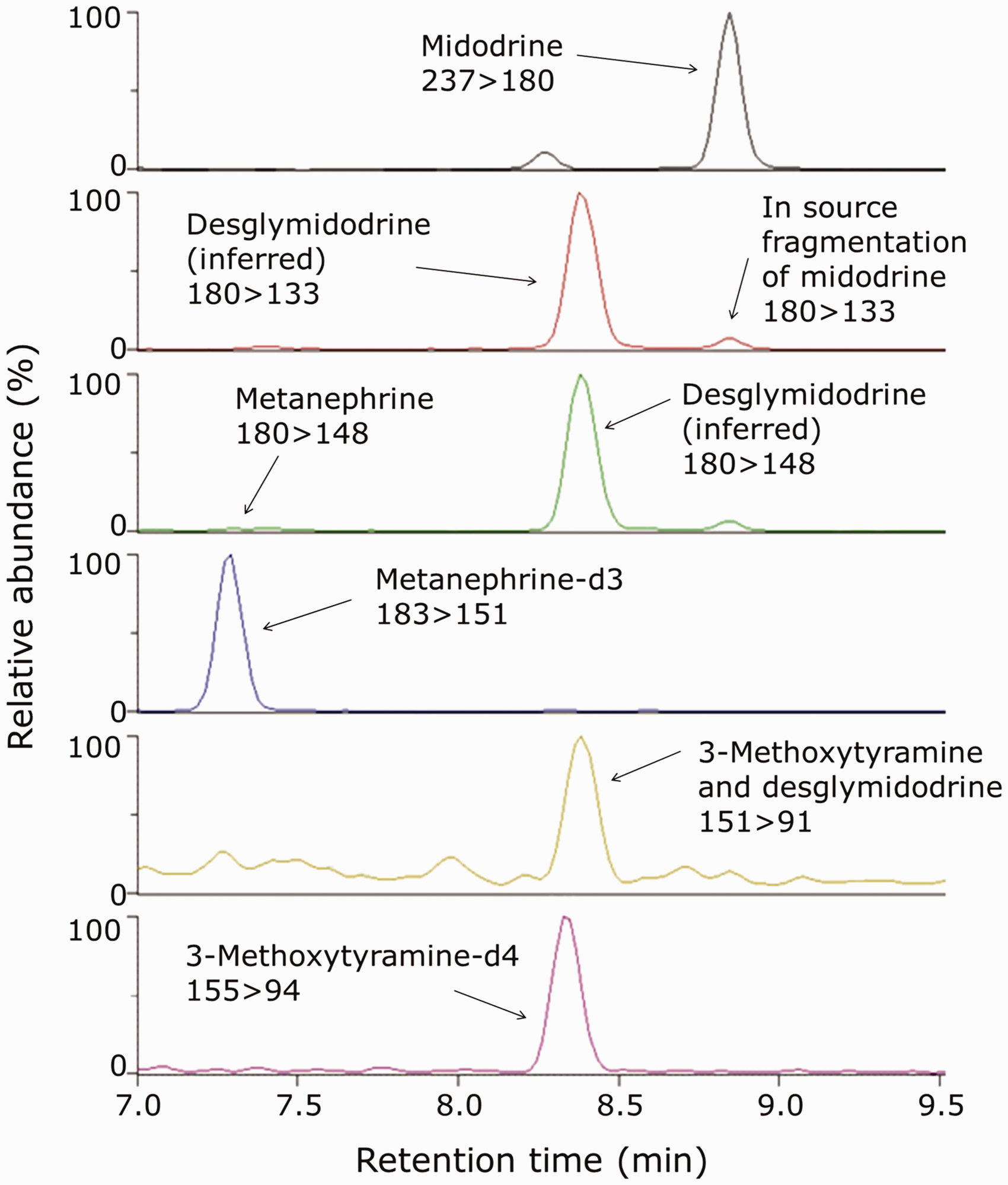
LC-MS/MS extracted-ion chromatograms of the patient's sample.Peaks in each chromatogram are labelled with the compound and corresponding MRM transition. Desglymidodrine is inferred due to lack of reference compound analysis.
In conclusion, we believe that the different chromatography columns employed (HILIC vs. Hypercarb) account for the different effects of midodrine in our method. These cases highlight the importance that known isobaric interferences for a particular LC-MS/MS assay should be interpreted in the context of the chromatography system being utilized.
Footnotes
Declaration of conflicting interests
The author(s) declared no potential conflicts of interest with respect to the research, authorship, and/or publication of this article.
Funding
The author(s) received no financial support for the research, authorship, and/or publication of this article.
Ethical approval
Not required.
Guarantor
DRT.
Contributorship
VT prepared the first draft, all authors reviewed and edited the manuscript and approved the final version for submission.