



Abstract
A recent paper has demonstrated difficulties in identifying rare haemoglobin variants using different methods for haemoglobin A1c (HbA1c) analysis. 1 We report the case of a 53-year-old Caucasian female whose HbA1c was 30 mmol/mol measured on our ion exchange high-performance liquid chromatography (HPLC) analyser; it was not reported due to the detection of a suspected variant. Routine haematological results were all normal, and haemoglobin electrophoresis unremarkable. However, on molecular genetic testing using Sanger sequencing, the patient was found to be heterozygous for the haemoglobin South Florida (Hb-SF) variant.
HbA1c was determined by various methods to look for possible interference. In each case EDTA-anticoagulated blood was analysed within seven days of collection. Calibration was done according to the manufacturer’s instructions. HPLC was performed on the Tosoh G8 analyser in variant mode (Tosoh Bioscience, USA). Further analysis was undertaken via immunoassay (DCA Vantage, Siemens, Germany) at the same hospital. The sample was subsequently sent for testing on boronate affinity (Afinion, Alere, USA) and capillary electrophoresis (Capillarys 3, Sebia, France) analysers.
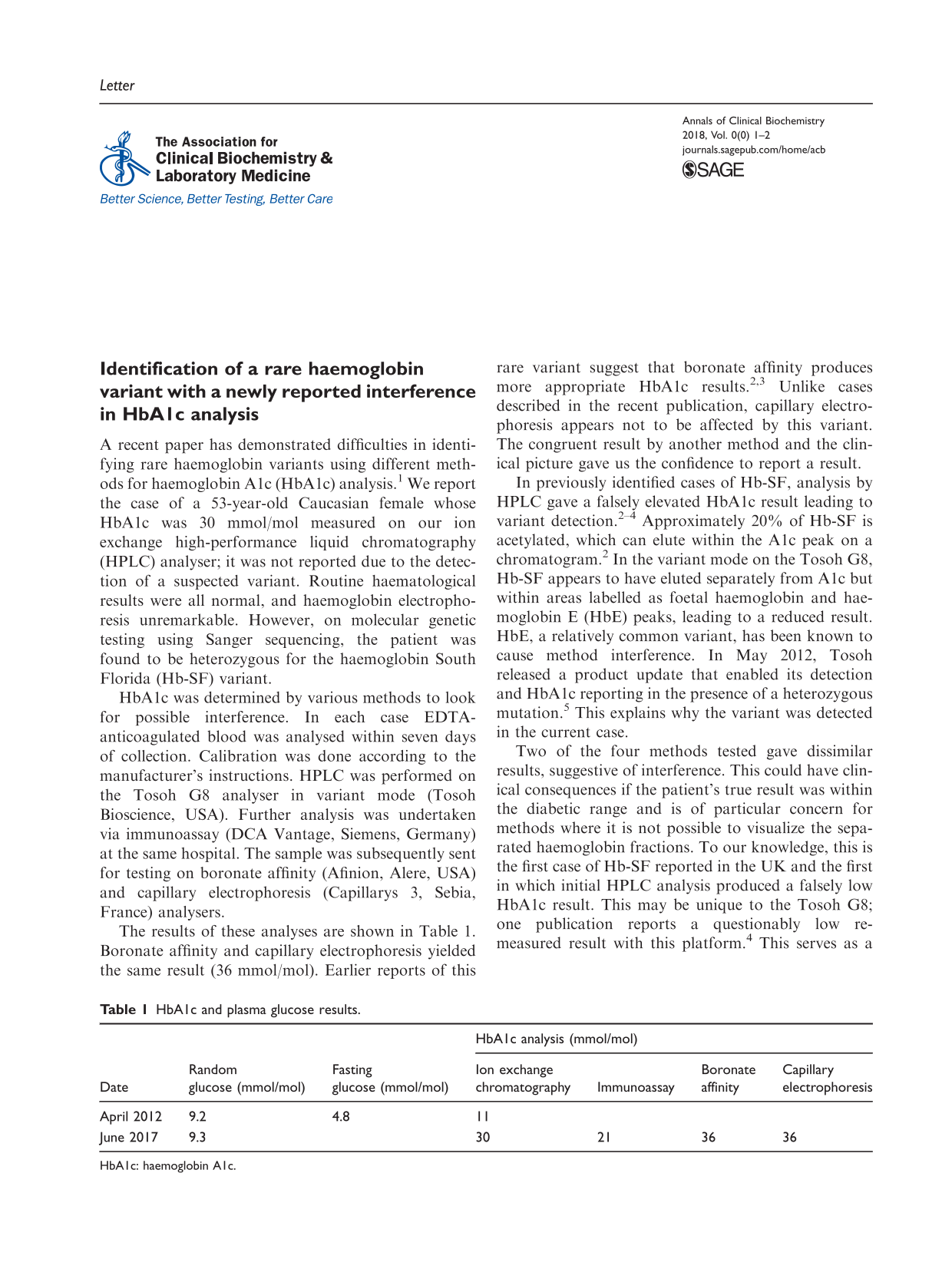
The results of these analyses are shown in Table 1. Boronate affinity and capillary electrophoresis yielded the same result (36 mmol/mol). Earlier reports of this rare variant suggest that boronate affinity produces more appropriate HbA1c results.2,3 Unlike cases described in the recent publication, capillary electrophoresis appears not to be affected by this variant. The congruent result by another method and the clinical picture gave us the confidence to report a result.
HbA1c and plasma glucose results.

HbA1c: haemoglobin A1c.
In previously identified cases of Hb-SF, analysis by HPLC gave a falsely elevated HbA1c result leading to variant detection.2–4 Approximately 20% of Hb-SF is acetylated, which can elute within the A1c peak on a chromatogram. 2 In the variant mode on the Tosoh G8, Hb-SF appears to have eluted separately from A1c but within areas labelled as foetal haemoglobin and haemoglobin E (HbE) peaks, leading to a reduced result. HbE, a relatively common variant, has been known to cause method interference. In May 2012, Tosoh released a product update that enabled its detection and HbA1c reporting in the presence of a heterozygous mutation. 5 This explains why the variant was detected in the current case.
Two of the four methods tested gave dissimilar results, suggestive of interference. This could have clinical consequences if the patient’s true result was within the diabetic range and is of particular concern for methods where it is not possible to visualize the separated haemoglobin fractions. To our knowledge, this is the first case of Hb-SF reported in the UK and the first in which initial HPLC analysis produced a falsely low HbA1c result. This may be unique to the Tosoh G8; one publication reports a questionably low re-measured result with this platform. 4 This serves as a reminder that variant interference in HbA1c testing is not only method specific but also analyser specific.
Footnotes
Acknowledgements
We would like to thank Dr Adam Cookson and Mr Lee Peters in the Department of Biochemistry, Morriston Hospital, Swansea, for facilitating testing on different platforms. We would also like to thank Mr Chris Hooper in the Haemoglobinopathy Laboratory, University Hospital of Wales, for assistance with this patient’s haemoglobinopathy reports.
Declaration of conflicting interests
The author(s) declared no potential conflicts of interest with respect to the research, authorship, and/or publication of this article.
Funding
The author(s) received no financial support for the research, authorship, and/or publication of this article.
Ethical approval
Ethical approval not required. Written informed patient consent has been obtained for publication of this case report.
Guarantor
SZ.
Contributorship
HC prepared the first draft of the text; both authors reviewed and edited the manuscript and approved the final version for submission.