




Abstract
Background
The use of acetaminophen as a drug for pain control is expected to increase in the neonatal field. The displacement factor of acetaminophen in the reaction in the glucose oxidase peroxidase method is very high, but is also considered to be inaccurate based on physicochemical properties.
Method
Unbound bilirubin was measured using the erythrocyte-bound bilirubin measurement method and glucose oxidase peroxidase method by the addition of acetaminophen or sulfisoxazole. The displacement factor was measured using glucose oxidase peroxidase method with the addition of tert-butyl-p-hydroxyanisole.
Results
Acetaminophen did not increase erythrocyte-bound bilirubin, and the addition of tert-butyl-p-hydroxyanisole lowered its displacement factor. On the other hand, sulfisoxazole increased erythrocyte-bound bilirubin, while tert-butyl-p-hydroxyanisole did not change its displacement factor.
Conclusion
Acetaminophen is an accelerator of the reaction in the glucose oxidase peroxidase method and does not displace bilirubin from human serum albumin.
Keywords
In the administration of drugs to neonates, drug-induced bilirubin release from human serum albumin (HSA) is considered to be a risk factor for kernicterus in neonatal jaundice. Based on the theory that HSA-unbound bilirubin plays a critical role in the development of kernicterus, many measurement methods for unbound bilirubin (UB), and the albumin reserve for bilirubin binding have been reported. 1 It is historically famous that the administration of sulfisoxazole to prevent neonatal bacterial infections increased the incidence of kernicterus in premature infants. 2 A later in vitro study demonstrated that sulfisoxazole strongly induced the release of bilirubin from HSA. 3 This finding indicated that an evaluation of the displacement of bilirubin from HSA by all drugs administered to neonate was also needed. To achieve this, UB was measured by mainly employing the glucose oxidase peroxidase method, and the level of the activity was compared based on the displacement factor (KD) determined by this method. 4 Problems associated with the glucose oxidase peroxidase method include the direct influence of drugs on the measurement system, and the accelerated production of free radicals by phenolic group and the inhibitory action of vitamin C have also been identified as influencing factors. 5
To overcome these limitations, we utilize the distribution of bilirubin in the biological materials or tissues such as α-fetoprotein, lipoprotein and erythrocyte membrane. In the displacement of bilirubin from HSA by drug, the drug binds to the bilirubin-binding site of HSA due to its physicochemical properties and releases bilirubin. Since bilirubin is hydrophobic, it readily binds to available hydrophobic substances when released. Bilirubin is distributed in biological tissue through these dynamics. 6 Erythrocyte membrane-bound bilirubin has been investigated extensively in vitro.7,8
Acetaminophen is frequently used in the paediatric field and is expected to be increasingly used as a drug for pain control in the neonatal field. The KD of acetaminophen, which was determined by Onishi et al. 9 and Sugino et al. 10 using the glucose oxidase peroxidase method, was shown to be very high. However, acetaminophen only exhibits weak plasma protein-binding affinity (0%–20%), 11 which cannot explain the very high KD. It also contains a phenolic group. Thus, we investigated the erythrocyte-bound bilirubin (E-B), as UB, in the presence of acetaminophen, and the accelerating effects of acetaminophen in glucose oxidase peroxidase method in vitro compared with sulfisoxazole.
Materials and methods
Bilirubin (Lot GC01, Tokyo Kasei Kogyo Co., Ltd., Tokyo, Japan) was dissolved in 0.1 M sodium hydroxide solution to prepare a bilirubin solution. HSA (essentially fatty acid-free, Sigma-Aldrich Inc., St. Louis, USA) was dissolved with 0.1 M phosphate buffer (pH 7.4) and adjusted to a concentration of 455 μM (3 g/dL) in order to prepare an HSA solution. The bilirubin solution was added to the HSA solution, and the bilirubin concentration was adjusted to 257 μM (15 mg/dL, bilirubin: HSA molar ratio = 0.56) or 684 μM (40 mg/dL, bilirubin: HSA molar ratio = 1.5). sulfisoxazole (Sigma-Aldrich Inc., St. Louis, USA) and acetaminophen (Wako Pure Chemicals Industries Ltd., Osaka, Japan) were dissolved with ethanol, and 5 mM standard solutions were prepared.
Total bilirubin (TB) and UB were measured using an UB-Analyzer (Arrows Co., Osaka, Japan)12,13 at the recommended sample dilution 1:42. 14 Enzymes and dilution buffers (0.1 M, glucose-Na2HPO4-KH2PO4, pH7.38) were provided in the reagent kits.
Displacement from erythrocytes by HSA extraction
Erythrocytes were washed three times with saline and centrifuged at 600 g for 10 min. These erythrocytes were mixed with the bilirubin–HSA solution (684 μM bilirubin, bilirubin: HSA molar ratio = 1.5) at a 1:1 volume ratio and incubated at 37℃ for 15 min. The mixture was distributed to test tubes at 2 mL per tube and combined with sulfisoxazole or acetaminophen. The concentration was adjusted to 0, 1, 3, and 5 mM, and the mixture was incubated at 37℃ for 15 min. TB and UB were measured in the supernatants prepared by centrifugation. E-B was measured as follows: after three-time washing erythrocytes with saline, 1 mL of 455 µM HSA solution and the same volume of the erythrocyte were mixed and incubated at 37℃ for 15 min. The mixture was centrifuged, and 25 µL of the supernatant was applied to high performance liquid chromatography (HPLC) to measure bilirubin, followed by corrections with the hematocrit. HPLC was performed by modifying the method reported by Itoh et al. 15 To measure (ZZ)-bilirubin only, the mobile phase was adjusted to acetonitrile: 0.1 M ammonium acetate buffer (pH 4.85) = 80:20, setting the flow rate at 1 mL/min. A NOVA-Pack C18 column (3.9 × 150 mm, Waters Co., Milford, USA) was used, and the detection wavelength was set at 454 nm. The bilirubin preparation contained 9.5% bilirubin IIIα and 20.9% bilirubin XIIIα, in addition to bilirubin IXα, when measured after binding to HSA, and these were included in the analysis of bilirubin IXα. The bilirubin concentration was measured using the absolute calibration curve method based on the peak area measured using Chromatopac CR-6 A (Shimazu Co., Kyoto, Japan). All measurements were performed three times, and the mean was adopted.
Accelerating effects in the glucose oxidase peroxidase method
Acetaminophen was added to 200 µL of the bilirubin–HSA solution (257 μM bilirubin, bilirubin: HSA molar ratio = 0.56) at the same concentrations as sulfisoxazole (1, 3, and 5 mM) as controls. To observe the accelerating effects, a free radical-based accelerator inhibitor, tert-butyl-p-hydroxyanisole (BHA) (Sigma-Aldrich, St Louis Inc. St. Louis, USA), was used. 5 One volume of 40 mM BHA in ethanol was added to 800 volumes of the dilution buffer, setting a final BHA concentration of 50 µM. 5 TB and UB were measured using this dilution buffer. As control, we used the non-BHA dilution buffer. We calculate acetaminophen KD at 0.025, 0.04 and 0.05 mM concentrations that observed the initial reaction velocity. All measurements were performed triple, and the mean was adopted.
Statistical analysis
Changes in the measured values with changes in the drug concentration were investigated by linear regression analysis, and the significance of between-group differences in the regression line was investigated using an analysis of covariance. The significance level was set at P < 0.05. Statistical analyses were performed using GraphPad Prism version 5.01 for Windows, GraphPad Software, San Diego California USA, www.graphpad.com.
Results
Displacement from erythrocytes by the HSA extraction
The addition of sulfisoxazole significantly decreased TB (P < 0.001) and UB (P < 0.001) and significantly increased E-B (P < 0.0001). The UB/TB ratio was constant (5.9 × 10⁻⁴) (Figure 1(a)). In contrast, the addition of acetaminophen significantly decreased TB (P = 0.0079), although the reduction rate was less than sulfisoxazole. UB was markedly increased by the addition of acetaminophen, and its concentration remained elevated regardless of the drug concentration. No significant change was noted in the E-B concentration with an increase in the concentration of acetaminophen (P = 0.69) (Figure 1(b)).
Drug concentrations and changes in erythrocyte-bound bilirubin (E-B), total bilirubin (TB), and unbound bilirubin concentrations (UB). (a) Sulfisoxazole: the addition of sulfisoxazole decreased TB by 98.3 µM, UB by 4.7 nM and increased E-B by 12.0 nM/Ht. (b) Acetaminophen: with the addition of acetaminophen, TB was decreased by 15.4 µM, UB was markedly increased by 30.5 nM and E-B remained at 5.1 nM/Ht. Closed circle indicates mean E-B, closed square, UB and open circle, TB, Ht: hematocrit.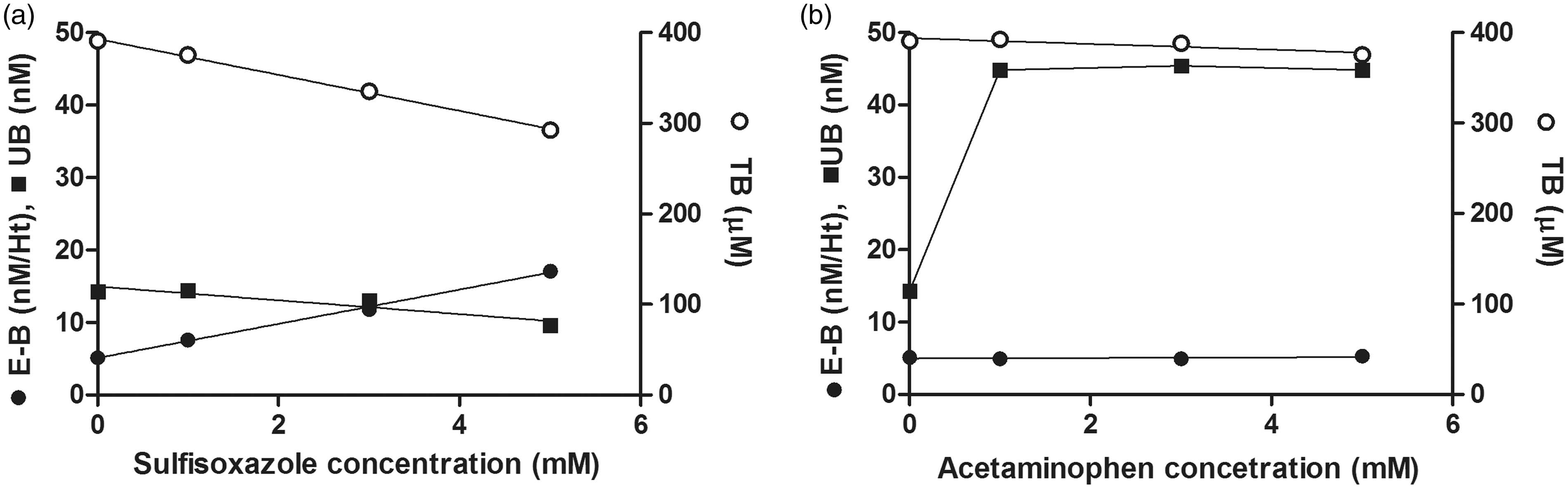
Accelerating effects in the glucose oxidase peroxidase method
KD was calculated from the drug concentration and slope of the V/V0 graph, using the equation: V/V0 = KD·D+1(V: UB with drug addition, V0: UB without drug addition, D: drug concentration).
4
The KD of sulfisoxazole in the presence and absence of BHA were 6.0 × 10² and 5.0 × 10² M−1, respectively, and were not significantly different (P = 0.24) (Figure 2(a)). However, BHA significantly reduced the KD of acetaminophen from 1.6 × 10⁵ to 5.3 × 10³ M−1 (P = 0.002) (Figure 2(b)).
Tert-butyl-p-hydroxyanisole (BHA)-induced changes in the initial reaction rate. (a) Sulfisoxazole: open circle means V/V0 in the presence of BHA (r2 = 0.964), and closed circle means without BHA (r2 = 0.800). (b) Acetaminophen: data shown without open circle, r2 = 0.961 and with closed circle, r2 = 0.952 the presence of BHA.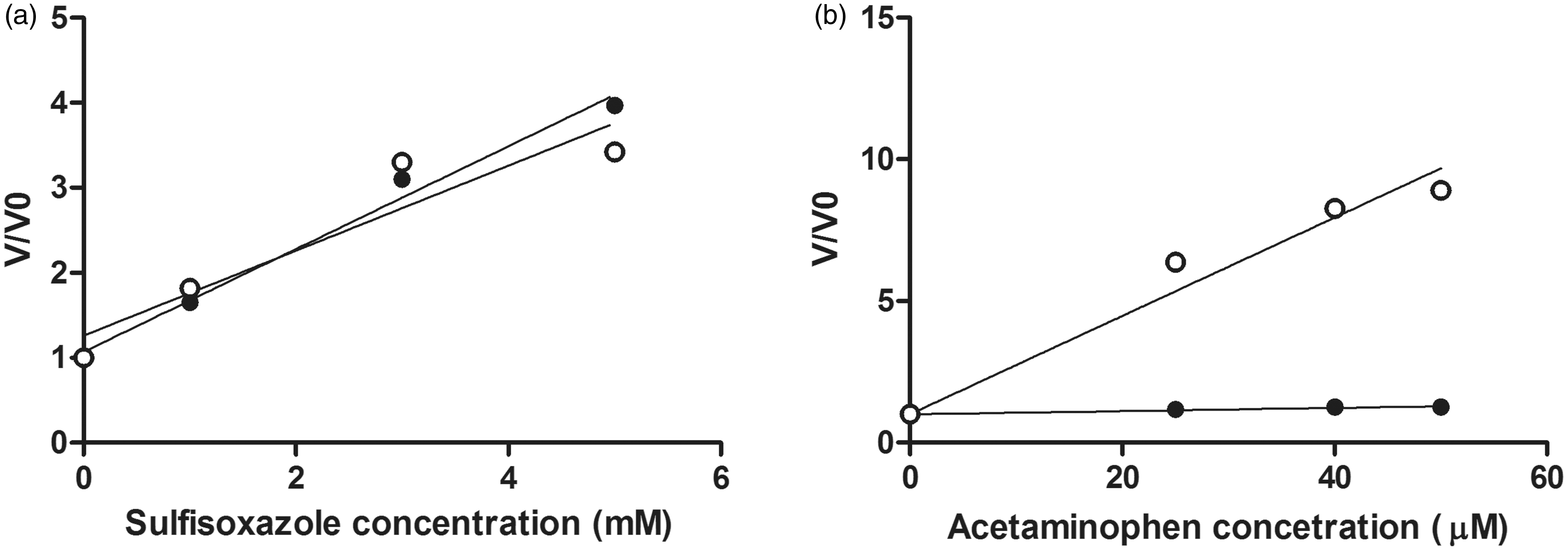
Discussion
We compared the displacement of bilirubin from HSA by acetaminophen with that by sulfisoxazole using a non-chemical reaction system. Drugs that displace bilirubin and do not accelerate the production of free radical, resulting in decreased TB and increased E-B concentrations. Although UB was assumed to be increased by these drugs, it decreased in this measurement system with high bilirubin/albumin molar ratio. A correlation between UB and E-B in the measurement system with non-supersaturated bilirubin16,17 has been reported previously. We considered that supersaturated bilirubin was partially aggregated in the aqueous solution, and the aggregated bilirubin did not react with peroxidase.
Drugs that accelerate production of free radical only slightly decreased TB concentrations, did not change E-B concentrations and markedly increased UB concentrations. Sulfisoxazole which has historically been proven to displace bilirubin both in vivo and in vitro, as the control drug,2,3 was a true bilirubin displacer from HSA. Our results indicated that acetaminophen was an accelerator to influence the glucose oxidase peroxidase reaction resulting in false positive increase of UB. It is important to use a system that incorporates the distribution of bilirubin in the biological organs or tissue, which most accurately reflects the physicochemical properties of bilirubin, in order to assess the bilirubin-displacing effect of drugs in vitro. We used erythrocytes as a biological tissue. Although the binding of bilirubin to the erythrocyte membrane was shown to be markedly weaker than that to HSA, 18 UB was readily distributed to the erythrocyte membrane because it is very hydrophobic and could be easily collected through binding to HSA.
We also investigated the accelerating effects of drugs using the radical scavenger, BHA, in the glucose oxidase peroxidase reaction, by setting the BHA concentration according to that reported by Brodersen et al. 5 Although UB decreased at both drugs concentration of 1 to 5 mM by the addition of BHA, both the slopes (ΔUB/Δdrug concentrations) were same (data not shown). At the acetaminophen concentrations employed for the initial reaction velocity, the slope (ΔUB/Δacetaminophen concentrations) is significantly decreased. The BHA-induced effect was also compared based on V/V0 instead of the UB concentration. The slope of sulfisoxazole (ΔV/V0/Δsulfisoxazole concentrations) is same with or without BHA at a concentration of 1 to 5 mM, while the slope of acetaminophen (ΔV/V0/Δacetaminophen concentrations) at a concentration of 0 to 50 µM decreased by the addition of BHA. Therefore, these results indicated that acetaminophen was an accelerator to influence the glucose oxidase peroxidase reaction, similar to phenol, chlorpromazine and propyl paraben. 5 Regarding the mechanism underlying this acceleration, it is assumed that the phenolic group of acetaminophen reacts with peroxidase in the presence of H2O2 produced by the glucose oxidase reaction. The phenoxy radical is formed by oxidation, and, when the phenoxy radical returned to phenol group, superoxide anion radical was produced and reacted with UB.
A previous pharmacokinetic study reported that the effective serum concentration of acetaminophen for neonates born after 32–45 weeks of gestation was 10–23 mg/L (66–152 µM). 19 Since a concentration of 20 µM or higher of acetaminophen elevated UB concentrations in our study, 10 attention should be paid to the influence of acetaminophen as an accelerator in vivo, i.e. the UB concentration may appear to increase after the clinical administration of acetaminophen to neonates when it is measured using the glucose oxidase peroxidase method.
Conclusion
The bilirubin-displacing effects of drugs in vitro should be assessed using a system utilizing the distribution of bilirubin in the biological organs or tissues, which most accurately reflects the physicochemical properties of bilirubin. Displacer and accelerating effects in the glucose oxidase peroxidase reaction may be judged better by employing a measurement system that uses the erythrocytes.
Footnotes
Acknowledgements
None.
Declaration of conflicting interests
None.
Funding
This research received no specific grant from any funding agency in the public, commercial, or not-for-profit sectors.
Ethical approval
Not required.
Guarantor
SI.
Contributorship
HO, SI contributed to the conception and design of this study; SM, HO performed analysis. HO, SI critically reviewed the manuscript, and SI and KT supervised the whole study process.