



Abstract
The Smackover Formation brines in southern Arkansas contain a large quantity of lithium, a critical resource for electric vehicle batteries and the global energy transition. To extract the lithium, efficient downstream enrichment technologies are urgently needed. Methods for direct lithium extraction are being explored, followed by further purification and concentration of the lithium salt solution, such as using reverse osmosis, which is energy intensive. Here we use reduced graphene oxide (RGO) membrane-based forward osmosis (FO) as an environment-friendly and near zero-energy input method to concentrate lithium brine. In the FO tests, a saturated NaCl solution serves as a draw solution and either a dilute lithium nitrate (LiNO3) solution (50.4 mM) or an artificial lithium brine (1.00 M NaCl + 12.0 mM LiNO3) as a feed solution, where LiNO3 is selected to mimics the typical LiCl component in lithium brine. Because nitrates have a unique absorption feature at ∼300 nm, their concentrations in both the feed and draw solutions can be monitored by a facile ultraviolet–visible (UV–Vis) absorption spectral method. For the dilute LiNO3 solution, a rejection rate is determined to be 97.9 ± 0.1%, with a water flux of 6.2 ± 0.2 L/hm2. For the artificial brine, a rejection rate of 88.4 ± 0.1% and a water flux of 5.0 ± 0.2 L/hm2 are observed. With further optimization, this forward osmosis approach could provide a more energy-efficient method for lithium salt enrichment, supporting sustainable lithium extraction from Smackover brines.
This is a visual representation of the abstract.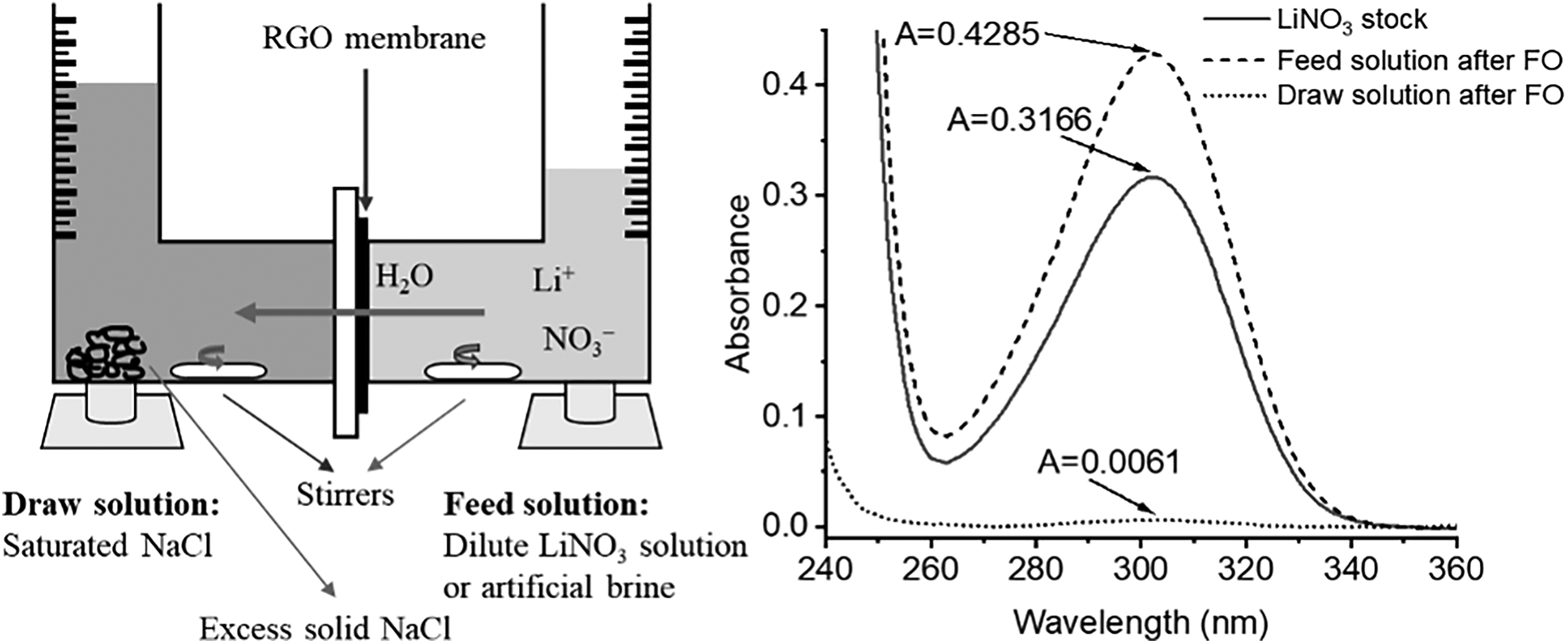
Keywords
Get full access to this article
View all access options for this article.
References
Supplementary Material
Please find the following supplemental material available below.
For Open Access articles published under a Creative Commons License, all supplemental material carries the same license as the article it is associated with.
For non-Open Access articles published, all supplemental material carries a non-exclusive license, and permission requests for re-use of supplemental material or any part of supplemental material shall be sent directly to the copyright owner as specified in the copyright notice associated with the article.
