



Abstract
Electrospun fibers generally exhibit improved properties with a reduction in diameter, a phenomenon often correlated with a higher orientation of the polymer chains. Over the years, confocal Raman microscopy has proven to be a valuable technique for studying the molecular orientation of individual fibers and understanding how electrospinning conditions govern their structure–properties relationships. However, the current methods for the quantification of orientation, via the order parameter ⟨P2⟩, require the acquisition of four Raman spectra in different polarization configurations, which makes them prone to drifts. Band ratio calibration curves are a useful alternative, but they may not be as reliable because they only rely on two bands. In this work, we develop a calibration method based on partial least squares regression (PLSR) to quantify the order parameter ⟨P2⟩ values from a single polarized Raman spectrum. As proof of concept, we demonstrate PLS models for three polymers exhibiting contrasting orientation and spectral properties, namely poly (ethylene terephthalate) or PET, poly (ethylene oxide) or PEO, and polyoxymethylene (POM). The three PLS models provide good calibration quality and prediction performance, where the errors of the predicted values are similar to those of the calibration data. We also demonstrate the applicability of our PLS models by reproducing the evolution of orientation with fiber diameter for the three systems investigated.
This is a visual representation of the abstract.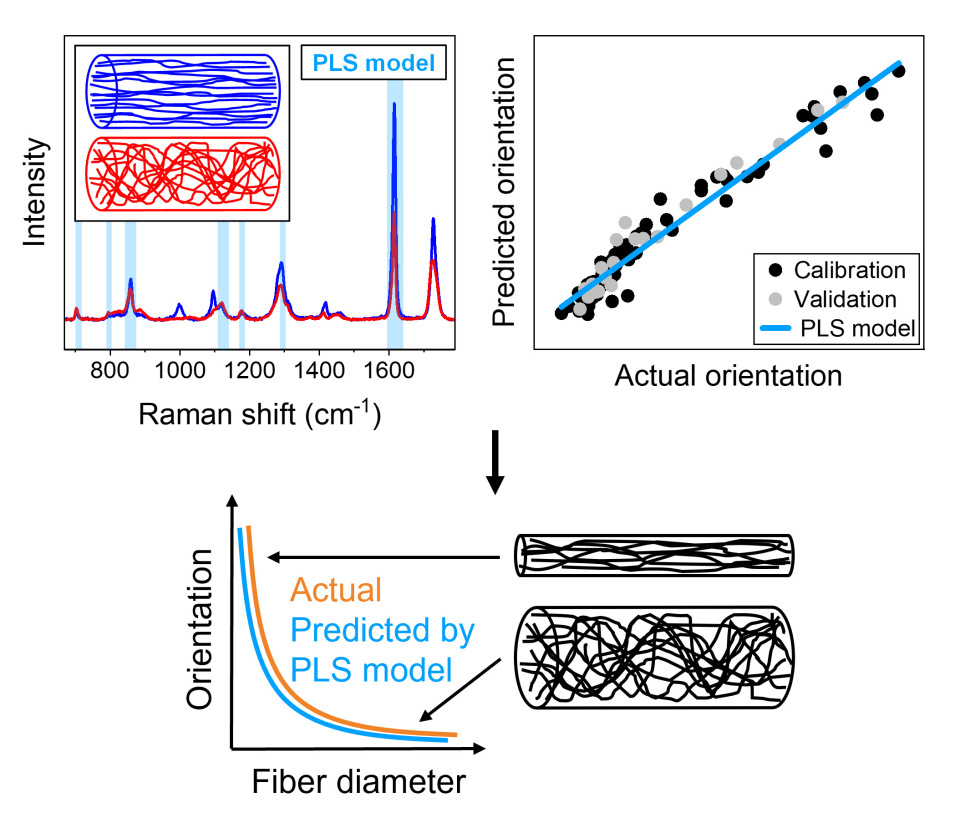
Keywords
Get full access to this article
View all access options for this article.