



Abstract
Laser-induced breakdown spectroscopy (LIBS) has broad application potential, yet its analytical accuracy is often limited by poor spectral stability. Since plasma optical signals directly reflect plasma fluctuations, they offer a promising basis for spectral correction. In a novel approach, we introduce a neuromorphic dynamic vision sensor (DVS) to capture plasma dynamics with microsecond temporal resolution. The DVS provides a 120 dB dynamic range and a low data rate (∼10 MB/s), enabling acquisition of plasma optical signals over a wide range of conditions. We further propose an event-enhanced spectroscopy correction network (EESCN), which employs a dual-stream convolutional neural network (CNN) to extract key features from spectra and plasma images, respectively. A multihead attention module then performs cross-modal fusion by dynamically weighting spectral and image features to predict and correct signal fluctuations. To emulate challenging conditions, we introduced laser energy fluctuations and selected spectral lines affected by self-absorption. EESCN substantially suppressed spectral fluctuations arising from self-absorption and laser energy fluctuations for C(I) 493.202 nm and Mn(I) 403.076 nm in carbon steel, and for Cu(I) 327.395 nm and Zn(I) 328.233 nm in copper alloys, reducing the mean relative standard deviations by 70.52%, 79.33%, 80.76%, and 72.09%, respectively. Calibration curves constructed from the corrected spectra all achieved R2 values above 0.99, markedly outperforming the original spectra, normalization, and other correction methods. By integrating a low-cost, high-speed DVS with a cross-modal fusion model, this work provides a practical and powerful solution for mitigating spectral instability in LIBS and supports robust on-site analytical applications.
This is a visual representation of the abstract.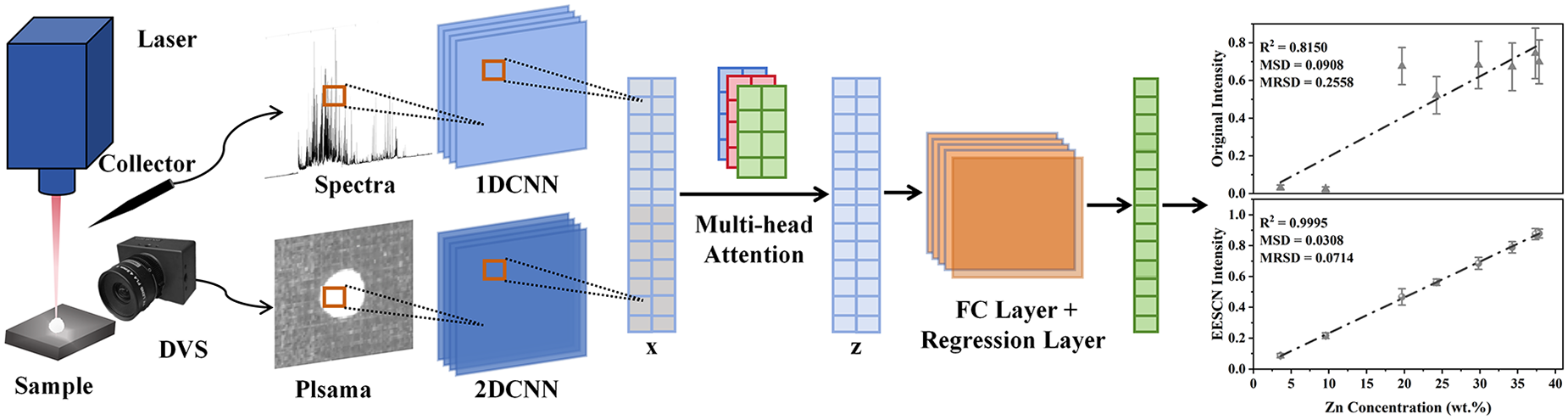
Keywords
Get full access to this article
View all access options for this article.