




Abstract
Sediment contamination by trace elements (TE) is a major environmental issue. In particular, TE speciation is of great importance because the form of the TE determines their mobility, bioavailability, and consequently their potential toxicity. Characterizing the chemical speciation of TEs can be complex and costly with current analytical methods. Non-destructive spectroscopic methods, which require limited sample preparation, are therefore useful tools for characterizing and possibly quantifying TEs in complex sedimentary matrices. Thus, this study explores the potential of visible and near-infrared hyperspectral imaging (HSI) to estimate the speciation of some TEs in sediments based on their spectral properties. Standard ranges of sixteen chemical species of six TEs, i.e., arsenic (As), cadmium (Cd), copper (Cu), nickel (Ni), lead (Pb), and zinc (Zn), were produced using three model sediment matrices (clay, silt, and organic matter). The results obtained show specific absorptions for each of the TE species, and nine of them could be quantified with detection limits of around 1 g/kg in the visible range and around 10 g/kg in the short-wave infrared range. This approach enables a more accurate and rapid assessment of environmental risk using HSI, in addition to conventional analytical methods.
This is a visual representation of the abstract.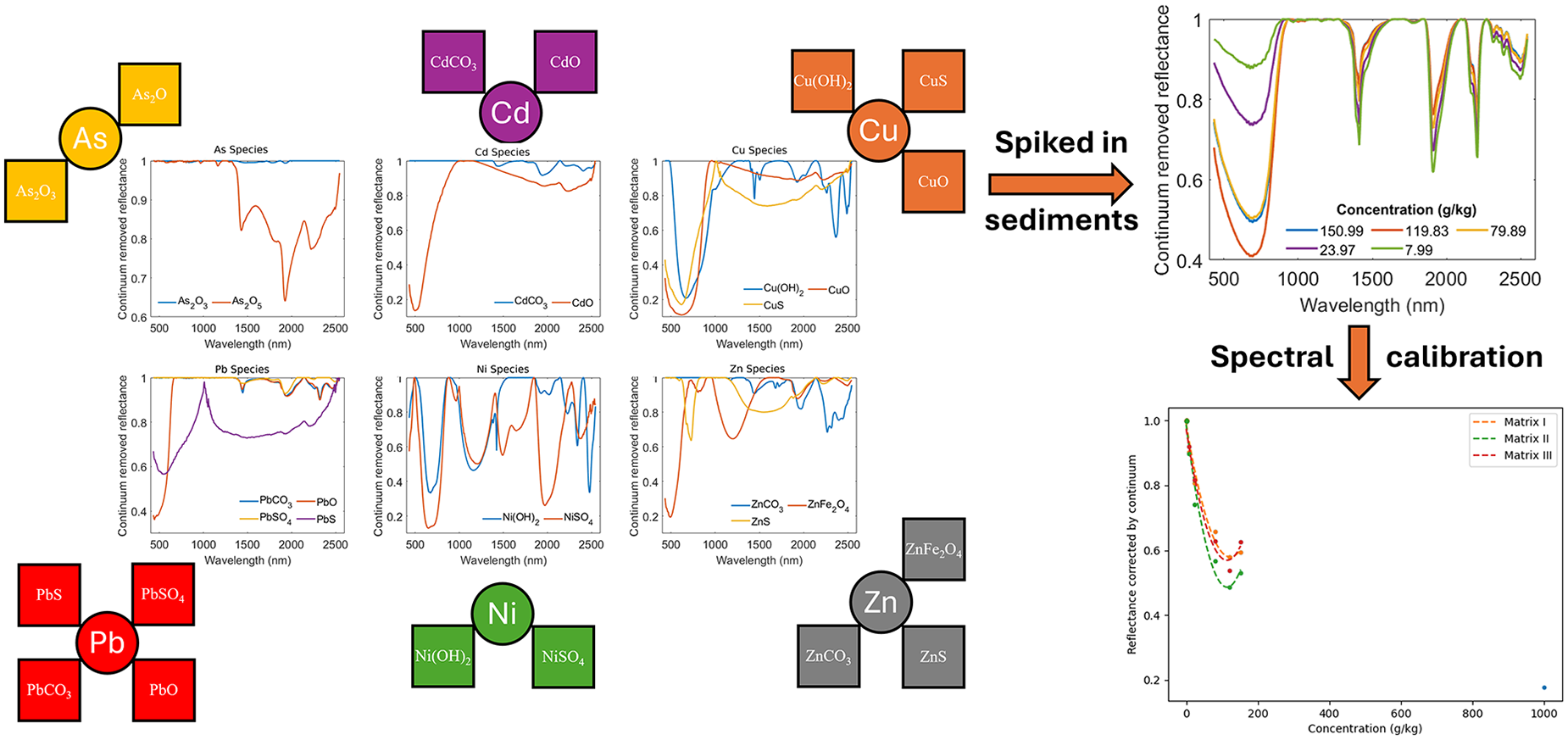
Get full access to this article
View all access options for this article.