



Abstract
Hair fluorescence spectroscopy was evaluated as a novel, non-invasive biomarker for the diagnosis and disease monitoring of systemic lupus erythematosus (SLE). Hair samples were collected from 47 female patients with SLE and 49 age-matched healthy controls (HC), with patients stratified into three clinical groups: active flare, remission of six months to three years (R6M–3Y group), and remission of more than three years (R > 3Y group). Fluorescence emission spectra of hair strands were recorded under ultraviolet excitation and analyzed using multivariate statistical methods, including principal component analysis and hierarchical clustering, to assess group discrimination. The fluorescence profiles differed significantly between SLE patients and the HC group, and within the SLE cohort, spectral signatures varied according to disease activity, enabling discrimination between flare and remission (low disease activity) states. Patients in long-term remission (R > 3Y) showed partial convergence toward the HC group, suggesting progressive normalization over time. Overall, hair fluorescence spectroscopy emerges as a non-invasive, inexpensive, and stable biomarker reflecting both disease presence and remission dynamics in SLE, with potential to complement existing clinical and laboratory indices and to provide rheumatologists with a novel tool for longitudinal disease monitoring.
This is a visual representation of the abstract.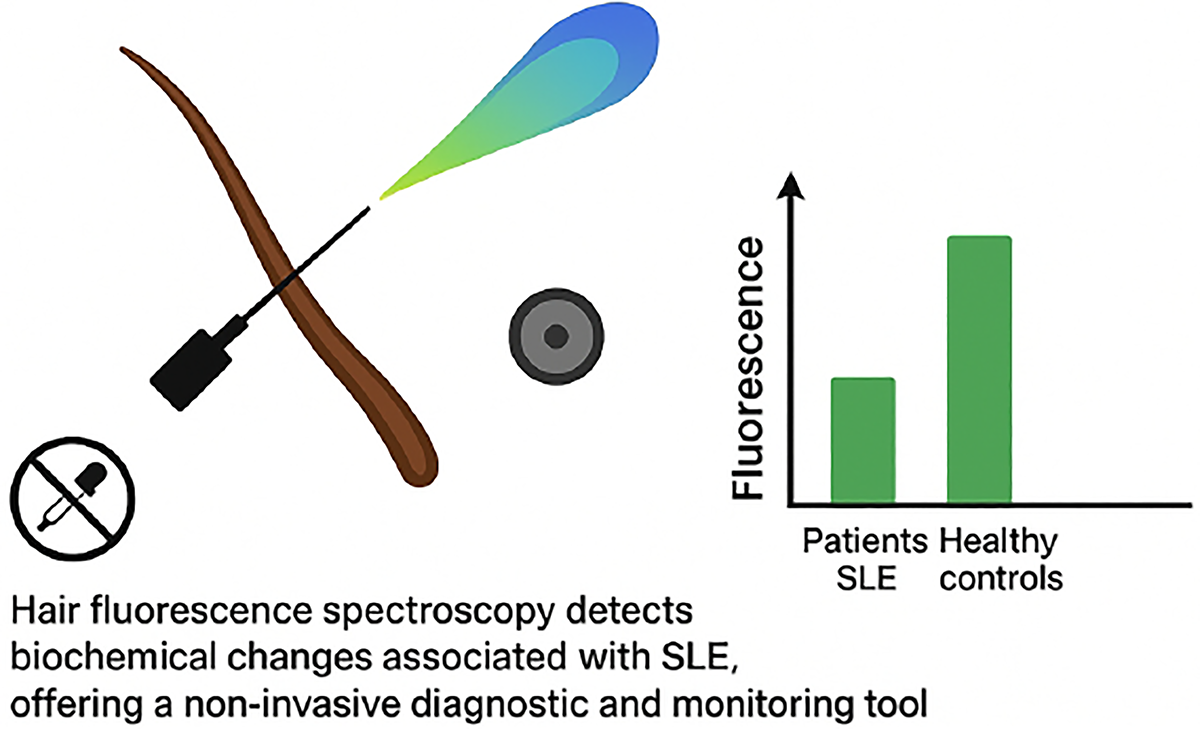
Get full access to this article
View all access options for this article.