




Abstract
Bamboo craftsmanship is highly valued for its aesthetics and cultural significance. The classification of bamboo craftsmanship plays a key role in preserving its heritage and ensuring its quality. However, the surface characteristics of bamboo exhibit substantial variation due to environmental factors. This study proposes a novel method using laser-induced breakdown spectroscopy (LIBS) combined with spectral data fusion to enhance the identification accuracy of bamboo age ranges. By fusing spectra from different bamboo parts, a broader range of elemental compositions can be captured while minimizing the influence of regional variations. A total of 50 bamboo craftsmanship samples of five different age ranges were prepared, and their internal and external surface LIBS spectra were collected for data analysis. Experimental results demonstrate that the peak selection–linear discriminant analysis model presents the highest classification accuracy of 99.0% before spectral data fusion. After fusion, the accuracy can be further improved to 99.9%. Additionally, a comparison of various data fusion methods reveals that the Concat method, which increases the dimensionality of the feature space and provides richer data representation, exhibits the best compatibility with LIBS spectral characteristics and classification models. In conclusion, the combination of LIBS and data fusion methods proves to be an effective approach for accurately identifying bamboo age ranges.
This is a visual representation of the abstract.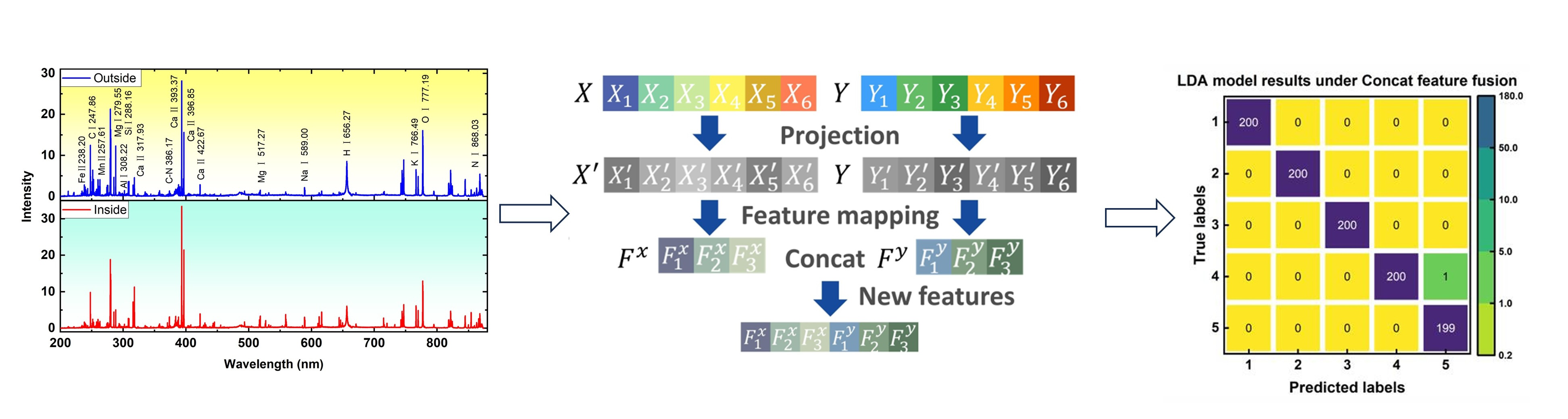
Keywords
Get full access to this article
View all access options for this article.