




Abstract
Butterfly wings exhibit optical phenomena resulting from pigments as well as from intricate nanostructures of the scales that plays an important role in their ecology mainly, communication, thermoregulation as well as mating. In our study, we examined the optical behavior of butterfly wing scales by analyzing their percent reflectance, absorbance, percent transmittance, and effective refractive index using ultraviolet–visible near-infrared (UV–Vis-NIR) spectroscopy which is a valuable analytical technique that provide details of the optical properties of materials. In the study conducted with 10 butterflies, the UV, visible, and NIR regions are highlighted to determine the optical properties of butterflies. From the study, it is explored that the UV region exhibit major absorbance, the visible region exhibits major reflectance, and infrared regions exhibit minor reflectance. Optical parameters other than reflectance and absorbance are derived from the spectroscopic data and plotted using Origin software. The percent reflectance, absorbance, percent transmittance, effective refractive index, and their respective wavelength of butterflies studied vary across species. Ariadne merione is observed to have the highest percent reflectance and the lowest is observed in the Eurema hecabe. The overall percentage of reflectance observed in the study ranges between 46%–68%. The absorbance is observed highest for Parantica aglea and lowest for Ypthima huebneri with optimum absorbance ranging between 1.23–0.82. The highest transmittance percentage is observed for Tirumala septentrionis, and the lowest value is observed in Mycalesis mineus and E. hecabe with optimum transmittance ranging between 63% to 47%, respectively. The refractive index was analyzed using the Fresnel equation, followed by an empirical Cauchy dispersion fit to characterize its wavelength dependence. The results revealed unusually high refractive index values for a biological specimen, indicating an effective refractive index behavior influenced by structural, pigmentation and optical complexity rather than representing the intrinsic material refractive index. This study is the first record on comprehensively determining the optical properties of Indian butterflies especially effective refractive index using UV–Vis-NIR spectroscopy.
This is a visual representation of the abstract.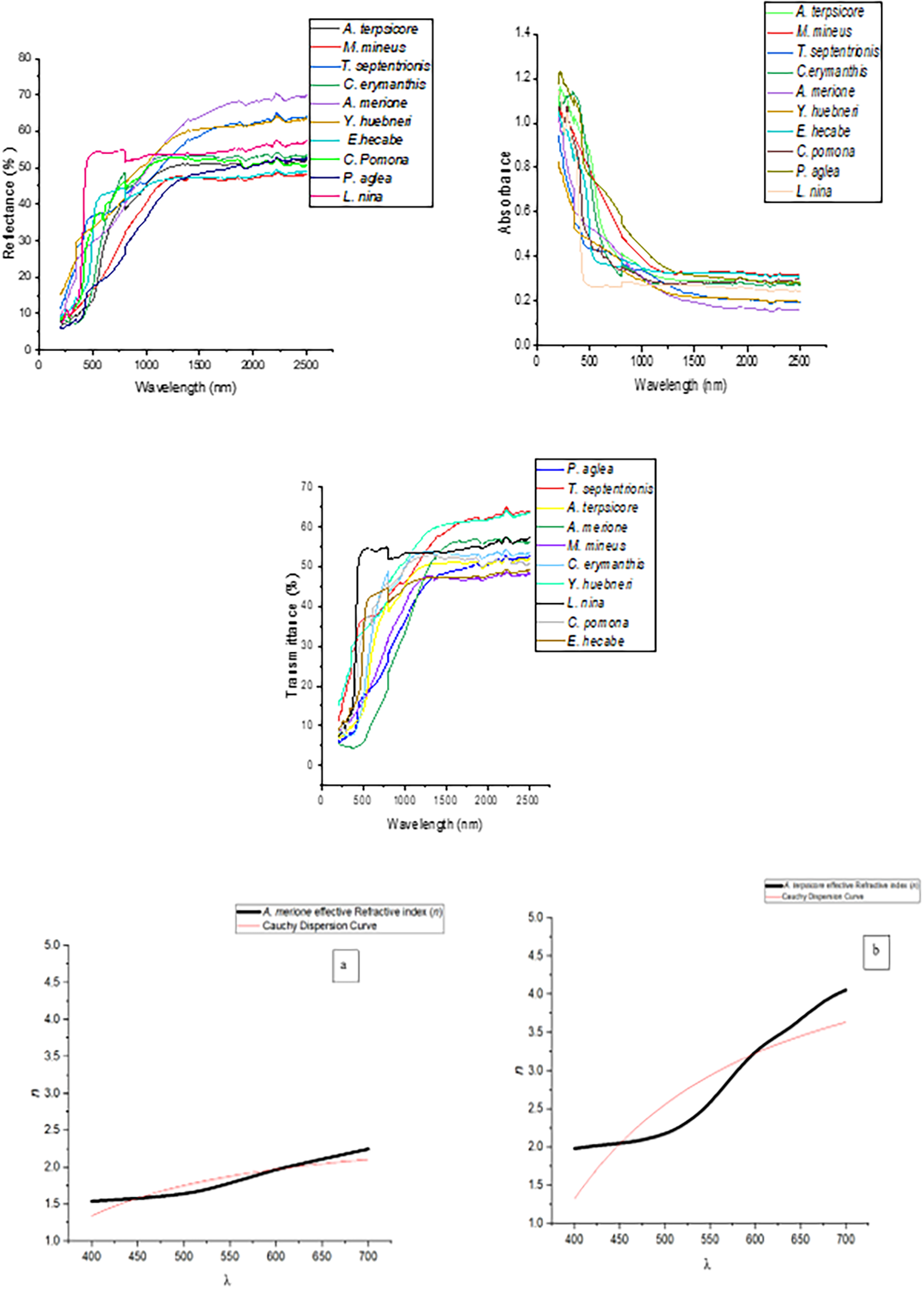
Keywords
Get full access to this article
View all access options for this article.