




Abstract
In the post-fire stage, precipitation and superficial incorporation of ashes alter the chemical properties of the soil. This study evaluated the combined effects of spectral preprocessing methods, data partitioning strategies, and modeling approaches on soil pH prediction using a portable near-infrared (NIR) spectrometer in wildfire ash-enriched soil. A laboratory column experiment was conducted using disturbed sandy loam soil, in which wildfire ashes were incorporated. The experimental design considered five treatments (n = 3) of Eucalyptus globulus and Quillaja saponaria ash incorporations (C: no ash; T1: 2% ash at 2.5 cm; T2: 2% ash at 5 cm; T3: 4% ash at 2.5 cm; T4: 4% ash at 5 cm). After simulating a precipitation of 20 mm h–1 for 6 hours, the soil columns were sampled at 5 depths (D1: 2–3 cm, D2: 7–8 cm, D3: 12–13 cm, D4: 16–17 cm, D5: 20–21 cm). The samples were analyzed using a NIR spectrometer (range: 1350–2550 nm), and the levels of pH (1:2.5) were determined in the laboratory. Eight preprocessing techniques (P0 to P7) were tested, including absorbance conversion, mean centering, trimming, smoothing, standard normal variate (SNV), moving window average (MWA), Savitzky–Golay filtering, and first derivative transformation. Using the Kennard–Stone method, 70% of the data was used for calibration (CAL) and 30% for validation (VAL), considering two partitioning approaches, the same partition by pseudo absorbance values (Scenario A) and different partitions by preprocessing method (Scenario B). Partial least square (PLS) and random forest (RF) models were applied, and performance was assessed using root mean square error (RMSE), coefficient of determination (r2), and ratio of performance to interquartile distance (RPIQ) analyses. The most accurate pH predictions were achieved with RF under Scenario B using trimming + standard normal variate (SNV) + moving weighted average (MWA) preprocessing, yielding r2 values of 0.95 (CAL) and 0.91 (VAL), with RMSEs of 0.23 (CAL) and 0.57 (VAL), and RPIQs of 4.33 (CAL) and 4.61 (VAL). Overall, portable NIR spectroscopy demonstrated strong potential for soil pH prediction in ash-enriched soil, emphasizing the critical role of appropriate spectral preprocessing to avoid overfitting. These findings provide insights into applying portable NIR spectroscopy as a cost-effective tool for monitoring soil pH following wildfires.
This is a visual representation of the abstract.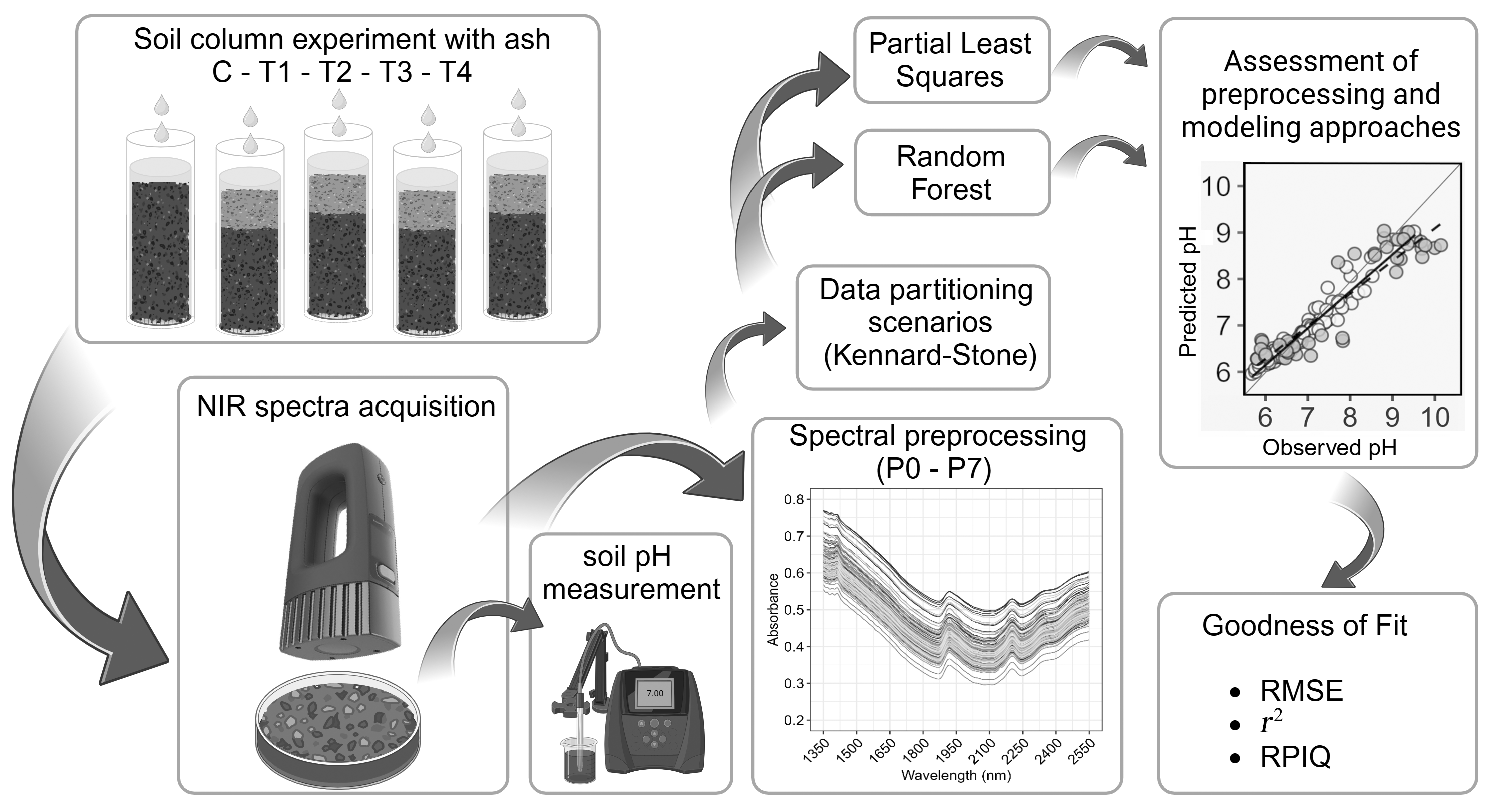
Keywords
Get full access to this article
View all access options for this article.
References
Supplementary Material
Please find the following supplemental material available below.
For Open Access articles published under a Creative Commons License, all supplemental material carries the same license as the article it is associated with.
For non-Open Access articles published, all supplemental material carries a non-exclusive license, and permission requests for re-use of supplemental material or any part of supplemental material shall be sent directly to the copyright owner as specified in the copyright notice associated with the article.
