



Abstract
High-spatial-resolution tip-enhanced Raman spectroscopy (TERS) measurements were carried out under ambient conditions on graphene nanobubbles with various associated structural features. The resulting signals were analyzed with consideration of the characteristic features inherent to high resolution TERS. Compared to flat graphene regions, nanobubbles and their associated nanoconvex pinning sites demonstrated enhanced TERS signals, attributed to the efficient coupling between the strong tip-enhanced electric field and out-of-plane deformations in graphene. Strong coupling with highly confined near-field light activates the D bands even in the absence of defects, with intensity depending on the degree of deformations. While the D band is observed across the nanobubbles, some local regions exhibit a weaker D band intensity compared to the surrounding areas. Given the finite number of hexagonal lattices within the area of highly confined near-field, this reduction in intensity is likely to result from defects that cause missing hexagonal lattices. These findings highlight the capability of near-field induced Raman signals in probing high resolution features of nanomaterials even under ambient conditions, providing deeper insights into their characteristics in situ.
This is a visual representation of the abstract.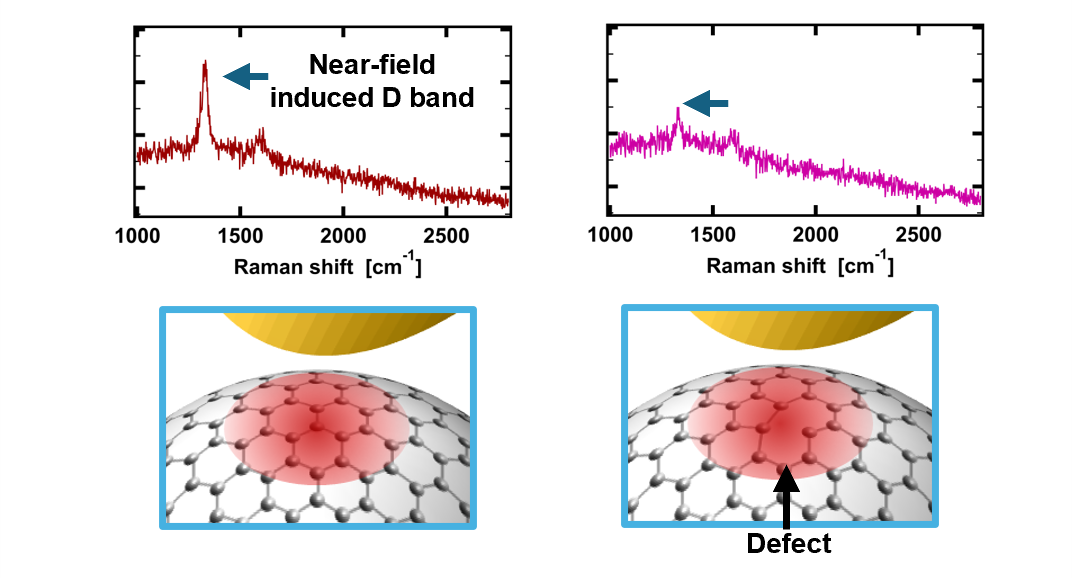
Keywords
Get full access to this article
View all access options for this article.
References
Supplementary Material
Please find the following supplemental material available below.
For Open Access articles published under a Creative Commons License, all supplemental material carries the same license as the article it is associated with.
For non-Open Access articles published, all supplemental material carries a non-exclusive license, and permission requests for re-use of supplemental material or any part of supplemental material shall be sent directly to the copyright owner as specified in the copyright notice associated with the article.
