




Abstract
The impact of pulsing a radio frequency (RF) glow discharge lamp on analytical aspects in glow discharge optical emission spectrometry (GD-OES) was investigated. The experiments were done with a LECO GDS950 spectrometer. This instrument has a fixed pulse frequency of 320 Hz and adjustable pulse duty cycles (PDC) 100%–6.4%. In the first part, emission yields (EY) were studied by measuring coated steel samples in compositional depth profiling (CDP) mode. Variations in EY were measured by integrating the intensity of emission lines from several elements through the entire coatings at several PDC settings. The results show generally small EY variations. For improved accuracy, a set of correction constants is suggested. In the second part, the impact on signal-to-background (S/B), signal-to-noise-noise (S/N), and precision was investigated using “high current” pulsing. This means increased pulse power leaving the average power constant at the different PDC settings. The samples were a low alloy steel and a high purity iron blank (background) sample. The results showed significant increase of the S/B and S/N for four out of six spectral lines investigated at increasing pulse power, showing potential for improved detection limits (DL). Furthermore, there was a tendency towards improved precision with higher pulse power. Finally, the effect on depth resolution in CDP was investigated by running a ZnNi coated steel using “high current” pulsing. It was found that the depth resolution was unaffected up to 30% PDC.
This is a visual representation of the abstract.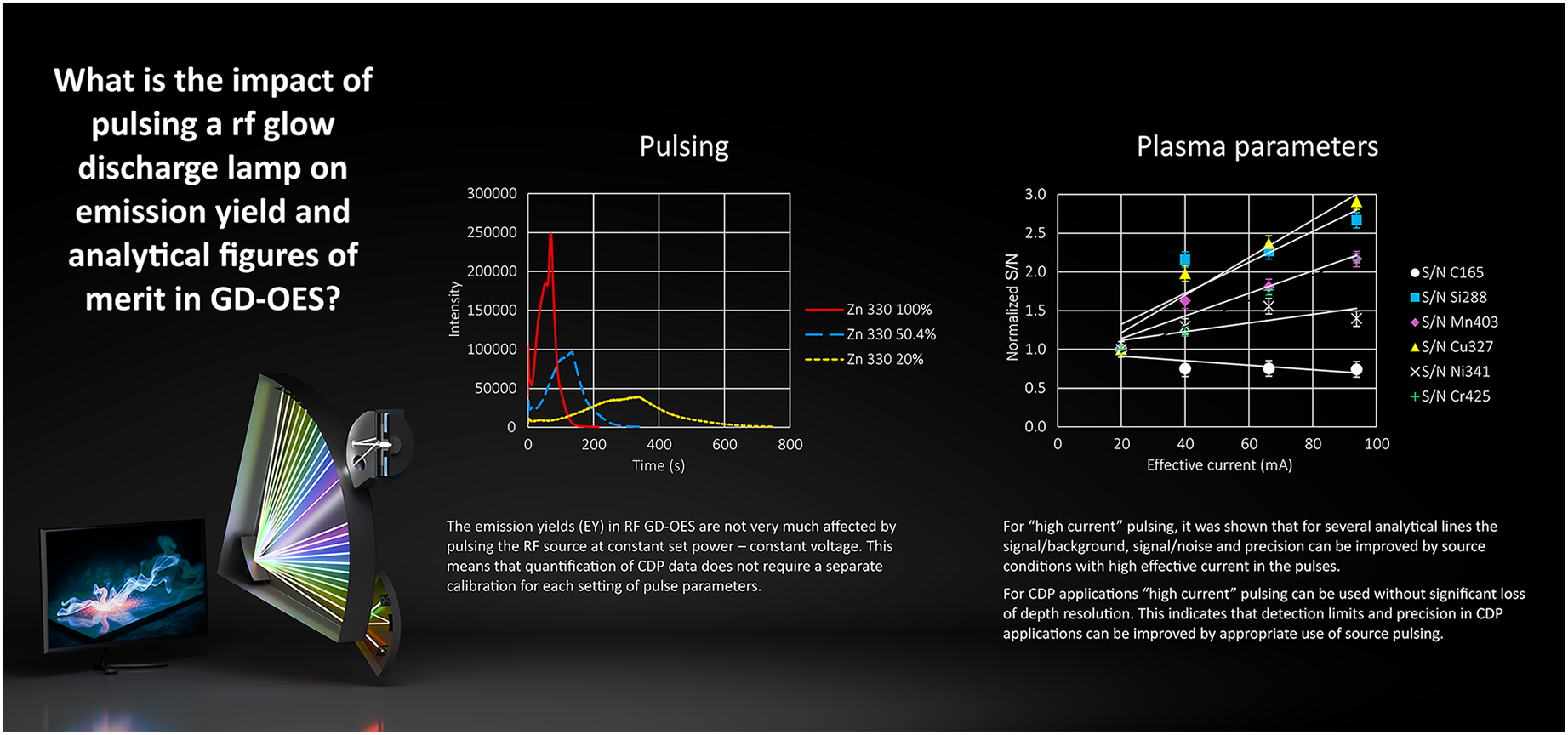
Keywords
Get full access to this article
View all access options for this article.
References
Supplementary Material
Please find the following supplemental material available below.
For Open Access articles published under a Creative Commons License, all supplemental material carries the same license as the article it is associated with.
For non-Open Access articles published, all supplemental material carries a non-exclusive license, and permission requests for re-use of supplemental material or any part of supplemental material shall be sent directly to the copyright owner as specified in the copyright notice associated with the article.
