



Abstract
The waxy gene of maize is a high value breeding target, but it is time consuming to separate waxy and wild-type kernels. A common method involves staining the endosperm with iodine. Near-infrared reflectance (NIR) spectroscopy has been used in several species including maize with success. A custom-built single kernel NIR spectroscopy instrument was used to scan 2880 individual kernels from 60 samples with a diversity of pedigrees, with both waxy, wild type, and heterozygous kernels represented. Chemical analysis was performed to classify the kernels with the waxy or wild type phenotypes. Linear discriminant analysis (LDA) was conducted to develop a prediction equation for single kernel NIR spectroscopy. The discriminant results showed that there was an 88% accuracy in predicting waxy kernels as waxy, and a 96% accuracy in predicting wild type kernels as wild type. A receiver operating characteristic (ROC) curve was determined to allow threshold adjustment to meet desired true positive or false negative rates. Thus, the prediction equation can be used in breeding programs to select for waxy kernels in an efficient and effective manner using a single kernel NIR instrument. This approach will benefit breeders of waxy corn by providing a rapid, automated non-destructive method for identification of waxy kernels in segregating breeding populations.
This is a visual representation of the abstract.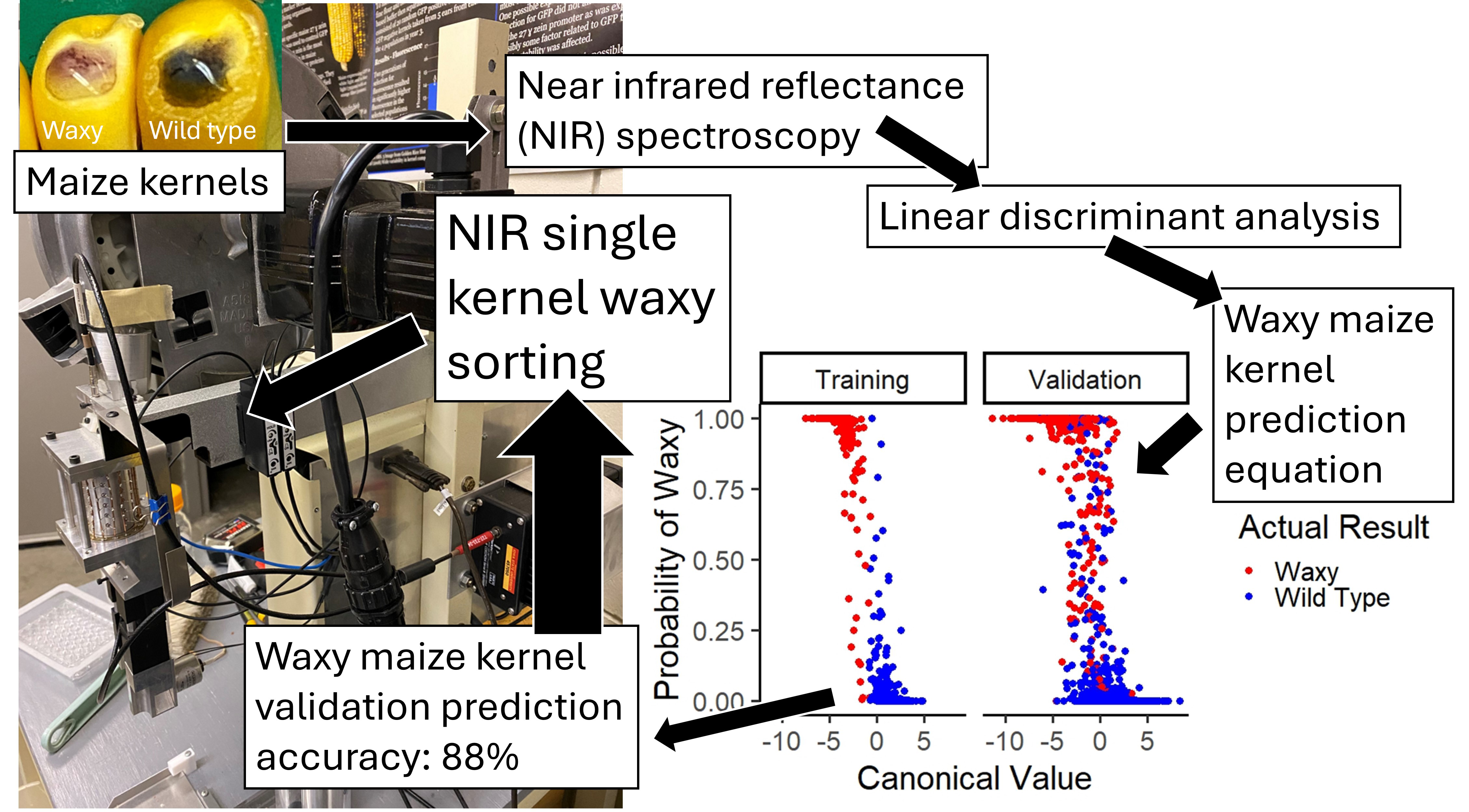
Get full access to this article
View all access options for this article.
References
Supplementary Material
Please find the following supplemental material available below.
For Open Access articles published under a Creative Commons License, all supplemental material carries the same license as the article it is associated with.
For non-Open Access articles published, all supplemental material carries a non-exclusive license, and permission requests for re-use of supplemental material or any part of supplemental material shall be sent directly to the copyright owner as specified in the copyright notice associated with the article.
