



Abstract
Rocks are an extremely important and indispensable part of the Earth's crust, with wide applications in various fields such as geology, environmental monitoring, and industry. Traditional methods often rely on a single analytical technique or visual inspection, but this may not achieve the accuracy required for thorough classification. Laser-induced breakdown spectroscopy (LIBS) technology mainly provides information on the composition and content of rock elements, while images can provide appearance information such as color and texture. The multilayer perceptron (MLP) and DenseNet121 models were selected for processing preprocessed LIBS and image data, respectively. When using LIBS and images separately for classification, the accuracy rates were 93.63% and 90.90%, respectively. However, after fusing the bimodal data using LIBS and images, we achieved a significant performance improvement of 97.27% in accuracy. This study indicates that advanced neural network models can effectively integrate LIBS and image data and improve the performance of rock classification.
This is a visual representation of the abstract.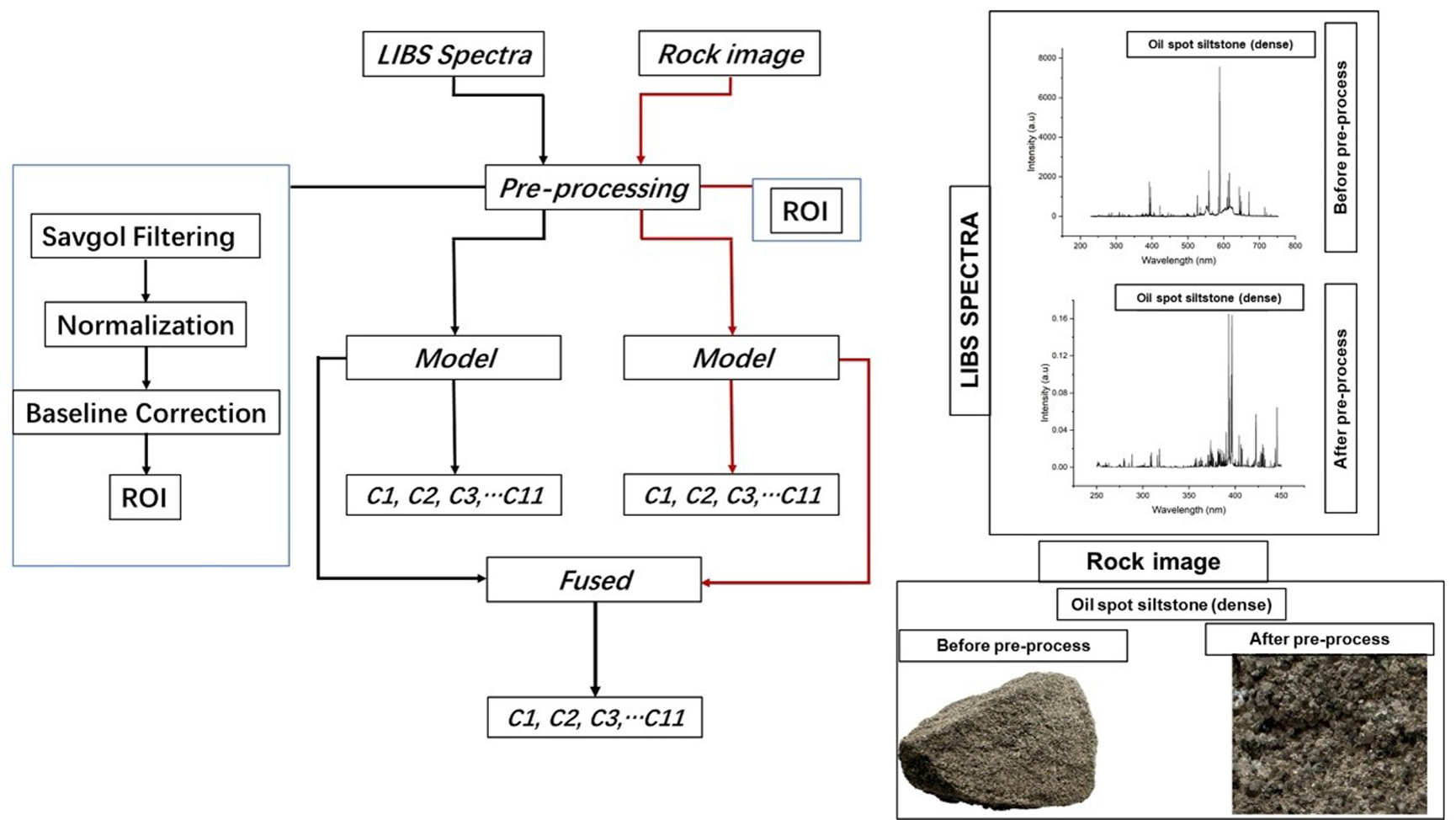
Keywords
Get full access to this article
View all access options for this article.