



Abstract
This study presents an optical sensor system utilizing multi-reflectance spectroscopy (MRS), specifically designed for in-line applications to enable the real-time determination of fat and protein content in milk products, simultaneously. This method employs multiple light wavelengths and various illumination-detection geometries. A field study was conducted in a milk mixing plant, where measurements were obtained from milk products with varying fat and protein concentrations, with a particular focus on recombined milk samples and a brief comparison to conventional milk products. In a first step the experimental data are compared with simulation data obtained from an analytical MRS formula. The fundamental spectroscopic characteristics, particularly the dependence of reflectance values on fat concentrations, as well as the relationship between wavelength and reflectance, remained consistent. However, some experimental bias was observed in the absolute values when comparing the analytical and experimental results. Secondly, to get reflectance models multi-linear regressions (MLR) were carried out based on the experimental and analytical data as well fat and protein content obtained from traditional wet chemical methods. To estimate the model accuracy the root mean square error (RMSE) has been used yielding around 0.1 wt% for fat and protein. A validation procedure using recombined milk results in approximately 0.1 wt% for fat and around 0.2 wt% for protein. Finally, it is shown that the process sample temperature has only a small influence on the reflectance. In contrast the homogenization pressure significantly influences the reflectance and should be considered to ensure accurate monitoring.
This is a visual representation of the abstract.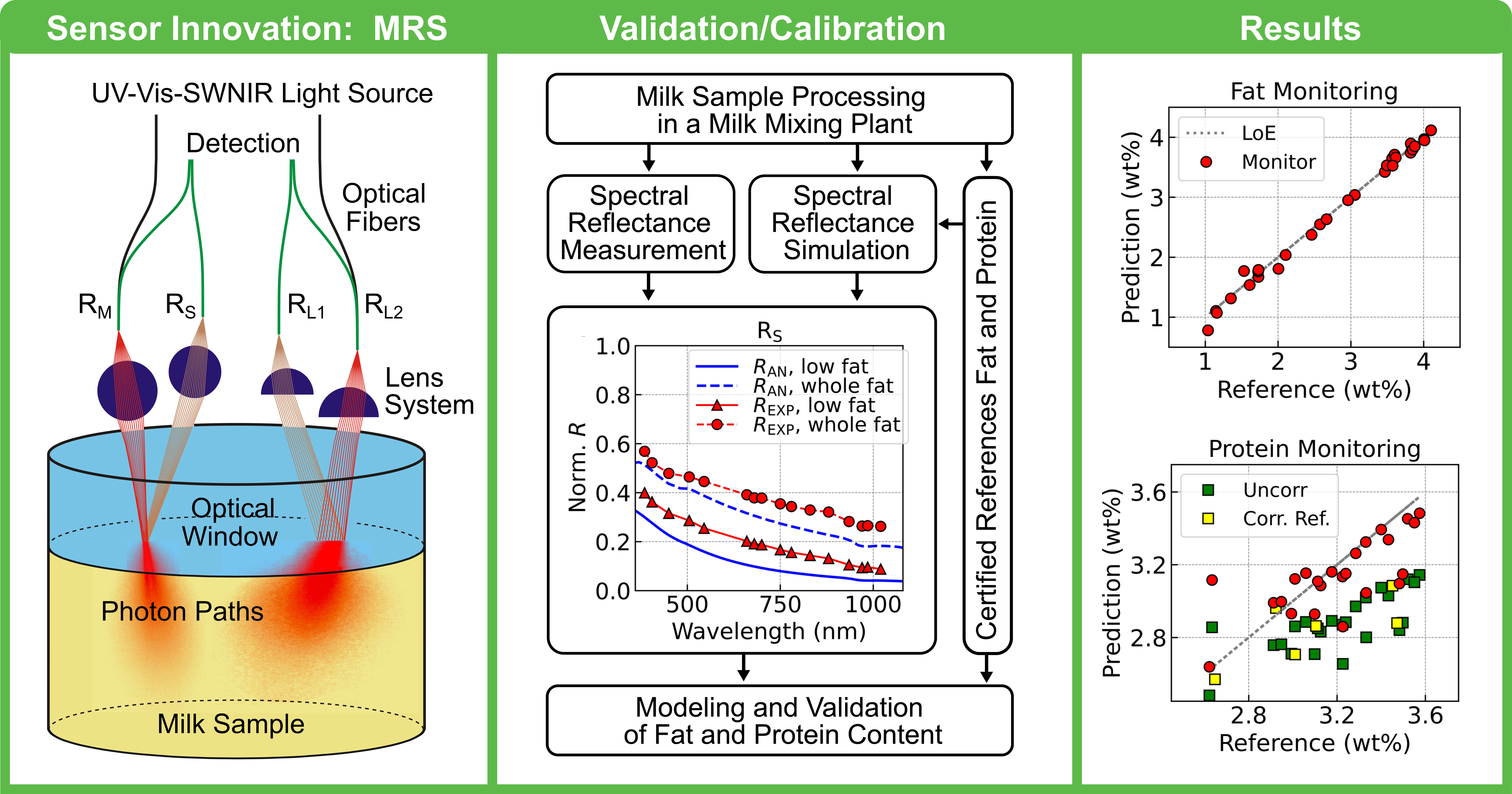
Keywords
Get full access to this article
View all access options for this article.
References
Supplementary Material
Please find the following supplemental material available below.
For Open Access articles published under a Creative Commons License, all supplemental material carries the same license as the article it is associated with.
For non-Open Access articles published, all supplemental material carries a non-exclusive license, and permission requests for re-use of supplemental material or any part of supplemental material shall be sent directly to the copyright owner as specified in the copyright notice associated with the article.
