




Abstract
Vibrational spectroscopy is gaining popularity for understanding ecological and evolutionary patterns in plants, particularly in relation to the analysis of pollen grains. So far, Fourier transform infrared spectroscopy (FT-IR) has been the main approach used to classify pollen grains based on chemical variations. However, FT-IR may be less suitable for detecting differences in the pollen grain exine, mainly composed of sporopollenin. In contrast, Raman spectroscopy has increased sensitivity for the main chemical components found within sporopollenins. We compare the classification performance and chemical information provided by FT-IR and FT-Raman using a large dataset of Quercus L. pollen, comprising five species in three sections: (i) Cerris: Q. suber, (ii) Ilex: Q. coccifera, Q. rotundifolia, and (iii) Quercus: Q. robur, Q. faginea). Here, we used multiblock sparse partial least squares discriminant analyses (MB-sPLS-DA) analyses to directly compare the two infrared methods. Both FT-IR and FT-Raman successfully classified Quercus pollen to section level (100% accuracy). At the species level our models achieved ∼90% accuracy for FT-Raman and FT-IR separately and in the combined multiblock model. The multiblock results showed an increased number of sporopollenin peaks observed in FT-Raman spectra as compared to FT-IR. These peaks are also of a higher importance for classification. Results also showed differences in the types of vibrations that are of diagnostic value for the two infrared methods. CH2 deformations are more important in FT-Raman, while C–O–C, C–O, and C = O stretches are more important for FT-IR-based identification of pollen. These vibrations are indicators of carbohydrates, proteins and lipids. FT-Raman provides equally successful diagnostic potential to FT-IR, but uses more chemical information based on variations in sporopollenin chemistry than FT-IR. We suggest that the combined analysis of FT-IR and FT-Raman using multiblock analysis has great potential for classification.
This is a visual representation of the abstract.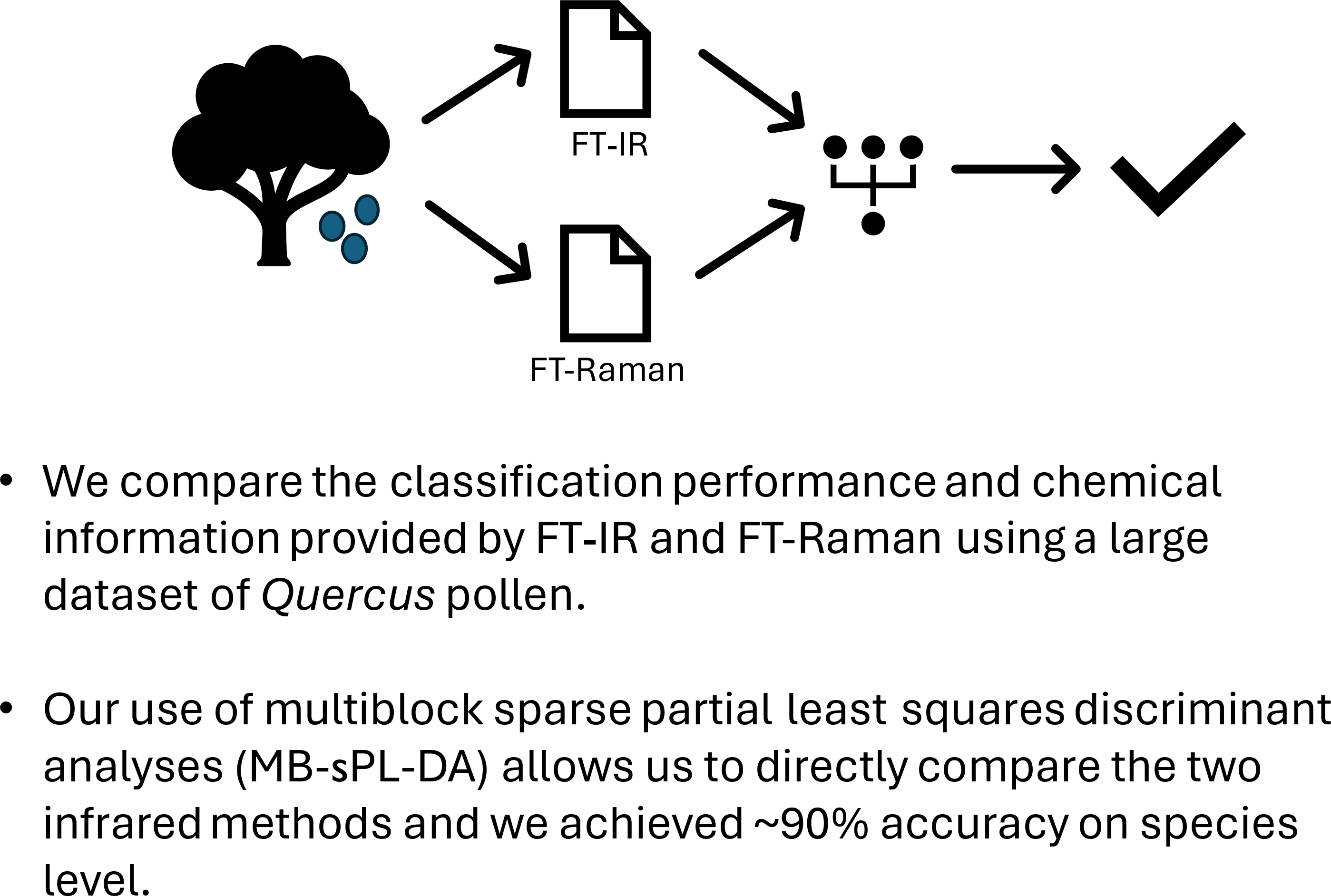
Get full access to this article
View all access options for this article.
References
Supplementary Material
Please find the following supplemental material available below.
For Open Access articles published under a Creative Commons License, all supplemental material carries the same license as the article it is associated with.
For non-Open Access articles published, all supplemental material carries a non-exclusive license, and permission requests for re-use of supplemental material or any part of supplemental material shall be sent directly to the copyright owner as specified in the copyright notice associated with the article.
