



Abstract
Diabetes, a chronic metabolic disorder affecting millions worldwide, presents a persistent need for reliable and non-invasive diagnostic techniques. Here, we suggest a highly effective approach for differentiating between fingernails from diabetic individuals and those from healthy controls using laser-induced breakdown spectroscopy (LIBS). The excitation source employed was a Q-switched neodymium-doped yttrium aluminum garnet (Nd:YAG) laser emitting light with a wavelength of 1064 nm. The initial differentiation between individuals with and without diabetes was achieved by applying principal component analysis (PCA) to LIBS spectral data, which was then incorporated into a novel machine-learning model. The classification model designed for a non-invasive system included random forest (RF), an extreme learning machine (ELM) classifier, and a hybrid classification model incorporating cross-validation techniques to evaluate the outcomes. The algorithm analyses the complete spectrum of both healthy and diseased samples, categorizing them according to differences in LIBS spectral intensity. The classification performance of the model was assessed using a k-fold cross-validation method. Seven parameters, i.e., specificity, sensitivity, area under curve (AUC), accuracy, precision, recall, and F-score, were used to evaluate the model's overall performance. The findings affirmed that the suggested non-invasive model could predict diabetic diseases with an accuracy of 95%.
This is a visual representation of the abstract.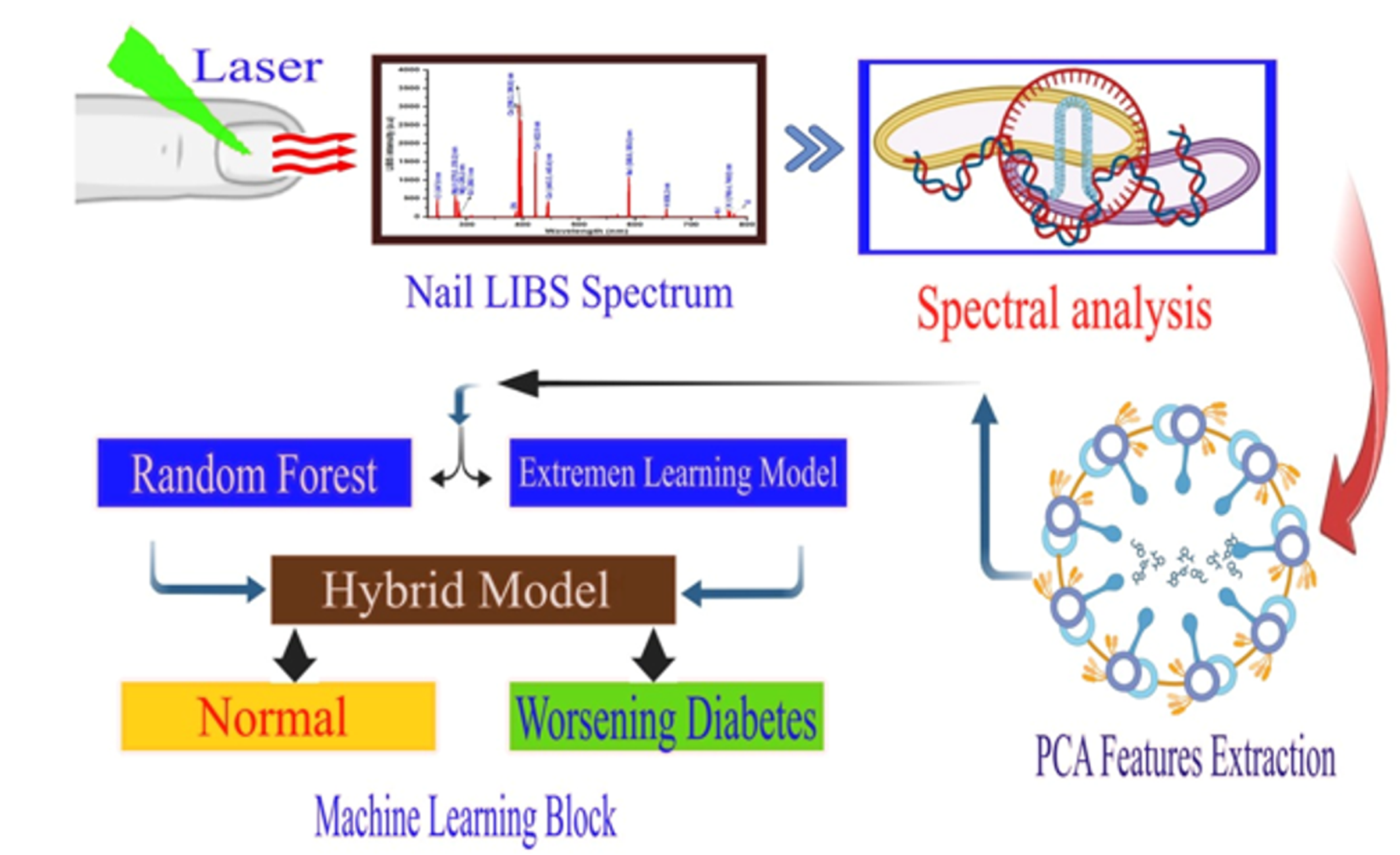
Keywords
Get full access to this article
View all access options for this article.