



Abstract
We evaluated the application of Fourier transform infrared (FT-IR) microspectroscopy in the mid-IR region (1500–550 cm–1) in reflectance mode as a semi-automated tool to quantify common heavy minerals (HM) found in natural sediments and sedimentary rocks. An in-house database of IR spectra for the main HM was acquired. Then, automated HM identification using FT-IR spectroscopy was tested on synthetic mixtures with known HM proportions. HM fractionation during sampling and mounting in epoxy is evaluated by testing several sample preparations techniques. Overall, HM are properly determined using FT-IR microspectroscopy. Most of the HM are found in proportions comparable to those documented in the synthetic mixtures. Main drawbacks to this method include: (i) the mid-IR region does not give access to the absorption bands of some HM, such as fluorite, pyrite, and cassiterite, compared to other methods such as Raman microspectroscopy, (ii) the failure to discriminate titanium dioxide (TiO2) polymorphs, and (iii) large spectral variations in some mineral groups such as amphiboles. Beyond these limitations, mid-FT-IR microspectroscopy in reflectance mode can be used to accurately determine HM proportions and could be simpler, faster, and/or cheaper when compared to other methods such as optical microscopy or scanning electron microscopy.
This is a visual representation of the abstract.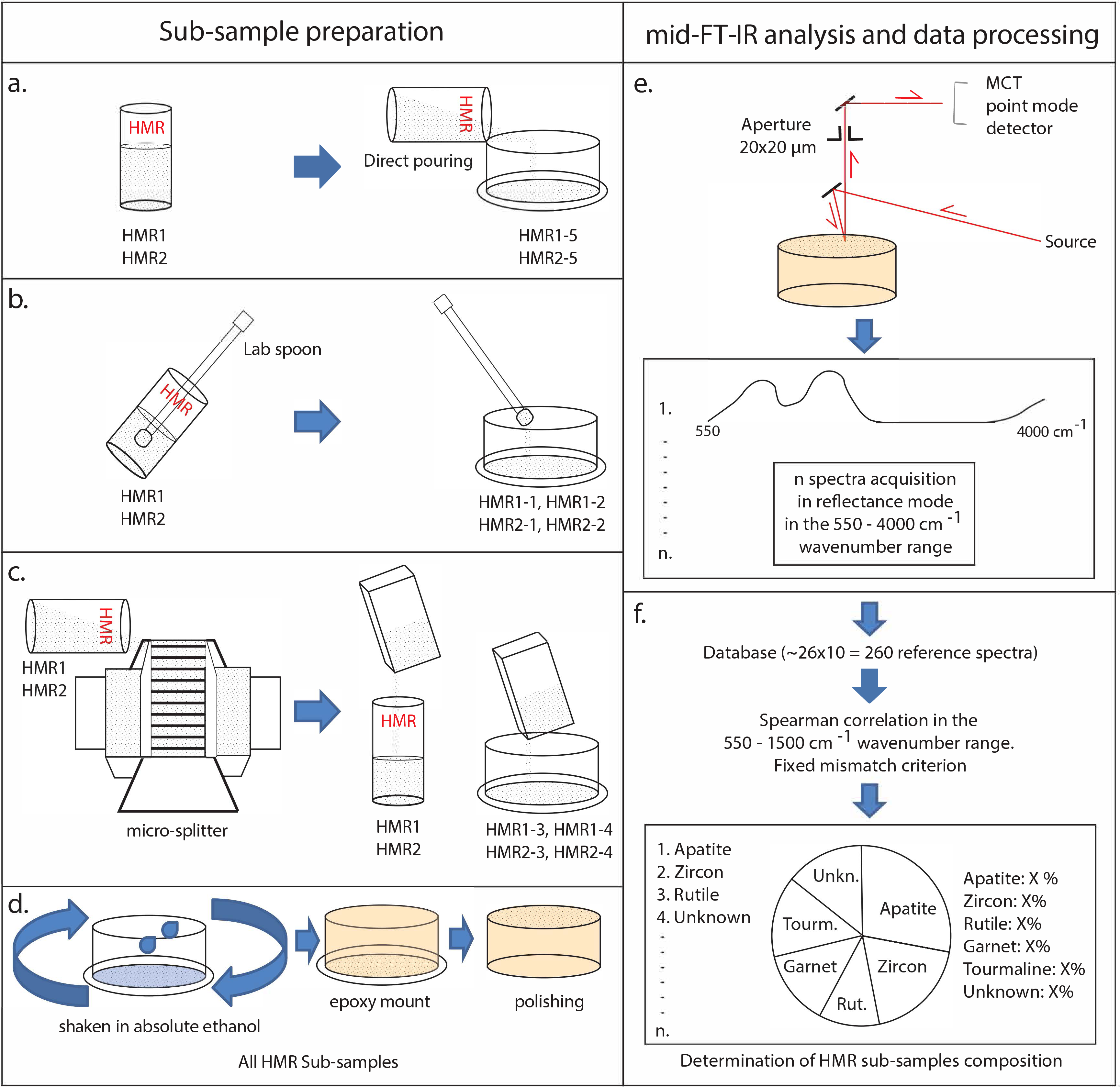
Keywords
Get full access to this article
View all access options for this article.
References
Supplementary Material
Please find the following supplemental material available below.
For Open Access articles published under a Creative Commons License, all supplemental material carries the same license as the article it is associated with.
For non-Open Access articles published, all supplemental material carries a non-exclusive license, and permission requests for re-use of supplemental material or any part of supplemental material shall be sent directly to the copyright owner as specified in the copyright notice associated with the article.
