



Abstract
Raman microscopes are widely used in various fields and their spectral resolutions differ greatly depending on the system and optical components. Thus, it is important to evaluate the spectral resolution of Raman systems under measurement conditions. Although calcite is a crystal with a trigonal structure and its narrow peak at ∼1086 cm−1 has been used to evaluate the spectral resolution of Raman spectrometers, the peak width of calcite itself, ∼1.3 cm−1 at full width half-maximum (FWHM), is not negligible under high spectral resolution conditions. Because the calcite peak at ∼1086 cm−1 originates from symmetric stretching, which is a common vibration mode for carbonate salts, we examined strontium carbonate (SrCO3), barium carbonate (BaCO3), and lead carbonate (PbCO3) reagents to find a material having a narrower peak width than calcite. SrCO3, BaCO3, and PbCO3 peaks originating from symmetric stretching were observed at 1072, 1059, and 1054 cm−1, respectively, and their peak widths at FWHM (0.67, 0.92, and 1.09 cm−1, respectively) were narrower than that of calcite (1.36 cm−1). The narrow peak width of SrCO3 was strongly dependent on its purity, probably due to its high structural regularity, and the change in the peak width (FWHM) was only 0.12 cm−1 between 5 °C and 45 °C. Thus, we concluded that the high-purity SrCO3 peak at 1072 cm−1 was the narrowest peak of Raman scattering light under ambient conditions and is suitable for evaluating high spectral resolution for Raman spectrometers.
This is a visual representation of the abstract.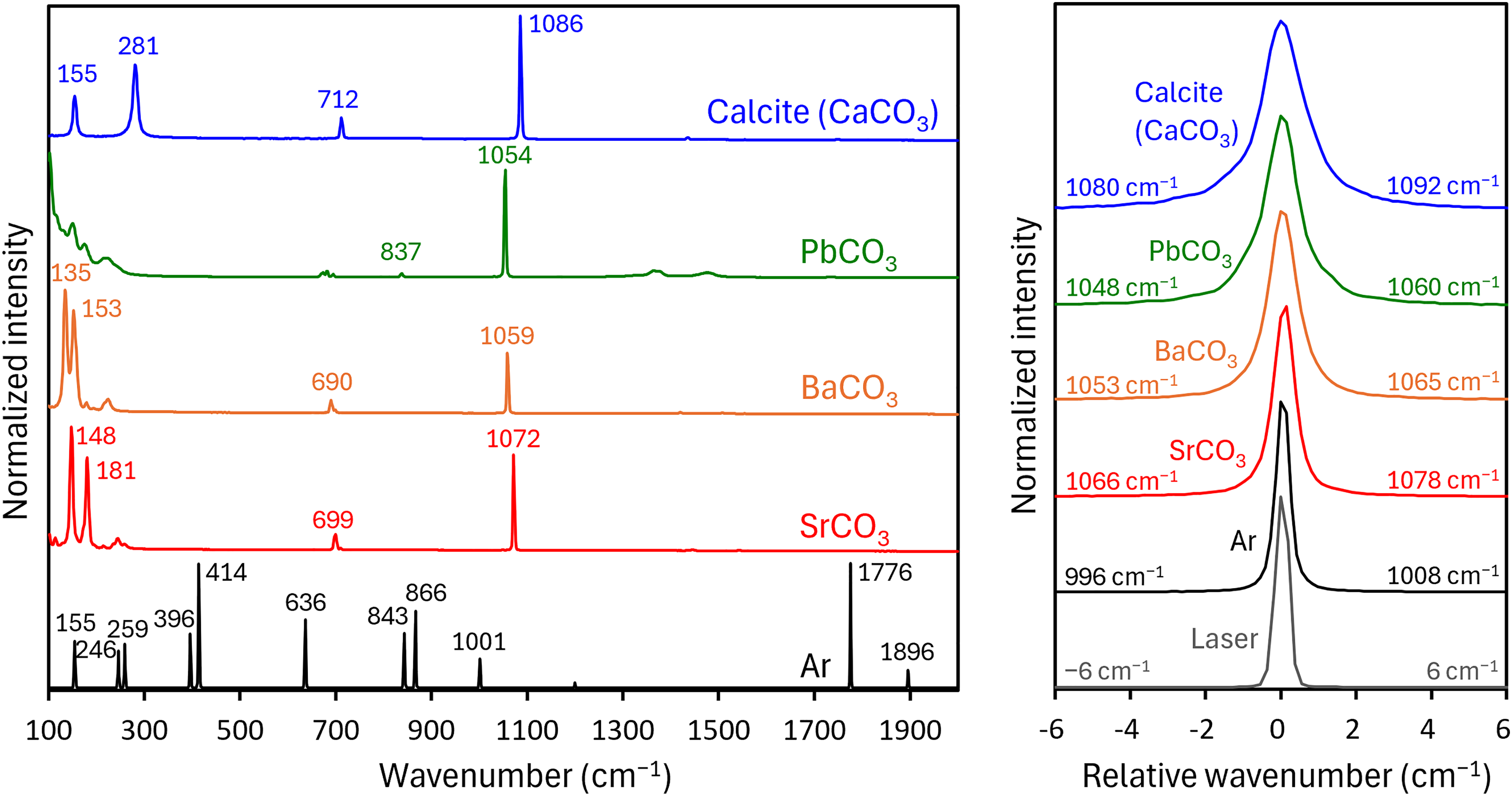
Get full access to this article
View all access options for this article.
References
Supplementary Material
Please find the following supplemental material available below.
For Open Access articles published under a Creative Commons License, all supplemental material carries the same license as the article it is associated with.
For non-Open Access articles published, all supplemental material carries a non-exclusive license, and permission requests for re-use of supplemental material or any part of supplemental material shall be sent directly to the copyright owner as specified in the copyright notice associated with the article.
