



Abstract
Sulfur dioxide (SO2), an air pollutant, poses significant threats to both public health and the environment. It is one of the six air pollutants regulated by the U.S. Environmental Protection Agency (EPA) under the Clean Air Act. In efforts to determine the application of molecular rotational resonance (MRR) spectroscopy for monitoring SO2 and its removal from point sources, a K-band MRR technique was evaluated. This method was applied to measure the products of heated mixtures of SO2 and oxygen (O2) in the presence of ammonium metavanadate (NH4VO3) as a catalyst. The observed MRR spectrum revealed the presence of SO2, water vapor (H2O), and ammonia (NH3) due to the sensitivity of MRR to only polar species. SO2 removal was further confirmed by the disappearance of SO2 as NH3 formed. The work presented here analyzed the measurements of SO2 and validated K-band MRR for monitoring SO2 removal. It was observed that the K-band MRR maintains its linearity and other polar species in the mixture did not interfere with MRR signature of SO2. The limit of detection, better than 1%, was determined by evaluating targeted K-band MRR signal response of SO2 removal obtained at varying partial pressures of SO2 in the mixture and using the MRR signal of pure SO2 at 3 mTorr as a reference (100%). Additionally, the results showed that the accuracy and precision of K-band MRR for measuring SO2 partial pressure were satisfactory.
This is a visual representation of the abstract.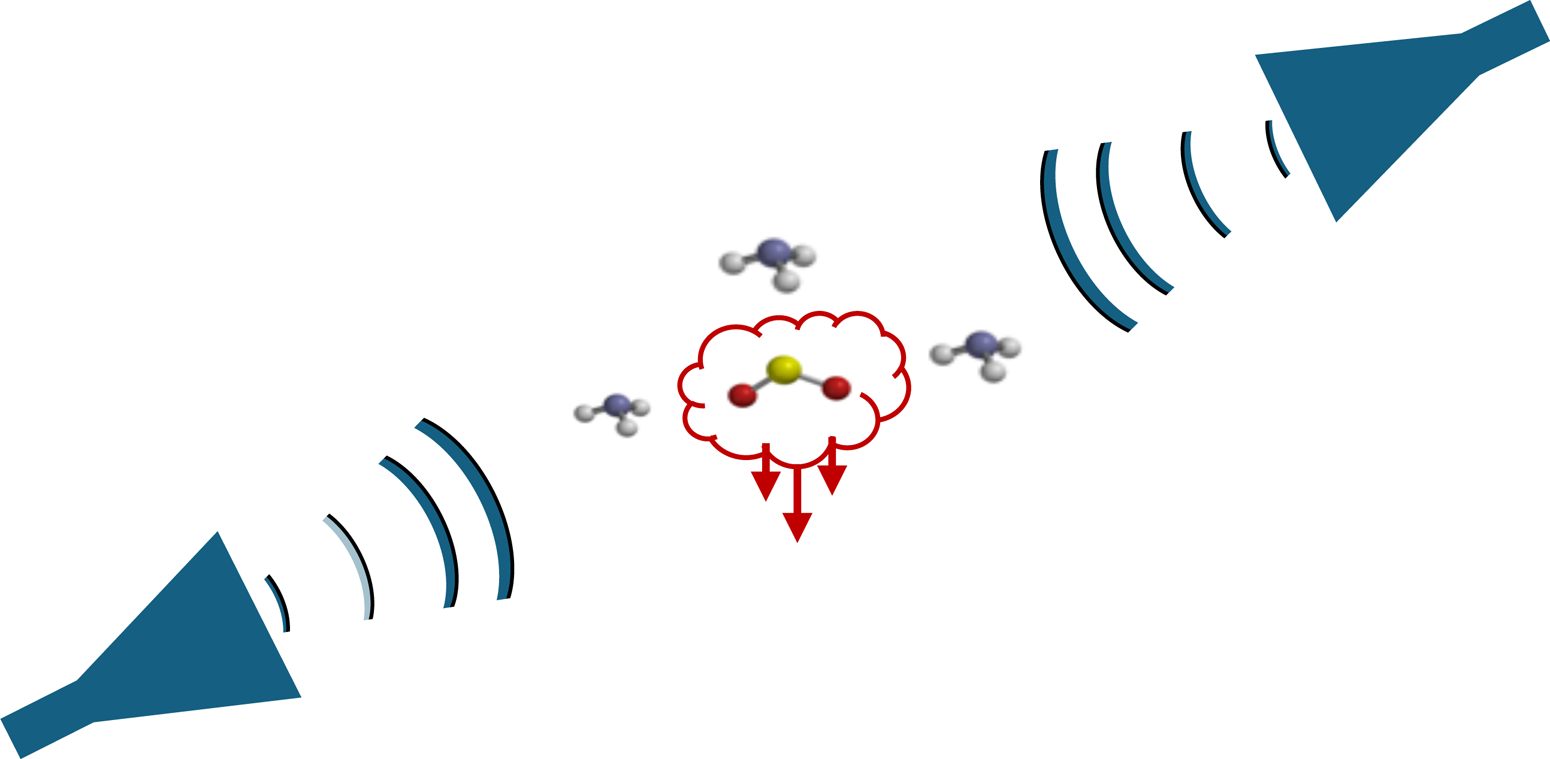
Keywords
Get full access to this article
View all access options for this article.